Quotulatiousness

October 14, 2009

IPCC to US: stop breathing

Filed under: Environment, USA — Tags: , , — Nicholas @ 07:50

Ace of Spades reports on the latest “modest suggestion” from those whacky folks at the IPCC:

The IPCC says that rich industrial countries must cut emissions 25 to 40 percent by 2020 (from 1990 levels) if the world is to have a fair chance of avoiding catastrophic climate change. By contrast, the WBGU study says the United States must cut emissions 100 percent by 2020—i.e., quit carbon entirely within ten years. Germany, Italy and other industrial nations must do the same by 2025 to 2030. China only has until 2035, and the world as a whole must be carbon-free by 2050. The study adds that big polluters can delay their day of reckoning by “buying” emissions rights from developing countries, a step the study estimates would extend some countries’ deadlines by a decade or so.

Emphasis mine.

October 2, 2009

Environmental warning from . . . Olympic bid committee chairman?

Filed under: Environment, Japan, Sports — Tags: , , , — Nicholas @ 12:05

I guess Japan’s Shintaro Ishihara had to say something to counteract the presence of US President Barack Obama:

Ishihara, who was celebrating his 77th birthday, is the president of the Tokyo bid to win the right to host the 2016 Games which will be voted on by the 100-plus International Olympic Committee (IOC) members here on Friday.

Ishihara, who won won the prestigious Akutagawa Prize for the best young author for his novel ‘Season of the Sun’ before he had graduated from university in 1956, said that unless the world took note of what was happening to the environment and global warming the Olympic Games faced a bleak future.

“I think this (the 2016 Games) could be the last for mankind,” he said at a reception for the bid, though, his opinion will come as a shock to his fellow bid members as they have been speaking of leaving a legacy that will last for at least the rest of the century should they host the Games.

“However, more realistically we have to come up with measures without which the Olympics cannot last long. [. . .] Tokyo is prepared to do everything to create the best conditions for the athletes environmentally speaking. [. . .] But if things are left unattended the Olympic Games will not continue for long. [. . .] I want people to make choices with consideration for the environment. [. . .] Global warming is getting worse. Scientists have said that the earth has passed the point of no return,” added Ishihara, whose focus on the environment is one of the major priorities in Tokyo’s bid.

So, since “the earth has passed the point of no return”, you’re devoting your time and effort to win the Olympic bid for your home city? Because it’s the best contribution towards averting this disaster you’re certain will strike? Doesn’t that seem a bit, you know, inappropriate? Thousands of athletes and their trainers/organizers/family/friends flying to Tokyo will add how many tonnes of carbon dioxide to the atmosphere? Building all the necessary facilities for the games will divert materials and labour away from other activities, yes?

Or are you just trying to take media attention away from Barack Obama?

For the record, I think the notion of returning the Olympics to Greece permanently would be a better idea than the every-four-years circus of cities and regions prostituting themselves to the International Olympic Committee. Greece could use the tourist income, and it would save untold billions of dollars being taxed from residents of the various “winning” cities. A win all-round.

Update: Looks like even trying to out-Gore Al didn’t help Tokyo win their bid. But even more surprising, Chicago was out on the very first ballot:

Rio de Janeiro and Madrid are vying to be the host of the 2016 Olympic Games, after Chicago and Tokyo were eliminated by the International Olympic Committee.

Tokyo secured the fewest of the 95 votes available in the second round at the meeting in Copenhagen. Chicago was knocked out in the first round vote.

Cities will be eliminated until one secures a majority with the winner set to be announced after 1730 BST.

Chicago’s early exit was a surprise, with bookmakers making them favourites.

Update, the second: Rio de Janeiro wins the bid, eliminating Madrid. BBC News story here.

September 30, 2009

More background on that broken hockey stick

Filed under: Bureaucracy, Environment, Media, Politics — Tags: , , — Nicholas @ 09:53

I don’t want to sound like a climate crank — there are more than enough of them out there, on both sides of the issue — and I’m still very much of the opinion that the question of anthropogenic global warming/climate change still needs a lot of work to answer. If human activities are causing the planet’s atmosphere to warm up in excess of what the natural feedback systems of the planet can handle, then we do need to look at ways to reduce our contribution to that warming.

Politicians and power-seeking bureaucrats jumping up and down in front of the cameras, insisting that the crisis is upon us and we need to do something now are in no way to be trusted with additional powers: without sufficient scientific evidence, we’d just be installing petty dictators over all sorts of different areas of our lives.

The specific piece of “evidence” most useful to the “do something now” faction has been the famous Hockey Stick Graph, which has been debunked. The data was carefully selected to support pre-decided conclusions. Everyone who took high school science knows the temptation . . . you know how the experiment is supposed to turn out, and who’ll know if you just write it up as if you got textbook results? The answer is . . . that’s why you do the experiment: to determine if the result matches the expectation. Skipping the whole “do the experiment” step saves time, but it’s not science.

Bishop Hill explains how the hockey stick became the best-known case of junk science in decades:

The story of Michael Mann’s Hockey Stick reconstruction, its statistical bias and the influence of the bristlecone pines is well known. McIntyre’s research into the other reconstructions has received less publicity, however. The story of the Yamal chronology may change that.

The bristlecone pines that created the shape of the Hockey Stick graph are used in nearly every millennial temperature reconstruction around today, but there are also a handful of other tree ring series that are nearly as common and just as influential on the results. Back at the start of McIntyre’s research into the area of paleoclimate, one of the most significant of these was called Polar Urals, a chronology first published by Keith Briffa of the Climate Research Unit (CRU) at the University of East Anglia. At the time, it was used in pretty much every temperature reconstruction around. In his paper, Briffa made the startling claim that the coldest year of the millennium was AD 1032, a statement that, if true, would have completely overturned the idea of the Medieval Warm Period. It is not hard to see why paleoclimatologists found the series so alluring.

Some of McIntyre’s research into Polar Urals deserves a story in its own right, but it is one that will have to wait for another day. We can pick up the narrative again in 2005, when McIntyre discovered that an update to the Polar Urals series had been collected in 1999. Through a contact he was able to obtain a copy of the revised series. Remarkably, in the update the eleventh century appeared to be much warmer than in the original – in fact it was higher even than the twentieth century. This must have been a severe blow to paleoclimatologists, a supposition that is borne out by what happened next, or rather what didn’t: the update to the Polar Urals was not published, it was not archived and it was almost never seen again.

With Polar Urals now unusable, paleclimatologists had a pressing need for a hockey stick shaped replacement and a solution appeared in the nick of time in the shape of a series from the nearby location of Yamal.

Yes, it’s long, and somewhat convoluted . . . but that is the point. Researchers were being deliberately obstructive to other researchers, concealing data necessary to reproduce the experimental results, yet publishing in numerous journals (who all should have enforced their own standards, but failed to do so) as if the data was impossible to refute.

And it was . . . because the raw data was kept out of the hands of other scientists. This is not science. It’s a deliberate fraud.

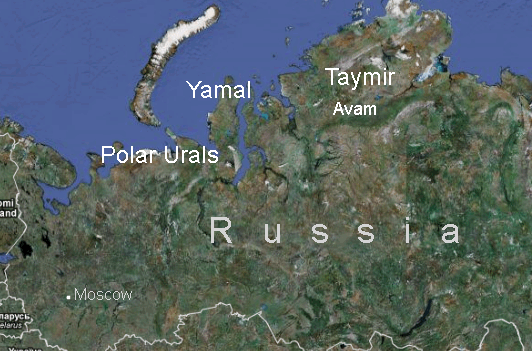
Update: JoNova adds to the story, including an image showing the relative locations of the sampled sites:
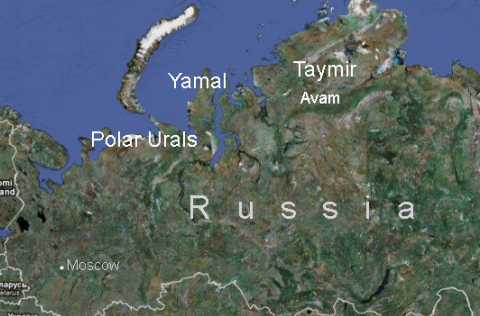
Busted_Hockey_Stick_locations

Update, the second: Tom Kelley corrects my use of the word “anthropogenic”, which I had idiotically written as “anthropomorphic”. Thanks, Tom.

September 29, 2009

A broken hockey stick graph

Filed under: Environment — Tags: , , — Nicholas @ 12:12

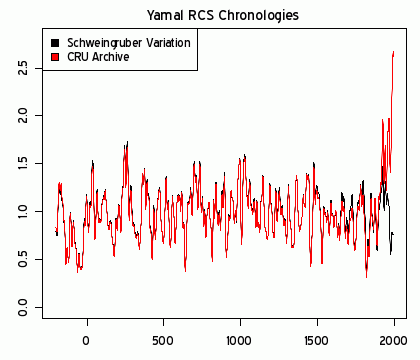
The red line in the following graph should be familiar to you, if you’ve been following the Global Warming/Climate Change debate:

Busted_Hockey_Stick

The trick here is the black line:

A comparison of Yamal RCS chronologies. red — as archived with 12 picked cores; black — including Schweingruber’s Khadyta River, Yamal (russ035w) archive and excluding 12 picked cores. Both smoothed with 21-year gaussian smooth. y-axis is in dimensionless chronology units centered on 1 (as are subsequent graphs (but represent age-adjusted ring width).

The “blade” of the hockey stick was a data artifact of the careful selection of only twelve samples. Including a wider sample produces a very different picture, as you can see above.

September 28, 2009

QotD: Gambling on CO2 reduction

Filed under: Economics, Environment, Politics, Quotations — Tags: , , — Nicholas @ 12:45

There is a real and growing prospect of an all-out trade war being waged in the name of climate change.

The struggle to generate international agreement on a carbon deal has created a desire to punish “free riders” who do not sign on to stringent carbon emission reduction targets. But the greater goals seem to be to barricade imports from China and India, to tax companies that outsource, and to go for short-term political benefits, destroying free trade.

This is a massive mistake. Economic models show that the global benefits of even slightly freer trade are in the order of $50 trillion — 50 times more than we could achieve, in the best of circumstances, with carbon cuts. If trade becomes less free, we could easily lose $50 trillion — or much more if we really bungle things. Poor nations — the very countries that will experience the worst of climate damage — would suffer most.

In other words: In our eagerness to avoid about $1 trillion worth of climate damage, we are being asked to spend at least 50 times as much — and, if we hinder free trade, we are likely to heap at least an additional $50 trillion loss on the global economy.

Bjorn Lomborg, “Costly Carbon Cuts: Proposed Strategies Would Hurt the Most Vulnerable”, The Washington Post, 2009-09-28

September 26, 2009

Those confusing/conflicting Arctic ice stories

Filed under: Cancon, Environment — Tags: , , — Nicholas @ 09:13

How can it be that on one day, we’re told that the Arctic is thawing at an unprecedented rate, yet the next day we’re told that the ice is twice as thick as predicted? Lawrence Solomon tries to sort out the sensational from the prosaic:

If you’re confused by stats on Arctic melting, you have lots of company. Arctic stats are easy to misunderstand because the Arctic environment is unlike our own — the Arctic magnifies the changes we experience in the temperate regions. In summer, our days get longer and theirs get really, really long, just as in winter, when our days gets shorter, theirs all but disappear. By analogy, the Arctic also magnifies temperature variations, and resulting changes to its physical environment.

In the Arctic, the ice has indeed been contracting, as the global warming doomsayers have been telling us. But it has also been expanding. The riddle of how the Arctic ice can both be contracting and expanding is easily explained. After you read the next two paragraphs, you’ll be able to describe it easily to your friends to set them straight.

September 24, 2009

Another reason why there’s still debate over Climate Change/Global Warming

Filed under: Environment — Tags: , , — Nicholas @ 07:47

True believers treat skeptics on the Climate Change/Global Warming question as heretics because “the proof is right there” . . . except the data supporting the case is not available to study:

. . . the data needed to verify the gloom-and-doom warming forecasts have disappeared.

Or so it seems. Apparently, they were either lost or purged from some discarded computer. Only a very few people know what really happened, and they aren’t talking much. And what little they are saying makes no sense.

[. . .]

If we are to believe Jones’s note to the younger Pielke, CRU adjusted the original data and then lost or destroyed them over twenty years ago. The letter to Warwick Hughes may have been an outright lie. After all, Peter Webster received some of the data this year. So the question remains: What was destroyed or lost, when was it destroyed or lost, and why?

All of this is much more than an academic spat. It now appears likely that the U.S. Senate will drop cap-and-trade climate legislation from its docket this fall — whereupon the Obama Environmental Protection Agency is going to step in and issue regulations on carbon-dioxide emissions. Unlike a law, which can’t be challenged on a scientific basis, a regulation can. If there are no data, there’s no science. U.S. taxpayers deserve to know the answer to the question posed above.

September 23, 2009

A few random links

Filed under: Cancon, Health, Randomness — Tags: , — Nicholas @ 17:12
  • Nick Packwood on a reason to be proud of Canada: “Canada’s entire delegation is set to walk out of the United Nations General Assembly chamber when Persian tyrant, Twelver whack job and Holocaust denier/enthusiast Mahmoud Ahmadinejad takes the podium.”
  • Talking down to irresponsible American adults. “Secretary Chu said he didn’t think that the public would throw the same political temper tantrum over climate legislation has has happened with the healthcare debate.”
  • “You Can Have Either Sex or Immortality”
  • Pimp my . . . bed?
    “After years of catering to women, manufacturers are setting their sights on men. The new macho mattresses they’re introducing have “muscle-recovery properties” and cooling technology, on the theory that men are more likely to feel too hot in bed. The bed frames feature built-in TVs, iPod docking stations, wine coolers, safes and other guy-friendly gadgetry.”

September 9, 2009

They switched to calling it “Climate Change” for a reason

Filed under: Environment, Science — Tags: , , — Nicholas @ 08:06

After all the vitriol over anthropomorphic (man-made) “Global Warming”, it was a significant change when the organizations which had been most prominent in trying to bring it to public attention switched terminology to Climate Change instead:

Last week a UK tribunal ruled that belief in manmade global warming had the same status as a religious conviction, such as transubstantiation. True believers in the hypothesis will need mountains of faith in the years ahead.

The New Scientist has given weight to the prediction that the planet is in for a cool 20 years — defying the computer models and contemporary climate theory. It’s “bad timing”, admits the magazine’s environmental correspondent, Fred Pearce.

Mojib Latif of the Leibniz Institute of Marine Sciences at Kiel University, quoted by the magazine, attributes much of the recent warming to naturally occurring ocean cycles. Scientific study of the periodic ocean climate variability is in its infancy; for example the PDO or Pacific Decadal Oscillation, was only described in the late 1990s. It’s the Leibniz team which predicted a forthcoming cooling earlier this year — causing a bullying outbreak at the BBC.

Much of the resistance to the “orthodoxy” of global warming was caused by the strong suspicion that this was merely an excuse for greater government control over business and further restrictions on individuals for a nebulous goal. It certainly didn’t help that any extreme or unusual weather was automatically “caused by global warming” according to the vast majority of media reports.

If global warming/climate change was actually being caused (or increased) by human activity, the proposals to “fix” the problem almost always seemed to impose far greater costs than the problem itself. Activists saying that the west pretty much had to give up most of their modern comforts (and their industrial base) in order to “save the planet” did their cause more harm than good.

Some data seemed to support the global warming theory, while other data seemed to contradict it. Rather than following traditional scientific methodology, too many scientists forgot their basic training and tried conducting media science (where peer review and providing raw data to support your findings are not required or expected). By saying that the problem was “too urgent” to be slowed down by following normal procedure, they undermined their own cause. By exaggerating the likely results if global warming was actually happening, they stopped being scientists at all and instead became political activists.

The confidence that higher atmospheric CO2 levels will result in significant long-term increases in temperature is founded on knock-on effects, or positive feedbacks, amplifying the CO2 effect. Large positive feedbacks imply “runaway” global warming — aka Thermageddon.

But even the basics are fiercely contested. Does a warmer climate mean more or fewer clouds, and do these trap even more heat, or act as a sunshade, cooling it back down again? Clouds are so poorly understood, you can take your pick. So if the climate isn’t getting warmer, the theory requires the view that the energy must be “hiding” somewhere, mostly likely in oceanic heat sinks.

But neither the feedbacks, nor the oceans, are currently being kind to contemporary climate theory.

« Newer Posts

Powered by WordPress