
Published on 15 Feb 2016
In June 1941, Nazi Germany launched an attack upon the Soviet Union. The German Reich had been building up forces along the Eastern Front for a long time, but the sudden aggression caught Soviet forces unprepared. Many troops were captured and the Germans quickly conquered territory from the Soviet states. But the Soviets reorganized, improved their communication structure, and pulled together a defense at Smolensk. Although they lost again, they critically slowed the German advance and halted their race towards Moscow. Instead, the Germans tried to lay siege at Leningrad, only to be struck themselves by insufficient supply lines and a brutal winter that claimed the lives of many soldiers. With that, the Wehrmacht withdrew and redirected its efforts towards Stalingrad. Josef Stalin refused to let them take any land “further than the Volga” in Russia, and mounted a stiff defense. Even when the Luftwaffe, the German air force, reduced the city to rubble, Soviet soldiers continued to wage war from the debris. Meanwhile, the Germans were so focused on their offensive that they let their defensive lines collapse, and in October 1942 the Soviets managed to surround and pin down the German 6th Army. Their commander refused surrender terms because he didn’t want to displease Adolf Hitler, but the 6th Army’s resistance inevitably collapsed in February 1943.
March 21, 2016
World War II: The Battle of Kursk – I: Operation Barbarossa – Extra History
January 30, 2016
Tanks – WW1 Uncut: Dan Snow – BBC
Published on 17 Apr 2014
Tanks were invented by the British during the First World War. Historian Dan Snow traces their development, from prototype to battlefield fixture.
July 3, 2015
QotD: “US tankers were notorious for identifying everything as a Tiger tank”
When you read unit accounts, whether it’s the actual unit after action reports or the published books, everyone talks about Tiger tanks. But in looking at it in both German records and US records, I’ve only found three instances in all the fighting from Normandy to 1945 where the US encountered Tigers. And by Tigers I mean Tiger 1, the type of tank we saw in the film [Fury]. I’m not talking King Tigers, the strange thing is that the US Army encountered King Tigers far more often than Tigers. That’s partly because there weren’t a lot of Tigers left by 1944, production ends in August 1944. There were not a lot of Tigers in Normandy, they were mostly in the British sector, the British saw a lot of Tigers. Part of the issue is that US tankers were notorious for identifying everything as a Tiger tank, everything from Stug III assault guns to Panzer IV and Panthers and Tigers.
There was one incident in August of 1944 where 3rd Armored division ran into three Tigers that were damaged and being pulled back on a train, they shot them up with an anti-aircraft half-track. And then there was a single Tiger company up in the Bulge that was involved in some fighting. And then there was one short set of instances in April 1945, right around the period of the film, where there was a small isolated Tiger unit that actually got engaged with one of the new US M26 Pershing tank units. They knocked out a Pershing and then in turn that Tiger was knocked out and the Pershing tanks knocked out another King Tiger over the following days. So I found three verifiable instances of Tigers encountering, or having skirmishes with US troops in 1944-45. So it was very uncommon. It definitely could have happened, there are certainly lots of gaps in the historical record both on the German side and the US side. I think the idea that the US encountered a lot of Tigers during WW2 is simply due to the tendency of the US troops to call all German tanks Tigers. It’s the same thing on the artillery side. Every time US troops are fired upon, it’s an 88, whether it’s a 75mm Pak 40 anti-tank gun, a real 88, a 105mm field howitzer, they were all called 88’s.
“Interview with Steven Zaloga”, Tank and AFV News, 2015-01-27.
June 25, 2015
Building A WW2 Tank: A Defense Report On Film – 1941 Educational Documentary
Published on 20 Jun 2015
Activities at the Chrysler Tank Arsenal in Detroit. Wheel suspension units are milled, wheels ground, gun mount gears cut, armor plate put through a punch press and drill, sprocket gears cut by an arc torch, gears heat treated and immersed in oil baths, armor plate hydraulically riveted, the tanks assembled, armament installed, and the tanks lifted from the assembly line by cranes. The tanks are tested at Fort Knox, Kentucky.
May 14, 2015
A new application for “dazzle” camouflage

RMS Olympic by Arthur Lismer 1919 (via Wikipedia).
Military History Now looks at some of the more eye-catching camouflage schemes of the world wars and suggests that something like it may have a modern application:
… nearly a century after the advent of dazzle, Dr. Nick Scott-Samuel of the University of Bristol believes that similar camouflage patterns painted on the sides of today’s jeeps and armoured cars will make it harder for enemy combatants to get a fix on military vehicles.
“Scott-Samuel, is the first to find evidence that dazzle camouflage can affect perception of speed – but only if the camouflaged object is moving quickly,” says a spokesperson with the British school. “These findings suggest that, while it would probably not have successfully distorted ships’ speeds in the two World Wars, dazzle camouflage could play a role in today’s battlefields where fast-moving army vehicles frequently come under attack from shoulder-launched, rocket-propelled grenades.”
Scott-Samuel arrived at his conclusion after putting volunteers through a series of visual tests. Researchers asked subjects to estimate the distance and speed of camouflaged objects in computer-simulated environments.
Participants observing virtual objects with dazzle patterns believed the targets were moving as much as 7 percent slower than they really were. Those who viewed unmarked objects were more likely to correctly estimate their speeds.
Scott-Samuel says the results indicate that military vehicles bearing dazzle patterns would be harder to hit than those painted with ordinary drab colours.
March 31, 2015
One for the zipperheads
Published on 27 Mar 2015
Digitized Leopard 2 systems improve mine protection, mobility, fire power.
December 1, 2014
The Soviet tank that won the war in the East
Paul Richard Huard looks at the tank that took away the Panzer’s reputation for invincibility, the T-34:
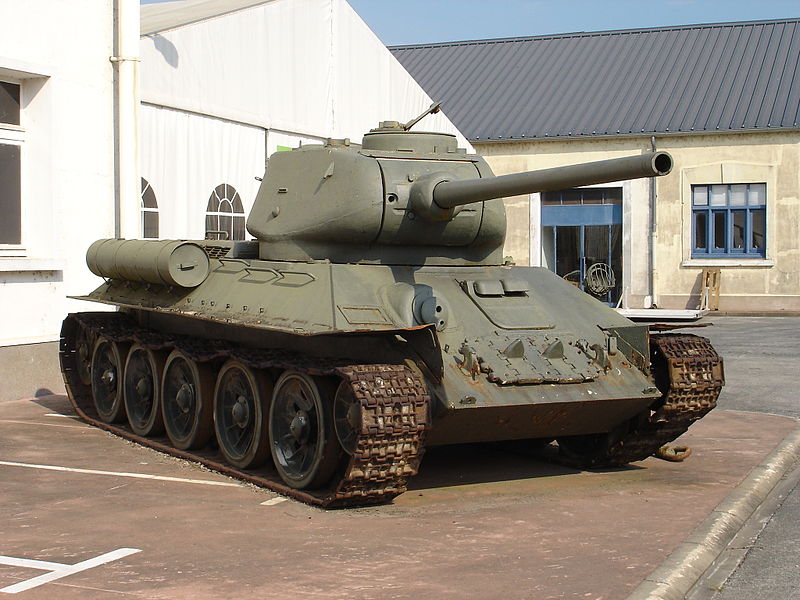
T-34/85 at musée des blindés de Saumur (via Wikipedia)
The T-34 had its problems — something we often forgotten when discussing a tank with a legendary reputation. The shortfalls included bad visibility for the crew and shoddy Soviet workmanship.
“They were good, but they were not miracle weapons and they had their faults,” writes Philip Kaplan in Rolling Thunder: A Century of Tank Warfare. “But the T-34, for all its faults, is now often referred to by tank experts and historians as possibly the best tank of the war.”
World War II German Field Marshall Ewald Von Kleist was more succinct. “The finest tank in the world,” is how he described the T-34.
The origins of the T-34 are simple enough. The Red Army sought a replacement for the BT-7 cavalry tank, which was fast-moving and lightly armored for use in maneuver warfare. It also had Christie suspension, one reason for the tank’s increased speed.
But during a 1938-to-1939 border war with Japan, the BT-7 fared poorly. Even with a low-powered gun, Japanese Type 95 tanks easily destroyed the BT-7s. Tank attack crews also assaulted the BT-7s with Molotov cocktails, reducing the Soviet tank to a flaming wreck when ignited gasoline dripped through chinks between poorly welded armor into the tank’s engine compartment.
[…]
By the end of the war, the Soviet Union had produced nearly 60,000 T-34 tanks — proving the point that quantity does have a quality all of its own.
At first, the Germans were at a loss when it came to countering the threat the T-34 posed. The Germans’ standard anti-tank guns, the 37-millimeter Kwk36 and the 50-millimeter Kwk 38, couldn’t put a dent in the Soviet tank with a shot to its front.
That left the Germans with a limited set of tactics. German tankers could attempt flank shots with their guns. The Wehrmacht could lay mines. Soldiers risked their lives in close assaults employing satchel charges and Molotov cocktails.
In what could be called an act of desperation, the Germans even used modified 88-millimeter anti-aircraft guns to stop attacking T-34s with direct fire.
November 25, 2014
Replica WW1 tanks at the Tank Museum
While they’re not true replica vehicles, the British Mark IV and the German A7V tanks can be seen at the Tank Museum in Bovington:
Uploaded on 11 Jan 2012
The Tank Museum has obtained the tank used in Steven Spielberg’s new World War One blockbuster Warhorse.
The fully operational replica of a British Mk IV tank is set to go on display when the film is released next week, and will also be used in the Dorset based Museum’s tank displays later in the year.
The full sized replica was based on the Museum’s own Mark IV, which was built in 1917. OSCAR award-wining special effects company Neil Corbould Special Effects LTD, whose credits include Saving Private Ryan and Gladiator, visited The Tank Museum in 2010 to take measurements from the vehicle and copy original documents related to the MK IV tank held in the Museum’s Archive.
Published on 30 Nov 2012
The Tank Museum has acquired a working replica of a German First World War tank. See it in action here, alongside our British First World War replica from the film War Horse. For more information, visit www.tankmuseum.org.
November 13, 2014
It was the tank that won WW2 in the west … and a deathtrap
Last month, Paul Richard Huard did a brief tribute to one of the iconic tanks of the Second World War, the M-4 Sherman. It was not a good tank, but it was good enough (if you ignore the survivability of the crews):
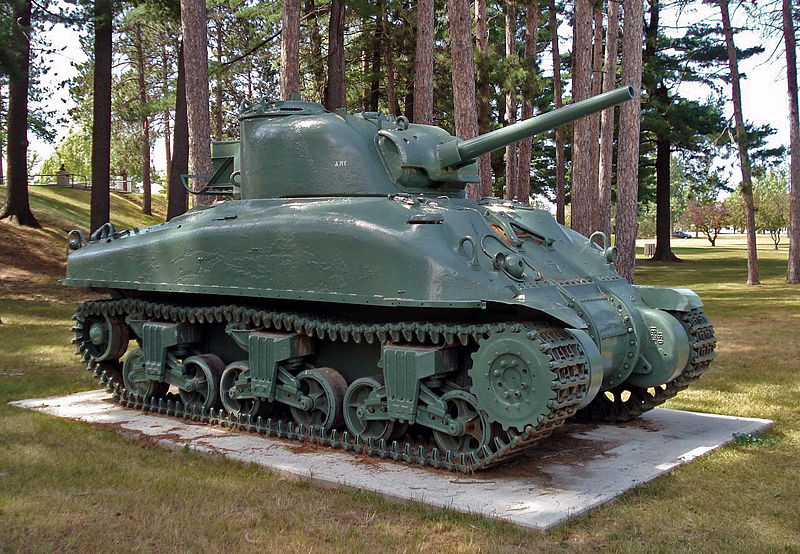
M4A1 Sherman tank at Canadian Forces Base Borden (via Wikipedia)
The M-4 Sherman was the workhorse medium tank of the U.S. Army and Marine Corps during World War II. It fought in every theater of operation — North Africa, the Pacific and Europe.
The Sherman was renown for its mechanical reliability, owing to its standardized parts and quality construction on the assembly line. It was roomy, easily repaired, easy to drive. It should have been the ideal tank.
But the Sherman was also a death trap.
Most tanks at the time ran on diesel, a safer and less flammable fuel than gasoline. The Sherman’s power plant was a 400-horsepower gas engine that, combined with the ammo on board, could transform the tank into a Hellish inferno after taking a hit.
All it took was a German adversary like the awe-inspiring Tiger tank with its 88-millimeter gun. One round could punch through the Sherman’s comparatively thin armor. If they were lucky, the tank’s five crew might have seconds to escape before they burned alive.
Hence, the Sherman’s grim nickname — Ronson, like the cigarette lighter, because “it lights up the first time, every time.”
Commonwealth units were allocated a proportion of Sherman tanks with the original 75mm or 76mm main gun replaced by a British 17-pounder anti-tank gun that gave Sherman Firefly tanks nearly the same punch as German Tiger tanks (and better than Panthers). There weren’t enough to go around, so they were parcelled out to allow a few Fireflies per troop or squadron. The 17-pounder gun also lacked a high explosive round for use against thin-skinned or unarmoured targets, so including one or two Fireflies among a group of conventionally armed Shermans was a good trade-off.

Sherman Firefly on display at Bovington Tank Museum (via Wikipedia)
October 4, 2014
Venerable Carl Gustav gets a major upgrade
Nicholas de Larrinaga reports for Janes 360 on the latest version of my favourite recoilless rifle:
Saab debuted a new variant of its Carl Gustaf 84 mm shoulder-fired recoilless rifle, the M4, during a series of demonstration firings at the Bofors Test Center at Karlskoga, Sweden, on 24 September.
The latest version of the nearly 70-year-old weapon system has been designed to offer significant weight savings over its predecessors, as well as improvements to other aspects of the system.
The M4 weighs 6.7 kg, some 3 kg lighter than the earlier Carl Gustaf M3 and half the weight of the 14.2 kg M2 version still in service with many nations. This has been achieved by constructing the recoilless rifle’s barrel out of titanium, saving 1.1 kg (compared to the M3’s steel barrel), building its outer casing our of carbon fibre (saving 0.8 kg), and by redesigning the weapon’s venturi to save a further 0.9 kg. The redesign has also served to decrease the size of the Carl Gustaf, bringing the M4’s total length down to under 1,000 mm.
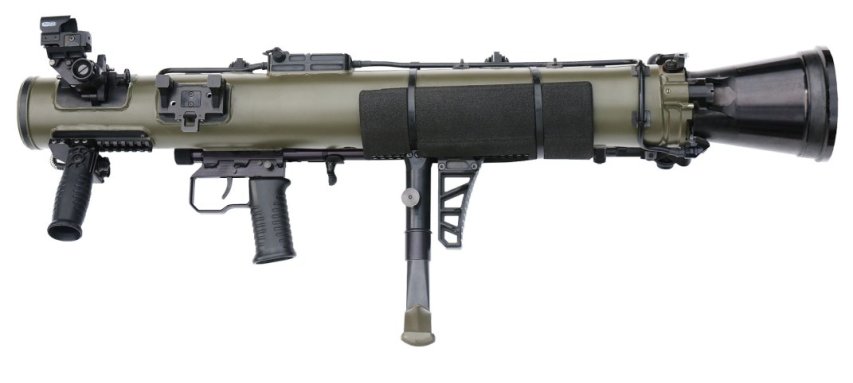
Saab Dynamics Carl Gustaf M4 84 mm recoilless rifle (Saab)
There are currently 11 different ammunition types available for the Carl Gustaf weapon system, providing considerable operational flexibility. Programmable ‘smart’ ammunition types for use with the M4 are expected to be the next to reach the market. Saab officials also disclosed they are working on a new concept of ammunition for the Carl Gustaf: and ‘Ultra-Light Missile’ that would feature lock-on before launch guidance, feature several attack modes, and have a range of 1,500-2,000 m – approximately doubling the range of the existing Carl Gustaf ammunition types.
August 28, 2014
Reason.tv – Pentagon Has ‘Everything Must Go’ Sale
Published on 28 Aug 2014
After protestors in Ferguson, Missouri, were met with a militarized police force, new attention was brought to the Pentagon’s 1033 program, a program that supplies military-grade equipment to local police departments, often for free. Check out a commercial Reason TV has unearthed advertising the program to law enforcement.
Extremely minor quibble: the “tanks” are actually armoured personnel carriers. But as I’ve moaned on about before, everyone in media thinks every tracked vehicle is a tank and every navy vessel that isn’t a submarine or an aircraft carrier is a battleship. (And some even mistake earplugs for rubber bullets…)
August 23, 2014
Defining the “best tank of World War 2”
Nigel Davies revisits one of the perpetual debates among amateur WW2 historians:
Let us start with the issue of tanks from the perspective of propaganda. More rubbish has been written about who had the best tanks during the Second World War than about any other topic to do with that war. Again and again you get supposedly serious historians talking about how the Germans started the Second World War with overwhelming tank superiority; that the Allies were only brought back into the race by the arrival of the Sherman tank; and how German technology leapt ahead again at the end of the Second World War to give them unrivalled vehicles. All these statements are of course completely incorrect.
One of the problems of course, is ‘best tank when, and for what?’
Comparing what was available in 1939/40 to what was being produced in 1945 (say a Panzer III or Matilda II with a Centurion or Stalin), is worse than useless. There is no comparison. Only the Panzer IV was actually produced throughout the war: and the heavily armoured final version of the tank — with a long barrelled 75mm gun capable of taking on almost every tank yet operational in mid 1945 — bore only a passing resemblance to the lightly armoured tank with a short barrelled infantry support gun — of with minimal ability to do more than scratch the paint of a CharB in 1939/40.

SOMUA 35 tank at Bovington Tank Museum (via Wikipedia)
The Matilda and its successor the Valentine would probably still the best Allied tanks in the world in early 1941, when they swept Italian forces before them, and several times fought the German African corps to a standstill. The German response to their shocking failures in 1940, had been to upgrade the Panzer III and IV with slightly improved armour, and the short barreled 50 mm gun. But they were still on a losing wicket engaging the British infantry tanks in any sort of close terrain, such as in the siege of Tobruk. Fortunately for Rommel, out in the open terrain of the desert he could deploy his tanks behind screens of high-powered anti-tank guns, which the British tanks lacked the long-range high explosive shells to engage effectively.Matilda II at Yad la-Shiryon Museum (via Wikipedia)

It also helped that too many British cavalry officers in the desert war still had a “tally ho!” attitude and were frequently drawn into unsupported tank charges against German or Italian tanks who were able to draw the fast but lightly armoured British cruisers into easy killing range of their anti-tank guns.
This is where the myth of the value of the Sherman tank comes from. The Sherman arrived at a time when it’s armour and weapon were on a par with the Panzer III and IV tanks that it was facing. Despite the fact that its 75 mm gun was greatly inferior as an anti-tank weapon to the new British six pounder guns that were starting to equip British tanks, the high explosive shell that the Sherman could fire was incredibly useful for engaging Rommel’s 88 mm guns at long-distance in the flat desert terrain.M4A1 Sherman tank at Canadian Forces Base Borden (via Wikipedia)
For several months, it seemed as though the mechanically reliable Sherman would be a war winner, despite its notable tendency to explode in flames whenever it was hit. (Allied troops refer to it as a Ronson — “lights first time every time”. German troops just referred to it as a “Tommy Cooker”.) But this concept was fantasy, which could be easily demonstrated within a few months, though it took the US government another two years to admit it.
[…]
In all of this so far, I have barely mentioned the Russians at all. Their T34 tank was possibly the single most effective of the war, and was the breakthrough that forced everyone else to rethink their designs. So we can say without a shadow of a doubt that the T34 was the best tank of the war for almost two years — from the time of Barbarossa (June 22, 1941) until the appearance of the Panther at Kursk (July 5, 1943). It certainly held this title unchallenged by the Sherman and Churchill tanks that appeared during its reign, and probably by the Tiger as well.T-34/85 at musée des blindés de Saumur (via Wikipedia)
The Tiger is a problem for this sort of discussion, because it re-introduces the concept of ‘what for’ into the debate. The Tiger was a far superior heavy infantry support or assault tank to the T34, but a far inferior battlefield manoeuvre or pursuit tank. In fact the Tiger was so slow and limited in cross country ability, that it was actually more effective as a defensive weapon once the Germans were thrown back on that approach, than it had been for re-igniting their Blitzkreig glory days.


He sums up the post with a league table of “best tanks” for given years and purposes:
Having noted the necessary division between medium cruisers and heavy assault/infantry support tanks however, we can still make a fair summary.
So, in contrast to what many history books and documentaries will tell you, the French had the best tanks in 1939, and the British had the best tanks of 1940 and 1945. Also in contrast to what many history books will tell you, the Shermans effective front-line role can best be defined as the few months between the battle of Alamein, and the arrival of Tiger tanks in Tunisia. All attempts to use it after that in Italy or northern France just demonstrated how pathetic it was in modern engagements. Even the British Firefly version with the 17 pounder, was extremely vulnerable to any German tank. In fact it is amusing to note, that they came into their own for the blitzkrieg across open country in pursuit of the defeated German armies across France; which has a direct parallel to the inferior German tanks pursuing the defeated French in 1940. (The equally inadequate British Cromwell tanks, being significantly faster, were actually still better at this pursuit than the Shermans.) The best tank of the Sherman’s period of functional use, of course being the T34.
So our list of ‘best tanks’ could go something like this.
1939 — Best cruiser – Somua 35, Best support – CharB.
1940 — Best support becomes Matilda II.
1941 — Best cruiser initially Panzer III/IV with short 50mm guns, becomes T34 when Russia enters the war.
1942 — Best support is Tiger.
1943 — Best cruiser is Panther.
1944 — Best support is Tiger II.
1945 — Best ‘all purpose’ is Centurion.
July 24, 2014
Niagara Peninsula to host brigade-level military exercise in August
A report in Niagara This Week by Paul Forsyth discusses a major Canadian military exercise to be held in the area next month:
Called Stalwart Guardian 14, the exercise is an annual one for troops across Ontario. But unlike many other training exercises that typically take place on military bases, this one will be much more visible to the public.
Col. Brock Millman, commander of the London, Ont.-based 31 Canadian Brigade Group, said in a letter to Thorold Mayor Ted Luciani earlier this year that the exercise will be “massive,” but will be conducted in a “safe, respectful and environmentally sound manner.”
At the July 15 meeting of Thorold city council, Millman and Maj. Paul Pickering — who is co-ordinating the exercise — said conducting the operation off-base makes it more realistic, because foreign bad guys are likely to hit infrastructure in populated areas.
“The terrain (on bases) is not complex, there are not big buildings, there are not roads, there is not a civilian population,” said Millman. “The training is not as effective as it can be.
“We’re coming here because it’s much more effective.”
Millman’s brigade, which is the reserve Canadian army in southwestern Ontario, is part of the 12,000-strong 4th Canadian division. He said more than 2,000 soldiers — a mix of reservists and veterans of missions in Afghanistan and Bosnia — will descend on Niagara for the exercise running from Aug. 16 to 24.
Back in my day, we’d have a camp established just outside Niagara-on-the-Lake and unless something went wrong, most of the civilian population in the area wouldn’t know we were there except for the unusually high number of short-haired guys in the bars after 6pm. In the mid-1970s, short hair was an unusual fashion statement…
While the soldiers take their soldiering seriously, Millman said there will be civil-military co-operation personnel to arrange interaction between soldiers and Niagara residents.
“Kids will get a chance to climb on their vehicles,” he said. “We’re not going to discourage (residents) from engaging with the soldiers” if it doesn’t conflict with the training, he said.
He told St. Catharines city council on Monday night that people simply find military vehicles fascinating
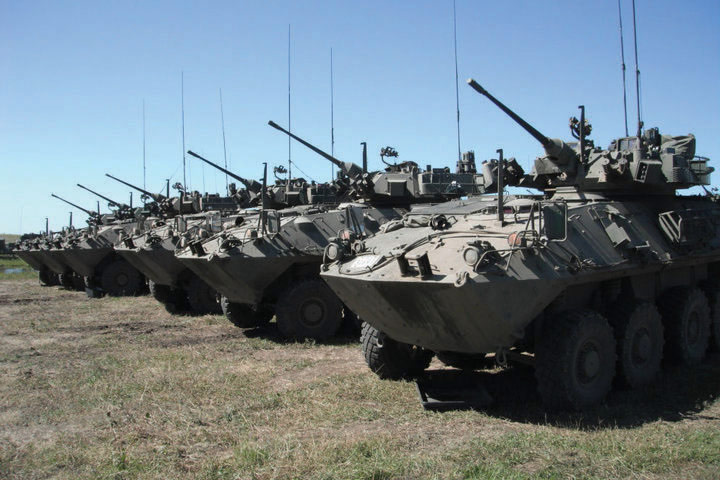
“There’s a five-year-old child in all of us who thinks…Thomas the Tank (Engine) is pretty cool,” he said. “Thomas the Coyote surveillance vehicle is super cool.”
Thorold city councillor Becky Lott said she hopes there is plenty of publicity about the exercise before soldiers arrive so people don’t fear the worst.
“I can see people calling and saying ‘why is there a tank rolling down my street?’” she said.
Coyotes? In my day we were just getting rid of the Korean War-vintage trucks and jeeps… get off my lawn, you kids!
June 6, 2014
Mulberries, PLUTO and Hobart’s Funnies
Seventy years ago today, the Allies launched Operation Overlord, the invasion of Normandy by the combined British, American, and Canadian armies. A huge fleet of combat and transport vessels, supported by a large proportion of the United States Army Air Force and the Royal Air Force bomber and fighter aircraft were all deeply involved in making the invasion a success. In addition, perhaps the world’s largest disinformation campaign was being run to keep the German high command unsure of the real time and location of the invasion: the Pas de Calais and the Norwegian coast were also potential invasion targets, forcing the defenders to spread their forces thinner and to keep as many as possible out of reach of the real beaches.
In addition to the operational uncertainty of where to expect the blow, the Germans were also split about how best to conduct the defence: Field Marshal Rommel wanted to rush units to the beach as soon as possible, to defeat the Allies before they got inland. General Geyr von Schweppenburg, commander of Panzer Group West (and Field Marshal von Rundstedt, overall commander in the West), on the other hand, preferred to meet the Allies further inland (not taking the full impact of Allied air superiority into account). On 6 June, the defenders fell between the two philosophies, not being able to mass enough force to stop the invaders in their tracks, but suffering higher casualties in the attempt to move units toward the coast in the teeth of RAF/USAAF attacks.

Operation Overlord (detail) Click to see full-sized image at wwii-info.net
The invasion beaches were code-named Utah (4th US Division), Omaha (1st and 29th US divisions), Gold (50th British Division), Juno (3rd Canadian Division), and Sword (3rd British Division). Before the amphibious forces landed, three paratroop divisions were dropped behind the beaches to slow down German response (US 82nd and 101st Airborne Divisions to the West and Southwest of Utah beach, and the 6th British Airborne to the East of Sword beach).
One thing to note from the map is that there wasn’t a significant port within the invasion zone: the Allies had learned the bitter lessons of attacking a port in August of 1942 and the 2nd Canadian Division had paid in blood for the tuition. This meant a way had to be found to keep getting supplies to the troops after they moved off the beaches, until a functioning port could be secured. The Allied answer was to bring a port with them from England — two of them, actually — one to support the US forces in the West and one to support the British and Canadian forces in the East. These were the Mulberry harbours:
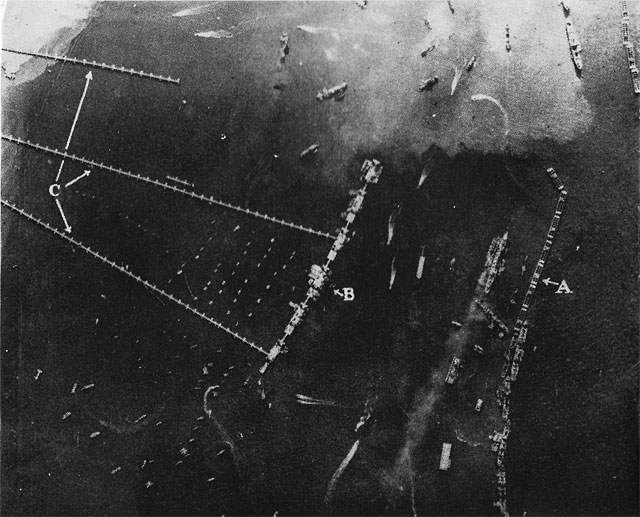
Think Defence explains how the Mulberry harbour worked:
In the image above these three components are shown.
A; Breakwater to attenuate waves
B; Pier heads at which to load and unload
C; Causeways that connected the pier heads to the beach
Each of the components was given a code word but fundamentally, they were concerned with either providing sheltered water or connecting ships and the beach.
There have been a number of different theories about how the Mulberry name was chosen, the more fanciful ones being completely incorrect.
Brigadier White recalls the moment he received a memo, unclassified, with the heading ‘Artificial Harbours’ and after recovering from the shock of such poor security immediately consulted with the Head of Security at the War Office. The next code, from the big book of code words, was Mulberry, it was that simple.
[…]
There were two complete Mulberry harbours, A for American and B for British, each the size of Dover harbour. Once the task of constructed and assembling the components on the South coast of England was complete they were ordered to Normandy on the 6th of June 1944, D-Day, departing on the 7th
Assembling the components was an effort in itself, requiring 600 tugs drawn from all parts of the UK and USA, all under the supervision of the Admiralty Towing Section commanded by Rear Admiral Brind.
Operational security was paramount, the captains of the block ships were told they were going to the Bay of Biscay and a model of the Mulberry harbour and invasion beaches in the headquarters of the Automobile Association at Fanum House was made by toymakers who were confined to the building until well after the invasion.
Unfortunately, the Western harbour was severely damaged in a storm a few weeks after coming into service, so the Eastern Mulberry had to do double duty after that.
Aside from the need to get reinforcements, rations, ammunition and other supplies forward, the Allied armies were highly motorized, and required vast amounts of fuel. Without a port’s specialized unloading facilities, it was assumed that it would be somewhere between difficult and impossible to keep the armies mobile. To address this, PLUTO was developed: Pipe Line Under The Ocean.
A great solution, although as Think Defence points out, it didn’t actually go into service until a few months after D-Day, and was not quite the war-winner the newsreel portrayed:
Second in daring only to the artificial harbors project and provided our main supplies of fuel during the Winter and Spring campaigns.
What also PLUTO did was allow vital tanker tonnage to be deployed to the Far East theatre.
Despite the understandable over exaggeration of the success of PLUTO it should be noted that fuel did not start flowing until September 1944, well after the invasion and on the 4th of October, BAMBI was closed down and operations concentrated on DUMBO after it had delivered a measly 3,300 tonnes, hardly war winning.
Cherbourg was by then receiving tanker supplies direct from the USA.
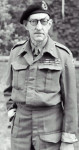 Getting across the channel was a major undertaking, but getting the troops ashore with enough firepower to break out of the beach defences required more innovation. The British army established a specialized unit to develop and operate vehicles and weapon systems specifically designed for that purpose. Major General Sir Percy Hobart was the commander of the 79th Armoured Division, and he was exactly the right man for the job (being related by marriage to Montgomery may have helped, too, but before taking command he was acting as a corporal in the Home Guard).
Hobart’s unit developed some of the most interesting armoured vehicles (not all of which were brilliant successes) and it’s safe to say that the Allies would have suffered much higher casualties without Hobart’s “Funnies”. In fact, General Eisenhower said as much himself: “Apart from the factor of tactical surprise, the comparatively light casualties which we sustained on all beaches, except OMAHA, were in large measure due to the success of the novel mechanical contrivances which we employed, and to the staggering moral and material effect of the mass of armor landed in the leading waves of the assault. It is doubtful if the assault forces could have firmly established themselves without the assistance of these weapons.” Think Defence has a good summary of many of these odd and interesting vehicles:
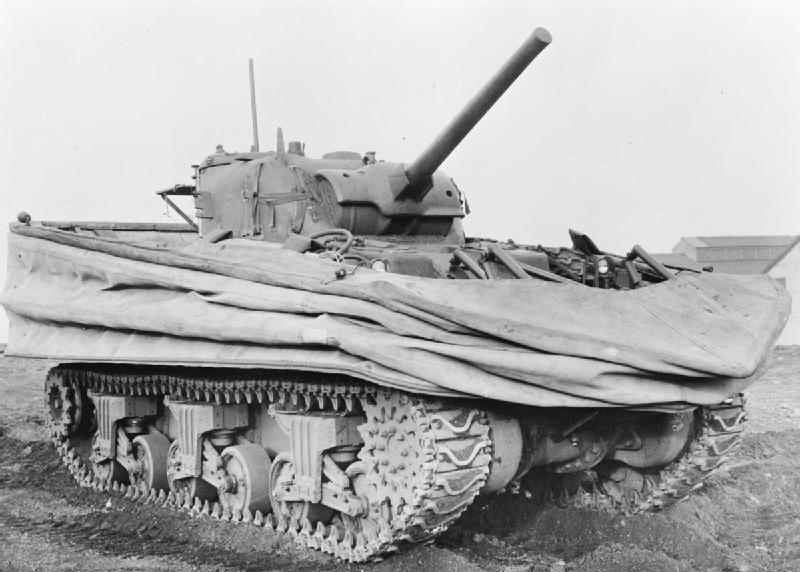
Sherman tanks were also converted into amphibious vehicles by the addition of a canvas skirt, propellers and other modifications. These provided vital armoured fire support in the opening phase of the beach assault although a number were lost to the heavy seas when they were launched too far from the beach. It is widely thought that as these losses were particularly heavy on Omaha beach it was this that contributed to the very high losses in that area.
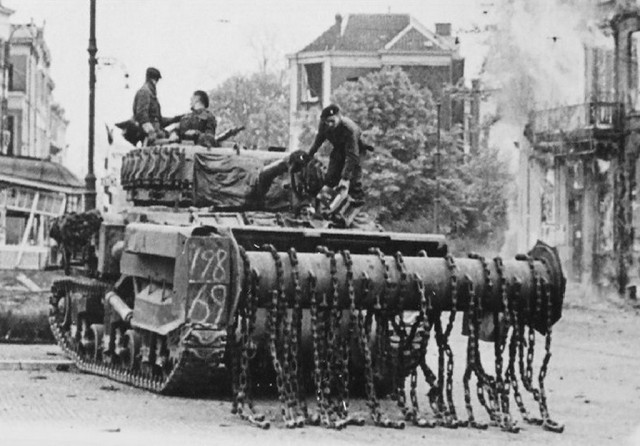
Mine clearance was carried out by a number of means but the preferred method was to use rotating chain flails to detonate the mines thus clearing a path the width of the tank. The flails were mounted on the front of the tank and were called Sherman Crabs. A number of Churchill based designs using rollers and ploughs were also employed, although this image shows one mounted on a Sherman.
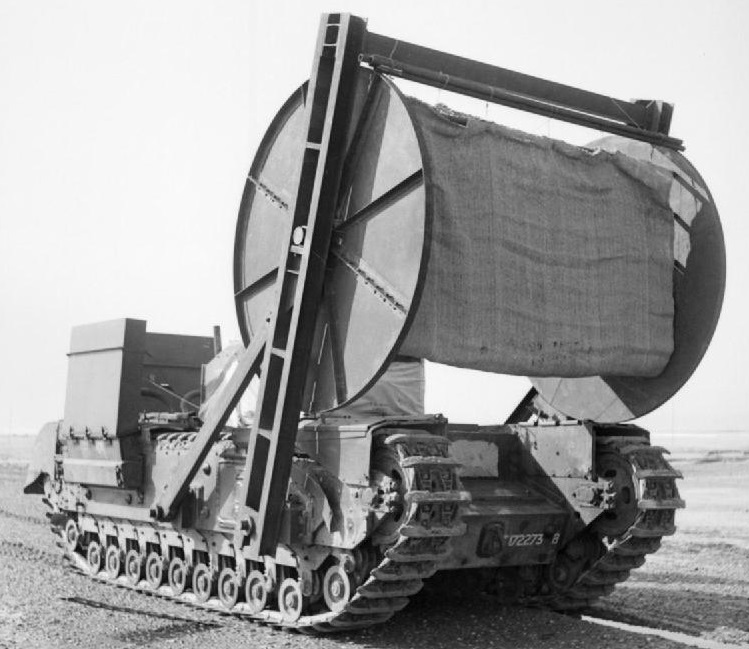
The beach surveys had revealed the existence of large patches of clay that would not bear the weight of heavy vehicles and artillery. To overcome this the ‘bobbin’ tanks were used that laid a continuous reinforced canvas mat over the soft ground, thus spreading the load over a wider area.
March 11, 2014
Stop That Tank!
Published on 31 May 2013
During World War II, the Disney company joined in the Allied war effort by producing animated movie material at cost for the US government (they also created insignia mascots for hundreds of aircraft and warships by request). These films number well over one hundred – although most are only partially created by Disney – and cover topics from antenna tuning to Beechcraft airplane maintenance to anti-German and Japanese propaganda. However, one piece in particular is of interest to us here at Forgotten Weapons: Stop That Tank!
Produced in 1942 for the Canadian military, it is a training film on the operation and maintenance of the Boys anti-tank rifle. The Disney contribution is in animated x-ray views of the various parts of the gun, and about 3 minutes of introduction featuring a section of Nazi tanks (the lead one driven by none other than Adolf Hitler) being surprised and driven back by a bunch of plucky doughboys hiding Boys AT rifles in bushes, outhouses, and horses.
The intro is pretty hilarious, but the meat of the film is actually a very informative piece on how the Boys works and how to use it. There are a couple copies of this already on YouTube, but thanks to reader Frank, we have this nice high-quality version.
Just one thing: if it was a Canadian film, there wouldn’t be any “doughboys” involved…
H/T to Think Defence for the link. They’ve also got a video of a modern shooter firing the Boys ATR (not using the original ammunition, this has been refitted to fire .50 BMG).


