
Military History Visualized
Published on 22 Dec 2017This video discusses what killed the most tanks in World War 2. Was it anti-tank guns, mines, planes, hand-held anti-tank weapons, mechanical breakdowns, etc. Also a short look at the problems of the term “kill”, e.g., mobility, firepower and catastrophic/complete kill.
Original Question by Christopher: “What destroyed the most tanks during WW2: infantry, planes, anti-tank guns, or other tanks (I’m not sure if tank destroyers needs its own category or not).”
January 19, 2018
What “killed” the most tanks in World War 2?
Comments Off on What “killed” the most tanks in World War 2?
January 16, 2018
PIAT: Britain’s Answer to the Anti-Tank Rifle Problem
Forgotten Weapons
Published on 25 Nov 2017The British began World War Two with the Boys antitank rifle, but like all antitank rifles it rather quickly became obsolete. The replacement for it was adopted in 1942 as the PIAT – Projector, Infantry, Anti-Tank. This was a unique sort of weapon which fired a 3 pound (~1.35kg) hollow charge projectile using a combination of a massive spring and a firing charge much like a rifle grenade blank cartridge – a spigot mortar, really. The large (3.25″, 83mm) projectile was able to defeat almost any tank that would be developed during the war, as it could burn through 3-4 inches of hardened armor. However, it had a terrifyingly short effective range – 110 yards on paper and more like 50 yards in practice.
The PIAT would recock itself upon firing, but the initial cocking was something like a crossbow, requiring the shooter to brace their feet on the buttplate and pull the body of the weapon upwards, compressing the 200 pound (90kg) mainspring. When fired, the weapon has a pretty harsh recoil, although it did not have any flash or backblast like the American Bazooka did. By the end of the war more 115,000 PIATs had been made, and they would serve the British military into the 1950s, when they were replaced with more traditional rocket launchers.
Comments Off on PIAT: Britain’s Answer to the Anti-Tank Rifle Problem
January 14, 2018
M4 Sherman Tank – Crew tell how shocking it was
spottydog4477
Published on 18 Sep 2011Doctrine
As the US approached entry in World War II, armored employment was doctrinally governed by FM 100-5 Operations (published May 1941, the month following selection of the M4 tank’s final design). That FM stated that:
The armored division is organized primarily to perform missions that require great mobility and firepower. It is given decisive missions. It is capable of engaging in all forms of combat, but its primary role is in offensive operations against hostile rear areas.
In other words, the M4 was envisioned to primarily fill the role of a cruiser tank — although the US Army did not use that doctrinal term. The M4 was not primarily intended as an infantry support tank; in fact, FM 100-5 specifically stated the opposite. It placed tanks in the “striking echelon” of the armored division, and placed the infantry in the “support echelon”. Neither was the M4 primarily intended for tank versus tank action. Doctrinally, anti-tank engagements were the primary role of tank destroyers. The field manual covering the use of the Sherman (FM 17-33 The Tank Battalion, Light and Medium of September 1942) devoted one page of text and four diagrams to tank versus tank action (out of 142 pages). This early armored doctrine was heavily influenced by the sweeping initial successes of the German blitzkrieg tactics. Unfortunately, by the time M4s reached combat in significant numbers, battlefield demands for infantry support and tank versus tank action far outnumbered the occasional opportunities for cruiser tanks.
Although envisioned primarily as a cruiser-type tank, US doctrine did also contemplate the M4’s use in other roles. Unlike some other nations, which had separate medium tank designs tailored specifically for anti-tank roles (e.g., the German PzKfw III) and support roles (the PzKfw IV), the US intended the M4 to fulfill all roles. Although not optimized for tank versus tank engagements or infantry support, the M4 was capable of performing these missions to varying degrees. In the Pacific Theater, the Sherman was used chiefly against Japanese infantry and fortifications; in their rare encounters with lighter Japanese tanks with weaker armor and guns, the Shermans were vastly superior.
The doctrine of the time had Shermans as a sort of infantry tank. All anti-tank work was supposed to be done by tank-destroyer crews. Speed was essential in order to bring the tank-destroyers from the rear to destroy incoming tanks. Thankfully, for Sherman crews, this doctrine was not entirely used as it would create a small window of time of weakness in the armored battalion until tank destroyers moved to the front. Obviously this would make it harder for an armored force to achieve a breakthrough, a main objective of armor, if the enemy had tanks. It would also be easier for an opposing armored force to achieve a breakthrough against an American tank battalion which would not have all of its anti-tank assets at the front during the beginning of any attack.
Comments Off on M4 Sherman Tank – Crew tell how shocking it was
January 9, 2018
German Anti-Tank Units – Herman Göring – Caltrops I OUT OF THE TRENCHES
The Great War
Published on 8 Jan 2018Ask your questions here: http://outofthetrenches.thegreatwar.tv
Comments Off on German Anti-Tank Units – Herman Göring – Caltrops I OUT OF THE TRENCHES
January 7, 2018
Inside the Rolls Royce Armoured Car I THE GREAT WAR Special
The Great War
Published on 6 Jan 2018Check out The Tank Museum on Patreon: https://www.patreon.com/tankmuseum
Indy speaks to David Willey, curator of The Tank Museum in Bovington, about the Rolls Royce Armoured Car, one of the most iconic armoured cars of World War 1. From its early, improvised days on the Western Front to deployment in the far corners of the British Empire.
Comments Off on Inside the Rolls Royce Armoured Car I THE GREAT WAR Special
December 3, 2017
Shell Recycling – WW1 Monuments in WW2 – Resistance Movements I OUT OF THE TRENCHES
The Great War
Published on 2 Dec 2017Chair of Wisdom Time!
Comments Off on Shell Recycling – WW1 Monuments in WW2 – Resistance Movements I OUT OF THE TRENCHES
November 28, 2017
The Canadian Army’s Leopard tanks
In a discussion on Facebook the other day, I’d mistakenly stated that the Canadian Army had initially sent the “new” Leopard 2 tanks leased from Germany (20 refurbished Leopard 2A6Ms) to Afghanistan to support the Kandahar mission. In fact, as a lengthy article linked by John Donovan pointed out, our poor zipperheads had been operating non-air-conditioned Leopard 1 tanks until the government made arrangements with some of our NATO allies to get modern MBTs into the combat zone. I suspect the reason for my confusion was that the old Leopard 1 tanks were designated as “C2” by the army and I’d confused that with the more general “Leopard 2” name for the modern tank. This article in Defence Industry Daily sets out the details:
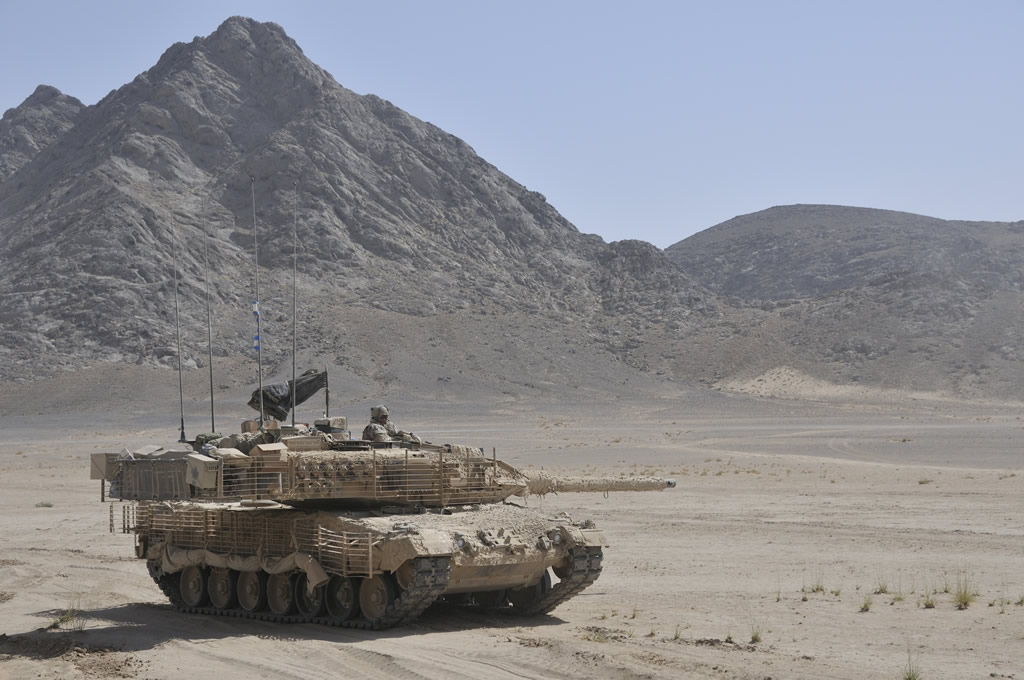
Leopard 2A6M in Afghanistan
A number of options for renewing Canada’s tank capability were considered, ranging from refurbishment, to surplus, to new. Delivery time was of the essence, and DND’s examination determined that the cost of any new vehicles involved paying up to 3 times as much as buying the same basic tank models on the surplus heavy tank market. New medium tank options like the 32-tonne CV90-120 light tank also offered full tracked mobility and similar firepower at less cost, but Canada had learned that heavier weight was often a tactical plus in theater, and decided that they needed vehicles sooner rather than later.
Accordingly, the Canadian government approached 6 allied nations regarding surplus main battle tank sales, and received proposals from 3 of them. It then went ahead and made 2 purchases, plus another 2 follow-on buys.
Their tank choice is a modern mainstay for many countries. Thanks in part to the great DeutschePanzerSchlussverkauf (German Panzer fire sale), the Leopard 2 and its variants external link have now been bought by Germany, Austria, Canada, Chile, Denmark, Finland, Greece, the Netherlands, Norway, Poland, Spain, Singapore, Switzerland, Sweden, and Turkey.
Canada’s 1st step was a lease, in order to get modern, air-conditioned tanks to the front lines immediately. Germany won that order, and 20 German Leopard 2A6M mine-protected tanks were delivered by the summer of 2007 to replace existing Leopard 1A5/C2 tanks in Afghanistan. The new tanks’ electric turret systems produce less heat than the C2s did, and air conditioning was added to the new German tanks in theater. This was a relief to Canadian tank crews, who had needed protective suites in the 140F/ 60C interiors of their Leopard 1A5 tanks.
The 2A6M is the most modern serving Leopard variant, though KMW had proposed a “Leopard 2 Peace Support Operations” variant with improved protection, and integrated combat engineering capabilities. By the time modifications were finished, the Leopard 2A6 CAN turned out to fall somewhere between the conventional 2A6M and the PSO. Canada actually ended up keeping the leased and modified German tanks, and sending 20 Leopard 2A6Ms from its follow-on purchases back to Germany.
The follow-on purchases of 127 tanks were won by 3 countries. The biggest order for 100 tanks went to the Dutch, who are serving under NATO ISAF beside Canadian forces in southern Afghanistan. Training for 5 years and initial spares will also be provided. Cooperation between these nations is not new. Dutch PzH-2000 mobile howitzers have already proven very helpful during Operation Medusa external link, and so had their CH-47 Chinook medium-heavy helicopters – some of which were bought as surplus from the Canadians in the 1980s. The cycle continues. And so it goes.
In the aftermath of their sales to Norway, Denmark, and now Canada, The Dutch were left with 110 Leopard 2A6-NL tanks in their arsenal. Other sales dropped that total further, and on On April 8/11, the Dutch Ministry of Defense announced that the last tank unit was to be dissolved and all remaining Leopard tanks sold.
The additional Leopard 2 buys totaled 27 tanks/ hulls. First, another 15 Leopard 2A4s were bought from Germany, to be used for spare parts. This hadn’t been contemplated in the initial plan, but it was necessary. The initial set of 20 leased German Leopard 2A6Ms were experiencing readiness problems, as tanks were cannibalized in order to keep others running. A 2010 buy from Switzerland added 12 stripped Pz 87s (Leopard 2A4 variants) for conversion to specialty vehicles, under Canada’s Force Mobility Enhancement (FME) program.
The earlier Leopard 1 tanks had been purchased in the late 1970s (very much against the preferences of the government of the day) to replace the late 1940s vintage Centurion tanks the Canadian Army had been operating:
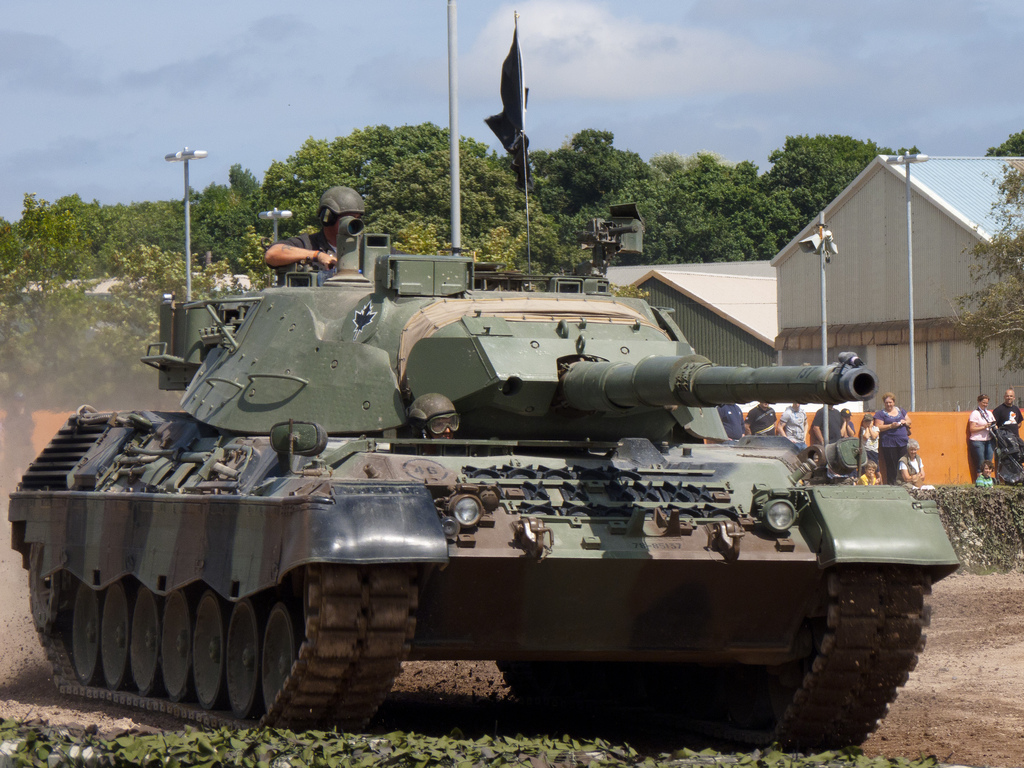
Canadian Leopard 1A3 (Leopard C1) at the Bovington Tank Museum.
Photo by Chris Parfeniuk, via Flickr.
When 4 Canadian Mechanized Brigade Group was moved from Westphalia to Lahr on the Rhine frontier with France, some policy-makers apparently sought to do away with Canada’s tanks entirely.
For some years, the brigade continued to use their Centurion tanks, an excellent tank in its day but one that could not be used on long road moves. In 1975, the Canadian Prime Minister, Pierre Trudeau, visited Germany to ask the Chancellor for his support for getting Canada special trade status with the European Common Market. He was told to come back to discuss the matter once Canada had replaced its antiquated tanks.
The contract for the Leopard tank acquisition followed quickly. Consideration had been given to totally rebuilding the Centurions with new power pack as the Israeli army has done with their Centurions. Before the order could be delivered Canada negotiated a deal with the German Government to lease 35 Leopard 1A2’s to train their crews on the new tanks.
The upgrade from the initial Leopard C1 to the C2 model began in 1996:
Late in 1996 it was announced that the Canadian Forces were to carry out a major update on their fleet of Leopard C1 tanks (The C1 was the equivalent of the Leopard 1A3), which involved the replacement of the existing turret with the complete turret of the German Leopard 1A5. The Leopard 1A5 turret features the STN ATLAS Elektronik EMES-18 computerized fire-control system which incorporates a Carl Zeiss thermal imager.
The 105mm L7 rifled guns in the Leopard 1A5 turrets were not retained but were replaced with Canadian Leopard C1 original 105mm guns, the L7A1. The ballistic computers were reprogrammed to match 105 mm Canadian ammunition.
The turret rebuild was carried out in Germany and commenced in June 1997 with the first turret being shipped to Canada in December 1997. GLS refurbished the turret, removed the 105 mm gun, modified the turret where required, including the installation of the new radios ordered under the Tactical Command, Control and Communications System project.
The turrets were shipped to Canada where a subcontractor installed the 105 mm L7A1 barrel and mounted the turret on the existing chassis for final delivery to the Canadian Forces. It was expected that about six turrets a month would be upgraded with each turret taking six months to upgrade. The program was completed by late 2001.
Comments Off on The Canadian Army’s Leopard tanks
November 25, 2017
Cambrai Tank Chats Special: The Mark IV Tank
Tank Museum
Published on 24 Nov 2017The Mark IV tank was the most numerous of the First World War and went in to battle en masse at the Battle of Cambrai, 20 November 1917. In this special edition of Tank Chats, Curator David Willey explains how the Mark IV tank functions and how it was used to break through the World War One German defences.
Comments Off on Cambrai Tank Chats Special: The Mark IV Tank
November 24, 2017
Tank Corps Unleashed – The Battle of Cambrai I THE GREAT WAR Week 174
The Great War
Published on 23 Nov 2017After stopping the offensive at Passchendaele, the British Army launches another, albeit more limited, offensive. Almost 500 tanks are put into place and the initial success is remarkable. But the Germans had been training in anti-tank warfare and are supported by fresh troops from the Eastern Front.
Comments Off on Tank Corps Unleashed – The Battle of Cambrai I THE GREAT WAR Week 174
November 23, 2017
Tank Chats #20 Mark IV
Tank Museum
Published on 13 May 2016Mechanically the Mark IV tank was the same as the Mark I but it had thicker armour, improved fuel supply and modified sponsons with slightly shorter guns in the Male version.
Mark IV tanks went into action for the first time in the summer of 1917, they were the mainstay of the Tank Corps at Cambrai in November and fought through to the end of the war with 7th and 12th Battalions of the Tank Corps. It was a male Mark IV tank which won the very first ‘Tank versus Tank’ action in April 1918 by knocking out the German A7V tank Nixe.
Comments Off on Tank Chats #20 Mark IV
November 20, 2017
Cambrai: The Tank Corps Story | The Tank Museum
Tank Museum
Published on 17 Nov 2017100 years on from the Battle of Cambrai, The Tank Museum presents a documentary on the moment the Tank Corps delivered one of the greatest advances of the First World War. This is the full-length version of Cambrai: The Tank Corps Story.
As the regimental museum of the Royal Tank Regiment, The Tank Museum is using the World War One centenary to draw attention to the struggle, sacrifice and ingenuity of the early tank men.
Comments Off on Cambrai: The Tank Corps Story | The Tank Museum
November 19, 2017
Development of British Tank Tactics 1917 I THE GREAT WAR Special
The Great War
Published on 18 Nov 2017The Battle of Cambrai 100 years ago was one of the pivotal moments for the British Tank Corps and tank combat in general. For the first time, the tanks were deployed in a way that they could play to their strengths.
Comments Off on Development of British Tank Tactics 1917 I THE GREAT WAR Special
November 15, 2017
The Man Whose Tank Collection Got WAY Out Of Hand | Forces TV
Forces TV
Published on 29 Oct 2017We take a trip to Cobbaton Combat Collection to meet the family with over 70 military vehicles!
Comments Off on The Man Whose Tank Collection Got WAY Out Of Hand | Forces TV
October 30, 2017
Tank Chats #19 Matilda II
Tank Museum
Published on 28 Apr 2016The name Matilda means Strength in Battle from the Germanic roots Maht, meaning strong and Hild meaning battle.
The Matilda was regarded as a superb tank in its day and carved a remarkable career for itself. A few served in France in 1940 but in the early stages of the North African campaign, under General Wavell, it virtually ruled the desert. Even when the Afrika Korps arrived it remained a formidable opponent, immune to everything but the notorious 88mm gun. Its main failings were its slow speed and small gun, which could not be improved.
Comments Off on Tank Chats #19 Matilda II
October 15, 2017
Panzers in Poland 1939 – Success, Failures & Losses
Military History Visualized
Published on 1 Sep 2017German Panzers in Poland 1939 were crucial in the success, but also suffered quite some losses and various shortcomings were detected.
Comments Off on Panzers in Poland 1939 – Success, Failures & Losses


