Quotulatiousness

July 14, 2019

The only WW2 battle with its own – fanatical – volunteer PR department

Filed under: Germany, History, Military, Russia, WW2 — Tags: , , , — Nicholas @ 03:00

The 1943 battle of Kursk has been called “the most overhyped battle in history”. I’ve read many, many books and articles about the events of World War 2, I’ve generally avoided reading much about Kursk, because reasons. As I wrote nearly a decade back:

Советские бойцы и командиры осматривают немецкие САУ «Фердинанд», подбитые на Орловском участке фронта (“Soviet fighters and commanders examine German self-propelled guns Ferdinand, shot down on the Orel front”).
Photo by Pavel Troshkin, July 1943 via Wikimedia Commons.

Although I’ve read much about World War II, I haven’t read much about arguably the most critical part of the entire war: the gargantuan battles pitting the Soviet Red Army against Hitler’s Wehrmacht. Some of that is just sheer pig-headedness: I used to work for the biggest wargame store in Toronto, back when wargames meant cardboard counters, vast paper hexagonal maps, and charts and tables galore. The hardest of the hard-core gamers seemed to be either Napoleonic grognards (down to the secret stash of sabres and shakos in the gaming room) or even more dedicated junkies of the “Great Patriotic War”/”Operation Barbarossa”. Some of the latter were genuinely crazy, right down to the barely contained hints that “Hitler was just misunderstood”.

Battle of Kursk – 4 July-1 August 1943
Map drawn by Frank Martini for the Department of History at the United States Military Academy (http://www.dean.usma.edu/history/web03/atlases/ww2%20europe/ww2%20europe%20pages/ww2%20europe%20map%2027.htm), via Wikimedia Commons.

On the assumption that certain forms of craziness are contagious, I avoided most of the latter as much as I could, consistent with my duty to sell them the latest and greatest game involving their particular passion.

One day, perhaps in a fit of weakness, I allowed myself to get lectured by one of the fanatics about the details of the Battle of Kursk. The fan who felt the need to bend my ear was eager to impart information about some “famous battle” that turned out to have been a serious tactical miscalculation by a Soviet officer. The story, as he told it, had a very large formation of Soviet tanks “taking a shortcut” through a major minefield, resulting in many disabled/destroyed tanks and wounded or dead men. In the telling, this kind of thing could not be admitted as having happened without some enemy contact, so it was propagandized as being a major tank battle involving significant formations of German panzer troops and/or SS units (of whom, of course, the glorious defenders of the Motherland took a greater toll than they suffered themselves).

The twitchy-eyed Panzertruppe fanboys helped keep my interest firmly directed away from much of the WW2 Eastern Front aside from the initial 1941 German invasion. A post at Blazing Cat Fur included a link to a BBC article discussing furious Russian reaction to an article recently published in Die Welt, but also indicates that there was actually some factual basis for the lecture I endured all those years ago:

The wider Battle of Kursk – from 5 July to 23 August 1943 – was indeed a turning-point in World War Two. Soviet forces thwarted a huge Nazi counter-attack, after Adolf Hitler’s troops had suffered a colossal defeat at Stalingrad in the winter of 1942-43.

But recently a British historian, Ben Wheatley, analysed German Luftwaffe aerial photos of the Prokhorovka battlefield, taken on 14-16 July, when the area was still in German hands. The photos were found in the US National Archives at College Park, Maryland.

T-34/85 at musée des blindés de Saumur (via Wikipedia)

Wheatley’s assessment, backed by detailed study of battle reports and historical archives, is that on 12 July the Germans lost just five Panzer IV tanks at Prokhorovka, but decimated “kamikaze” Soviet tank formations, turning more than 200 Soviet tanks into smouldering wrecks.

He writes that dozens of Soviet T-34 tanks tumbled into an anti-tank ditch 4.5m (15ft) deep, dug by Soviet infantry, and when the Red Army realised its mistake other T-34s started queuing up to cross a bridge. German tanks were easily able to pick them off at the bridge.

Wheatley and a German military historian, Karl-Heinz Frieser, were cited in a feature in the German daily Die Welt, which hit a Russian raw nerve.

The writer, Sven Felix Kellerhoff, argued that the evidence of Soviet humiliation at Prokhorovka was so convincing that Russia ought to tear down its memorial there, which celebrates the heroism of Soviet tank crews on 12 July.

[…]

War photographer Anatoly Yegorov was in the thick of the fighting at Kursk. His nephew Mikhail Yegorov spoke to the daily Moskovsky Komsomolets, recalling what Anatoly told him about his work there.

“Most of those photos were not published. ‘Do you know why no panoramic photos of the Prokhorovka battlefield were ever shown in our country?’ my uncle asked me. ‘Because for every burning Tiger there were 10 of our smashed up T-34s! How could you publish such photos in the papers?'”

BCF also linked to this artice from a few years ago at The National Interest:

Kursk is the Santa Claus and Easter Bunny of World War II battles, whose popular history was constructed from German and Soviet propaganda, and based on early accounts lacking vital information buried in Russian archives until after the fall of the Soviet Union. Kursk was indeed an epic battle, that pitted 3 million German and Soviet soldiers and 8,000 tanks, all crammed into a small portion of southern Russia.

[…]

Top commanders such as Erich Von Manstein wanted to attack in May, before the Soviets had time to dig in and reinforce the salient. But a nervous and indecisive Hitler decided to postpone Operation Citadel until July, to allow time to deploy his vaunted new Panther, Tiger and Elefant tanks. While the big cats lumbered off the railroad cars near the front lines, the Germans managed to amass nearly 800,000 men, 3,000 tanks, 10,000 guns and mortars, and 2,000 aircraft. It would be the last time the Germans could concentrate such an attack force (by comparison, at the Battle of the Bulge, the Germans had 400,000 men and 600 tanks). Yet as usual, the Germans were outnumbered. They faced 1.9 million Soviet soldiers, 5,000 tanks, 25,000 guns and mortars and more than 3,000 aircraft.

Citadel was a prophetic name for the German offensive. The Soviets used the extra time to build an incredibly dense defense system of multiple layers of fortifications, including trenches, bunkers, tank traps and machine gun nests 25 miles deep, as well as minefields that averaged more than 3,000 mines per kilometer.

Kursk was not an imaginative battle. The Germans attacked an obvious target, the Soviets fortified the obvious target, and the German offensive on July 4, 1943 was a traditional pincer move against the north and south base of the salient to cut off the defenders inside. Despite support by 89 Elefants (a Porsche version of the Tiger that the German army rejected), the northern pincer quickly bogged down after advancing just a few miles. But the southern pincer, led by the II SS Panzer Corps, managed to advance 20 miles to the town of Prokhorovka, until its advance was checked by the Soviet Fifth Guards Tank Army.

The article then goes on to address many of the myths and legends that have grown up around the battle, including:

  • The Tigers didn’t burn. Soviet tanks did
  • Kursk was not a turning point of the war
  • Prokhorovka was not the Greatest Tank Battle in History
  • The Red Army was still not as good as the German Army
  • It was the Soviet counteroffensive that bled the Germans
  • Soviet tanks didn’t ram German tanks at Kursk
  • Kursk was an Anglo-American victory as well as a Soviet one

July 11, 2019

Unofficial High Speed Tour of Borden Base Military Museum

Filed under: Cancon, History, Military, WW2 — Tags: , , , , , — Nicholas @ 02:00

The_Chieftain
Published on 8 Jun 2019

Canadian Forces Base Borden is located about an hour’s drive North of Toronto. The base is open access, so anyone can go to the museum.

In addition to the vehicles at the museum, there are others scattered as monuments around the base. I encountered a T-72 and T-55 on my way out the gate.

July 7, 2019

Granatbuchse GrB-39 Antitank Rifle

Filed under: Germany, History, Military, Technology, Weapons, WW2 — Tags: , , — Nicholas @ 02:00

Forgotten Weapons
Published on 29 Aug 2015

http://www.patreon.com/ForgottenWeapons

Hammer price: $13,000

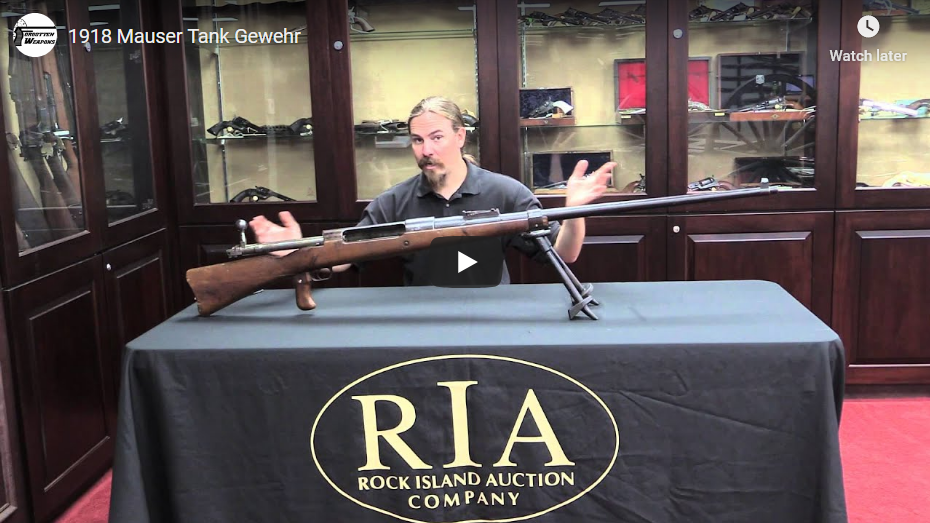
Like most countries, Germany had a standard-issue antitank rifle when World War II began — the Panzerbuchse 39. It fired an 8 x 94mm cartridge with a small very high velocity armor-piercing bullet. And like the other AT rifles from the 1930s, the PzB-39 became obsolete quickly as tank armor improved during the war. However, while most countries simply scrapped their antitank rifles, the Germans opted instead to convert the guns into dedicated grenade launchers.

Because the PzB-39 was already designed for a very high pressure cartridge, it was ideally suited to handle the stresses of firing large anti-tank grenades. Rather than relying on simple kinetic energy to penetrate, the grenades could use shaped charge technology to be vastly more effective than AP bullets.

In converting the PzB-39 into the GrB-39, the barrels were cut down, grenade launching cups attached to the muzzles, new sights designed for grenade use, bipods lengthened, and the folding stocks were fixed in place. Most of the PzB-39 rifles in service were subject to these modifications, and the resulting GrB-39 guns were able to be reasonably effective through the end of the war.

July 3, 2019

Tank Chats #51 TANKFEST 2017 | The Tank Museum

Filed under: Britain, France, Germany, History, Military, Technology, WW1 — Tags: , , , — Nicholas @ 02:00

The Tank Museum
Published on 25 May 2018

At TANKFEST 2017, the Musée des Blindés brought their unique Saint Chamond tank, which sat alongside the Museum’s replica Mark IV and A7V. David Fletcher took the opportunity to talk about the three First World War vehicles as they stood side-by-side.

Support the work of The Tank Museum on Patreon: ► https://www.patreon.com/tankmuseum
Or donate http://tankmuseum.org/support-us/donate

Visit The Tank Museum SHOP: ►https://tankmuseumshop.org/

Twitter: ► https://twitter.com/TankMuseum
Tiger Tank Blog: ► http://blog.tiger-tank.com/
Tank 100 First World War Centenary Blog: ► http://tank100.com/ #tankmuseum #tanks

June 28, 2019

Lesser-known details of the France 1940 Campaign

Filed under: Britain, France, Germany, History, Military, WW2 — Tags: , , , — Nicholas @ 04:00

The_Chieftain
Premiered on 22 Jun 2019

Your friendly history lesson, with a little bit of Op-Ed thrown in, some parts of the 1940 campaign in France of which many folks weren’t aware.
Why was Guderian relieved of command?
Why might condoms have changed the course of the war?
What’s a Niwi?
Was the French failure one of doctrine, or execution?
You get the idea.

Patreon link here:
https://www.patreon.com/The_Chieftain

World War Two channel, if you haven’t already found it… : https://www.youtube.com/channel/UCP1A…

Panzerbüchse 39 German Anti-Tank Rifle

Filed under: Germany, History, Military, Weapons, WW2 — Tags: , , — Nicholas @ 02:00

Forgotten Weapons
Published on 7 Apr 2015

Sold for $37,375.

Most countries still had anti-tank rifles in their military inventory at the beginning of WWII – the Solothurn S18-100, the Lahti L39, the Boys AT Rifle, the PTRD and PTRS, and so on. For Germany, this role was fulfilled by the Panzerbüchse 39, a single-shot falling block rifle firing a high velocity 8mm AP cartridge. It was nominally effective in the opening campaigns of the war, but was quickly rendered obsolete as Allied armor improved. German planners has a huge number (25,000) of these on hand for the invasion of Russia, where they expected Russian armor to be vulnerable to them – which was not the case. Most were subsequently converted into Granatbüchse 39 AT grenade launchers, which were then used until the end of the war.

Cool Forgotten Weapons Merch! http://shop.bbtv.com/collections/forg…

June 27, 2019

Tank Chats #50 Ha-Go | The Tank Museum

Filed under: History, Japan, Military, Technology, WW2 — Tags: , — Nicholas @ 02:00

The Tank Museum
Published on 18 May 2018

The Type 95 Ha-Go tank was produced by the Imperial Japanese Army in 1935 and used throughout the Second World War.

The Tank Museum’s Type 95 was captured in Malaya and was examined in Calcutta before being sent to Britain. Surviving Japanese tanks from the Second World War are extremely rare.

Support the work of The Tank Museum on Patreon: ► https://www.patreon.com/tankmuseum
Or donate http://tankmuseum.org/support-us/donate

Visit The Tank Museum SHOP: ►https://tankmuseumshop.org/

Twitter: ► https://twitter.com/TankMuseum
Tiger Tank Blog: ► http://blog.tiger-tank.com/
Tank 100 First World War Centenary Blog: ► http://tank100.com/ #tankmuseum #tanks

June 20, 2019

Tank Chats #49 A7V | The Tank Museum

Filed under: Germany, History, Military, Technology, WW1 — Tags: , — Nicholas @ 02:00

The Tank Museum
Published on 20 Mar 2018

21 March 1918, was the action debut of the German A7V tank during the First World War.

One hundred years later, historian David Fletcher talks through the vehicle and its history. The Tank Museum’s A7V is a replica, which can be seen running at Museum events, like TANKFEST.

Support the work of The Tank Museum on Patreon: ► https://www.patreon.com/tankmuseum
Or donate http://tankmuseum.org/support-us/donate

Visit The Tank Museum SHOP: ►https://tankmuseumshop.org/

Twitter: ► https://twitter.com/TankMuseum
Tiger Tank Blog: ► http://blog.tiger-tank.com/
Tank 100 First World War Centenary Blog: ► http://tank100.com/ #tankmuseum #tanks

June 19, 2019

37mm Antitank Gun on a Dodge Weapons Carrier – M6

Filed under: History, Military, USA, Weapons, WW2 — Tags: , , , , — Nicholas @ 02:00

Forgotten Weapons
Published on 1 Jun 2014

http://www.forgottenweapons.com

Theme music by Dylan Benson – http://dbproductioncompany.webs.com

The M6 Gun Motor Carriage was the first American tank destroyer of WWII – a 37mm antitank gun (basically identical to the M3 gun) mounted on the back of a Dodge 3/4 ton weapons carrier. A large armor shield protected the gun crew from small arms fire, but the vehicle was otherwise highly exposed. The truck was powered by a flathead 6-cylinder engine producing 99 horsepower, and had a top speed of 55 mph. The gun was effective and modern in the late 1930s when its design process began, but was underpowered and insufficient by the time the M6 first saw action in 1942/3 in Tunisia.

Not many complete M6 carriages remain in existence today, as they were replaced quickly after their poor showing in North Africa. Most had the guns removed and were converted back into utility trucks, while some were used by the Free French forces and some saw use in the Pacific theater (where the underpowered gun was less of a concern).

June 16, 2019

Finnish Bofors 37mm anti-tank gun

Filed under: Europe, History, Military, Weapons, WW2 — Tags: , , , , , — Nicholas @ 02:00

Forgotten Weapons
Published on 27 Apr 2014

Cool Forgotten Weapons Merch! http://shop.bbtv.com/collections/forg…

Theme music by Dylan Benson – http://dbproductioncompany.webs.com

The Swedish Bofors company developed a sophisticated and very high-quality light anti-tank gun in the early 1930s, and found significant commercial success with it. A variety of countries either purchased the guns outright from Bofors or paid for licenses to produce them domestically. These countries included Denmark, Finland, Poland, the Netherlands, and Sweden itself. The largest number were in Poland (1200 or more), and there is speculation that some may have been sold to Spain during the Spanish Civil War (both these guns and a 40mm AA gun which definitely went to Spain were designated wz.36). A significant number were also captured and reused by German and Russian forces during WWII. On the Allied side, some of the guns were sold to the Sudan and used by British forces in North Africa (generally mounted on trucks).

The gun itself was an excellent design, capable of 12 rounds/minute of accurate fire and potent enough to deal with most of the smaller tanks in existence at the beginning of WWII. New tank developments made it obsolete, but it was at least effective against Russian light tanks (BT, T-26, T-28) in the Winter War if not the heavier T-34s. The gun has a sophisticated suspension system to help absorb recoil energy, and fired a 37 x 257mm shell with a 740g projectile at about 825 m/s (26oz @ 2700 fps). The action was semi-automatic, meaning that once fired, the action would recoil on the carriage, and automatically eject the empty case. It would then return to battery with the breech open, ready for a new shell to be loaded (in the video, the ejection mechanism has been disabled to help preserve the brass cases).

June 11, 2019

TAB Episode 48: QF 6pdr Anti-Tank Gun

Filed under: Britain, History, Military, Weapons, WW2 — Tags: , , — Nicholas @ 02:00

The Armourer’s Bench
Published on Apr 28, 2019

The 6pdr AT Gun was introduced in 1942, joining the lighter 2pdr, the new gun was more capable of dealing with the increasing thickness of Axis armour. The 6pdr first saw action in North Africa and was used throughout the war in Europe and Asia. It also armed a series of British armoured cars, tanks, ships and even aircraft!

In this video Matt looks at the history, development and use of Britain’s second dedicated anti-tank gun.
Check out our accompanying blog on the 6pdr AT Gun over at: http://armourersbench.com/2019/04/28/the-6pdr-qf-anti-tank-gun/

If you enjoyed the video please consider supporting our work via Patreon, TAB is a viewer supported, non-monetised channel and any help is very much appreciated!
Check out our Patreon page here: https://www.patreon.com/thearmourersb…

Where to find TAB:
https://armourersbench.com
https://imgur.com/user/ArmourersBench
https://discord.gg/DAjRSBc

Don’t forget to like, share and subscribe and spread the word!

June 10, 2019

Pak-40 German 75mm AT Gun Firing

Filed under: Germany, History, Military, Weapons, WW2 — Tags: , , — Nicholas @ 02:00

Forgotten Weapons
Published on 30 Mar 2014

Cool Forgotten Weapons Merch! http://shop.bbtv.com/collections/forg…

Intro music by Dylan Benson – http://dbproductioncompany.webs.com

While we normally stick to small arms here, this beast of a gun was just way too impressive for me to not pay attention to. I was at a cannon and machine gun shoot just recently where some folks brought out what is (I believe) the only functional Pak-40 in the United States. And shot it.

The Pak-40 was the backbone of German antitank guns during WWII, and fired a 75mm AP shell out to an effective range of about a mile in a direct-fire role, with enough energy to defeat pretty much any Allied tank except the late-war Russian heavies. It was fairly light weight given its effectiveness, and makes one hell of a concussion when fired.

Thanks to the gun’s owners for being awesome!

June 8, 2019

Tank Chats #48 Centaur Dozer | The Funnies | The Tank Museum

Filed under: Britain, History, Military, Technology, WW2 — Tags: , , — Nicholas @ 02:00

The Tank Museum
Published on 9 Mar 2018

A Centaur tank converted into a dozer, part of the Tank Chat Funnies specials. The design had been worked out by 79th Armoured Division in Belgium in autumn 1944. In early 1945, the first conversions were issued to 87th Assault Dozer Squadron, 6th Assault Regiment Royal Engineers; a few saw action in Germany. Some were deployed during the Korean War and the intervention around the Suez Canal in 1956.

Support the work of The Tank Museum on Patreon: ► https://www.patreon.com/tankmuseum
Or donate http://tankmuseum.org/support-us/donate

Visit The Tank Museum SHOP: ►https://tankmuseumshop.org/

Twitter: ► https://twitter.com/TankMuseum
Tiger Tank Blog: ► http://blog.tiger-tank.com/
Tank 100 First World War Centenary Blog: ► http://tank100.com/ #tankmuseum #tanks

May 30, 2019

Tank Chats #47 King Tiger | The Tank Museum

Filed under: Germany, History, Military, Technology, WW2 — Tags: , , — Nicholas @ 02:00

The Tank Museum
Published on 2 Mar 2018

Known variously as the Tiger Ausf. B, Tiger II or Königstiger (the British also referred to it as the “Royal Tiger”), 489 Tiger IIs, were produced at the Henschel assembly plant, between January 1944 and March 1945. However, despite lacking in numbers, and being prone to mechanical and mobility issues based on its size and weight, the Tiger II’s combination of devastating firepower, and thick sloped armour plate made it a formidable adversary.

Support the work of The Tank Museum on Patreon: ► https://www.patreon.com/tankmuseum
Or donate http://tankmuseum.org/support-us/donate

Visit The Tank Museum SHOP: ►https://tankmuseumshop.org/

Twitter: ► https://twitter.com/TankMuseum
Tiger Tank Blog: ► http://blog.tiger-tank.com/
Tank 100 First World War Centenary Blog: ► http://tank100.com/ #tankmuseum #tanks #tigertank

May 21, 2019

Armoured Vehicles of the Invasion of France 1940, by The Chieftain – WW2 Special

Filed under: Britain, France, Germany, History, Military, Technology, WW2 — Tags: , , — Nicholas @ 06:00

World War Two
Published on 20 May 2019

The Chieftain takes you on an extensive walkthrough of the armoured vehicles used by both sides during the German invasion of France in 1940.

The Chieftain’s channel: https://www.youtube.com/user/TheChief…

« Newer PostsOlder Posts »

Powered by WordPress