Quotulatiousness

September 19, 2025

QotD: The sub-generations of Generation X

Filed under: Media, Quotations, Technology, USA — Tags: , , , , , , — Nicholas @ 01:00

… “Gen X” is actually a misnomer, as there are at least three distinct subgroups. There’s the very earliest Xers, the guys who were in high school in the late 1970s. They often get lumped in with the Baby Boomers, too, though they’re as different from the Boomers as they are from us, the “mid” Xers. Think Wooderson from Dazed and Confused. Brian Niemeier calls them “Generation Jones”, and while I don’t like that tag I don’t know what else to call them (except maybe “Woodersons”), so roll with it.

Then there’s the group that was in high school in the late 1980s. I squeak into this group (barely). We’re the mid-Xers. The real “grunge” generation. If Dazed and Confused is a pretty decent late-90s approximation of late-70s high school kids, then the best description I can give you of a “grunge” kid is the movie Deadpool. Made in 2016, by guys who were born in the mid-1970s. That’s grunge, in a way Kurt Cobain couldn’t even imagine. Fourth wall breaks! Sarcastic asides about the fourth wall breaks! Profanity! Masturbation jokes! And snark, snark, snark — unrelenting snark, about everything, all the time. Every second of that movie screams “I can’t believe you fags are amused by this, but since you obviously do, here’s lots more! Choke on it!!!”

The writers obviously wanted to work on Buffy the Vampire Slayer, but Joss Whedon was too cool for them — imagine the twisted psyche of a person who thinks Joss Whedon is cool — and Sarah Michelle Gellar just laughed at them, so they made Deadpool out of spite.

Then there’s the late Xers. They were in high school in the late 1990s, which is why us oldsters call them “Millennials” (as the term is now used, it seems to mean “those born around 2000”, i.e. the generation just now getting out of college. We took it to mean “those who were just getting out of college around the turn of the century”). Obviously I use the Internet. I’m using it now, but I’m not on the internet, and I’m certainly not an Internet Person. The very late Xers are Internet People. The very first Internet People; they invented the concept of Internet People. Mark Zuckerberg (born 1984) is a late Xer. The people behind Twitter (Jack Dorsey born 1976; Biz Stone 1974; Evan Williams 1972) are mid-Xers; they were ahead of the curve.

Severian, “Addendum to Previous”, Founding Questions, 2022-02-24.

September 8, 2025

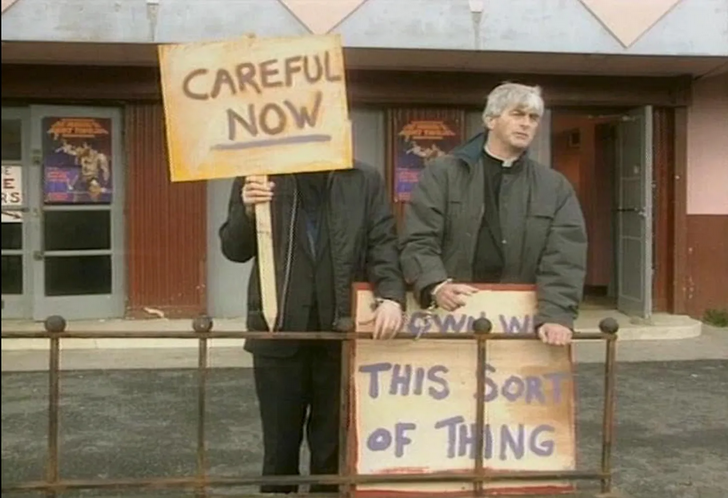
“Down with this sort of thing!”

In the free-to-cheapskates part of Ed West’s post on the Graham Linehan case in Britain, he identifies one of the reasons that Linehan’s Father Ted became so popular in the country it was situated in:

I don’t think I’d seen a “down with this sort of thing” placard in the flesh since I watched the Protest the Pope march back in September 2010. Those were the heady days of New Atheism, before the movement evolved into something more explicitly progressive.

The sign references an episode of the 1990s comedy Father Ted, in which the protagonist and his dim-witted sidekick Fr Dougal are forced to protest the screening of a blasphemous new film called The Passion of Saint Tibulus. Among the many catchphrases popularised by the comedy, back in 2010 this one suggested an ironic and gently mocking attitude to religion; that it was ridiculous, rather than evil.

This week, outside Westminster Magistrates’ Court in Marylebone Road, the sign appeared in a rather different context, carried by supporters of Father Ted co-creator Graham Linehan as he faced charges of harassment and criminal damage in an ongoing trial, following an incident at last year’s Battle of Ideas involving a young transgender activist.

Linehan had been bailed before trial, allowing him to travel to the United States to work on a new comedy project. When he arrived back at Heathrow on Monday, however, he was arrested by five armed police officers over three tweets he had posted back in April. The situation was as absurd and surreal as anything that had emerged from the writer’s fertile imagination.

As Linehan described it on his substack: “When I first saw the cops, I actually laughed. I couldn’t help myself. ‘Don’t tell me! You’ve been sent by trans activists’. The officers gave no reaction and this was the theme throughout most of the day. Among the rank-and-file, there was a sort of polite bafflement. Entirely professional and even kind, but most had absolutely no idea what any of this was about.”

The incident is embarrassing to Britain as it faces increasing scrutiny in the US for its poor record on free speech, especially over the Lucy Connolly case. It was unfortunate timing that this arrest happened just as Nigel Farage was heading in the other direction to talk about this very issue in Washington. But Linehan’s ordeal is also part of a much longer and sadder story about the perils of the political meeting the personal.

Arthur Mathews and Graham Linehan had worked on The Fast Show before renowned comedy producer Geoffrey Perkins had taken to one of their ideas, about a group of priests stuck on a remote Irish island, proposing that it be written as a six-part sitcom. It was brilliant, and hugely loved, and in its timing was significant.

Conor Fitzgerald wrote of Father Ted that, while well-loved in Britain, in Ireland it is more like “the national sitcom, a piece of light entertainment that nevertheless Says Something Meaningful About Us”. It also appeared at a crucial time in history.

    Not only was Father Ted one of the few successful TV representations of Ireland, it was made during Ireland’s version of the Swinging Sixties, our flux decade of the Nineties. The accelerating collapse of the Church and the exposure of longstanding political corruption coincided with the dawn of the Celtic Tiger years, lending peripheral Ireland a sense of self-conscious modernity. It was a unique national turning point, where our 19th-century past seemed to co-exist with our 21st-century future. In reflecting this upheaval, Father Ted has become not just a social historical document, but a portent of where Ireland stands today.

    When Ted was broadcast, the Church was formally still one of the central pillars of Irish life, but its authority rang hollow. Priests often felt like administrators of a vanished country. And on remote Craggy, Ted, Dougal and Jack mirror this directly. All good sitcoms feature characters who are trapped, but Ted is doubly so: first on his island; and second in an institution people are coming to see as irrelevant. He is still an essential member of the community, more than just a ceremonial functionary for weddings and funerals. But it’s just not clear what the essential thing he does is anymore, beyond being a common reference point that deserves token respect.

    Ted and Ted therefore stand at a crossroads, and capture the more fundamental social change in Ireland at this time: the collapse in respect for older establishment hierarchies generally.

Those establishment hierarchies collapsed across the West in the late 20th century, first in more secularised nations such as Britain and France and later, and more quickly, in places like Ireland and Spain where the Catholic Church still held on.

The Church lost its power to patrol its taboos, without which it became a sitting duck for satirists; the Passion of St Tibulus was influenced by the protest against Life of Brian, successfully banned in Ireland until 1987. As a teenager, Linehan had to join a film club to watch it, but such censorship was disappearing everywhere.

Father Ted was a work of genius, employing a surreal style of humour that has often been characteristic of Linehan and Mathews, and later seen in their under-appreciated sketch show Big Train – including the brilliantly bizarre sketch in which Beatles producer George Martin is kidnapped by Hezbollah.

The clerical comedy bequeathed numerous catchphrases. “I hear you’re a racist now, Father”, which features in an episode where Fr Ted is wrongly accused of anti-Chinese prejudice, is still a popular meme. Likewise, “These are small, but the ones out there are far away“, Ted’s explanation of perspective to his idiotic housemate, is still used to mock the gormless.

The show was also charming, and its treatment of religion was far from vicious. Rather than being a vitriolic attack on Church authority, Father Ted poked gentle fun at the absurdity of the old order, a kind of mockery which is perhaps a more dangerous threat to a belief system that relies on awe and fear. It was innocent, and many years later Linehan said he would find writing Father Ted much harder in light of the abuse scandal.

September 7, 2025

QotD: Generation X

Filed under: Books, Humour, Quotations, USA — Tags: , , , , , — Nicholas @ 01:00

… But Sailer’s right about Klosterman’s ability to grasp the obvious about Gen X. For instance:

    The concept of “selling out” — and the degree to which that notion altered the meaning and perception of almost everything — is the single most nineties aspect of the nineties. The complexity, nuance, and application of the term sellout was both ubiquitous and impossible to grasp. Nothing was more inadvertently detrimental to the Gen X psyche.

Or, as I like to put it, we were so obsessed with “authenticity” that we took as our guru an exquisitely sensitive longhaired goof who fronted a band named after spooge. […] But Klosterman does have genuine insights sometimes:

    The detail always noted in remembrances of the Bronco chase is the throngs of bystanders cheering for Simpson as the car rolled down the freeway, congregating on overpasses and holding makeshift cardboard signs proclaiming, “The Juice Is Loose”. It seemed perverse then and still seems perverse now. Yet this can also be understood as the primordial impulse of what would eventually drive the mechanism of social media: the desire of uninformed people to be involved with the news, broadcasting their support for a homicidal maniac not because they liked him, but because it was exhilarating to participate in an experience all of society was experiencing at once.

Sailer thinks that’s clever and perceptive, and I agree. Too bad you have to read some masturbatory bullshit about Zima to get to it.

Sadly, he doesn’t take that out a step (or, at least, he doesn’t get quoted doing so in Sailer’s review). Here’s Klosterman’s verdict on why Gen X, for all its faults, wasn’t so bad:

    The enforced ennui and alienation of Gen X had one social upside: Self-righteous outrage was not considered cool, in an era when coolness counted for almost everything. Solipsism was preferable to narcissism. The idea of policing morality or blaming strangers for the condition of one’s own existence was perceived as overbearing and uncouth. If you weren’t happy, the preferred stance was to simply shrug and accept that you were unhappy.

True enough, but look: Of all the things that made the Boomers so fucking insufferable, right near the top was their utter inability to let go of their youth. Instead of seeing Forrest Gump as a metaphor so unsubtle, an anvil to the head seems sneakier, they thought it was a lighthearted celebration of a simpler, more innocent time. We knew better. Since they couldn’t let go of their youth, we made “being old and jaded long before our time” into our signature thing.

But where, my fellow alterna-dudes, is that attitude now, when it matters? We’re in the same position in 2022 as our parents were in 1992: Staring down the barrel of middle age, teeing off on life’s back nine, pick your metaphor. It’s time to put away childish things. Grow the fuck up already, the way we wish our parents would’ve done for us back in 1992. Instead, we’re letting our lunatic children smear their pathologies all over what’s left of America, because … ?

I know why Klosterman does it: That’s what they pay him for. What’s our excuse?

Severian, “A Meta-Review”, Founding Questions, 2022-02-24.

September 5, 2025

QotD: Hillary Clinton in the White House

Filed under: Government, Quotations, USA — Tags: , , , — Nicholas @ 01:00

As some of you know, I was the Air Force Military Aide for Bill Clinton, lived in the White House, traveled everywhere they traveled, and carried the “nuclear football”. As such, I was always in close proximity to both Bill and Hill.

Among the military who served in the White House and the professional White House staff, the Clinton administration was infamously known for its lack of professionalism and courtesy, though few ever spoke about it. But when it came to rudeness, it was Hillary Clinton who was the most feared person in the administration. She set the tone. From the very first day in my assignment.

When I first arrived to work in the White House, my predecessor warned me. “You can get away with pissing off Bill but if you make her mad, she’ll rip your heart out.” I heeded those words. I did make him mad a few times, but I never really pissed her off. I knew the ramifications. I learned very quickly that the administration’s day-to-day character, whether inside or outside of DC, depended solely on the presence or absence of Hillary. Her reputation preceded her. We used to say that when Hillary was gone, it was a frat party. When she was home, it was Schindler’s List.

In my first few days on the job, and remember I essentially lived there, I realized there were different rules for Hillary. She instructed the senior staff, including me, that she didn’t want to be forced to encounter us. We were instructed that “whenever Mrs. Clinton is moving through the halls, be as inconspicuous as possible”. She did not want to see “staff” and be forced to “interact” with anyone. No matter their position in the building. Many a time, I’d see mature, professional adults, working in the most important building in the world, scurrying into office doorways to escape Hillary’s line of sight. I’d hear whispering, “She’s coming, she’s coming!” I could be walking down a West Wing hallway, midday, busier than hell, people doing the administration’s work whether in the press office, medical unit, wherever. She’d walk in and they’d scatter. She was the Nazi schoolmarm and the rest of us were expected to hide as though we were kids in trouble. I wasn’t a kid, I was a professional officer and pilot. I said “I’m not doing that”.

There was also a period of time when she attempted to ban military uniforms in the White House. It was the reelection year of 1996, and she was trying to craft the narrative that the military was not a priority in the Clinton administration. As a military aide, carrying the football, and working closely with the Secret Service, I objected to that. It simply wasn’t a matter of her political agenda; it was national security. If the balloon went up, the Secret Service would need to find me as quickly as possible. Seconds matter. Finding the aide in military uniform made complete sense. Besides, what commander in chief wouldn’t want to advertise his leadership and command? She finally relented because the Secret Service weighed in.

The Clintons are corrupt beyond words. Hillary is evil, vindictive, and profane. Hillary is a bitch.

Buzz Patterson, Twitter, 2025-05-17.

August 12, 2025

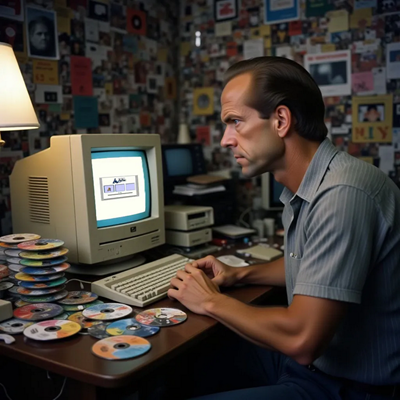
AOL to shut down its last dial-up access: dozens to be inconvenienced

Filed under: Business, Humour, Media, Technology, USA — Tags: , , — Nicholas @ 03:00

James Lileks on the end-of-era announcement from AOL — and I can’t recall the last time I thought of that company — that they’ll be eliminating the last of their dial-up internet access accounts:

New tech: shiny today, tarnished tomorrow. Everything that was once bright and brilliant now stamps its walker towards the exit door. The headlines wave goodbye: Last telegram office in the US shut down.

Last phone booth in New York is decommissioned. The latest: AOL to shut off its landline customers.

You’d think this would be news on the level of “homing pigeon trainer employment hits record lows”.

Who uses dialup? Yahoo, which now owns the AOL brand, says that the user base is in the “low thousands”, which suggests that some people forgot to turn off autopay in 2005. What does AOL do today? The usual basket of dross and chum. A website that offers “trending videos” — gosh, don’t know where else you’d find those — and a lot of news stories, supplied by Yahoo, and its … numberless army of journalists, I guess.

It’s a legacy brand for people who want to slide into the internet like comfy slippers they left under the desk. And that’s fine. Facebook serves the same function. It’s a place to start, a home base. A familiar window out which we gaze daily We all have them. But let us not get nostalgic for AOL and the early days of the internet. Some people, of course, love to talk about the pioneer days, and how it required some technical know-how:

    Well, we didn’t have those fancy little pre-made modems like you got in the 90s, so we had to get a little matchbox and fill it up with a certain kind of specially-bred insect that sang a note at a particular pitch when exposed to electrical current. So you’d crank up the generator and put the little alligator clips on the box and hold the box up to the phone while you entered your user name in Morse code by pushing on the hang-up buttons, and then you had to shake the box so the insect singing would modulate. Took about an hour, but then you’d be “On the Line”, as we said, and you could go to a Usenet group and call people Nazis. Kids today, they can call someone a Nazi without lifting a finger.

August 11, 2025

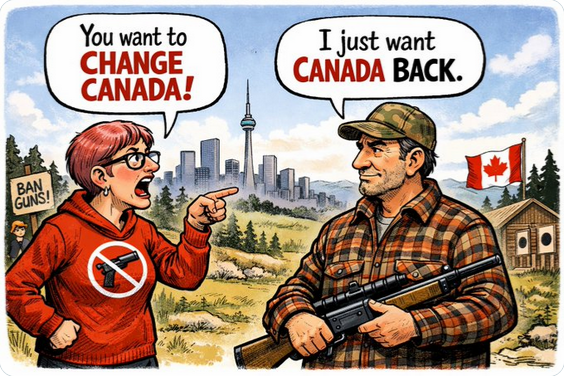
Smug Canadian boomer autohagiography rightly antagonizes the under-35s

Fortissax had an argument with one of his readers over a smug, self-congratulating meme about how wonderful Canada was in the 1990s and early 2000s:

What we lived through long before Trudeau was the Shattering, the breakdown of Canada’s social cohesion, driven by left-liberalism with communist characteristics applied to race, ethnicity, sex, and gender, and punitive almost exclusively toward visibly White men. My generation, those millennials born on the cusp of Gen Z, saw post-national Canada take shape not in the comfortable suburban rings of the GTA or the posh boroughs of Outremont and Westmount, but in self-segregated, ghettoised enclaves of immigrants whose parents never integrated and were never required to.

Memes like that are dishonest because they feed a false memory. The 2000s were not normal. Wages were stagnant, housing was already an asset bubble, and immigration was still flooding in under a policy that explicitly forbade assimilation. Brian Mulroney had enshrined multiculturalism into law in 1988. Quebec alone resisted, carving out the right to limit immigration under the 1992 Quebec–Canada Accord. After Chrétien, Stephen Harper brought in three million immigrants, primarily from China, India, and the Philippines in that order.

The Don Cherry conservatives of that era were Bush lite. They were rootless, cut off from their history, their identities manufactured from the top down since the days of Lester B. Pearson. They conserved nothing. For Canadian youth, it was the dawn of a civic religion of wokeness, totalitarian self-policing by striver peers, and the quiet coercion of every institution. My memories of that decade are of constant assault — mental, physical, spiritual — from leftists in power, from encroaching foreigners, and from the cowardice of conservatives.

Your 2000s might have been great. For us, they were communist struggle sessions. In 2009 we were pulled from class to watch the inauguration of Barack Obama, a foreign president, as a historic moment for civil rights. Our schools excluded us while granting space to every group under the sun: LGBT safe spaces and cultural clubs for Italians, Jamaicans, Jews, Indians, Indigenous, Balkaners, Greeks, Slavs, Portuguese, Quebecois, Iroquois, Pakistanis — every culture celebrated except our own. Anglo-Quebecers and Anglo-Canadians got nothing but an Irish club, closely monitored for “white supremacy” and “racism” by the HR grandmas of the gyno-gerontocracy of English Montreal. Students self-segregated, sitting at different cafeteria tables and smoking at different bus shelters. At Vanier, Dawson, and John Abbott College, these divisions were institutionalised. I remember walking into the atrium of Dawson, my first post-secondary experience, greeted by a wigger rolling a joint while a Jamaican beatboxed to Soulja Boy.

We became amateur anthropologists out of necessity, forced to navigate a nationwide cosmopolitan experiment from birth. We learned the distinctions between squabbling southeastern Europeans of the former Yugoslavia, and we did not care if Kosovo was Serbia or whether Romanians and Albanians were Slavic, they all acted the same way. We learned the divides within South Asia, the rivalries between Hindutva and Khalistani, the differences between a Punjabi, a Gujarati, a Telugu, a Pakistani, a Hong Konger, a mainlander, and a Taiwanese. We know the shades of Caribbean identity, the factions of the Middle East, and the intricacies of North African identity. We should never have needed to know these things, but we do.

For us, childhood in this cesspit was the seedbed of radicalism. We never knew an era when contact with foreigners was limited to sampling food at Loblaws. All we know is being surrounded by those who hate us, governed by a state that wants to erase us, with no healthcare, no homes, no jobs that are not contested by foreigners, and no money to start families.

January 2, 2025

QotD: Sincerity

Filed under: History, Media, Quotations, USA — Tags: , , , , — Nicholas @ 01:00

… in the ’90s, the human spirit was alive and free. And that’s the vibe that resonates with me.

This is what the French call le horse pucky. If we may be so bold as to speak of “the human spirit” — which is pretty heavy for a column starting with a professional wrestler — the 90s killed it stone cold dead. The human spirit can flourish in the most awful situations, but one indispensable requirement is: Sincerity. You just can’t be snarky about the “Ode to Joy” or ironic about the Sistine Chapel. If you do, then there really is no difference between Beethoven and MC Funetik Spelyn, nothing to choose between Michelangelo and a dog turd on the sidewalk — someone placed them there intentionally, which is the only distinguishing characteristic of “art” possible in a world overrun by Postmodernists and Deconstructionists.

Severian, “Why the 90s Was the Worst Decade Ever”, Rotten Chestnuts, 2021-07-04.

November 13, 2024

QotD: The 1990s

Filed under: History, Media, Quotations, USA — Tags: , , , , , — Nicholas @ 01:00

Remember The Matrix? It spawned a zillion pop-academic books with titles like The Matrix and Philosophy, and for once it wasn’t just a marketing gimmick. I doubt the filmmakers intended this — given that at least one of the Wachowski Brothers is now a trannie, I suppose their intended message was “let your freak flag fly, because that makes you Secret Jesus” — but all that Baudrillard stuff that inevitably attaches itself to a movie about virtual reality was actually kinda true.

Consider that if we really do live in a computer simulation, then everything the #wokesters are always going on about is actually true. Everything really IS a “social construction”, because “society” was literally constructed. All that stuff about “systemic racism” is true, too, because again, we’re dealing with a design. Nothing evolves organically inside The Matrix, because there’s nothing organic in there at all. It’s ALL on purpose …

… and you, #wokester, are the only one who can see it. Unlike Karl Marx, who was able to see beyond his class situation enough to say that no one can see beyond his class situation, because reasons, you, #wokester, can do it because you’re Neo. That, too, is built into the system. It’s an endless recursion … but one that entails that you, and you alone, are special, on purpose.

That, kameraden, was the 1990s. Even those movies our author mentioned — Beverly Hills Cop III, Lethal Weapons 3 and 4 — weren’t just copies of copies, they were ironic, snarky commentaries on copies of copies. See also Scream, which was a “deconstruction” of every slasher picture ever made. If you can’t beat ’em, join ’em … but since both beating ’em and joining ’em entail making a sincere effort and sincerity is forbidden, all you can do is mock ’em. That’s what “deconstruction” is, one long polysyllabic mockery of the very idea of excellence. It’s the perfect philosophy for people who know themselves to be mediocre but have been told from day one that they’re special.

See also the tv show Friends, where five ludicrously attractive people and David Schwimmer all pretend to be just normal folks (who happen to live in 3,000 square foot apartments in Manhattan) — each episode is “the one that’s just like The Brady Bunch, but snarky”. Or Seinfeld, which was deliberately designed to be a grating mockery of stuff like The Odd Couple. All snarky mockeries of the very concept of sincerity.

See what I mean? That’s normal now, which is why the 90s must be dragged into an alley and shot, for Western Civ’s sake.

Severian, “Why the 90s Was the Worst Decade Ever”, Rotten Chestnuts, 2021-07-04.

October 23, 2024

Canadian history through the propagandist lens

Filed under: Britain, Cancon, History, Media, Politics — Tags: , , , , , — Nicholas @ 03:00

Fortissax casually tosses a few bricks into the glass house of Canadian history as it has been taught to schoolchildren over the last 30-40 years:

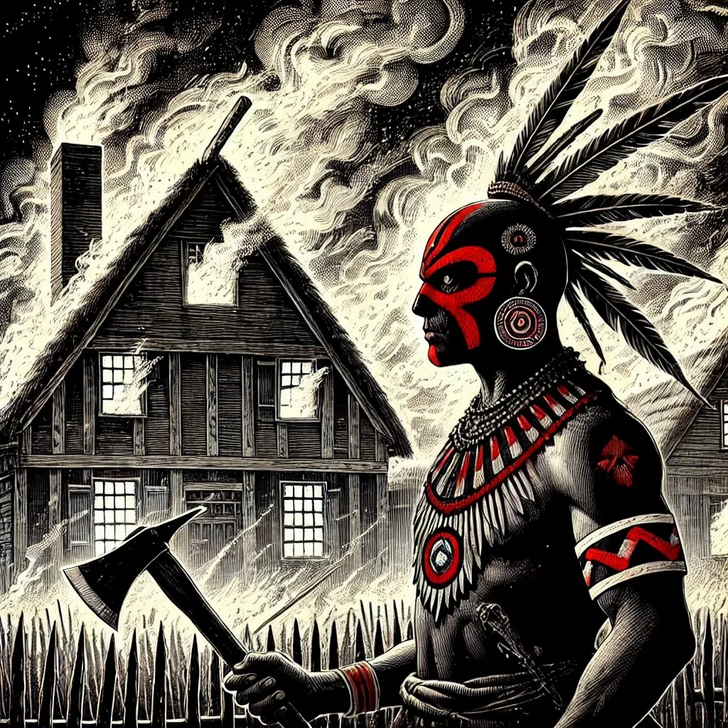
During our annual Not One Body Found season, I thought I’d discuss the truth about the brutal violence and savagery of North America’s most early, prominent and influential indigenous tribes, and popular narratives surrounding them.

If you’re an ethnic Canadian, born in the 1990s, you’re no doubt familiar with the education system’s attempts to subject you to a program of Maoist-style struggle sessions over the alleged genocide of the indigenous peoples in Canada. These struggle sessions in classrooms and collective humiliation rituals serve multiple purposes. One is to de-legitimize the history of, and perpetuate the ongoing deconstruction of Canada. The other is to de-legitimize the existence of the Canadian people as a nation (defined as a group sharing ethnic, cultural, and historical ties), in preparation for demographic replacement via mass migration.

The average Canadian’s school experience is filled with a turbo-charged version of liberal Noble Savage mythology, which is still propagated by leftists and indigenous activists. This has given the impression to many of the indigenous tribes as a singular race, continent-wide, uniformly peace-loving, non-binary, nature-appreciating matriarchal egalitarians until the evil, white, patriarchal Christian man arrived.

This resembles equally revisionist history about the Indo-European invasions into Europe around 4000 B.C. against the Pre-Indo-Europeans. You know that story: patriarchal brutes from the Eurasian steppes, with their advanced bronze weaponry and horse-powered chariots, wiped out the longhouse-dwelling, peace-loving, egalitarian agricultural Early European Farmers, who were feminist. This theory, conceived by Maria Gimbutas, a feminist intellectual, was debunked and discarded years ago. In reality, the Early-European-Farmers were extraordinarily warlike, violent, engaged in child murder or sacrifice and were apparently innovative as they built monuments like Stonehenge. This is much the same for indigenous in North America. All of this is framed in a Marxist oppressor-oppressed paradigm.

Tales of cruel treatment, deliberate biological warfare via smallpox blankets (of which there is only one known reference, with attempts to implement unknown), or extermination by colonial death squads haunts the minds of Canadians, planting the seeds of self-doubt and masochism. If you listen carefully to the rhetoric of leftists and indigenous activists, you’d be led to believe there was an industrial mass-slaughter of tribes, with conveyor belts funneling indigenous people into machines that spit out moccasins and dream catchers. The depopulation of indigenous tribes was not the result of deliberate action but rather Europeans being far more numerous and carrying diseases to which they had no immunity. The second cause was perpetual, brutal warfare by the survivors against each other. The mass depopulation from epidemic disease in North America occurred in the mid-1600s, after epidemic breakouts in the filthy, cramped conditions of Europe. Not almost a hundred years later in 1763, where smallpox blankets are merely discussed by General Jeffrey Amherst and Colonel Henry Bouquet.

Indigenous activists believe they were subject to a holocaust-style genocide. It is not a coincidence that the amplifying of the National Day for Truth and Reconciliation occurs at the same time as the Managerial Regime in Canada has declared itself a “post-national state” (which the indigenous also live in and suffer consequences from). They believe Canada is a country without a people. Ironically this lines up with activists’ own definition of “cultural genocide”, because in 1867 during Confederation Year, according to census data, Canada was 92% Anglo-French, 7% miscellaneous Europeans, and the remaining 1% indigenous. Canada is unquestionably, unmistakably, a European construct of Anglo-French extraction.

In 2021, seemingly out of nowhere, the public was subjected to the establishment of this astroturfed federal holiday, which was made statutory—still only for employees of the federal government (what a coincidence!)—as of March 2023. Participation in this public humiliation ritual involves the coerced wearing of orange, and sometimes red, shirts. Canadians across the political spectrum knowingly or unknowingly participate in this ritual, with many rough, cowboy-hat-wearing, lifted-big-black-truck-driving conservatives, as well as tattooed, soy-eating, vegan ketamine enthusiast quartz-worshiping leftists also enthusiastically partaking.

It’s called being a decent human being, Chud! Schools, the monopolized legacy media, corporations, and brands all recognize and partake in the humiliation ritual, directed exclusively at ethnic Canadians. Football games have their players sing the national anthem, and every clinically obese, corn-syrup-slurping sportsball fan claps as the announcer humiliates and shames him or her with a land acknowledgement to prove to the crowd and community that they “don’t see race”. Medical professionals and university faculty across the country also include land acknowledgements in professional email signatures. Even law enforcement gleefully participate in the the ritual, dancing like circus monkeys to the tune of people who despise them.

October 18, 2024

Accidentally creating an epidemic of food allergies, from the best of intentions

Filed under: Food, Health, Media, USA — Tags: , , , , , — Nicholas @ 03:00

Jon Miltimore discusses how the unintentional outcome of professional organizations making recommendations to the public without proper scientific understanding created so many of the allergies that now plague youngsters:

“Peanuts, LEAP study (Learning Early About Peanut allergy)” by jlcampbell104 is marked with Public Domain Mark 1.0 .

In 1992, with the help of a grant from the National Institutes of Health, The New England Journal of Medicine published a report on a rare phenomenon: fatal or near-fatal anaphylactic reactions in young people due to food allergies.

Examining a period of 14 months, researchers identified thirteen cases, twelve of which involved asthmatic youths. Six of the thirteen anaphylactic reactions resulted in death, and each case had involved a young person with a known food allergy who had unknowingly ingested the food.

“The reactions were to peanuts (four patients), nuts (six patients), eggs (one patient), and milk (two patients), all of which were contained in foods such as candy, cookies, and pastry,” researchers wrote.

The paper said nothing about banning these foods, but concluded that “failure to recognize the severity of these reactions and to administer epinephrine promptly increases the risk of a fatal outcome”.

Nevertheless, food bans followed, and the Centers for Disease Control and Prevention (CDC) began to encourage educators to “consider possible food allergies” during food preparation.

By 1998, the New York Times was reporting on the rise of peanut allergies and the measures school districts were taking to stop them.

“Prodded by parents warning of lethal allergies, by the contentions of some researchers that peanut allergies are on the rise and, not least, by a fear of litigation, growing numbers of public and private schools across the country, including many of New York City’s most selective independent schools, have banned peanut butter from their cafeterias,” wrote Anemona Maria Hartocollis.

“The Biggest Misconception”

When the Times published its article in 1998, the American Academy of Pediatrics (AAP) was not yet issuing recommendations about peanuts or food allergies in infants. But as public concern grew, they decided they had to offer guidelines of some kind.

“There was just one problem,” Marty Makary, a Johns Hopkins University surgeon, noted in a recent Wall Street Journal op-ed. “Doctors didn’t actually know what precautions, if any, parents should take.”

Instead of remaining mum, the AAP followed the lead of the United Kingdom’s Committee on Toxicology and recommended that mothers avoid peanuts during pregnancy and lactation, and that children avoid peanuts until the age of 3.

The decision to make such a sweeping decision in the absence of compelling scientific evidence was a mistake, allergists say, and runs counter to basic immunology.

Dr. Gideon Lack, an allergist at King’s College London, says the collective effort to cocoon children from peanuts and other foods is responsible for what has been described as a “food allergy epidemic”.

The data suggest Lack is right.

In the 25 years since the AAP issued its recommendation, the US (like the UK, which also advised peanut avoidance) has experienced an explosion of food allergies, especially peanut allergies. Data from Mount Sinai Hospital System in New York show that peanut allergies more than tripled in the decade and a half following the AAP’s guidance. In 1997, peanut allergies affected 1 in 250 children in the United States. By 2002, this rate had risen to 1 in 125, and by 2008, it reached 1 in 70 children.

Anecdotally, I only remember one kid in my middle school who had food allergies … and poor Rusty had ’em all. He was known as the “Kid with a thousand allergies” and had to be so careful of what he ate and even what he touched. but this was the mid-1970s and there weren’t formal school guidelines on what we could bring in our school lunch bags or use scented things like deodorant. (It was the 1970s, and a lot of us were just hitting puberty and many of my classmates were new Canadians from poorer countries … we needed the deodorant!)

September 12, 2024

Infantry Combat: The Rifle Platoon by Col. John F. Antal

Filed under: Books, History, Military — Tags: , , , , — Nicholas @ 03:00

At anarchonomicon, kulak reviews Antal’s book from the 1990s:

There are a lot of weird experimental products in the world of Military Publishing … there’s no other subject for adults where professional volumes are published in the same format as children’s picture books where every other page is a full page image so that when you hold it in your hands you always have 50% picture/50% text, and yet that’s exactly how military atlases are formatted. They’re amazing!

Likewise military identification/vehicle guides, book length manuals or ship tours, or regimental campaign histories and memorabilia … These push the limits of the publishing medium, because they have to. The subject matter is complex, technical, tactile, risky, and multifaceted enough that aside from experimental horror novels or the vanishingly rare graphic novel … Nothing pushes the limits of paper so completely … indeed there are almost certainly some military history books that rival the experimental horror novel House of Leaves in terms of sheer medium breaking complexity.

And while Colonel John F. Antal hasn’t produced the most complex example of this… He may have produced one of the most experimental.

Infantry Combat: The Rifle Platoon is a simultaneous Military Tactics and Leadership crash course and semi-political argument about the wrong lessons that were learned from Operation Desert Storm (it was first published in 1995) in the format of a “Choose your own Adventure” novel.

And my god does it work. Its argument is incredibly well presented, its intangible concepts and ethos is really strongly conveyed, it teaches an impressive amount of theory and application despite NOT being a textbook of theory or doctrine …

And It just has no conceivable right to work as well as it works.

It actually does push the format of the “Choose your own adventure novel” incredibly far in terms of complexity. I’ve never seen one before that included several pages of charts just to track your decisions down the matrix.

The setup is primally simple.

You are US Army 2nd Lieutenant Davis. While it isn’t your first-First day, it is nearly your first after getting to the unit, and a very unlucky one at that.

You graduated West Point, attended ranger school, and this is day 2-3 of your first command.

America’s army is in an unnamed country and temporarily outnumbered as it is invaded, however they’re just dumb Arabs … its fine. Will probably get settled at the negotiating, and beside you have air dominance and the technological marvel of the US Military behind you.

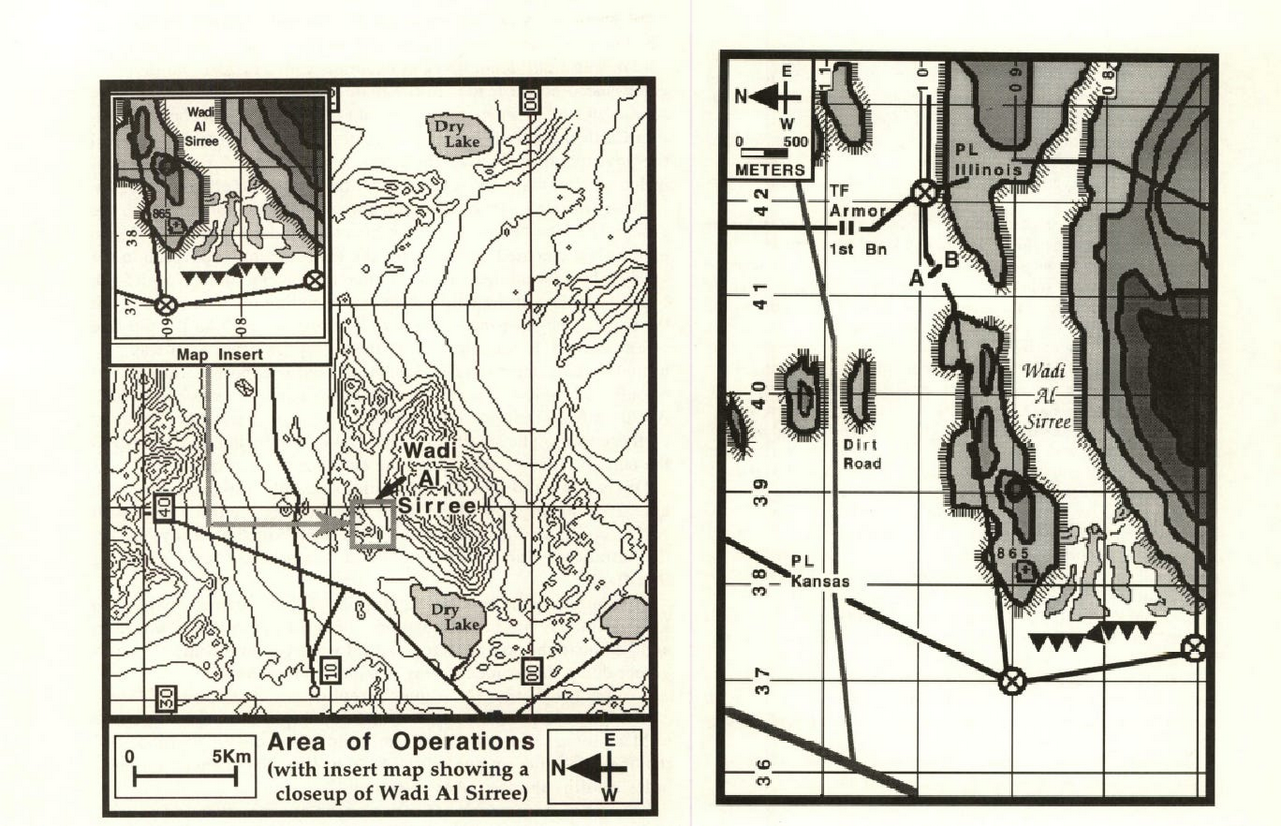
Note this map is oriented 90 degrees off. North is on the left, east at the top. The triangles are a tank ditch meant to stop armoured vehicles (like a massive dry moat)

The main force isn’t going to be attacking you.

Your lone platoon of just 38 will be defending Wadi Al Sirree, a narrow mountain pass separate and a little ahead of your main force.

You might think this is a little exposed but they’re almost certainly going to exploit the open country with their armor and proceed up the dirt road to hit the 1st armoured battalion and the rest of your company. This is the fastest way they can proceed and exploit their momentary numbers in the theater before the rest of the US military arrives. Your pass isn’t valuable much at all for a ground invasion, and besides there’s a massive tank ditch and other obstacles that will deter the enemy. Your troops are really just there as an auxiliary to the land and the ditch. Maybe spot some artillery fire.

But hey! This is a great opportunity to see what war in the late 20th/early 21st century is about up close and personal. Just keep your head down, let your NCOs who have the experience do their jobs, and you’ll get a nice combat medal on your second day on the job. Just try not to get in people’s way.

As you can guess, the job of a Infantry commander is probably a bit more complex than that …

July 15, 2024

Revisiting the “official” story of Srebrenica

Filed under: Europe, History, Military — Tags: , , , , , , — Nicholas @ 04:00

Niccolo Soldo’s weekly roundup includes a look at the differences between the story the media told us about the Srebrenica massacre and what has come to light since then:

Map of military operations on July, 1995 against the town of Srebrenica.
Map 61 from Balkan Battlegrounds: A Military History of the Yugoslav Conflict; Map Case (2002) via Wikimedia Commons.

29 years ago this week, Bosnian Serb forces of the VRS managed to seize the town of Srebrenica in Eastern Bosnia, on the border with Serbia. A massacre of Bosnian Muslim males ensued shortly thereafter, and the narrative of genocide sprung forth quickly from it, giving cause to NATO’s intervention in that conflict.

Did a massacre occur? Certainly. Some 2,000 Bosnian Muslim males were summarily executed by Bosnian Serb forces around Srebrenica shortly after the UN-designated “safe haven” fell to the Serbs. Some 8,000 Bosnian Muslims lost their lives in the immediate aftermath of the fall of Srebrenica, but the narrative of “genocide” whereby all 8,000 were executed is simply not true as per John Schindler, the then-Technical Director for the Balkans Division of the NSA:

    Twenty-nine years ago today, the Bosnian Serb Army captured Srebrenica, an isolated town in Bosnia’s east that was jam-packed with Bosnian Muslims, most of them refugees. This small offensive, involving only a couple of battalions of Bosnian Serb troops, soon became the biggest story in the world. What happened around Srebrenica in mid-July 1995 permanently changed the West’s approach to war-making and diplomacy.

    The essential facts of the Srebrenica massacre are not in dispute. The town was a United Nations “safe area” but U.N. peacekeepers there, an understrength Dutch battalion, failed to protect anyone. Over the week following Srebrenica’s quick fall, some 8,000 Bosnian Muslims, almost all male, a mix of civilians and military personnel, were killed by Bosnian Serb forces. About 2,000 disarmed Bosnian Muslim prisoners of war were executed soon after the town’s capture. The rest died in the days that followed, all over eastern Bosnia.

    As the world learned the extent of the massacre, by far the biggest atrocity in the Bosnian War that had raged since the spring of 1992, Western anger mounted. Six weeks later, President Bill Clinton ordered the Pentagon to bomb the Bosnian Serbs in Operation Deliberate Force, the first major military action in NATO’s history. By the year’s end, the war was concluded by American-led diplomacy.

Here are Schindler’s conclusions:

    That for three years, Srebrenica, supposedly a U.N. “safe area,” served as a staging base for Bosnian Muslim attacks into Serb territory. The Muslim military’s 28th Division regularly attacked out of Srebrenica. Bosnian Serbs claim they lost over 3,000 people, civilian and military, to those attacks.

    That the Bosnian Muslim commander at Srebrenica, Naser Oric, was a thug who tortured and killed Serb civilians (he showed Western journalists footage of his troops decapitating Serb prisoners), as well as fellow Muslims he disliked. Mysteriously, Oric fled Srebrenica three months before the town’s fall, leaving his troops to die.

    That most of the Bosnian Muslim dead, some three-quarters of them, died not at Srebrenica but during an attempted breakout by troops of the 28th Division to reach their own lines around Tuzla. They showed little communications discipline, and Bosnian Serb forces called down their artillery on them, columns of Muslim military and civilians together, slaughtering them. This doesn’t meet any standard definition of genocide.

    That the Muslims were flying weapons into the “safe area” by helicopter in the months before the Bosnian Serb offensive. (Controversially, the Pentagon knew this was happening but pretended it didn’t.) The Serbs repeatedly protested to the U.N. about this violation, to no avail. This was the reason for the offensive to take the town.

    There’s also convincing evidence that the Muslim leadership in Sarajevo knew Srebrenica would be attacked and allowed it to fall. Their leader, Alija Izetbegovic, stated that if Srebrenica fell, the Serbs would massacre Muslims as payback, and America would intervene on the Muslim side in the war. He was right.

Some of you may not like what John has to say here about Gaza and how it relates to Srebrenica:

    This isn’t merely a historical matter. What happened in Bosnia is being repeated today in Gaza. Western journalists uncritically accept Muslim claims about war crimes and “genocide” to smear a Western state that’s at war with radical Islam.

    Here the strange ideological affinity between jihadists and the Western Left plays a role, as it did during the Bosnian War as well. No claims of war crimes, which possess great political value on the world stage, should be accepted without independent confirmation. Srebrenica should have taught Western elites this essential truth, but it didn’t.

On a personal note, I like to bring up Srebrenica to Serbs as an example of how media shapes narratives that are often very remote from the truth in the hope that they understand what I am saying in a wider context.

Fun fact: Srebrenica translates into “Silverton”, as it was a significant silver mining town during the late Medieval era, with imported Saxons running the show.

May 27, 2024

The Manda: Croatia’s Minimalist .50 BMG

Filed under: Europe, History, Military, Weapons — Tags: , , , , , — Nicholas @ 02:00

Forgotten Weapons
Published Feb 21, 2024

The Manda is a rifle that was designed for the Croatian Special Police at the beginning of the Homeland War in 1991. At that point, the Special Police (basically the SWAT teams) were basically the only really well-trained fighters in the country with combat experience. They wanted .50 BMG anti-material rifles for the war that was breaking out, and the Croatian Ministry of the Interior developed and produced the Manda for them.

Specifically, the rifle was designed by engineer Petar Vucetic (and named after his sister). Mechanically, it is a very simple rifle, with two large locking lugs, a tubular stock, M70 AK pistol grip, and a barrel made from a turned-down Browning M2 bolt with a large muzzle brake. A total of 84 were made, fitted with Leupold scopes and mounts with integrated BDC cams for use from 300 out to 1000 meters.
(more…)

April 5, 2024

Ero: The Croatian Uzi (With Israeli Help?)

Filed under: Europe, History, Military, Weapons — Tags: , , , , , — Nicholas @ 02:00

Forgotten Weapons
Published Jan 3, 2024

The best of the submachine guns made in Croatia during the Homeland War was the Ero, made by a company called Arma. The Ero is a basically perfect, parts-interchangeable copy of the Israeli Uzi that was developed in 1992 and adopted into Croatian Army service in 1993. The only really distinguishable difference between the Ero and Uzi is the Ero’s use of Croatian-language selector markings (and receiver markings). Between 15,000 and 20,000 were produced, and they remained in service long after Croatian independence was secured. They were issued to vehicle crews, military police, special forces, and reconnaissance units.

Arma was a subsidiary of a major Croatian engineering firm, and after the Ero production it developed the APS-95 Croatian AK (which is a story for another video). They were a very competent company, but the details and quality of the Ero are so good that I believe it must have been made with tacit or explicit assistance from Israel. Croatia does have a strong Jewish community, and there were rumors during the war that the technical data package for the Uzi did find its way into Croatia. There is no official acknowledgement of this happening, but it would certainly not be hard to believe. But however the development happened, the result was a very high quality submachine gun.

A big thanks to the Croatian Police Museum (Muzej Policije) in Zagreb for giving me access to film this cool piece for you! Check them out at: https://muzej-policije.gov.hr
(more…)

April 3, 2024

Canada’s The Idler was intended for “a sprightly, octogenarian spinster with a drinking problem, and an ability to conceal it”

Filed under: Business, Cancon, History — Tags: , , , , , , — Nicholas @ 03:00

David Warren had already shuttered The Idler by the time I met him, but I was an avid reader of the magazine in the late 80s and early 90s. I doubt he remembers meeting me, as I was just one of a cluster of brand-new bloggers at the occasional “VRWC pub nights” in Toronto in the early aughts, but I always felt he was one of our elder statesmen in the Canadian blogosphere. He recalls his time as the prime mover behind The Idler at The Hub:

Some late Idler covers from 1991-92. I’ve got most of the magazine’s run … somewhere. These were the ones I could lay my hands on for a quick photo.

This attitude was clinched by our motto, “For those who read.” Note that it was not for those who can read, for we were in general opposition to literacy crusades, as, instinctively, to every other “good cause”. We once described the ideal Idler reader as “a sprightly, octogenarian spinster with a drinking problem, and an ability to conceal it”.

It was to be a magazine of elevated general interest, as opposed to the despicable tabloids. We — myself and the few co-conspirators — wished to address that tiny minority of Canadians with functioning minds. These co-conspirators included people like Eric McLuhan, Paul Wilson, George Jonas, Ian Hunter, Danielle Crittenden, and artists Paul Barker and Charles Jaffe. David Frum, Andrew Coyne, Douglas Cooper, Patricia Pearson, and Barbara Amiel also graced our pages.

I was the founder and would be the first editor. I felt I had the arrogance needed for the job.

I had spent much of my life outside the country and recently returned to it from Britain and the Far East. I had left Canada when I dropped out of high school because there seemed no chance that a person of untrammelled spirit could earn a living in Canadian publishing or journalism. Canada was, as Frum wrote in an early issue of The Idler, “a country where there is one side to every question”.

But there were several young people, and possibly many, with some literary talent, kicking around in the shadows, who lacked a literary outlet. These could perhaps be co-opted. (Dr. Johnson: “Much can be made of a Scotchman, if he be caught young.”)

The notion of publishing non-Canadians also occurred to me. The idea of not publishing the A.B.C. of official CanLit (it would be invidious to name them) further appealed.

We provided elegant 18th-century design, fine but not precious typography, tastefully dangerous uncaptioned drawings, shrewd editorial judgement, and crisp wit. I hoped this would win friends and influence people over the next century or so.

We would later be described as an “elegant, brilliant and often irritating thing, proudly pretentious and nostalgic, written by philosophers, curmudgeons, pedants, intellectual dandies. … There were articles on philosophical conundrums, on opera, on unjustifiably unknown Eastern European and Chinese poets.”

We struck the pose of 18th-century gentlemen and gentlewomen and used sentences that had subordinate clauses. We reviewed heavy books, devoted long articles to subjects such as birdwatching in Kenya or the anthropic cosmological principle, and we printed mottoes in Latin or German without translating them. This left our natural ideological adversaries scratching their heads.

« Newer PostsOlder Posts »

Powered by WordPress