
Extra Credits
Published on 19 Dec 2017Start your free 1-month trial for The Great Courses Plus! http://ow.ly/3iLM30egcfR
After Star Wars, the science fiction genre suddenly became a pop culture darling, and a flood of schlocky imitations followed. William Gibson led the charge to reclaim space in the genre for his concept of future history – one that, in turn, eventually launched cyberpunk.
December 21, 2017
William Gibson: The 80s Revolution – Extra Sci Fi – #7
Comments Off on William Gibson: The 80s Revolution – Extra Sci Fi – #7
December 18, 2017
Repost – Induced aversion to a particular Christmas song
Earlier this year, I had occasion to run a Google search for “Mr Gameway’s Ark” (it’s still almost unknown: the Googles, they do nothing). However, I did find a very early post on the old site that I thought deserved to be pulled out of the dusty archives, because it explains why I can — to this day — barely stand to listen to “Little Drummer Boy”:
Seasonal Melodies
James Lileks has a concern about Christmas music:
This isn’t to say all the classics are great, no matter who sings them. I can do without “The Little Drummer Boy,” for example.
It’s the “Bolero” of Christmas songs. It just goes on, and on, and on. Bara-pa-pa-pum, already. Plus, I understand it’s a sweet little story — all the kid had was a drum to play for the newborn infant — but for anyone who remembers what it was like when they had a baby, some kid showing up unannounced to stand around and beat on the skins would not exactly complete your mood. Happily, the song has not spawned a sequel like “The Somewhat Larger Cymbal Adolescent.”
This reminds me about my aversion to this particular song. It was so bad that I could not hear even three notes before starting to wince and/or growl.
Back in the early 1980’s, I was working in Toronto’s largest toy and game store, Mr Gameway’s Ark. It was a very odd store, and the owners were (to be polite) highly idiosyncratic types. They had a razor-thin profit margin, so any expenses that could be avoided, reduced, or eliminated were so treated. One thing that they didn’t want to pay for was Muzak (or the local equivalent), so one of the owners brought in his home stereo and another one put together a tape of Christmas music.
Note that singular. “Tape”.
Christmas season started somewhat later in those distant days, so that it was really only in December that we had to decorate the store and cope with the sudden influx of Christmas merchandise. Well, also, they couldn’t pay for the Christmas merchandise until sales started to pick up, so that kinda accounted for the delay in stocking-up the shelves as well …
So, Christmas season was officially open, and we decorated the store with the left-over krep from the owners’ various homes. It was, at best, kinda sad. But — we had Christmas music! And the tape was pretty eclectic: some typical 50’s stuff (White Christmas and the like), some medieval stuff, some Victorian stuff and that damned Drummer Boy song.
We were working ten- to twelve-hour shifts over the holidays (extra staff? you want Extra Staff, Mr. Cratchitt???), and the music played on. And on. And freaking on. Eternally. There was no way to escape it.
To top it all off, we were the exclusive distributor for a brand new game that suddenly was in high demand: Trivial Pursuit. We could not even get the truck unloaded safely without a cordon of employees to keep the random passers-by from snatching boxes of the damned game. When we tried to unpack the boxes on the sales floor, we had customers snatching them out of our hands and running (running!) to the cashier. Stress? It was like combat, except we couldn’t shoot back at the buggers.
Oh, and those were also the days that Ontario had a Sunday closing law, so we were violating all sorts of labour laws on top of the Sunday closing laws, so the Police were regular visitors. Given that some of our staff spent their spare time hiding from the Police, it just added immeasurably to the tension levels on the shop floor.
And all of this to the background soundtrack of Christmas music. One tape of Christmas music. Over and over and over and over and over and over and over again.
It’s been over 20 years, and I still feel the hackles rise on the back of my neck with this song … but I’m over the worst of it now: I can actually listen to it without feeling that all-consuming desire to rip out the sound system and dance on the speakers. After two decades.
Comments Off on Repost – Induced aversion to a particular Christmas song
June 23, 2017
Kate Bush – Hounds of Love – Official Music Video
Uploaded on 1 Mar 2011
Official music video for the single “Hounds of Love” — which is the title track of the Hounds of Love album by Kate Bush. It was also the third of the album’s four singles. The single was released on 24 February 1986, and reached number 18 in the UK Singles Chart.
The music video was directed by Kate Bush herself.
The versions worldwide differ slightly: the US single mix included an additional chorus just after the second chorus.
Comments Off on Kate Bush – Hounds of Love – Official Music Video
February 6, 2016
Alberta and federal equalization payments
Colby Cosh on the wrenching psychological damage the collapse of oil prices is inflicting on Alberta:
Alberta is not in any real danger of becoming a “have-not” province under the equalization program. Its fiscal capacity did not dip below the required standard even under the intentional cudgelling of former prime minister Pierre Trudeau’s National Energy Program in the 1980s. As it happens, it has been a half-century since Alberta received any equalization at all: the last payment was a paltry $1.2 million, received in fiscal 1964-65.
You can’t mention Alberta and equalization in the same sentence without attracting a gnat-like cloud of failed accountants who are eager to remind you that equalization doesn’t technically “take” from particular provinces. The money comes out of the general revenue; Alberta as a province, the lecture goes, has not been “paying in” so that others can “take out.”
But since equalization was introduced in 1957, Ottawa has transferred, if my figures are right, about $374 billion to the provinces. Almost exactly half of that has gone to Quebec. Alberta got a grand total of $92 million in the early years, zero since and zero for the foreseeable future.
It is thought paranoid to dwell on this. When the flow of funds is acknowledged at all, Albertans are told to buck up, for it is merely the price of living in a decent, well-ordered Confederation. Like brethren, we lift one another out of economic turmoil!
Yet, mysteriously, the identities of the equalization recipients do not change much from decade to decade. Little if any lifting occurs. Quebec has not only never threatened to join the “haves”; it becomes more disadvantaged, relatively, as the haves give it more.
How much easier would it be for Alberta to bear this long-term proposition — which I dare not call a swindle — if it had, just once, been pulled out of the mire by its fellow provinces at a timely moment? Imagine there were a Trudeau who, instead of deliberately designing economic shocks for Alberta, actually displayed some enterprise in assisting it at a time of perceived crisis? It might not even have to cost all that much: follow up a lot of fine talk and concern with a few hundred million, and perhaps you buy yourself another half-century of calm. The moral high ground is fine real estate. A bargain, surely, at the price.
Comments Off on Alberta and federal equalization payments
July 28, 2014
Mark Knopfler – Brothers in arms
Uploaded on 28 May 2008
Mark Knopfler from his promo tour for Kill to Get Crimson, live in Berlin 2007.
Comments Off on Mark Knopfler – Brothers in arms
April 11, 2014
Dungeons and Dragons versus BADD
BBC News Magazine looks back at the moral panic about Dungeons & Dragons in the early 1980s:
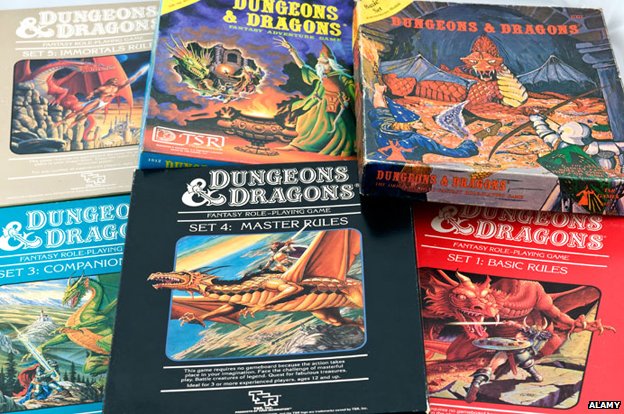
In 1982, high school student Irving Lee Pulling died after shooting himself in the chest. Despite an article in the Washington Post at the time commenting “how [Pulling] had trouble ‘fitting in'”, mother Patricia Pulling believed her son’s suicide was caused by him playing D&D.
Again, it was clear that more complex psychological factors were at play. Victoria Rockecharlie, a classmate of Irving Pulling, commented that “he had a lot of problems anyway that weren’t associated with the game”.
At first, Patricia Pulling attempted to sue her son’s high school principal, claiming the curse placed upon her son’s character during a game run by the principal was real. She also sued TSR Inc, the publishers of D&D. Despite the court dismissing these cases, Pulling continued her campaign by forming Bothered About Dungeons and Dragons (BADD) in 1983.
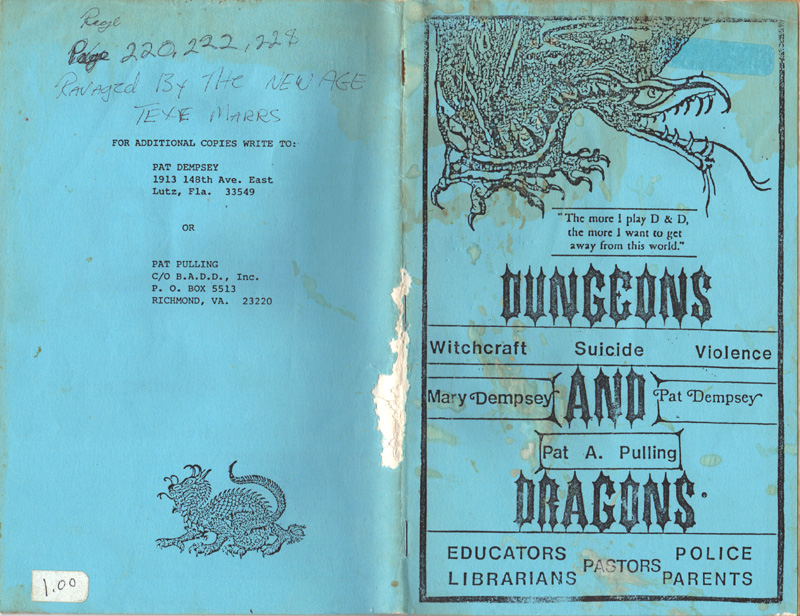
Pulling described D&D as “a fantasy role-playing game which uses demonology, witchcraft, voodoo, murder, rape, blasphemy, suicide, assassination, insanity, sex perversion, homosexuality, prostitution, satanic type rituals, gambling, barbarism, cannibalism, sadism, desecration, demon summoning, necromantics, divination and other teachings”.
Pulling’s pamphlet on the dangers of D&D:
In 1985, Jon Quigley, of the Lakeview Full Gospel Fellowship, spoke for many opponents when he claimed: “The game is an occult tool that opens up young people to influence or possession by demons.”
These fears also found their way into the UK. Fantasy author KT Davies recalls “showing a vicar a gaming figure – he likened D&D to demon worship because there were ‘gods’ in the game”.
Veteran roleplayer Andy Smith found himself in the unusual position of being both a roleplayer and a Christian. “While working for a Christian organisation I was told to remove my roleplaying books from the shared accommodation as they were offensive to some of the other workers and contained references to demon-worship.”
Looking back now, it’s possible to see the tendrils of a classic moral panic, and some elements of the slightly esoteric world of roleplaying did stir the imaginations of panicked outsiders.
Comments Off on Dungeons and Dragons versus BADD
March 27, 2014
Remembering “the war on Dungeons and Dragons“
First, the comment that @FakeTSR linked to:
It was never a fair fight between fundamentalist Christianity and D&D. One was a dangerous system full of dark mysticism and threats to warp a young mind beyond repair, and the other was a tabletop RPG.
And then, the article by Annalee Newitz:
Thirty years ago, a war raged between the dorks who played Dungeons & Dragons, and the conservative parent groups who believed that gaming was debauched at best and Satanic at worst. Lives were ruined. People died. And now that war is over. I still can’t believe we won.
[…]
Still, unlike my fantasy of being a hot half-elf, the Christians actually had some control over our lives. My best friend got kicked out of Catholic school for playing D&D, which we counted as a win because it meant she could come to our shitty public school and play D&D with us. Outside our southern California town, however, D&D players weren’t getting off so easily. They were ostracized by their peers, kicked out of public schools, and sent to glorified reeducation camps by parents who feared their children were about to start sacrificing babies to Lolth the spider demon.
Update, 28 March: Techdirt‘s Timothy Geigner sorrowfully points out that even though this particular moral panic eventually came to a happy end, the lessons of each significant outbreak of hysteria are not carried forward and the next professional pants-wetting politician or “concerned parent group” does not get the scrutiny they deserve.
As the article says, looking back from the vantage point of a world where entertainment is strewn with the fantasy genre, it’s stunning to see the propaganda that had been unleashed. Unsurprisingly, said propaganda has since been eviscerated, with all the common tales of kids killing themselves being shown to be completely unrelated to anything having to do with children’s games. Still, this kind of thing propagated like hell-fire. For all the normal, non-Satan-worshipping kids out there that were just trying to have a little fun, it must have seemed like insanity would rule the day. Fortunately, it didn’t.
[…]
Winners who are now all grown up and who have moved on to their next moral panic, be it violent video games, drill gangster rap, or any number of the next thing the younger generations will come up with. The cycle repeats. Every generation was young, became old, and feared the new young again. That’s too bad, but for those of us still reveling in our youth, real or imagined, it’s nice to know that the moral panic over video games, like all those before it, will eventually subside.
Comments Off on Remembering “the war on Dungeons and Dragons“
September 18, 2013
QotD: 80’s pop music
Before Auto-Tune, if you wanted to make money in pop music, you sort of had to be able to sing. It wasn’t absolutely necessary, of course. You used to be able to mumble into a microphone, then the producer would put all sorts of sturm und drang all around it, and you could have a hit; see: Don’t You Want Me Baby, by Human League. But crooners have an easier time of it, and have less trouble having more than one bite of the top forty apple.
Crowded House was one of those eighties bands — A Flock of Seagulls; ABC, The Bangles; Thompson Twins; Duran Duran; Escape Club; The Fixx; Simple Minds; Simply Red; Howard Jones; XTC; Dan Hartman; Icehouse; Level 42; Psychedelic Furs; Hair Cut 100; Tears for Fears; Wang Chung; World Party — bands that are growing interchangeable with the decades slipping by. If you put them all on the same bill, and they all wore matching suits, they could all play each other’s tunes and not many people would notice. But you always notice when people sing well.
Sippican Cottage, “Pure Pop For Then People — Crowded House”, Sippican Cottage, 2013-09-17
Comments Off on QotD: 80’s pop music


