
Published on 27 Feb 2017
Chisels come from the manufacturer needing preparing or initialising as well sharpening. How do you check they are flat and get them sharp? Paul shows you the process he follows. This gets them to the level we need for crisp and accurate work.
For more information on these topics, see https://paulsellers.com or https://woodworkingmasterclasses.com
March 3, 2017
Sharpening a Chisel with Paul Sellers
Comments Off on Sharpening a Chisel with Paul Sellers
February 1, 2017
Ace and the shitty tools of despair
Ace put up some shelves recently. He was not impressed with some of the tools he used:
I thought I had a drill that could drill (and drive screws) through studs. I did not. What I had was two pieces of shit which, combined together, made up a collection of shit that took up more space in my tool drawer than a single piece of shit would.
The things could not even push past the first eighth inch of drywall. The easiest part.
It’s like, “Hey, thanks Tool. Thanks for getting me past that first easy eighth inch. I’ll take it the rest of the way, now that you’ve gotten me off to such a swell start. You take a well-earned break, and get back to napping in that drawer. I’ll power through the rest of this with my forearms and my dinky little ratchet.”
I literally was just pushing on the drill to make a small starter hole for the screw, like it was a poorly-balanced nail with a pistol grip.
It’s a poor workman who blames his tools, but I think you can all agree I am a poor workman in the first place, and these really are shitty, shitty tools.
Comments Off on Ace and the shitty tools of despair
July 8, 2016
Leonard G. Lee, 1938-2016
 Click to read full obituary at the Lee Valley website
Comments Off on Leonard G. Lee, 1938-2016
May 17, 2016
March 15, 2016
QotD: Safety glasses are not magical talismans of protection
Sewer gas is like a lot of topics in construction and maintenance. Sewer gas should be understood, and its relative danger respected. Fear is not the same as knowledge and respect.
Knowledge coupled with respect is not au courant in today’s world. If you watch any “home improvement” show, there is only one constant. Everyone wears safety glasses all the time no matter how trivial the dangers involved. I have seen people put on safety glasses to hang drapes. If you truly understand risk, and respect danger in proportion to that risk, you are using judgment. If you do not understand risk, but are simply afraid of everything, you wear safety glasses all the time. An overwhelming fear of putting your eye out trumps any rational assessment of the behavior you should undertake to avoid it. You’d be smarter to examine your neurotic urge to achieve an illusory feeling of safety while ignoring really dangerous things.
Safety glasses are the clown shoes of fear. I have seen all the shelter shows — once — and I have observed a noticeably pregnant woman put on safety glasses in order to undertake the demolition of perfectly good tile in her tract home bathroom. It’s not unwise to wear safety glasses if you’re determined to strike ceramic tile with a sledgehammer. It’s just really dumb to think that striking ceramic tile with a sledgehammer is how demolition is accomplished. The pregnant woman was wearing flip flops in order to display her painted toenails to the public. People who understand risk and respect the process they’ve undertaken do not perform demolition in open-toed shoes while pregnant. Believing that wearing safety glasses under those circumstances bestows safety is magical, cargo cult thinking. Magical thinking doesn’t result in safety, ever. It results in paranoia with recklessness ladled all over it.
Sippican Cottage, “Interestingly, ‘Malfunction of Unknown Provenance’ Is the Name of My Men Without Hats Tribute Band. But I Digress”, Sippican Cottage, 2016-02-25.
Comments Off on QotD: Safety glasses are not magical talismans of protection
January 9, 2016
QotD: Humans and apes
On what separates us from the apes:
Michael Tomasello, one of the world’s foremost experts on chimpanzee cognition, [said] “It is inconceivable that you would ever see two chimpanzees carrying a log together.”
On what doesn’t separate us from the apes:
Acheulean tools [a style used by hominids 1.8 million years ago] are nearly identical everywhere, from Africa to Europe to Asia, for more than a million years. There’s hardly any variation, which suggests that the knowledge of how to make these tools may not have been passed on culturally. Rather, the knowledge of how to make these tools may have become innate, just as the “knowledge” of how to build a dam is innate in beavers.
Jonathan Haidt, quoted by Scott Alexander in “List Of The Passages I Highlighted In My Copy Of Jonathan Haidt’s The Righteous Mind“, Slate Star Codex, 2014-06-12.
Comments Off on QotD: Humans and apes
December 13, 2015
How to Sharpen a Knife with Paul Sellers
Published on 11 Dec 2015
Paul shows his very simple method of how to get a razor sharp edge on your kitchen, carving, pocket or any form of knife using just a few pieces of sandpaper or some diamond paddles.
Comments Off on How to Sharpen a Knife with Paul Sellers
November 7, 2015
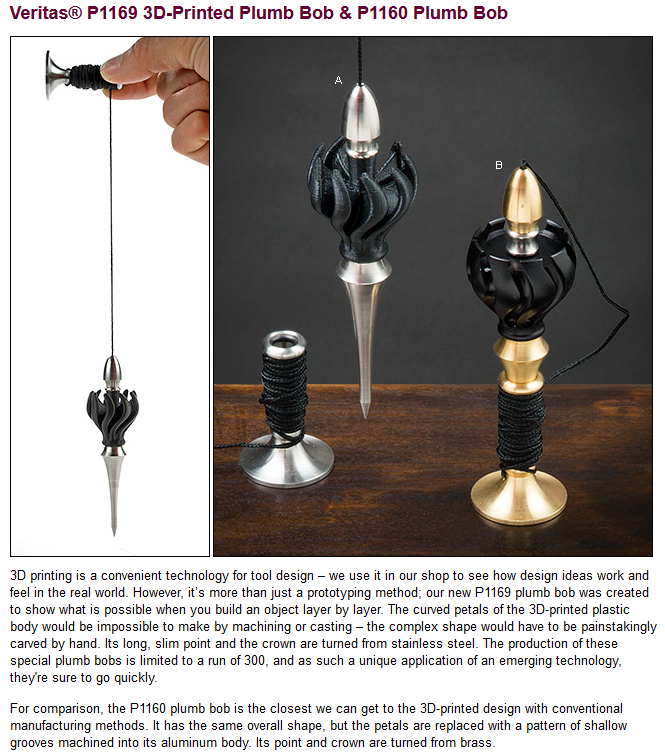
3D printing is coming to all sorts of markets
Lee Valley now offers a 3D-printed plumb bob and shows the advantages of using 3D print capabilities:
Comments Off on 3D printing is coming to all sorts of markets
July 27, 2015
Sharpening and Setting the Bench Plane with Paul Sellers
Published on 23 Jul 2015
Paul Sellers shows how he sharpens and sets a bench plane in his every day of work. A quick and easy guide to get your plane working.
April 1, 2015
The Building of a Custom Bench Plane Revealed
Published on 1 Apr 2015
Watch this behind-the-scenes video on the making of our Custom Bench Planes.
Comments Off on The Building of a Custom Bench Plane Revealed
February 21, 2015
How to make the Three Joints – Dovetail – with Paul Sellers
Published on 17 Feb 2015
It takes a master woodworker to teach the basics. Watch Paul’s every move in this video. He shows every single detail of cutting this essential woodworking joint. This is one of the three joints that Paul talks about in his woodworking curriculum. The dovetail is the essential box joint. It is the strongest way to join two pieces of wood at the corner. Although there are many variations on a theme with this joint mastering the most simple form is the most difficult and important step.
Comments Off on How to make the Three Joints – Dovetail – with Paul Sellers
January 29, 2015

October 25, 2014
Sharpening woodworking tools
Paul Sellers talks about the practical limits to sharpening woodworking tools like planes and chisels:
As I have said, we have become something of an obsessive bunch when it comes to the different elements of working wood; sharpness has become more and more obsessive. Now we are not talking about the violin maker seeking sharp levels for clear tone from the wood and who uses wood so soft, unsharp gouges and planes would bruise rather than cut the fine surfaces he strives to achieve. His standards parallel the levels needed for severing tissue by the surgeon’s hand, not the bench joiner chopping mortises and cutting a few dovetails.
It’s unfortunate that since the demise of ordinary craftsmanship we now turn to guru wood writers and not wood-wrights. Woodwrights are no longer there to give us our information of course. It’s true too that the sources of information become more and more questionable. Three recent sources of information teaching on sharpening techniques I tracked back to tool catalog and online sales people selling products for sharpening. Most of the information they have is not new but regurgitated. Each phase of sharpening change marks another saleable product and so we see Japanese water stones added to carborundum stones, Arkansas stones and Washita stones and then came diamonds and abrasive films, diamond paste and flattening stones. The list goes on.
We have survived the different gospels of scary sharp and micro-bevel methodology and are emerging to this very simple reality. As long as you start the cutting edge somewhere around 30-degrees and polish it out it will cut well. If you you sharpen to around 1200-grit it will cut most anything you need in woodworking. If you sharpen to a polished edge of around 15,000-grit you can slice the most delicate of materials effortlessly, but 98% of the time that’s far from necessary. What am I saying? I’m saying that we generally sharpen to task but often sharpen to a higher level because it’s not much extra effort. We all know after a few efforts at sharpening that the greatest effort comes at the start of the process when we have to regain ground to get through a fractured and dulled edge and back to a productive cutting edge. That said, it’s not a big deal, just a few extra strokes on the coarse diamonds gets you there. So, if that is the case, why do we sharpen to higher levels than are usually needed. Well, it is a fact that the more polished the two plains forming the arête for a cutting edge are, the sharper the edge is but the stronger the edge is too. As I said, the extra effort is worth the work because it’s so quick and effective. It’s not so much what we do to the edge to establish it but what we do to the edge after we have prepared it for work. Taking the chisel to the surface of the wood to work the wood begins an immediate process of edge reduction we now know is edge fracture but was once called wear. No matter the steel, edge fracture occurs at some level but some steels fracture more readily than others. What we often do not realise is that it is impossible to find a steel that both takes and retains an edge and at the same time has a level of durability we can rely on forever. All edges wear away by fracture and constantly need restoring.

Comments Off on Sharpening woodworking tools
September 2, 2014
Sharpening woodworking tools
I’m an occasional woodworker, but I’m always aware I don’t sharpen my tools as often as I should. One of the reasons I don’t is that it’s such a hassle to sharpen them properly: it’s not as simple as sharpening a kitchen knife, and you need to spend time to work through from a coarse grit (250 or so), through medium grit (1000) and into fine (4000) or even superfine (15000 and higher). This video by Paul Sellers has persuaded me that it doesn’t have to be that way for most of the woodworking hand tools I’m likely to use:
Published on 8 Nov 2013
In this video Paul Sellers shows that you don’t need to sharpen to 15,000+ grit on you planes, chisels and other woodworking tools. 250-grit works just fine for most of our woodwork. Paul addresses the myths and misinformation put forward, and challenges what we think about sharpening.
To find out more about Paul Sellers and the work he is involved with visit http://paulsellers.com
Comments Off on Sharpening woodworking tools
April 1, 2014
Innovative new bench design for woodworkers
The deep thinkers at Lee Valley Tools have come up with a brilliant solution to a perennial woodworking problem:
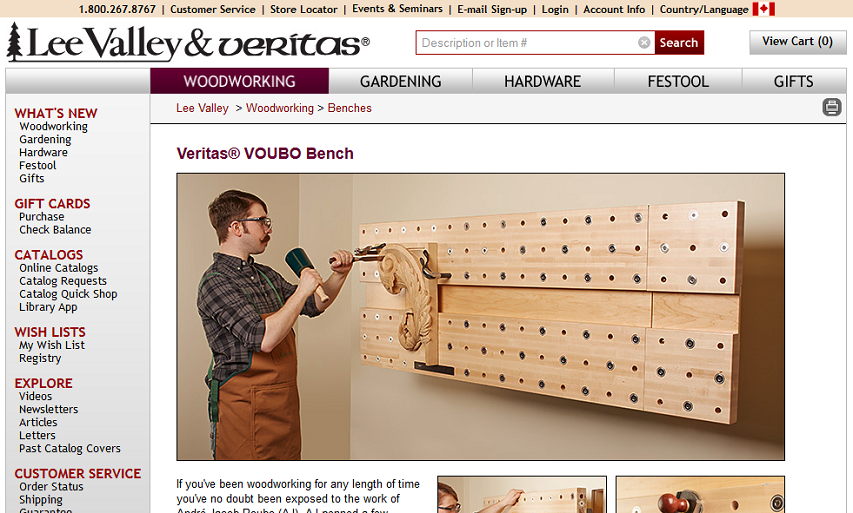
H/T to Jon, my former virtual landlord, who said “I’d like to see someone do a legitimate motion study on this and prove that it would actually work”.
Comments Off on Innovative new bench design for woodworkers


