
Forgotten Weapons
Published on 13 Jan 2019You have asked for it for years, so we made it happen. The two hardest-working gun channels on the ‘net have joined forces in the best collaboration in all history. Coming February 14th (because we love you all so much)…Project Lightening!
https://www.patreon.com/ForgottenWeapons
https://www.patreon.com/CandRsenal
Cool Forgotten Weapons merch! http://shop.bbtv.com/collections/forg…
Contact:
Forgotten Weapons
PO Box 87647
Tucson, AZ 85754
February 13, 2019
Project Lightening: The World’s Best Collab
Comments Off on Project Lightening: The World’s Best Collab
February 11, 2019
How Does it Work: Blowback Action
Forgotten Weapons
Published on 10 Jan 2019http://www.patreon.com/ForgottenWeapons
Cool Forgotten Weapons merch! http://shop.bbtv.com/collections/forg…
How Does it Work: Blowback Action
The simplest for of firearms action is blowback, also called simple blowback. It is basically just an application of Newton’s 3rd Law; that for every action there is an equal and opposite reaction. As the bullet moves forward down the barrel, the slide or bolt of the gun moves backwards. The two move with the same energy, meaning that the light and very fast bullet is balanced out by the heavy and slow bolt or slide.
Contact:
Forgotten Weapons
PO Box 87647
Tucson, AZ 85754
Comments Off on How Does it Work: Blowback Action
February 10, 2019
Semiauto M2 Hyde Reproduction: The Interim US WW2 Subgun
Forgotten Weapons
Published on 9 Jan 2019http://www.patreon.com/ForgottenWeapons
Cool Forgotten Weapons merch! http://shop.bbtv.com/collections/forg…
George Hyde designed the gun that would eventually be adopted as the M2 submachine gun in the late 1930s, and it was first tested at Aberdeen Proving Grounds in October of 1939. At that time, the gun had many good traits (weight, handlings, etc) but suffered from parts breakage and unreliability. Hyde went back to work on the gun at the Inland Division of GM, and came back with a much improved version in April of 1942.
The Inland-Hyde SMG was chambered for .45 ACP ammunition and used standard Thompson magazines, and was poised to become the US Army’s new submachine gun, replacing the overly expensive Thompson. The Hyde passed a 6080 round endurance test with flying colors, and exhibited much better effectiveness in fully automatic than the Thompson. At the end of the April tests, it was formally accepted to replace the Thompson and given the designation M2.
A contract was given to the Marlin company (Inland being busy with other projects) to manufacture 164,450 of the guns, with delivery to begin in December 1942. However, Marlin had problems tooling up to produce the new gun, in particular with dies for several parts to be made using powdered metal sintering. Actual delivery of the first guns did not happen until May of 1943. In the meantime, Hyde and Inland had continued working on cheaper and simpler designs, and created the stamped sheet metal M3 “Grease Gun”. By the time the M2 was actually ready for delivery, the M3 had been tested and accepted by the Army as a better replacement than the M2. By mid-June, the M2 was declared obsolete and Marlin’s contract cancelled.
In total only about 500 M2 submachine guns were made, with (I believe) 6 surviving today. The example in this video is a semiautomatic-only reproduction made from scratch by a viewer of the channel, who graciously offered to loan it to me for this filming. Thanks, K!
Contact:
Forgotten Weapons
PO Box 87647
Tucson, AZ 85754
Comments Off on Semiauto M2 Hyde Reproduction: The Interim US WW2 Subgun
February 9, 2019
HMS Dreadnought – Guide 001
Drachinifel
Published on 12 Dec 2018HMS Dreadnought, the first dreadnought battleship and game changer for the British Royal Navy, is today’s subject.
Want to support the channel? – https://www.patreon.com/Drachinifel
Want to talk about ships? https://discord.gg/TYu88mt
Comments Off on HMS Dreadnought – Guide 001
February 3, 2019
How Does it Work: Open Bolt vs Closed Bolt Firearms
Forgotten Weapons
Published on 3 Jan 2019http://www.patreon.com/ForgottenWeapons
Cool Forgotten Weapons merch! http://shop.bbtv.com/collections/forg…
How Does it Work: Open Bolt vs Closed Bolt Firearms
Most semiauto firearms fire from a closed bolt and most fully automatic firearms fire from an open bolt, but these are far from strict rules, and many exception exist. Open bolt offers better cooling and prevents any possibility of cookoff, while closed bolt offers better practical accuracy.
Contact:
Forgotten Weapons
PO Box 87647
Tucson, AZ 85754
Comments Off on How Does it Work: Open Bolt vs Closed Bolt Firearms
January 31, 2019
Coming soon for Canadians – mandatory maple-flavoured search results
Michael Geist relates the ongoing efforts of ACTRA to get the federal government to mandate high visibility for Canadian content in search engines:
The escalating battle being waged for new Internet taxes to fund Canadian content does not stop with proposals for new fees on Internet access and online video services. Cultural groups also want to increase the “discoverability” of Canadian content by mandating its inclusion in search results. According to the ACTRA submission to the broadcast and telecom legislative review panel, it has been calling for search engine regulation for the past 20 years:
ACTRA stated during the 1999 CRTC process that Internet search engines would become the gateway for consumers to access the vast array of entertainment and information now available from around the world. We argued then the CRTC should regulate them.
It now argues for mandated inclusion of Canadian content in search results for cultural content under threat of economic sanction:
Regulating search engines would be difficult, but ACTRA recommends the government approach search engines like Google, Bing and others, and request they ensure Canadians are offered some Canadian choices in their search results. While it is neither possible nor appropriate to interfere in the final selection made by individuals, Canadian consumers should have a real choice, including Canadian films, television programs and music. We expect companies would concur with the government’s reasonable request to be seen as good corporate citizens. If a particular search engine does not agree to this request, the government should impose an appropriate regulatory constraint or burden, such as amending the Income Tax Act to discourage Canadians from advertising on search engines that fail to comply.
Comments Off on Coming soon for Canadians – mandatory maple-flavoured search results
January 29, 2019
The T-26 and Tank Warfare in Finland and China – WORLD WAR TWO Special
World War Two
Published on 28 Jan 2019The T-26 tank was one of the most frequently used tanks during the first battles of World War Two. It saw action in the Soviet Union, Finland and China. In our first collaborative video with the Tank Museum in Bovington, UK, David Willey and David Fletcher talk about the development, production and action of the this tank.
Check out the Tank Talk about the T-26 to hear David Fletcher explain some more about the T-26 on The Tank Museum YouTube Channel: https://youtu.be/EaBlg5pxe-4
Join us on Patreon: https://www.patreon.com/TimeGhostHistory
Or join The TimeGhost Army directly at: https://timeghost.tvFollow WW2 day by day on Instagram @World_war_two_realtime https://www.instagram.com/world_war_t…
Between 2 Wars: https://www.youtube.com/playlist?list…
Written and Hosted by: David Willey and David Fletcher
Produced by: Spartacus Olsson and Astrid Deinhard
Executive Producers: Bodo Rittenauer, Astrid Deinhard, Indy Neidell, Spartacus Olsson
Creative Producer: Joram Appel
Research by: The Tank Museum
Edited by: Joram Appel and Wieke KapteijnsPhotos of the Winter War are mostly from the Finnish Wartime Photograph Archive (SA-Kuva).
Archive by Screenocean/Reuters: https://www.screenocean.comA TimeGhost chronological documentary produced by OnLion Entertainment GmbH
Comments Off on The T-26 and Tank Warfare in Finland and China – WORLD WAR TWO Special
January 28, 2019
A Most Inauthentic Portrayal of Musketry
Brandon F.
Published on 6 Jan 2018NOTE: At one point in this video I mention lever-action rifles, but I show a Martini-Henry image. The Martini-Henry is not actually a lever-action, but a falling-block rifle. I had incorrectly assumed that the requirements for a rifle to be a ‘lever action’ were more literal- as in, that it used a lever! This is not the case, as lever action rifles are generally repeating, whereas falling block rifles see individual rounds chambered.
This is a video that I’ve wanted to make for some time, but unfortunately, I had to wait until the highly political topic which the source material discusses was less ‘relevant,’ lest my pedantic corrections be considered grossly inappropriate or offensive. That said, this commercial by the organization “States United to End Gun Violence,” features a musket being used in a criminal nature to provide a social commentary on American legislation. However, the manner in which the musket is portrayed and used in this commercial has a few problems, which I thought it would be fun to discuss here.
This is not a political video, and at no point do I express my own views on this highly contentious issue. Please treat it as what it is- historical nitpicking.
The original video: https://www.youtube.com/watch?v=LORVf…
For those who are so inclined, we have a Discord chat for the channel! Do stop by!
https://discord.gg/bJzUWxaIf you would like to support the Channel on Patreon:
https://www.patreon.com/BrandonF
From the comments:
I was originally planning to upload a ‘me standing in front of the camera,’ lecture style video today, but I’m afraid that I had to alter my schedule rather last minute, so I had to resort to a quicker voiceover video. The next one will (most likely) be in the traditional style!
Also, as you can all see, on advice from some friends I’m trying out a new approach to video thumbnails. This one was actually made by someone else for me, but if we all think it’s a good idea I’ll be trying to edit my thumbnails to include text like this more often in the future.
Also from the comments, and this was almost literally the first thing I thought of when watching the commercial:
lalucre1803
11 months ago
Mistake no. 1 – not fixing bayonet before hand. Could’ve easily finished the job.
Comments Off on A Most Inauthentic Portrayal of Musketry
January 27, 2019
Some reasons to be bearish on Tesla’s future
At Coyote Blog, Warren Meyer climbs back onto one of his favourite hobby horses:
Yes, I am like an addict on Tesla but I find the company absolutely fascinating. Books and HBS case studies will be written on this saga some day (a couple are being written right now but seem to be headed for Musk hagiography rather than a real accounting ala business classics like Barbarians at the Gate or Bad Blood).
I still stand by my past thoughts here, where I predicted in advance of results that 3Q2018 was probably going to be Tesla’s high water mark, and explained the reasons why. I won’t go into them all. There are more than one. But I do want to give an update on one of them, which is the growth and investment story.
First, I want to explain that I have nothing against electric vehicles. I actually have solar panels on my roof and a deposit down on an EV, though it is months away from being available. What Tesla bulls don’t really understand about the short position on Tesla is that most of us don’t hate on the concept — I respect them for really bootstrapping the mass EV market into existence. If they were valued in the market at five or even ten billion dollars, you would not hear a peep out of me. But they are valued (depending on the day, it is a volatile stock) between $55 to $65 billion.
The difference in valuation is entirely due to the charisma and relentless promotion by the 21st century’s PT Barnum — Elon Musk. I used to get super excited by Musk as well, until two things happened. One, he committed what I consider outright fraud in bailing out friends and family by getting Tesla to buy out SolarCity when SolarCity was days or weeks from falling apart. And two, he started talking about things I know about and I realized he was totally full of sh*t. That is a common reaction from people I read about Musk — “I found him totally spellbinding until he was discussing something I am an expert in, and I then realized he was a fraud.”
Elon Musk spins great technology visions. Like Popular Mechanics magazine covers from the sixties and seventies (e.g. a flying RV! a mile long blimp will change logging!) he spins exciting visions that geeky males in particular resonate with. Long time readers will know I identify as one of this tribe — my most lamented two lost products in the marketplace are Omni Magazine and the Firefly TV series. So I see his appeal, but I have also seen his BS — something I think a lot more people have caught on to after his embarrassing Boring Company tunnel reveal.
Comments Off on Some reasons to be bearish on Tesla’s future
January 24, 2019
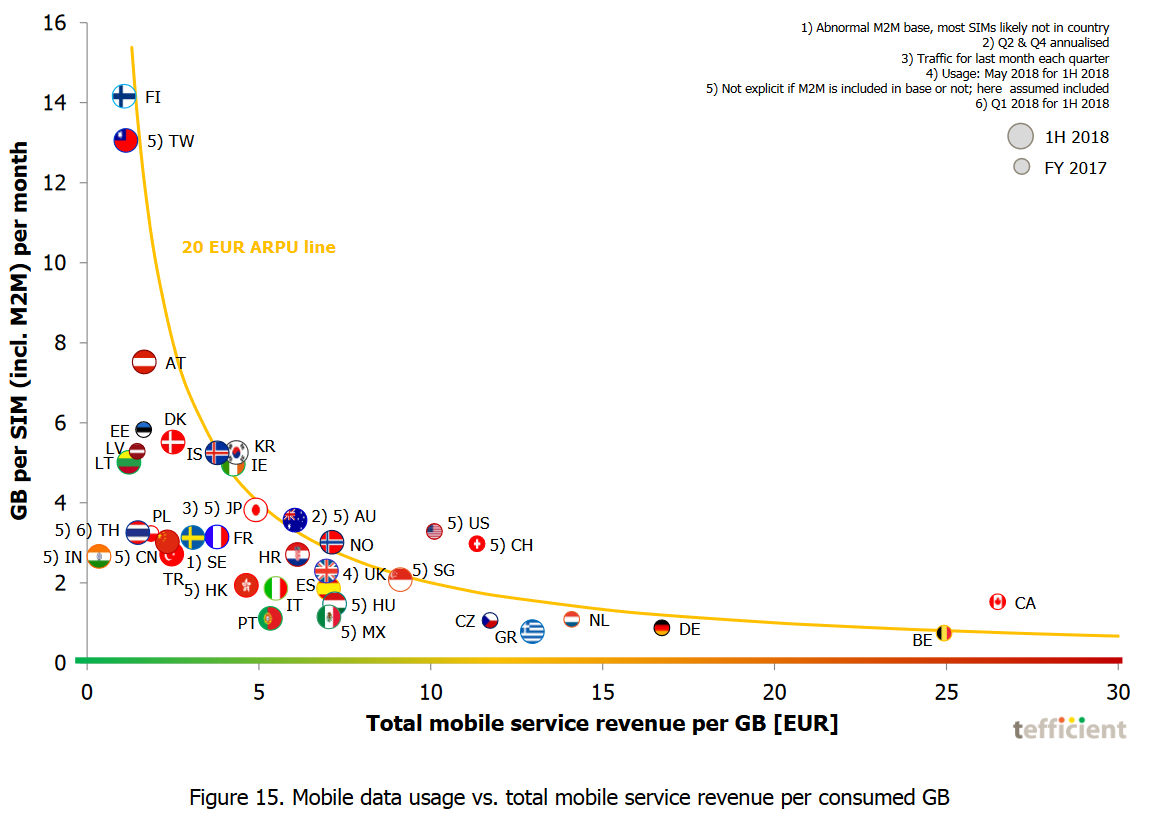
In Canada, “total revenue per GB is roughly 70 times higher than in India and 23 times higher than in Finland”
Canadians are used to being screwed by our telecommunications companies, but it’s worse than I thought, as Michael Geist illustrates:
Tefficient, a European-based consultancy on the wireless market, released its latest report this morning comparing pricing and usage in the global wireless market. The data, which incorporates the most recent CRTC numbers on the Canadian market, shows Canada as a global outlier when it comes to the revenues generated by wireless carriers. The report notes the unsurprising correlation between high prices and low data usage:
There is a prerequisite for continued data usage growth, though: The total revenue per gigabyte can’t be too high – like in Canada and Belgium. The total revenue per gigabyte here is roughly 70 times higher than in India and 23 times higher than in Finland. And consequently, mobile usage is lower than average.
The charts show where Canada stands relative to other countries with carriers generating more revenue per GB than anywhere else in the world and consequently Canada lagging behind many other countries in wireless usage.
Source: https://tefficient.com/wp-content/uploads/2019/01/tefficient-industry-analysis-3-2018-mobile-data-usage-and-revenue-1H-2018-per-country-final-17-Jan-2019.pdf
Comments Off on In Canada, “total revenue per GB is roughly 70 times higher than in India and 23 times higher than in Finland”
January 23, 2019
The value of boredom
I must have missed this Quillette essay by Caroline ffiske when it was published earlier this month:
In their book The Coddling of the American Mind Jonathan Haidt and Greg Lukianoff wonder where it all went wrong. How did we get to a situation where so many of our kids see themselves as fragile victims, but at the same time throw their weight around, telling the rest of us what we are allowed to think and say and do? Haidt and Lukianoff have set up a website devoted to exploring the issue and finding solutions.
I have a suggestion. It hit me like a hammer blow when I read Joseph Brodsky’s essay “In Praise of Boredom.” This was delivered as a commencement address at Dartmouth College in July 1989. Here is the opening sentence: “A substantial part of what lies ahead of you is going to be claimed by boredom.” That’s right. Joseph Brodsky, winner of the Nobel Prize for literature in 1987, assumed that these Ivy League graduates, in common with the rest of humanity since the dawn of time would face hours of the psychological Sahara of boredom that “starts right in your bedroom and spurns the horizon.”
How could Brodsky have guessed that the young people he addressed in July 1989 would be the last Western generation to live alongside boredom: in their bedrooms, on the bus, at the end of the day, and in the morning? That now, when the tiniest tips of our little fingers feel the first twinges of tedium, while the elevator travels between ground and first, we reach for our screens to become masters of fate, captains of souls, kings of new continents.
Even the vocabulary of boredom is disappearing. Brodsky lists these: “anguish, ennui, tedium, doldrums, humdrum, the blahs, apathy, listlessness, stolidity, lethargy, languor, accidie, etc.” Most of those can be excised from the Dictionary. Tell me honestly when you last used any of them?
[…]
Why? Because boredom represents your window onto infinity. And that is to say, onto your own insignificance. “For boredom speaks the language of time, and it is to teach you the most valuable lesson in your life … the lesson of your utter insignificance.” Boredom puts your existence into perspective “the net result of which is precision and humility.” The more you learn about your own size “the more humble and compassionate you become to your likes.”
Is boredom the ingredient our “snowflake” generation is missing?
Comments Off on The value of boredom
January 21, 2019
M551 “Sheridan” AR/AAV | DESIGN DISASTER!
Matsimus
Published on 24 Dec 2018The M551 Sheridan was a light reconnaissance tank developed by the American company General Motors in May 1960 under the designation XM551. In November 1965 approval was given for the type classification of the XM551 as Limited Production and a four-year production contract was awarded to the Allison Motor Car Division of General Motors Corporation. In May 1966 the Sheridan was classified as Standard A and by this time production was well under way with the first production vehicle being completed in June 1966. Production continued until 1970 by when 1700 M551S (or General Sheridans) had been built, of which 1570 were still in service with the US Army in 1970. The role of the M551. as originally conceived, is to function as the main reconnaissance vehicle for armour, infantry and airborne operations and arms teams not employing main battle tanks. Late in 1978, it was announced that the M551 would be phased out of service and replaced by the M60A1 MBT, apart from those vehicles allocated to the 82nd Airborne Division (57) and Arkansas National Guard (12), 330 have been assigned to the National training Center at Fort Irwin, California. These are essentially basic M551s but with visual modifications to the outside to disguise them as “OPFOR force” vehicles such as BMP-1 and ZSU-23-4.
Hope you enjoy!!
💰 Want to support my channel? Check out my Patreon Donation page! https://www.patreon.com/user?u=3081754
My PO Box: Matthew James 210A – 12A Street N Suite #135 Lethbridge Alberta Canada T1H2J
DISCORD: https://discord.gg/B7cbXgy
🐦Twitter: https://twitter.com/MatsimusGaming(DISCLAIMER: This video is for entertainment purposes only. The views and opinion come from personal experience or information from public accessible sources.)
Comments Off on M551 “Sheridan” AR/AAV | DESIGN DISASTER!
January 19, 2019
Stopper 37mm: A Simple South African Riot Control Gun
Forgotten Weapons
Published on 29 Dec 2018http://www.patreon.com/ForgottenWeapons
Cool Forgotten Weapons merch! http://shop.bbtv.com/collections/forg…
The Stopper is a simple 37mm single shot riot control gun designed by Andries Piek in 1980. The South African police services were at that time using 37mm guns made by Federal Labs in the US, dating back to the 1930s, and the international embargo on South Africa made it impossible to get parts and do basic maintenance on those arms. So Piek (whose other work included the BXP carbine/SMG and design improvements to the LDP/Kommando) whipped out the Stopper in all of two weeks to provide a new domestic-production 37mm weapon for the police.
The Stopper is a simple break-action gun, with a manually cocked, single action, hammer-fired trigger mechanism. Two versions were made, one with the front grip and one without, and all were fitted with collapsing stocks. Production began in 1982 and ran until 1999, by Mitco Special Products under the Milkor name.
As an interesting postscript, Piek was inspired by seeing Christopher Walken using a Mannville 25mm revolving gas gun in the movie Dogs of War to make something similar in 37mm or 40mm. The gun he designed to this end became the Milkor MGL, adopted by South Africa in 1983 and by the US Marine Corps in 2005.
Contact:
Forgotten Weapons
PO Box 87647
Tucson, AZ 85754
Comments Off on Stopper 37mm: A Simple South African Riot Control Gun
January 17, 2019
How effective was the Tiger really?
Military History Visualized
Published on 18 Dec 2018There are quite many debates about the Panzerkampfwagen VI Ausführung E & B – the Tiger & Königstiger – tanks, so in this video we look at how effective or ineffective these panzers were in combat. This means we look at doctrine, kill to loss ratios, mission accomplishment and various other issues.
»» SUPPORT MHV ««
» patreon – https://www.patreon.com/mhv
» subscribe star – https://www.subscribestar.com/mhv»» SOCIAL MEDIA ««
» twitter – https://twitter.com/MilHiVisualizedMilitary History Visualized provides a series of short narrative and visual presentations like documentaries based on academic literature or sometimes primary sources. Videos are intended as introduction to military history, but also contain a lot of details for history buffs. Since the aim is to keep the episodes short and comprehensive some details are often cut.
Comments Off on How effective was the Tiger really?
January 13, 2019
Canada’s role in India’s nuclear weapons development program
Canadian nuclear technology was critical to India for helping them develop their first nuclear weapons (although the Canadian reactor was supposed to be used only for civilian purposes):
Maybe you have heard the story of how India got the Bomb with Canada’s inadvertent help. We sold India a nuclear reactor called CIRUS in 1954 on an explicit promise that the facility would only be used for peaceful purposes. When India astonished the world with its first nuke test in May 1974, having upgraded the fuel output from CIRUS, it duly announced that it had successfully created a Peaceful Nuclear Explosive. The permanent consequence was, for better or worse, a nuclear-armed Subcontinent.
This is old news to enthusiasts of Cold War history. Here’s the new news: it almost happened twice. Canadian technology was almost used by another country to break into the nuclear club.
In November, historians David Albright and Andrea Stricker published a new book called Taiwan’s Former Nuclear Weapons Program: Nuclear Weapons On-Demand. The book pulls together the previously sketchy story of Nationalist China’s covert nuclear research, which had its roots in the postwar exodus of Chiang Kai-shek and the Kuomintang party (KMT). Albright and Stricker describe decades of effort by the offshore Republic of China on Taiwan to play a double game with nuclear weapons.
At first Taiwan engaged in sneaky nuclear research — it turns out that if you research nuclear safety you learn a lot about nuclear explosions — and it tried to create a plutonium stockpile on the sly. But their scientists left too many clues: a plutonium-based nuke requires processed plutonium metal, and that is hard to make without raising suspicions. The Indian test of 1974 was an important wake-up call to the world, and the nonproliferation establishment and the U.S. Department of State started to get nervous about Taiwan.
After a 1977 confrontation with American officials, who could hardly be ignored by the vulnerable Republic of China, the KMT deep state tried subtler methods to create the “on-demand” weapon described in the title. Taiwan committed formally to nonproliferation and full U.S. inspections of their facilities, but sought to be able to make low-yield nukes within three to six months in the event of a Communist invasion from the mainland.
Comments Off on Canada’s role in India’s nuclear weapons development program


