Quotulatiousness

January 11, 2010

Coming to your area soon: the XHL!

Filed under: Europe, Sports — Tags: — Nicholas @ 10:18

Remember that old joke about “I went to the fights and a hockey game broke out”? Apparently the Kontinental Hockey League thought that was a formula for success:

The Kontinental Hockey League may be taking the NHL’s bottom-tier and overage players for the most part, but one thing they’ve provided to the hockey world in their two seasons of existence is plenty of YouTube-worthy brawls. Just over a week ago Barys Astana and SKA St. Petersburg had a brawl that featured former NHL’ers Sergei Zubov, Oleg Saprykin, friend of Puck Daddy Kevin Dallman, commercial superstar Robert Esche, and even a goalie-on-defenseman scrap.

Sovetsky Sport writer Genadi Boguslavski tweeted out details of today’s punch-up that featured Vityaz Chekhov and Avangard Omsk. It didn’t take long for things to go from a line-brawl to the bench-clearing variety.

This first video features Jaromir Jagr in a bit of a tussle and apparently trying out some new Greco-Roman wrestling moves:

The game lasted four minutes, with 637 minutes of penalties handed out.

January 8, 2010

Second career for Jeanne d’Arc?

Filed under: Europe, France, Military — Tags: , — Nicholas @ 12:06

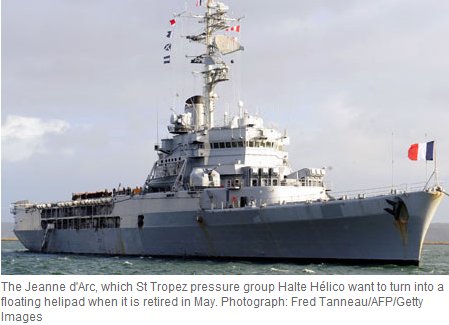
Due for retirement from the French fleet later this year, the helicopter carrier Jeanne d’Arc may have a civilian career ahead of her:

For the past 50 years, the venerable Jeanne d’Arc has had a career worthy of her name. She has toured the world, sailed to the rescue of populations in need and become a symbol of French military might.

But, if a bellicose group of activists get their way, the distinguished helicopter carrier could face a very different future when it is retired in May. Driven to distraction by private helicopters whirring above their homes, St Tropez residents are pushing for the icon of seafaring glory to become a landing strip for the international jet set.

The pressure group Halte Hélico sees the ageing 180m-long hulk of the carrier as a potential solution to the problems they have been fighting for years. Jean-Claude Molho, its president, said: “We thought it could be a good solution as there are already many landing strips for helicopters and we could also transform it into a hotel and restaurant to combine tourism with the practical issues.”

Snow, 1963

Filed under: Britain, Railways — Tags: , , — Nicholas @ 09:21

What would happen if you took a typical Canadian snowfall and dumped it on Britain? In 1963, this is what happened. As you can see, it must have been the “right kind of snow”.

H/T to Roger Henry for the link.

January 7, 2010

10 Downing Street: the coup that wasn’t

Filed under: Britain, Politics — Tags: , , — Nicholas @ 07:48

A rather odd week for Britain’s embattled Prime Minister, with members of his cabinet seeming to be working on his ouster, yet still publicly supporting him. I suspect it’s a case of timing — few expect Mr. Brown to win the next general election, but potential leadership contenders don’t want to push him out of the top spot until after the coming debacle. If he gets replaced before the election, the new leader will take a lot of blame for the polling results, while the Brown team can take Parthian shots at the new leader’s supporters.

This the most likely reason that the “coup” never happened. All the key players in the next act want this act over properly, with Gordon Brown facing his doom at the hands of the voters, and a new leader in place (theoretically) untainted by the outcome of the election.

Marmite versus Vegemite

Filed under: Australia, Britain, Food, Humour, Randomness — Tags: — Nicholas @ 07:25

Charles Stross has run out of things to post that will rile up the reader base, so he finds another way to get the chattering masses chattering — by declaring his unnatural love for Marmite and Vegemite:

Note to American readers: Marmite is what I (being a Brit) grew up with. If you brew beer on a commercial scale, when you drain the fermenting vessel you end up with a scum of dead and dying yeast cells on the side. Some time in the late 19th century, rather than treating this as waste, some nameless genius had the idea of tasting it. It turns out that brewer’s yeast, once you lyse the cells by adding salt, tastes remarkably savoury — somewhat like soy sauce, only thicker (with much the same consistency as non-set honey). Marmite, the product, is mostly yeast extract, combined with salt and a few additional spices. It’s what belongs on toast, or cheese, or in gravy and sauces to add body to them. And the stuff’s addictive. I get through it in catering-tub quantities, alas: it’s my one real high sodium vice.

Vegemite . . . it’s the antipodean antithesis. Invented in 1922 by Dr Cyril P. Callister in Australia, it was designed to plug the strategic gap opened by unrestricted U-boat warfare against the vital British Marmite convoys that had kept the colonies supplied during wartime — or something like that. Kraft popularized it, pushed it into military rations during the second world war, and over a decade clawed back sales from Marmite until it’s now the favourite toast topping down under. The recipe differs somewhat from Marmite, as does the flavour — just enough that if you’re used to one, the other tastes slightly “off” — too flat, or too astringent.

If you want to really liven up a party, pour a small jar of Marmite into the fruit punch — or add Vegemite to the dog’s bowl (as long as you don’t mind being asked to clean up afterwards). Hours of friendly discussion and informed debate can be provoked by discussing the relative merits of the two products! And it’s always a good idea to introduce visiting American guests to what they’ve been missing all these years, by exhorting them to spread it on their bread “just like peanut butter”.

January 5, 2010

A decade of war

Filed under: Africa, Asia, Europe, History, Middle East, Military — Tags: , , — Nicholas @ 07:19

Strategy Page has an annotated list of the last decade’s wars, declared and undeclared, and armed confrontations just short of warfare:

It’s actually been a decade of less and less war. There’s also been a lot of déjà vu, with many wars seeming to be endless. Some wars are like that. So what were all the current hot spots like a decade ago, and what happened to them? Below is a list, with the short version of what happened (check out archives for the much longer version).

Afghanistan was sort of under the control of the Pakistani backed Taliban in 2000. But the civil war, that began in the late 1970s, was still going on. The Taliban were winning, slowly, fueled by taxes on the heroin trade. But the Taliban were increasingly unpopular, mainly for trying to impose lifestyle rules on a hostile population. September 11, 2001 brought in the Americans to help the factions still fighting the Taliban, and within three months, the Taliban were out of power, and fleeing to Pakistan. A democracy was established, but corruption and tribal rivalries crippled it from the start. The Pushtun tribes resented the domination of the non-Pushtun tribes (60 percent of the population), and this enabled the Taliban to rebuild and undertake a terror campaign to regain control of the country. It’s a suicide mission (even most Pushtuns oppose them), but that’s pretty normal for Afghanistan.

[. . .]

Iraq- Saddam Hussein was under siege at the beginning of the decade, refusing to comply with the terms of his defeat in the 1991 war over Kuwait. Saddam, as he later admitted, had no weapons of mass destruction, but did not want the Iranians (who wanted to kill him for invading in 1980) to know. It was a successful deception, so much so that all the world’s intel agencies agreed that Saddam had these weapons, and that was used to justify the U.S./British invasion of 2003. There followed five years of terrorism, as the Sunni Arab minority (which Saddam had led) tried to murder their way back into power. That didn’t work, and Iraq ends the decade with a booming, not shrinking, economy, and a bloody resolution to some long time political disputes.

December 26, 2009

QotD: Soccer

Filed under: Britain, Quotations, Soccer — Tags: — Nicholas @ 00:10

Over the years I have argued that football is a stupid game in which 22 overpaid nancy boys with idiotic hair run around a field attempting to kick an inflated sheep’s pancreas into some netting while an audience of several thousand van drivers beat one another over the head with bottles and chairs.

Nor could I understand how someone from Tooting could possibly support, say, Manchester United, a team sponsored by those hateful bastards at AIG and made up of players from Portugal, France, Holland and, in the case of Wayne Rooney, Walt Disney. Where’s the connection? What’s the point?

I have also suggested that it’s preposterous to have football stadiums in the middle of cities. Why should anyone be delayed by match traffic just so a handful of thugs can watch a Brazilian man falling over?

And as for those people who can’t cope if their team loses. Give me strength. If you get all teary-eyed just because someone from Latvia, playing in a town you’ve never been to, for an Arab you’ve never met, against some Italians you hate for no reason, has missed a penalty, how are you going to manage when you are diagnosed with cancer?

Jeremy Clarkson, “You’re a bunch of overpaid nancies – and I love you: Why should anyone be held up by match traffic just so some thugs can watch a Brazilian man falling over?”, Times Online, 2009-03-22

December 23, 2009

Tornado to the rescue!

Filed under: Britain, Railways, Technology — Tags: , — Nicholas @ 12:44

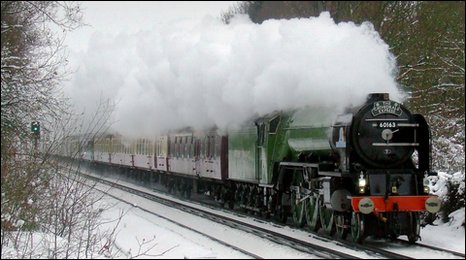
With all the winter weather in England this week, the railways are struggling to cope. One of the newest locomotives didn’t have any problems with the snow and ice:

TornadoInSnow_22Dec09

Passengers were rescued by a steam locomotive after modern rail services were brought to a halt by the snowy conditions in south-east England.

Trains between Ashford and Dover were suspended on Monday when cold weather disabled the electric rail.

Some commuters at London Victoria faced lengthy delays until Tornado — Britain’s first mainline steam engine in 50 years — offered them a lift.

They were taken home “in style”, said the Darlington-built engine’s owners.

December 22, 2009

Anglicans now allowed to shoplift

Filed under: Britain, Law, Religion — Tags: , , , — Nicholas @ 07:11

There’s updating your church to appeal to modern attitudes, and then there’s this:

Thou shall steal after all! Holy row greets fatherly advice from York vicar
Church of England priest Tim Jones preaches it’s OK to shoplift, though it’s best from a big retail company not family business

In issuing the 10 commandments to Moses atop Mount Sinai, God was pretty unequivocal: “Thou shalt not steal.”

However, there’s good news for anyone whose passion for pilfering has hitherto been tempered by the eighth commandment: according to one Church of England vicar, we can steal after all.

Father Tim Jones, the parish priest of St Lawrence and St Hilda in York, told his congregation on Sunday that certain vulnerable people face difficult situations.

“My advice, as a Christian priest, is to shoplift,” he said. “I do not offer such advice because I think that stealing is a good thing, or because I think it is harmless, for it is neither.”

Well, that pretty much seals it, doesn’t it? Any other commandments we can dispense with — with the blessings of the Church of England?

December 18, 2009

The lesson is . . . next time, don’t turn it in

Filed under: Britain, Bureaucracy, Law — Tags: , , , — Nicholas @ 13:06

Remember the report of a man who’d found a shotgun on his lawn, turned it in to the police, and was promptly charged with posession of an illegal weapon? Well, he’s been convicted and will face up toa minimum of five years in prison for his “crime”:

A former soldier who handed a discarded shotgun in to police faces at least five years imprisonment for “doing his duty”.

Paul Clarke, 27, was found guilty of possessing a firearm at Guildford Crown Court on Tuesday — after finding the gun and handing it personally to police officers on March 20 this year.

The jury took 20 minutes to make its conviction, and Mr Clarke now faces a minimum of five year’s imprisonment for handing in the weapon.

In a statement read out in court, Mr Clarke said: “I didn’t think for one moment I would be arrested.

“I thought it was my duty to hand it in and get it off the streets.”

The way the law is written, the jury would have had no choice but to find him guilty. If only there were some way for a jury to find that the law was at fault. (Or, among their other limits to civil liberties, has the British government made jury nullification illegal?)

Update: Fixed the mis-statement about the length of sentence Mr. Clarke may face.

Surprising court decision doesn’t favour the artist

Filed under: Britain, Media — Tags: , — Nicholas @ 08:48

Having just read the brief outline of the case, I was more than a little surprised that the court (correctly, in my opinion) decided that the “art” in question was just glorified vandalism:

Glass act: student fined for smashing gallery window and calling it art
Gallery fails to see funny side after student puts metal pole through window as part of an art project

Does breaking a window count as art? Yes, murmured the 50 or so artniks who recently crowded into a former Edinburgh ambulance garage to view a film of sculptor Kevin Harman doing just that. No, insisted Kate Gray, director of the Collective Gallery in Cockburn Street, whose window it was.

The courts are on Gray’s side. Yesterday Harman, a prize-winning graduate of Edinburgh College of Art, was fined £200 for breaching the peace on 23 November, when he smashed a metal scaffolding pole through one of the gallery’s windows. Fiscal depute Malcolm Stewart described the affair as “a rather bizarre incident” which had left Collective staff “upset.”

I’m actually quite surprised that the court decided this case properly . . . it has seemed for quite some time that an “artist” could declare just about anything to be “art” and get away with it. I’m not against all art, but if in the performance of your artistic work you happen to break a law, I think the police and the courts should not mitigate your treatment just because you’re an “artist”.

December 16, 2009

More info on the RAF cuts

Filed under: Britain, Military — Tags: , , — Nicholas @ 12:50

Lewis Page finds the MoD’s recently announced cuts to — shock, horror — make good military and economic sense:

It doesn’t happen often, but just for once there’s good news out of the Ministry of Defence — good news for British troops in combat overseas, and good news for British taxpayers too. But it’s bad news for the UK arms biz, and bad news for certain regional communities who rely on the MoD to bring them government money they wouldn’t otherwise receive — and don’t particularly deserve.

So what’s the government done?

In essence, they have cut down massively on military things which we don’t — and almost certainly won’t — need, and ordered a lot of things which we are desperately short of.

Other than the reduction of the RAF’s Harrier force by one squadron, the government also indicated they may cut the Tornado force by one or two squadrons. This is sensible because the Tornado was designed to do a job that no longer needs to be done — or, rather, no longer needs to be done by manned bombers. Another big change is that the RAF will be losing their Nimrod aircraft, which has both military and political aspects:

Quite apart from all that, the Nimrod MR2 — being a flying antique — is horribly expensive to run, both in money and in lives. The MR2’s extensive use above Afghanistan in recent times as a flying spyeye and to relay radio messages between ground units in no way justified its continued, very expensive existence; far less could such unimportant work possibly have justified the known risks of refuelling these aged birds in mid-air.

So getting rid of the MR2s loses us nothing important, and will make our service people noticeably safer — the Nimrod has actually killed one of our people for every 15 killed by the Taliban. Better still, this will permit another pricey airbase here in the UK to largely close, saving money to be spent at the front line. As a fringe benefit, the base in question — RAF Kinloss — is in a Scottish National Party constituency, giving people there a taste of the independence from the UK that they have voted for. (Strangely the local SNP member of parliament still isn’t happy**.)

December 15, 2009

Heart-warming story of the day

Filed under: Britain, Law — Tags: , , , , — Nicholas @ 12:52

Jon sent me this heart-warming story, and I thought it best to share:

A millionaire businessman who fought back against a knife-wielding burglar was jailed for two-and-a-half years yesterday. But his attacker has been spared prison.

Munir Hussain, 53, and his family were tied up and told to lie on the floor by career criminal Waled Salem, who burst into his home with two other masked men.

Mr Hussain escaped and attacked Salem with a metal pole and a cricket bat. But yesterday it was the businessman who was starting a prison sentence for his ‘very violent revenge’.

Jailing him, Judge John Reddihough said some members of the public would think that 56-year-old Salem ‘deserved what happened to him’ and that Mr Hussain ‘should not have been prosecuted’.

But had he spared Mr Hussain jail, the judge said, the ‘rule of law’ would collapse.

He said: ‘If persons were permitted to take the law into their own hands and inflict their own instant and violent punishment on an apprehended offender rather than letting the criminal justice system take its course, then the rule of law and our system of criminal justice, which are hallmarks of a civilised society, would collapse.’

Salem, who has previous convictions, has already been given a non-custodial sentence despite carrying out what the judge called a ‘serious and wicked’ attack.

Well, it’s nice to know that some judges carry the best interests of “society” close to their hearts. And he’s right, you know: society would indeed collapse if the courts were forced to spend their time trying and sentencing career criminals like Salem. They’re career criminals. Custodial sentences would interfere with their careers, which would be a serious infringement of their human rights. Can’t have that.

The courts, however, are well situated to send serious messages to wanton millionaires like Hussain, who need to be regularly reminded that their wealth and privilege does not give them rights over and above those enjoyed by normal non-millionaires. I have no need to remind you that non-millionaires are not allowed to defend themselves against criminals either.

So, clearly, justice is served.

In some parallel universe, anyway.

Nanny state now to come with pop-up warnings

Filed under: Britain, Technology — Tags: , , , , — Nicholas @ 12:36

Just in case you British internet users weren’t already aware, the government may start including pop-ups whenever you access an out-of-country social networking site. Nice of them to at least warn you that your internet usage will be monitored for quality and customer satisfaction (the customer in question is the government, BTW):

The ACPO document, obtained by The Register, suggests the government may “minimise or discourage or give ‘pop-up’ warnings as regards to communications services within the online environment where there is evidence, presented to a Circuit Judge or Secretary of State, that allowing the public access or use of specific communications services could make them vulnerable to fraud, the theft of personal information or other attack”.

ACPO does not explain the technical details of its plan, but points out that “measures already exist to minimise the availability of potentially illegal content”. However, it cites the Internet Watch Foundation’s blacklist of international URLs carrying indecent and abusive images of children, suggesting a parallel list of social networks, forums and real time messaging sites judged to be risky could be created.

The proposal was drawn up by ACPO’s Data Communications Group. The group is chaired by Jim Gamble, the chief executive of the Child Exploitation and Online Protection Centre, which is responsible for policing paedophiles on the internet.

RAF and Royal Navy facing further cuts

Filed under: Britain, Bureaucracy, Military — Tags: , , , , — Nicholas @ 07:40

With the costs of maintaining British troops in Afghanistan still rising, the government is expected to announce further cuts to the Royal Air Force and Royal Navy today:

Some RAF bases face closure to pay for extra equipment for British forces in Afghanistan, a defence minister indicated this morning.

Quentin Davies said that it would be a “very good thing” to get by with fewer RAF bases if that was possible and that the Ministry of Defence wanted to spend its money with “maximum effect”.

[. . .]

Some Tornado and Harrier aircraft and small navy surface vessels are likely to face cuts. A number of RAF bases will be closed — including reportedly RAF Kinloss in Moray — and part of the sovereign base areas in Cyprus will be sold.

The two large aircraft carriers are expected to survive this particular cut, although it wouldn’t be surprising to see further delay introduced into their construction . . . even though stretching out delivery dates is an expensive way to increase short-term savings:

The announcement follows the publication of a report from the National Audit Office saying the gap between the cost of planned weapons projects and what the MoD can actually afford could be as much as £36bn.

The gap would have been larger had the ministry not delayed a number of projects, such as the construction of two large aircraft carriers, the Queen Elizabeth and the Prince of Wales, the NAO reports.

However, the decision to delay the carrier project to save £450m over the next four years will increase costs by £1.12bn over later years — a net increase of £674m, the NAO says.

The MoD has also decided to reduce an order of Lynx Wildcats from 80 to 62 helicopters, saving £194m but reducing planned flying hours by a third. The report says that last year the price for the 15 biggest military schemes rose by £1.2bn, £733m of which was the result of delays designed to save money in the short term.

Update: Believe it or not, there’s actually some sense to the government’s announced changes:

The headlining move comes with the announcement, widely anticipated, that the British fleet of US-made Chinook heavy-lift helicopters is to increase from 48 to 70 aircraft, with initial deliveries of ten new choppers arriving by 2013. The Chinook is the only helicopter in widespread Western service with enough spare lift to operate with any freedom in Afghanistan’s heat and high altitudes, and the new copters will be extremely welcome among British forces there.

It is also expected that another Boeing C-17 heavy transport plane will be ordered to join the existing UK fleet of 5, which are regarded as crucial to sustaining the “air bridge” logistic link between Blighty and its troops in Afghanistan.

These short-term improvements will be paid for not by any budget increase, but by reducing the active forces of Tornado bombers and Harrier close-support jets, and early retirement for much of the existing fleet of antique Nimrod MR2 maritime patrol aircraft. These moves will allow closure or mothballing of some of the RAF’s 45+ UK stations, with associated further job losses and savings.

They’ve also announced the retirement of the Sea King helicopter from active service, with the existing inventory of Merlin HC3 moving from the RAF to RN service (including whatever refitting will be necessary to “maricise” them for full-time service with the fleet).

Overall, the changes make a good deal of sense . . . what a surprise.

« Newer PostsOlder Posts »

Powered by WordPress