
One of the two US Supreme Court rulings this week that sparked controversy was the court’s decision to overrule a 1935 precedent that enabled the growth of the administrative state:
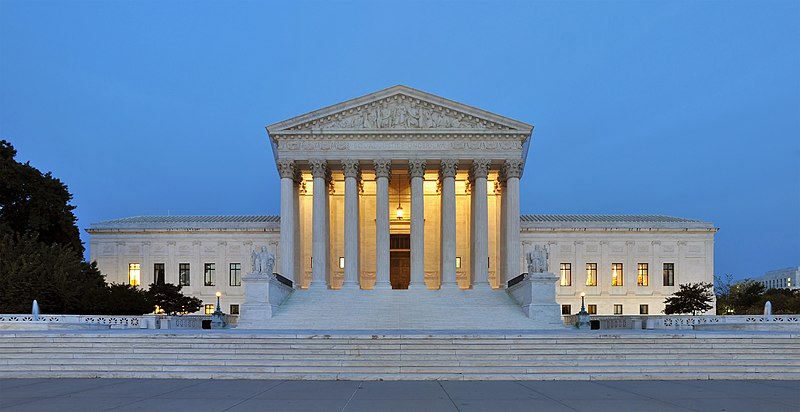
Panorama of the west facade of United States Supreme Court Building at dusk in Washington, D.C., 10 October, 2011.
Photo by Joe Ravi via Wikimedia Commons.
The Supreme Court this week restored an old-fashioned constitutional idea: if a principal federal officer exercises executive power, the president must be able to remove him. The justices’ 6–3 ruling in Trump v. Slaughter, which struck down a law prohibiting the president from firing members of the FTC except for cause, is the logical endpoint of a 15-year series of cases that have steadily chipped away at Humphrey’s Executor, the 1935 decision that blessed for-cause removal protections for the heads of so-called independent agencies.
The Court didn’t mince words. Chief Justice John Roberts wrote that “Humphrey‘s framework, in short, has not withstood the test of time”. Then came the sentence that will launch a thousand administrative-law articles: “If anything more is left of Humphrey‘s, we overrule it”. The New Deal compromise that invented quasi-legislative agencies has finally met Article II of the U.S. Constitution.
That’s good, because the Federal Trade Commission isn’t a debating society. It, along with its alphabet-agency brethren, writes rules with the force of law, investigates private parties, adjudicates violations, and sues in federal court on behalf of the United States. Whatever labels Congress attached to that body in the Progressive Era, the FTC — like the FCC, SEC, NLRB, and so on — today exercises executive power. And the Constitution vests “the executive power” in one president, not in commissioners serving staggered terms, answerable to no one whom voters can fire.
This ruling isn’t a gift to Donald Trump or his successors. It’s a restoration of constitutional accountability. Congress can create executive-branch agencies and specify what they may do, but it cannot create a fourth branch of government and then pretend its officers are independent of the only person the Constitution makes responsible for executing federal law.
Roberts put the point crisply at the end of Slaughter: “Subordinates who exercise the President’s power are subject to removal by him”. That’s a unitary, not an imperial, presidency, and it’s a hallmark of republican government. The president remains constrained by statutes, appropriations, courts, Congress, elections, and the Constitution itself. If the people dislike how the FTC enforces the law, they should be able to blame — and replace — the president, not chase a goulash of insulated mandarins.
Justice Neil Gorsuch’s concurrence adds the important next step. Killing Humphrey’s Executor doesn’t cure every constitutional disease in the administrative state. It simply reallocates the power Congress poured into independent agencies. As Gorsuch warned, “the fourth branch’s powers still exist; they have just been reassigned to the President”. If agencies possess vast legislative and judicial authority, the answer isn’t to hide those powers from presidential control, but to restore legislative powers to Congress. Make Congress great again!



My identity as a Canadian is based upon our shared history and our accomplishments as a people. Multicultural propaganda attempts to erase those facts, leaving us with with the negative identity of what we’re not.
As an aside, in my 69 years I have seen anxiety about Canadian identity mostly among our self described elite. Most Canadian people are quite comfortable with their identity, they know who they are. On the other hand, our elite seem to be consumed with both envy and fear of our American neighbours. They know that their American counterparts are richer and more important than they are. Should Canada become part of the USA, our Laurentian elite wil become a regional one, and an important one at that. If the USA incorporates Canada into a N. American union, I will still be Canadian.
Comment by Raymond R — July 2, 2026 @ 09:51