
In The Critic, John Wills explains that public housing organizations, like any organization with perverse incentives, will never solve the problem of providing enough housing for those who cannot afford it:
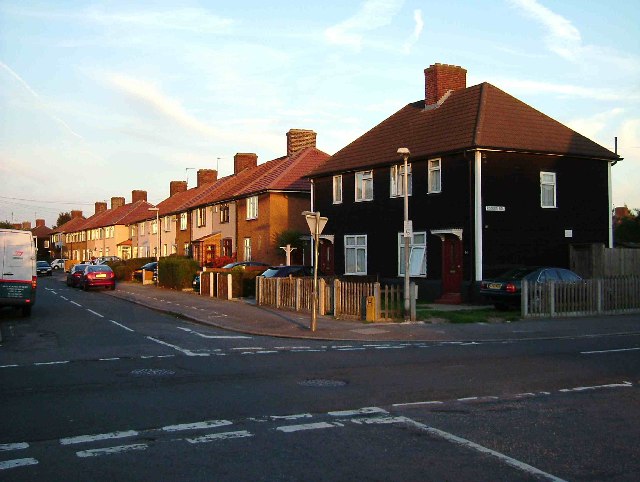
Homes Fit for Heroes – Dagenham
“These are typical examples of the housing on the Becontree Estate. Initially 25000 homes were built by the London County Council between 1921 and 1934. These homes fit for the heroes of WW1 had all mod cons gas, water and electricity with inside toilets and bathrooms. A further 2000 homes were built before WW2. The Becontree estate was the biggest council estate in the world.”
Image and description from geograph.uk. Photo by Glyn Baker – CC BY SA 2.0
There is a moment, familiar to anyone who has spent serious time inside a housing association, when the institutional logic becomes impossible to ignore.
Perhaps you are sitting in a meeting, reviewing the organisation’s performance: voids are down, rent arrears are within tolerance, development pipeline is healthy and the regulator is satisfied. By every measure the sector uses to evaluate itself, things are going well.
Outside the window, however, the waiting list has not reduced. The families in temporary accommodation are the same families (or families very much like them), who were there five years ago. In short, the problem the organisation was created to solve is precisely as large as it was when the meeting began.
Despite these demonstrable facts, nobody in the meeting thinks this is strange. Nobody considers the organisation a failure. The metrics are, after all, fine.
I spent a decade working at a senior level in housing associations. I left as I became disillusioned with a model that has evolved to measure everything except the thing that matters.
The founding logic was sound enough: postwar Britain faced a housing crisis that was specific, urgent and — crucially — finite. Tens of thousands of homes had been destroyed or damaged, men had died in enormous numbers, and a baby boom was placing acute pressure on stock that was already inadequate before the war started. Social Housing was therefore a rational response to a bounded problem: build homes, house people and alleviate a crisis that would, in time and as a result of the initial centralised effort, resolve itself. You might also apply the same logic to slum clearance a decade later: deplorable housing stock needed replacing, and the state needed a mechanism to do it. The model remained defensible so long as everyone understood that success meant crossing a defined finish line.
However, nobody thought to define that finish line. The problem here is that once you remove the time horizon from an organisation tasked with solving a problem, the organisation’s survival becomes contingent on the problem’s persistence, not its resolution. This is not a conspiracy and it requires no bad actors, nor even a conscious decision to perpetuate matters. It is simply what institutions do when the incentives are wrong. As a thought-experiment, imagine that the eradication of smallpox had been incentivised not by the goal of total global elimination, but instead by vaccines administered, clinics built or healthcare workers employed. What would the probability be of us continuing to battle smallpox into the 21st Century? I cannot be certain, but suspect it would be considerably higher than nil.
The regulatory framework for social housing has compounded the error rather than correcting it. Regulators, quite reasonably, dislike hoarded capital. A registered social landlord (RSL) sitting on large reserves and doing nothing with them is, from a regulator’s perspective, a problem to be solved. The solution the sector has converged on is growth — more stock acquired, more homes built, larger balance sheets, bigger organisations and more services and people employed to deliver them. The key metric of a healthy RSL is therefore its size: which is to say, the scale of the problem it exists to address. (To test this proposition, ask someone in housing to describe their organisation. The chances are the first words out of their mouth will be the number of homes they manage). An organisation genuinely succeeding in its mission — one that is housing fewer people because fewer people in its area of operations need housing — under the current framework would look like a failure. It would be encouraged to merge with a larger, more “successful” neighbour, which is to say one that has accumulated more evidence of unresolved housing need.


