
As many have noted, the President of the United States does not have the constitutional power to declare war, as that is explicitly assigned to the rights of Congress. But in this, as in many other areas, Congress is unlikely to interfere once a President has set the military machine in motion. It is convenient for both the sitting President and for the individual members of Congress, who can posture and speechify against or in favour, but won’t actually be held responsible by the voters regardless of the war’s outcome. President Trump’s use of trade war tactics against allies and enemies alike is also an area where Congress is apparently willing to turn a blind eye:
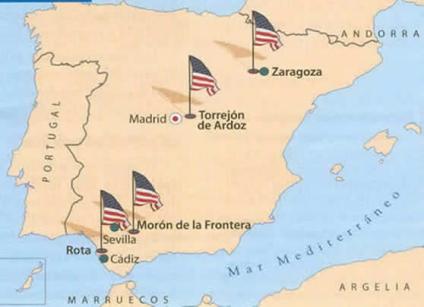
US military bases in Spain (Map from sutori.com)
No Spain, no gain? It was probably inevitable that President Donald Trump’s trade war would eventually get mixed up in his actual war.
Earlier this week, Spanish officials said they would prohibit American forces from using joint bases for war operations, unless those activities were covered by the United Nations Charter. Spanish Prime Minister Pedro Sánchez said his country would not “be complicit in something that is bad for the world”, the Associated Press reports.
On Tuesday, Trump declared that he intended to “cut off all trade with Spain”.
You might wonder: What legal authority does Trump have to unilaterally impose these sorts of revenge tariffs? After all, the Supreme Court ruled not that long ago that the authority Trump had been using to unilaterally impose tariffs based on his whims was unconstitutional. You might as well ask: On what legal authority did Trump launch a war against Iran? In theory, under the Constitution, Congress is supposed to authorize both tariffs and wars. In practice, they, uh, don’t.
Trump just does things, and the annoying constitutional worrywarts can figure it out later. (I say this as an annoying constitutional worrywart.)
In any case, yesterday, the Trump administration announced that Spain had changed its tune. “The U.S. military is coordinating with their counterparts in Spain”, White House Press press secretary Karoline Leavitt said. The implication was that the tariff threats had worked.
Spain, however, said otherwise. “I can refute (the White House spokesperson)”, Spanish Foreign Minister José Manuel Albares said. “The position of the Spanish government regarding the war in the Middle East, the bombing of Iran and the use of our bases has not changed one iota.” Maybe those tariff threats aren’t as effective as Trump thinks?
In a speech, Sánchez warned that the war could spin out of control. “Nobody knows for sure what will happen now”, he said. “Even the objectives of those who launched the first attack are unclear. But we must be prepared, as the proponents say, for the possibility that this will be a long war, with numerous casualties and, therefore, with serious economic consequences on a global scale.”
Sánchez also implicitly admonished Trump for escalating the war: “You can’t respond to one illegality with another because that’s how humanity’s great disasters begin”.
I will just note that in the Star Wars prequels, the fall of the Republic, and the descent into darkness and imperial rule, began with a planetary blockade and a trade war. At the time, people said it was wonky and boring. But here we are.
Where is Congress? The Constitution was built around the idea that each branch would fight to preserve its own powers, and this would create a system of checks and balances. But in Trump’s second term, Republicans in the legislature have been actively fighting to not preserve their power.
Yesterday, in a 47–53 vote, Senate Republicans voted against a resolution that would have required Trump to ask Congress to sign off on any further military aggression in Iran. Sen. Rand Paul (R–Ky.) voted with Democrats in favor of the measure; Sen. John Fetterman (D–Pa.) joined Republicans to vote against it.
The measure was mostly symbolic. Even a successful vote would have been subject to a House vote and a presidential veto. And the position of both the White House and the GOP Speaker of the House is that this whole situation in which America is spending billions of dollars dropping thousands and thousands of bombs on military and political targets in a foreign country is not, in fact, a war. Nothing to see here. Everyone in Congress can go home and crack open a beer.


