Quotulatiousness

February 28, 2026

Corruption and red tape rise in lockstep

Filed under: Bureaucracy, Europe, Government, Law, Politics, USA — Tags: , , , , , — Nicholas @ 05:00

J.D. Tuccille notes that corruption — at least corruption being brought to our attention — is rising at the same rate as bureaucratic red tape. It’s almost as though there’s a correlation between making things harder to do and officials accepting “sweeteners” to make things easier to do …

At the moment, corruption investigations and trials of political figures are taking place in jurisdictions around the U.S. including Hawaii, Mississippi, and Washington, D.C. These aren’t isolated scandals; the latest edition of an international corruption index finds corruption worsening globally, with the United States earning its worst score to date. Given that corruption involves government officials peddling favors for compensation, it shouldn’t be surprising that evidence suggests the solution lies in reducing the power and role of the state.

[…]

Regulation Breeds Corruption

“EU regulation is not only becoming more cumbersome but it is also pilling in”, Oscar Guinea and Oscar du Roy of the European Centre for Political Economy wrote in 2024. “The amount of new regulation accumulated during the last years has been staggering.”

That matters. In its advice for reducing corruption, Transparency International emphasizes, “there is a broad consensus that unnecessary and excessive administrative requirements for complying with regulations create both incentives and opportunities for bribery and corruption”.

The means by which this occurs is logical enough. Government-imposed permitting and licensing requirements, administrative procedures, prolonged decision-making, and contract awards create a temptation to shorten delays and reduce costs by padding officials’ pockets. In many cases, selling exceptions becomes the real reason for red tape. That phenomenon applies to the entire world, including the United States.

In the U.S., the More Regulations, the More Bribery

In a paper published in the European Journal of Political Economy in 2020, Oguzhan Dincer of the Department of Economics at Illinois State University and Burak Gunalp of the Department of Economics at Turkey’s Cankaya University looked at the relative effects of federal regulations on the corruption levels in U.S. states.

“Power to enforce the regulations gives government officials power to extort bribes”, they wrote. “Government officials have an opportunity to extort bribes from the firms trying to enter an industry because they have the power to issue the industry licenses. They also have an opportunity to extort bribes from the incumbent firms by simply colluding with them and keeping the regulations unchanged and/or strengthening the regulations to increase the costs of entry for new firms. Finally, regulations and the discretionary power given to government officials to extract bribes create incentives for firms to operate in the unofficial economy.”

Specific to the U.S., they examined two decades of data to see how red tape affected the honesty of public officials.

What they found shouldn’t be surprising: “Using the U.S. Justice Department’s data on the number of federal convictions for the crimes related to corruption, and controlling for several economic and demographic variables, we find a positive and statistically significant relationship between federal regulations and corruption.”

Just when you think Canada can’t get worse … it gets worse

Unlike most other Anglosphere countries, Canada does not have a resurgent right wing in domestic politics — we barely have a right wing at all — and the governing Liberal Party is constantly trying to steal sitting opposition MPs to achieve a majority of seats in Parliament. It’s no wonder that Alberta’s separatist movement has been active the last few years. In case you still have an optimistic view of Canada’s present and future, here’s a long “state of Canada” post from John Carter that will probably increase the numbers signing up for free euthanasia (“MAID” in Canadian):

The US is now leading Canada 3-0 in international hockey. If you count the Stanley Cup as an occasional international match, a Canadian team hasn’t won since 1993. For a country that has long practically defined itself as the Hockey Nation, this is especially humiliating. Given the continual year-round repetition of the Elbows Up mantra, this is the kind of thing a Roman augur would have interpreted as a portent of divine disfavour.

Months, you say? Oh dear.

Consistent with that interpretation, Canada’s recent humiliations have not been limited to sportspuck losses. What follows is a snapshot in time, headlines from a country beset by interlocking economic, demographic, spiritual, and political crises, a country which has not had good news in so long that it has forgotten what optimism even looks like.

Item: Canada recently watched the worst school shooting in Canadian history, and the second-worse mass shooting after the infamous 1989 Montreal Massacre in which “Mark Lepine”1 shot 14 female engineering students. The shooting took place in Tumbler Ridge, British Columbia, a small rural village in the country’s north, and claimed the lives of 10 people including the shooter, his mother, his brother, and several students. Dozens of others were injured. It soon turned out that the murderer was a trannie whose brain had been twisted into a psychotic pretzel by psychedelics, legal weed, SSRIs, and the gender woo he was force-fed at school, at home, and on Reddit. This has led to it being referred to as the Tumblr Shooting. Naturally, both the Royal Canadian Mounted Police and the Canadian media went out of their way to respect the shooter’s pronouns in all reporting and official communications. The media even made sure to give the shooter an AI filter glow-up, so that he could be remembered as the pretty girl we all know he really was deep down inside.

After a desultory and hilariously unsuccessful attempt at scolding the public that the problem wasn’t trannies, but guns or whiteness or something (blessedly, they couldn’t say “men” this time), the Canadian media just dropped it, though not before the government flew the flag at half mast.

Which is how this happened.

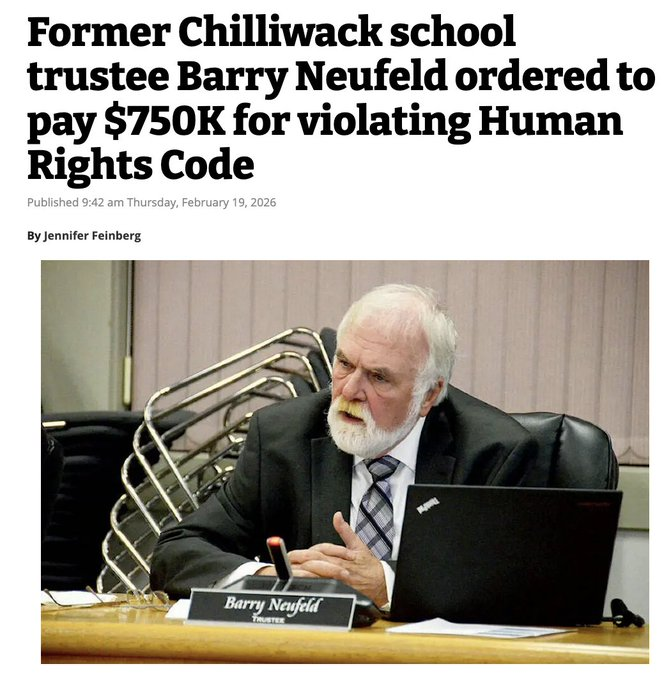
Item: A former school board trustee in Chilliwack, British Columbia, was fined $750,000 for failure to respect pronouns. Shooting up a school is bad, but misgendering is unforgivable.

[…]

Item: A xeet went viral in which a leaflib tried to fact check an American poster making fun of 18-month MRI wait times by pointing out that she’d only had to wait six months, prompting widespread mockery from incredulous Yanks.

Pennsylvania, which has about 1/3 of Canada’s population, has more MRIs than all of Canada put together. The Canadian mind cannot comprehend, etc.

Item: Euthanasia via Canada’s Medical Assistance in Dying (MAiD) program now accounts for 1 death in 20 in Canada. The overwhelming majority, around 96%, of MAiD recipients are white, despite white Canadians comprising 86% of Canadians in the elderly demographic that dominates assisted suicide participants.

Since 2016 over 76,000 Canadians have been killed by MAiD. Moreover, the program is accelerating: the death toll in 2024 was the highest on record at 16,499. Annual death tolls have risen by around a few thousand every year since the program started, with no sign of stopping. Canada is expected to hit 100,000 MAiD deaths by summer.

Item: While most MAiD victims are elderly and infirm, this is not true in every case. Recently it came out that a 26-year-old man was euthanized, simply because he was depressed over his diabetes-induced blindness. His family allege that he doctor-shopped until he found one who would kill him (she has apparently killed several hundred others).

MAiD was originally billed as an easy, painless out for people with terminal illnesses, a dignified death that would spare them a few months of pointless agony. It’s now being extended to people whose imminent death is not reasonably foreseeable. Several Canadian Armed Forces veterans have been offered MAiD in lieu of treatment for injuries sustained in the course of their service.

The primary goal of MAiD is almost certainly to reduce pressure on Canada’s overstretched public health care system whilst simultaneously reducing the fiscal burden of pensioners on the federal budget. Someone looked at the financials, and concluded that unfunded liabilities were going to bankrupt the country when the boomers reached their 80s. Therefore the government is talking them into killing themselves. However, while they’re at it, they might as well expand the program to hasten demographic replacement within the younger sectors of the population pyramid.


  1. Née Gamil Gharbi, a detail the Canadian media successfully kept from us for decades as it didn’t fit their narrative that “men” are the problem, rather than men from … certain places.

The by-election in the British riding of Gorton and Denton

Filed under: Britain, Media, Politics — Tags: , , , , — Nicholas @ 03:00

A few surprises in the outcome, although the expected winner — the Green Party — did manage to pick up the seat by pandering harder than anyone else for the Muslim vote (according to multiple sources). And, as Francis Turner points out, this may be a problem:

The Gorton and Denton by-election has happened, and as I predicted, Labour came third.

Though more people voted Labour than I expected (25% actual vs 10-15% prediction) and sadly not enough people were convinced to vote Reform so the Greens won. But, while turnout was lower than one might have hoped, there’s a real humdinger of an allegation that makes the Green victory very iffy.

    Today we have seen concerningly high levels of family voting in Gorton and Denton. Based on our assessment of today’s observations, we have seen the highest levels of family voting at any election in our 10 year history of observing elections in the UK.

Family voting is not a term I’ve heard of before, but it is the situation where two voters either confer, collude or direct each other on voting. And obviously cases where one voter oversees the votes of more than one other person as well.

Democracy Volunteers, the organization making the allegation, is a reputable decade plus old organization and not a partisan one.

    Democracy Volunteers is run by Dr John Ault, a former Liberal Democrat politician who has observed elections in countries including Britain, Sweden, Norway and Finland.

They give more detail on their webpage

    2023 saw the enactment of the Ballot Secrecy Act, which made the practice of family voting more clearly a breach of the secret ballot, making it more enforceable by staff in polling stations. Signage is now available to discourage the practice. Signage was only seen in 45% of the polling stations observed.

    The observer team saw family voting in 15 of the 22 polling stations observed, some 32 cases in total, nine cases in one polling station alone. The team observed a sample of 545 voters casting their vote – meaning 12% of those voters observed either caused or were affected by family voting.

    Commenting John Ault, Director of Democracy Volunteers said;

    “Today we have seen concerningly high levels of family voting in Gorton and Denton. Based on our assessment of today’s observations, we have seen the highest levels of family voting at any election in our 10 year history of observing elections in the UK.”

    “We rarely issue a report on the night of an election, but the data we have collected today on family voting, when compared to other recent by-elections, is extremely high.”

    “In the other recent Westminster parliamentary by-election in Runcorn and Helsby we saw family voting in 12% of polling stations, affecting 1% of voters. In Gorton and Denton, we observed family voting in 68% of polling stations, affecting 12% of those voters observed.”

    […]

    The team also saw a number of voters taking photographs of their ballot papers and one voter being authorised to vote despite them already having been marked as voted earlier in the day.

What they do not say, unfortunately, is which polling stations they observed this in. We can guess. In fact the Torygraph reports that Reform has explicitly made the obvious accusation:

    Nigel Farage, the Reform leader, said allegations of family voting raised “serious questions about the integrity of the democratic process in predominantly Muslim areas”.

I would imagine such things are happening all over the Anglosphere with the large increase in Muslim voters in recent years — many of whom may be voting for the first time, depending on their national origin. In the free-to-cheapskates portion of this post, Ed West considers the evolution of the UK Green Party from granola-eating no-nukes freaks into a consciously sectarian party aiming to leverage the rising Muslim vote:

A good pub quiz question in the year 2050 will go something like this: “True or false, the ‘green’ in the ‘Green Party’ originally referred to the environment”. By this point, the etymological origins of Britain’s sectional Islamic party will be as obscure as the relationship between British Conservatives and 17th century Irish bandits.

A key milestone, our mid-century quiz regular will inform his teammates, was the 2026 Gorton and Denton by-election in which the Greens stood neck and neck in a three-way race with Labour and Reform.

Eagle-eyed observers these past weeks will have noted how the once environment-focused party have been pitching at particular sections of “the community”, with campaign leaflets featuring candidate Hannah Spencer wearing a red and black keffiyeh while posing in front of a mosque.

Written in Urdu, the pamphlet calls for voters to: “Push the falling walls one more time. Labour must be punished for Gaza. Reform must be defeated and Green must be voted for. Vote for the Green Party for a strong Muslims voice.” Then it adds, in English, “Stop Islamophobia. Stop Reform.”

There was also an Urdu-language video linking Reform Party candidate Matt Goodwin and leader Nigel Farage with Donald Trump and ICE deportation raids. The video then cuts to Gaza, before showing Keir Starmer beside India’s Narendra Modi. Subtle stuff.

The video states in Urdu: “A cruel politician can win if we don’t vote Green to stop the Reforms … Workers, cleaners, drivers, mothers – it’s us who keep this area running. But the politicians are not working for us … The Reforms want to break up our communities. They want to deport families who have lived here for years, and they want to tax people born abroad even more. They give air to Islamophobia, and they put our safety and dignity at risk.”

[…]

Britain’s Green Party has historically been a thing of amusement to many, a bunch of harmless hippies and Quakers with wacky beliefs; at the time of their first breakthrough in the early 1990s their most high-profile figure was David Icke, then seen as an amusing crank with interests in new age mysticism and alternative medicine.

As traditional politics fractured, the Greens came to fill the space inhabited by high-education, low-income graduates, the group who most favour redistributive economics and highly progressive social policies. Yet political parties have no souls, as such, being merely vote-seeking businesses, and they go where the market is — and now they find the lowest hanging fruit in appealing to sectarian interests.

If decades of generous immigration policies have created constituencies where people vote along religious lines, and are more comfortable with the national language of Pakistan than English, there is nothing to stop someone appealing to that market. It’s within the rules of democracy, if not the spirit.

Gorton and Denton is among the increasing number of constituencies in which a candidate can win by appealing overtly to the Islamic vote; “Gaza independents” won 5 seats in 2024 and could win 10 or 12 by 2029 and 20 or 30 by the election that follows; after that, the ceiling is limited by high levels of segregation. This could be good news for the Green Party, if that’s the path they want to go down, and they certainly don’t seem to shy away from the prospect.

Polanski has welcomed the endorsement of the Muslim Vote, an organisation which instructs people how to cast their ballot along religious lines, even if adding the caveat that people should vote as individuals. In February he told PoliticsHome that “I think any organisation that wants to back the Green Party because they align with our values is something that I applaud and welcome”.

Lauri Torni Biography Part 1: Soldier of Three Armies

Filed under: Asia, Europe, Germany, History, Military, USA, WW2 — Tags: , , , , , — Nicholas @ 02:00

Forgotten Weapons
Published 3 Oct 2025

Today is the first of a two-part biography on Finnish legend Lauri Törni, later known as Larry Thorne. He fought in the Winter War and Continuation War, and was awarded the Mannerheim Cross for his actions in the Continuation War. He also travelled to Germany between the two (and again after the Continuation War), spending some time with the German army. In the early 1950s he emigrated to the United States, joining the US Army and eventually serving several tours in Vietnam.

My guest today is Finnish writer and researcher Kari Kallonen, who has written several books on Törni and was kind enough to join me to share the man’s story …
(more…)

QotD: The “Balance of Terror” in the missile age

The advance of missile and rocket technology in the late 1950s started to change the strategic picture; the significance of Sputnik (launched in 1957) was always that if the USSR could orbit a small satellite around the Earth, they could do the same with a nuclear weapon. By 1959, both the USA and the USSR had mounted nuclear warheads on intercontinental ballistic missiles (ICBMs), fulfilling Brodie’s prophecy that nuclear weapons would accelerate the development of longer-range and harder to intercept platforms: now the platforms had effectively infinite range and were effectively impossible to intercept.

This also meant that a devastating nuclear “first strike” could now be delivered before an opponent would know it was coming, or at least on extremely short notice. A nuclear power could no longer count on having enough warning to get its nuclear weapons off before the enemy’s nuclear strike had arrived. Bernard Brodie grappled with these problems in Strategy in the Missile Age (1959) but let’s focus on a different theorist, Albert Wohlstetter, also with the RAND Corporation, who wrote The Delicate Balance of Terror (1958) the year prior.

Wohlstetter argued that deterrence was not assured, but was in fact fragile: any development which allowed one party to break the other’s nuclear strike capability (e.g. the ability to deliver your strike so powerfully that the enemy’s retaliation was impossible) would encourage that power to strike in the window of vulnerability. Wohstetter, writing in the post-Sputnik shock, saw the likelihood that the USSR’s momentary advantage in missile technology would create such a moment of vulnerability for the United States.

Like Brodie, Wohlstetter concluded that the only way to avoid being the victim of a nuclear first strike (that having the enemy hit you with their nukes) was being able to credibly deliver a second strike. This is an important distinction that is often misunderstood; there is a tendency to read these theorists (Dr. Strangelove does this to a degree and influences public perception on this point) as planning for a “winnable” nuclear war (and some did, just not these fellows here), but indeed the point is quite the opposite: they assume nuclear war is fundamentally unwinnable and to be avoided, but that the only way to avoid it successfully is through deterrence and deterrence can only be maintained if the second strike (that is, your retaliation after your opponent’s nuclear weapons have already gone off) can be assured. Consequently, planning for nuclear war is the only way to avoid nuclear war – a point we’ll come back to.

Wohlstetter identifies six hurdles that must be overcome in order to provide a durable, credible second strike system – and remember, it is the perception of the system, not its reality that matters (though reality may be the best way to create perception). Such systems need to be stable in peacetime (and Wohlstetter notes that stability is both in the sense of being able to work in the event after a period of peace, but also such that they do not cause unintended escalation; he thus warns against, for instance, just keeping lots of nuclear-armed bombers in the air all of the time), they must be able to survive the enemy’s initial nuclear strikes, it must be possible to decide to retaliate and communicate that to the units with the nuclear weapons, then they must be able to reach enemy territory, then they have to penetrate enemy defenses, and finally they have to be powerful enough to guarantee that whatever fraction do penetrate those defenses are powerful enough to inflict irrecoverable damage.

You can think of these hurdles as a series of filters. You start a conflict with a certain number of systems and then each hurdle filters some of them out. Some may not work in the event, some may be destroyed by the enemy attack, some may be out of communication, some may be intercepted by enemy defenses. You need enough at the end to do so much damage that it would never be worth it to sustain such damage.

This is the logic behind the otherwise preposterously large nuclear arsenals of the United States and the Russian Federation (inherited from the USSR). In order to sustain your nuclear deterrent, you need more weapons than you would need in the event because you are planning for scenarios in which some large number of weapons are lost in the enemy’s first strike. At the same time, as you overbuild nuclear weapons to counter this, you both look more like you are planning a first strike and your opponent has to estimate that a larger portion of their nuclear arsenal may be destroyed in that (theoretical) first strike, which means they too need more missiles.

What I want to note about this logic is that it neatly explains why nuclear disarmament is so hard: nuclear weapons are, in a deterrence scenario, both necessary and useless. Necessary, because your nuclear arsenal is the only thing which can deter an enemy with nuclear weapons, but that very deterrence renders the weapons useless in the sense that you are trying to avoid any scenario in which you use them. If one side unilaterally disarmed, nuclear weapons would suddenly become useful – if only one side has them, well, they are the “absolute” weapon, able to make up for essentially any deficiency in conventional strength – and once useful, they would be used. Humanity has never once developed a useful weapon they would not use in extremis; and war is the land of in extremis.

Thus the absurd-sounding conclusion to fairly solid chain of logic: to avoid the use of nuclear weapons, you have to build so many nuclear weapons that it is impossible for a nuclear-armed opponent to destroy them all in a first strike, ensuring your second-strike lands. You build extra missiles for the purpose of not having to fire them.

(I should note here that these concerns were not the only things driving the US and USSR’s buildup of nuclear weapons. Often politics and a lack of clear information contributed as well. In the 1960s, US fears of a “missile gap” – which were unfounded and which many of the politicians pushing them knew were unfounded – were used to push for more investment in the US’s nuclear arsenal despite the United States already having at that time a stronger position in terms of nuclear weapons. In the 1970s and 1980s, the push for the development of precision guidance systems – partly driven by inter-agency rivalry in the USA and not designed to make a first strike possible – played a role in the massive Soviet nuclear buildup in that period; the USSR feared that precision systems might be designed for a “counter-force” first strike (that is a first strike targeting Soviet nuclear weapons themselves) and so built up to try to have enough missiles to ensure survivable second strike capability. This buildup, driven by concerns beyond even deterrence did lead to absurdities: when the SIOP (“Single Integrated Operational Plan”) for a nuclear war was assessed by General George Lee Butler in 1991, he declared it, “the single most absurd and irresponsible document I had ever reviewed in my life”. Having more warheads than targets had lead to the assignment of absurd amounts of nuclear firepower on increasingly trivial targets.)

All of this theory eventually filtered into American policy making in the form of “mutually assured destruction” (initially phrased as “assured destruction” by Secretary of Defense Robert McNamara in 1964). The idea here was, as we have laid out, that US nuclear forces would be designed to withstand a first nuclear strike still able to launch a retaliatory second strike of such scale that the attacker would be utterly destroyed; by doing so it was hoped that one would avoid nuclear war in general. Because different kinds of systems would have different survivability capabilities, it also led to procurement focused on a nuclear “triad” with nuclear systems split between land-based ICBMs in hardened silos, forward-deployed long-range bombers operating from bases in Europe and nuclear-armed missiles launched from submarines which could lurk off an enemy coast undetected. The idea here is that with a triad it would be impossible for an enemy to assure themselves that they could neutralize all of these systems, which assures the second strike, which assures the destruction, which deters the nuclear war you don’t want to have in the first place.

It is worth noting that while the United States and the USSR both developed such a nuclear triad, other nuclear powers have often seen this sort of secure, absolute second-strike capability as not being essential to create deterrence. The People’s Republic of China, for instance, has generally focused their resources on a fewer number of systems, confident that even with a smaller number of bombs, the risk of any of them striking an enemy city (typically an American city) would be enough to deter an enemy. As I’ve heard it phrased informally by one western observer, a strategy of, “one bomb and we’ll be sure to get it to L.A.” though of course that requires more than one bomb and one doubts the PRC phrases their doctrine so glibly (note that China is, in theory committed to developing a triad, they just haven’t bothered to actually really do so).

Bret Devereaux, “Collections: Nuclear Deterrence 101”, A Collection of Unmitigated Pedantry, 2022-03-11.


Powered by WordPress