On the social media site formerly known as Twitter, John Konrad talks about the latest “OMG we’re all going to die!” pants-wetting over scary new hypersonic missiles as a threat to the navies of the west, especially the US Navy’s big carriers:
R.C. Maxwell @RCMaxw3ll
EXCLUSIVE: After Russia used hypersonics in western Ukraine, @RedState talked with senior executives from American startup @CastelionCorp, which is on the brink of finishing a comparable missile system that surpasses the capabilities of Russia & China.

This is insane and it’s great news for the U.S. Navy.
All the worst people keep telling me Trump-class battleships are “obsolete” because of hypersonic missiles.
Then this drops:
“Blackbeard, engineered from a clean-sheet design by former SpaceX alumni, will not only match but decisively outpace foreign systems … rapid iteration and scalable production. We’re not just going to provide a comparable missile. We’re going to provide better missiles.”
A tiny startup just told Russia and China’s entire missile-industrial complex: we can beat you.
That’s the tell.
If hypersonics were the unstoppable carrier-killers people claim, you wouldn’t see startups leapfrogging them in a garage with venture capital. You’d see locked-in monopolies and terrified Western navies.
Here’s what the hype crowd misses:
1) Future battleships won’t be naked.
They will carry layered anti-hypersonic defenses, directed-energy weapons, decoys, and interceptors specifically designed to kill these things.
2) Hitting a moving ship at hypersonic speed is brutally hard.
No nation has publicly demonstrated a successful hypersonic strike on a maneuvering warship. China hit a fake carrier sitting still in the desert. That proves almost nothing.
Think about the physics.
Flying a kamikaze plane into a carrier was hard but pilots had eyes, brains, and real-time judgment.
Now imagine doing that blind, with sensors the size of a soda can, while the target is jamming, maneuvering, spoofing, and throwing decoys.
Now imagine the Honey I Shrunk the Kids laser made you the size of an ant and you are told to steer a bullet into a weaving jet ski.
Russia can hit slow oil tankers. If they could reliably hit moving ships bringing supplies into Ukraine, they already would have.
3) Hypersonics are scarce and insanely expensive.
Even if it took 100 missiles to score a hit on a battleship, that’s 100 missiles that aren’t hitting ports, refineries, factories, air bases, and ammo depots.
Most of those targets don’t shoot back. None of them weave like a battleship.
Battleships change the economics of war.
They force the enemy to burn their most precious weapons just to try to hurt one ship.
That’s not vulnerability.
That’s deterrence.
Stop black-pilling naval power. The physics, the economics, and now the tech sector are all pointing in the same direction.
Also on naval matters, Matt Gurney at The Line talks about his unfamiliar feelings of hope that the Canadian government’s promised spending boost for the Royal Canadian Navy will not only happen, but that the RCN may generate significantly improved capabilities as a result:
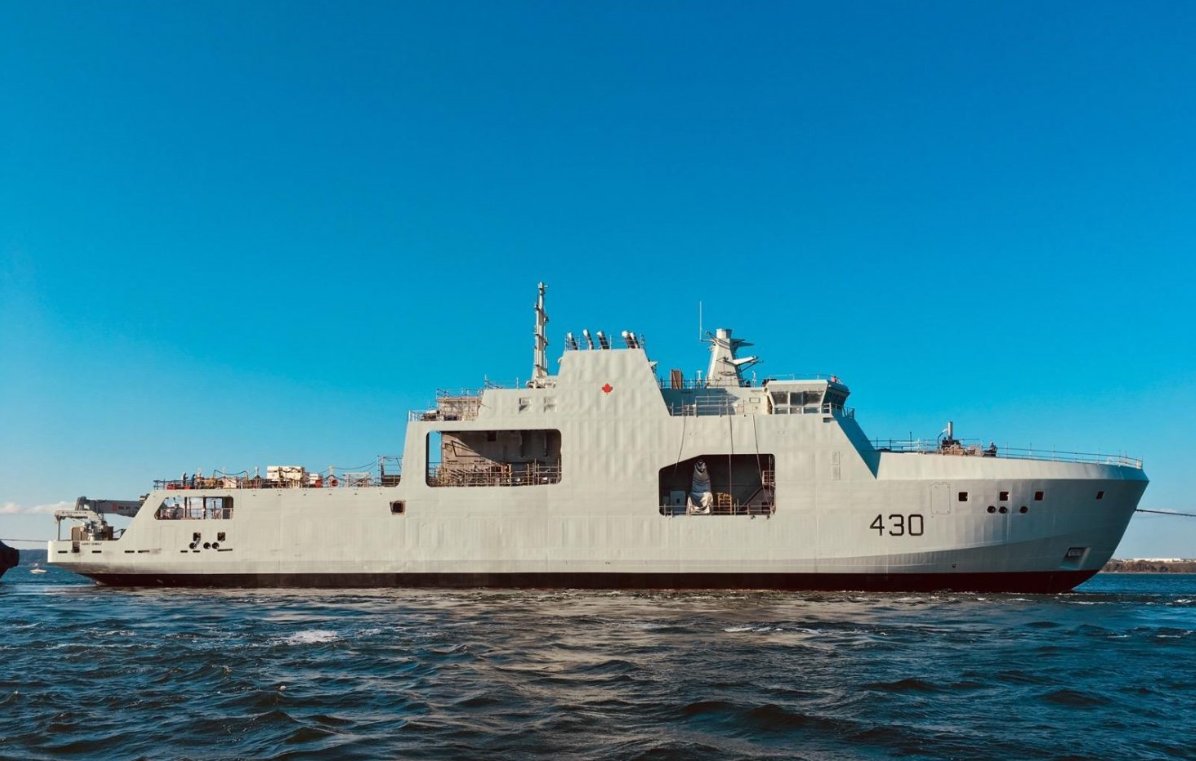
Arctic Offshore Patrol Ship HMCS Harry DeWolf shortly after launch in 2018. The ship was commissioned into the Royal Canadian Navy in June, 2021.
A day or two ago, I found myself thinking about the state of the Royal Canadian Navy. Because, I mean, hey — who doesn’t?
Anyone who has paid much attention to my work will be aware that I’m not exactly bullish on our country’s ability to get much done — especially on the file of military procurement. Yet, a day or two ago, I found myself thinking about the state of the Royal Canadian Navy and feeling something almost like … hope? Is this what hope feels like?
There is a lot going on in Canadian naval news, and that fits a broader pattern. There’s a lot going on on the seas globally, and, somewhat to my surprise, Canada seems to be doing a pretty good job — could be better, but could be worse — adapting to the new reality.
[…]
So let’s talk about seapower. The U.S. has it — not as much as it wants, but it’s got it. It wants more. Even if that ends up taking some pretty weird forms. And others are racing to catch up.
Including, intriguingly, Canada.
Last week, Canadian shipyard Seaspan announced that it had signed agreements with both Finland and American shipyards to licence its design for Multi-Purpose Icebreakers to the U.S. Coast Guard’s Arctic Security Cutter Program. And while the “Elbows Up” crowd may look askance at the prevalence of the word “American” in that sentence, this is damned interesting — not only are we continuing to show interest in the Arctic, but we’re also trying to sustain real shipbuilding in this country. The situation in the White House is so bizarre these days that it’s hard to take any announcement like this to the bank, but it was notable. If nothing else, it would be nice to see more efforts like this — whether the plans work will, alas, largely be out of our hands.
In addition to that, a few more stories came to mind. The first was this announcement from a few months ago: the Irving Shipyards have begun work on the final Arctic Offshore Patrol Ship of the Harry DeWolf class. Irving is also getting started on the next generation of Canada’s main warships, the River-class destroyers. Canada is actively seeking a replacement, in far greater numbers, of its current fleet of problematic submarines. And there’s also growing talk about a new smaller, mid-range class of Canadian warship, dubbed, for now, the Continental Defence Corvette. (Which I guess rolls off the tongue better than the See, Trump, We’re Spending On the Military Now Program.)
It’s easy to be a cynic on Canadian defence procurement — I am cynical about Canadian defence procurement. But then I looked at the ships being seized by U.S. forces. At Russia cutting cables, China ringing Taiwan with missiles and the U.S. throwing fleets around like Theodore Roosevelt has something to prove. And I look at a plan to not only replace Canada’s (too small) fleet of warships, but to considerably grow it … and it’s hard not to see the bigger picture.
Reverting to a pre-1945 geopolitical reality isn’t going to be an exercise in vibes. It’s going to be an exercise in power — or at least attempts to wield power. Air forces matter, cyber matters, drones matter and Lord knows armies matter. But they matter locally. True global power, or at least the ability to give a global power some pause before they decide to whisk your el jefe off to a Manhattan courtroom in a tracksuit, requires the ability to control your coasts and all the ocean approaches to them.