Quotulatiousness

January 12, 2026

Britain’s new “war against misogyny”

Filed under: Britain, Media, Politics — Tags: , , , , , , — Nicholas @ 05:00

At Oxford Sour, Christopher Gage explains how a Netflix show ended up as a key exhibit in the British chattering classes’ latest crusade:

Under our Labour government, the dictionary of euphemisms has swollen to rival War and Peace. Each day mints a fresh brick of Lego Language — words pressed together into sentence shapes that feel moral without actually meaning anything. Euphemism is not just annoying speech; it is a habit of mind. The mouth that traffics in euphemisms aligns with the mind that thinks in euphemisms too.

Nowhere is this clearer than in Labour’s declared War on Misogyny. According to our betters, Britain is a scorched plain over which misogynists roam, knuckles dragging, hypnotised by Andrew Tate and the Manosphere. These creatures, we are told, stalk the land, muttering statistics about male athletic advantage like a swarm of demented Daleks.

Our Labour government, its approval rating currently three percent lower than the percentage of Brits who believe there is a monster living in Loch Ness Lake, will train teachers to spot misogyny in boys and send “high-risk” offenders to courses to “tackle the root causes of misogyny”.


Misogyny, however, is not a vibes-based category. The word comes from the Ancient Greek misos (hatred) and gunē (woman): hatred of women. Until recently, it described a pathological condition involving fear, control, and violence directed at women. Such brutal men exist. They always have. But are they representative of the average British schoolboy doom-scrolling through social-media nonsense? Press X to doubt.

Yet this is where the campaign now lands: in classrooms of adolescent boys, taught to interrogate their latent depravity before it has manifested. It is not behaviour being punished, but probability.

In a culture strapped to the algorithm, only the most extreme definitions float to the surface. The brain, trained by screens, learns to seek the sensational, the novel, the ludicrous. And so, Labour shapes its moral imagination on content rather than evidence.

The Netflix drama Adolescence perfectly captures this drift. For the unacquainted, the series — an incel murder story drugged liberally with “that Andrew Tate shit” — was received as revealed truth. For The Guardian, it was “the best TV show ever”. It was not. Even a semi-literate eye would charge Adolescence as, well … adolescent.

Nevertheless, Adolescence assumed the status of revealed truth. On a BBC news panel, Tory leader Kemi Badenoch was interrogated for admitting she had not yet seen it. Middle-class parents dutifully watched alongside their sons, scanning their offspring for signs of misogyny leaking from its gills. Fiction hardened into diagnosis.

Life now imitates social media. Labour’s plan to tackle misogyny appears lifted directly from the website formerly known as Twitter. Schools will teach boys that it is not acceptable to act like barbarians. One wonders who imagined otherwise.


What these awareness seminars will not address — naturally — are the forms of misogyny that are neither hypothetical nor algorithmically inferred, but routine, organised, and existing beyond a Twitter feed or a Netflix menu.

They will not dwell on forced veiling, female genital mutilation, so-called honour violence, or acid attacks — practices documented in Britain and overwhelmingly concentrated within small but electorally critical communities governed by brutal patriarchal codes.

A rational observer might reasonably conclude that such practices meet any serious definition of misogyny: not ironic hatred, not incel posturing, but actual coercion, violence, and control exercised over women’s bodies and lives. You know, the very domination that Iranian women (and men) are currently risking their lives — quite literally — to uproot.

Yet these realities remain untouched and unmentioned, whilst classrooms revert into courtrooms enlisted to pre-emptively correct the imagined sins of adolescent boys. The reason is not moral complexity but political convenience. Euphemism thrives where naming the problem would threaten electoral arithmetic.

And so, the language grows ever softer around real brutality, even as it hardens against boys whose only crime is to physically resemble a fictitious incel murderer on Netflix.
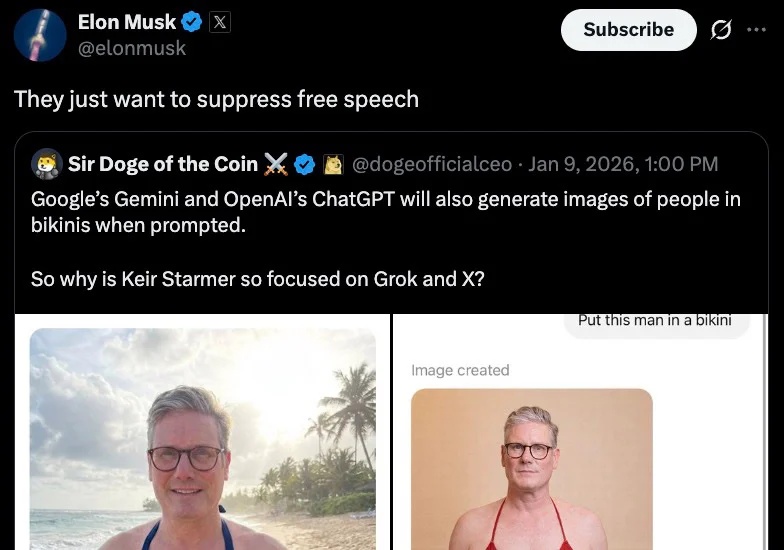
Is Keir Starmer malevolent or stupid? Or both?

On his Substack, Tim Worstall wonders just how damn stupid Two Tier Keir actually is:

I fear our answer has to be very, very, stupid indeed. Unless he’s simply malevolent which makes things oh so much better, right?

Now, I confess to a fundamental disagreement with the very premise here. For the argument about why we should make child porn legal, see here. Making it more difficult to generate, let alone illegal, strikes me as the wrong decision. But then I’m sufficiently wise in years to realise that I might not be able to persuade some people of either that or of the many other things I am correct about. So, let us leave that aside.

There’s also the point that Grok is hardly the only image generation tool out there these days. Further, the one thing we know about computing is that this year’s leading, bleeding, edge is the free phone app of 5 years in the future. Shrieking that this must be banned just isn’t going to cut it as anyone trying that is simply a Cnut demanding the tide doesn’t flow in.1 On that larger issue of image generation in general we’re just going to end up changing the societal rules. A picture is no longer proof of anything. After all, it wasn’t up until about 1850 — those painters would just do any old thing, the truth be damned — and it won’t be after about 2028. Well, there we are then but …

But OK, let us leave all of that to one side and start from where British politics currently is. Grok generated AI kiddie porn is Bad, M’Kay, and must stop:

    Technology Secretary Liz Kendall says she would back regulator Ofcom if it blocks UK access to Elon Musk’s social media site X for failing to comply with online safety laws.

    Ofcom says it is urgently deciding what to do about X’s artificial intelligence (AI) chatbot Grok, which digitally undressed people without their consent when tagged beneath images posted on the platform. X has now limited the use of this image function to those who pay a monthly fee.

    But Downing Street said the change was “insulting” to victims of sexual violence.

“Downing St” is the equivalent of the American “the White House said” … so yes, that is Keir Starmer, the Prime Minister there.

We’ve also an article from Liz Kendall today:

    That Grok continues to allow this kind of content to be created by those willing to pay for it is an insult to victims. No business model should be built on the exploitation and abuse of women and children.

    The Online Safety Act was designed precisely for situations like this, where platforms fail to take their responsibilities seriously and allow harmful content to proliferate. The British public rightly expects robust action. This is a matter of urgency that demands an urgent response.

    I’ve also been clear that the Online Safety Act includes the power to apply to the courts to block services from being accessed in the United Kingdom if they refuse to comply with UK law.

We can see the threat there. If Elon Musk doesn’t do something about this then we’ll block X/Twitter from the UK.


  1. Why yes, I do know the correct story of Canute and the tides.

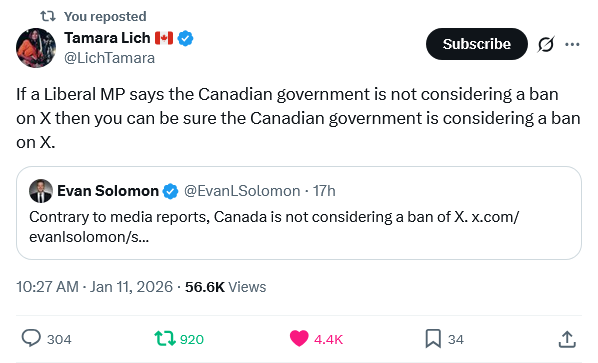
A Canadian and Australian connection showed up as well:

While I don’t depend on the social media site formerly known as Twitter for my news, I have found it a very useful additional source since Elon Musk took over the site. I’m clearly not the only one to feel this way:

As they used to say, however, “never believe anything until it’s been denied by the Kremlin”:

The rise of slop – “you get a clanker, and you get a clanker, everyone gets a clanker!”

Filed under: Business, Media, Technology — Tags: , , , — Nicholas @ 03:00

The artificial intelligence wave continues, despite widespread resistance to AI being inserted into everything. It was bad when your toaster and refrigerator started needing access to the internet, but it’s bound to be so much worse when everything has to have an AI component bolted on to it as well. At The Libertarian Alliance, Neil Lock decries the rising tide of AI slop:

In recent days, there has been an eruption in the tech world. It is unlike anything I have seen in my more than half a century as a software developer, consultant and project manager. Microsoft, its Windows 11 operating system in particular, and artificial intelligence (AI), are in trouble. Big trouble.

The pressures leading to this eruption have been building for a year or so. Right now, the effects are confined mostly to tech blogs and tech people in the USA. But they are spreading. And fast.

Slop

In the last couple of years, AI-generated content has become ubiquitous on the Internet. It may consist of text, images or videos. Some of it is dangerous – for example, erroneous medical information. Most of it is of low to very low quality. And some of it is just bizarre. Such as the infamous “shrimp Jesus” I used as the featured image for this post.

In tech circles, the stuff has become known as “slop”. When you do a Google search, you may see more links to slop than to human-produced material. It looks as if “sloppers” have been using AI to generate large amounts of clickbait, not to mention content that may be misleading or downright dangerous.

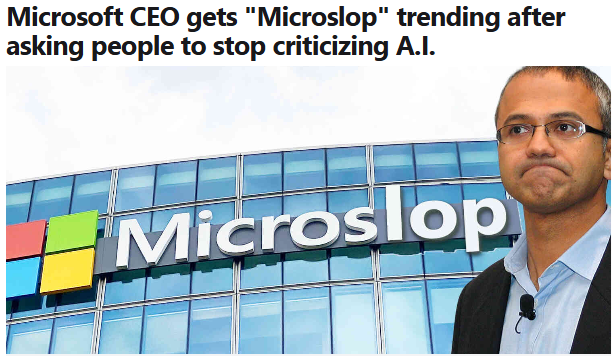
In February 2025, Microsoft’s CEO, Satya Nadella, pleaded in an interview for people to stop using the term “slop”. Saying “people are getting too precious about this”. The response could not have been further from what he asked for. The word “slop” went viral.

So much so, that last month Merriam-Webster, the dictionary publishers, declared “slop” to be their “word of the year”. Nadella responded huffily to this, saying: “we need to get beyond the arguments of slop versus sophistication”. The Internet tech community disagreed. And they took their revenge1 by re-naming the phenomenon “Microslop”.

Windows 10 and Windows 11

All tied up with this is Microsoft’s botched transition from Windows 10 to Windows 11.

Windows 11 was launched in October 2021. Due to higher hardware requirements, it would not run on around 60% of the PCs then running Windows 10. Including mine. That was already a time-bomb.

Support for Windows 10 was withdrawn for general customers on October 14th, 2025. Although Extended Security Updates (ESUs) remained available for corporate customers who wanted to keep Windows 10 running.

At no point has Windows 11 been popular with users. It had only about half the take-up Microsoft had expected. And by February 2025, many companies who had “upgraded” their staff’s PCs to Windows 11 had started returning them to Windows 10. It’s estimated that 400 million computers world-wide are still running Windows 10 without any Microsoft software support, simply because the users cannot, or do not wish to, “upgrade” to Windows 11.

Worse, some of Microsoft’s biggest corporate clients, with hundreds of thousands of users each, are switching to Apple Mac. And tech-savvy customers, including gamers and many smaller professional firms, are moving towards platforms like Linux.


  1. https://cybernews.com/ai-news/microsoft-ai-microslop-copilot/

If — when — Microsoft tries to force me to switch to a version of Windows with a built-in clanker, then I’ll be forced to switch to Linux. I do have a functional Linux laptop (a 14-year-old HP laptop that could barely boot under Windows by the end, but is now almost peppy running Linux). There’s only one piece of software I still run that doesn’t have a Linux version or competitor but if I accept the reduced functionality of running it in a web browser rather than natively, I could get by.

A Modern Integrally Suppressed Pistol for Everyone: The SilencerCo Maxim 9

Filed under: USA, Weapons — Tags: , , , , , — Nicholas @ 02:00

Forgotten Weapons
Published 20 Aug 2025

SilencerCo announced the Maxim-9 pistol in late 2015. Having gone through some huge growth of the past few years, the company wanted to expand its capabilities and thought that the time was right for a modern integrally suppressed pistol. It was a unique new design of modern semiautomatic pistol build from the ground up to be integrally suppressed. The action is a proprietary delayed blowback system with all of the moving parts in the back half of the slide. This leaves the front of the gun dedicated entirely to suppressor volume.

The guns were released at SHOT Show 2017, and were relatively slow sellers, because of the high price and the required NFA registration. The expected passage of the Hearing Protection Act around that time would have been a huge boon for sales, but did not ultimately happen. Still, production continued until tapering off in early 2021 as SilencerCo shifted priority to regular suppressor manufacture in the face of a boom in demand.

The project may not have been a massive success for SilencerCo, but it was still a worthy endeavor that they do not regret. It helped mature the company, forcing them to embrace new proficiency in things like GD&T and advanced quality control machinery. And the pistol is, in fact, very cool.
(more…)

QotD: The death of satire

The English comedian, Harry Enfield, made a return to the BBC between 2007 and 2012. Compared to his more observation-based comedy in the early ’90s, there was clearly a more reactionary turn in his 2000s work. Targets included a multitude of establishment celebrities and pompous television presenters, Eastern European immigrants, the band U2, and, most brutally of all, upper-middle-class liberals.

Enfield was doing what all court jesters should do: delivering uncomfortable truths to those in power. The jester’s often painful or embarrassing jibes can be taken in good faith and acted upon, ignored, or worse. The idea is to convey what everyone outside the court is thinking and how the ordinary person perceives those with power and influence. While Enfield’s work of this era certainly merits a more focused analysis, here I’d like to zoom in on one sketch based on a favourite Enfield target, the show Dragons’ Den.

Enfield excoriates the ludicrously pompous panel of wealthy, high-status business owners and their seeming right to supreme arrogance justified simply by their wealth. In one skit, Enfield and Paul Whitehouse arrive to pitch an idea as bumbling English entrepreneurs trying to get the “Dragons” to invest in their concept called “I can’t believe it’s not custard”. The Dragons, also played by Enfield and Whitehouse, sneer and spit venom at the Englishmen and their stupid idea, swiftly sending them away with no investment whatsoever.

The two white men later return, adorned in black-face and Jamaican accents with a pitch called “Me kyan believe it nat custard” and the Dragons fall at their feet, showering them with money. They then begin to compete with each other in sycophantically grovelling, fearful that the least enthusiastic of them will be deemed racist.

The sketch hits like a thunderbolt because Enfield holds up a mirror to a particular class of people, saying, “This is what you are!” We, as the common folk, take great delight in this lampooning because we know it to be a painful, somewhat grotesque truth. In an ocean of noise, it is a clear, bright signal that something is not right.

It is both a commentary on multiculturalism and a critique of those with power and influence. Yet, for some reason, this sketch lands harder than, say, a Spitting Image sketch in the 1980s targeting Margaret Thatcher’s economic policies. There is a sense that an agreed-upon lie is being teased out into the glare of daylight and unceremoniously prodded and kicked about. The morality of the pretentious Dragons is a sham, and as such, their status is deflated before us.

Enfield revealed, in that single clip, the inherent fragility of the managerial classes dedicated to propagating via “virtue signalling” the values of the multicultural state. The millionaires of the Dragons’ Den panel adopt the attitudes and worldview of brutal free-market meritocrats, with the only subject of interest to them being whether or not a product or service is worthy of investment. Enfield implied that this worldview was a lie, a charade, and that they were no more outside of the central multicultural metanarrative than a Guardian journalist. The Dragons’ Den panel, and therefore neoliberalism, was not an alternative or competitor, but rather subordinate to the politically correct dogma of the age.

From the perspective of Britain’s liberal elite, Enfield committed a multitude of sins against them and their values, which probably explains why, after his show was shuffled off to BBC 2 to die, they never allowed themselves to be confronted with such lampooning ever again. The external frame from which people can gaze back into the general narrative would be kept permanently locked out.

Yet, this also marked a transition from a Blairite neoliberalism, in which the justification for mass immigration was to infuse British society with fresh energy and dynamism, into a more stagnant form wherein the upholding of the multicultural order became its own justification.

Morgoth, “How Multiculturalism Consumes Everything”, Morgoth’s Review, 2025-10-04.

Powered by WordPress