Quotulatiousness

January 11, 2026

“The Paradox of Indifference”

Filed under: Media, Politics, Technology — Tags: , , , — Nicholas @ 05:00

Kulak describes the experiences of crafting takes for the gaping maw of social media and getting … nothing. You might as well not have bothered — we all know how that works, don’t we? But sometimes you catch lightning in a bottle and your post goes viral and then you get the worst kind of feedback:

People don’t show up to comment “No one gets it”, “Another miss”, “You aren’t funny”, “You’re wasting your life on Twitter” [as they tweet at you], “No one loves you”, “You never get laid”, “you’re a whore”, “you know nothing about BDSM Romance in Desert Storm, nor how that relates to the Czech Surrealism”, “No one cares”

When you are actually wasting your time and getting no traction, Not a soul alive is going waste their own time EVEN MORE-SO to sit there and commentate your embarrassment and failure.

Think about it, No matter how much Jehovah’s Witnesses or street preachers are wasting their lives and no one is listening, you’d be wasting your life even more so to sit there trying to persuade them of that fact.

Indeed the ONLY times you’ll EVER get comments like these … Is when you ARE getting traction.

It’s really amazing! Countless times you’ll tweet or post something you thought was clever, insightful, drole, important, philosophically or spiritually relevant … And nothing.

Then one of them Moon-Shoots, takes off to 6, 8, 10 MILLION impressions, 10s of thousands of likes …, thousands of retweets … And suddenly THAT ONE you start getting “No one cares”.

I’ve seen THOUSANDS of comments, “No one cares” “you’re weird for caring” all on the same tweet, RETWEETS from accounts with a MILLION followers “Who cares what this person thinks!? No one’s listening to them” They tweet out to a million people.

YOU DO!

Otherwise you would have just kept scrolling.

Its actually really remarkable the amount of effort, collective work, and social organization that goes into this.

I’ve seen Tweets with THOUSANDS OF COMMENTS, getting hundreds of retweets and hundreds of comments that “No one cares” … Sometimes these retweets themselves get comments and conversations going in circles “These people really think we care what they think?”, “I know right? They’re obsessed with us, as if we care” and if you’re looking closely you can actually see various followers of the people who “don’t care”, Comment themselves that they “don’t care” beneath their favorite E-Celebrity “not caring” that they also “don’t care”, and then follow their way back to your original tweet to say “We don’t care”, before Retweeting you themselves to say “God, these people. They actually think we care!?”

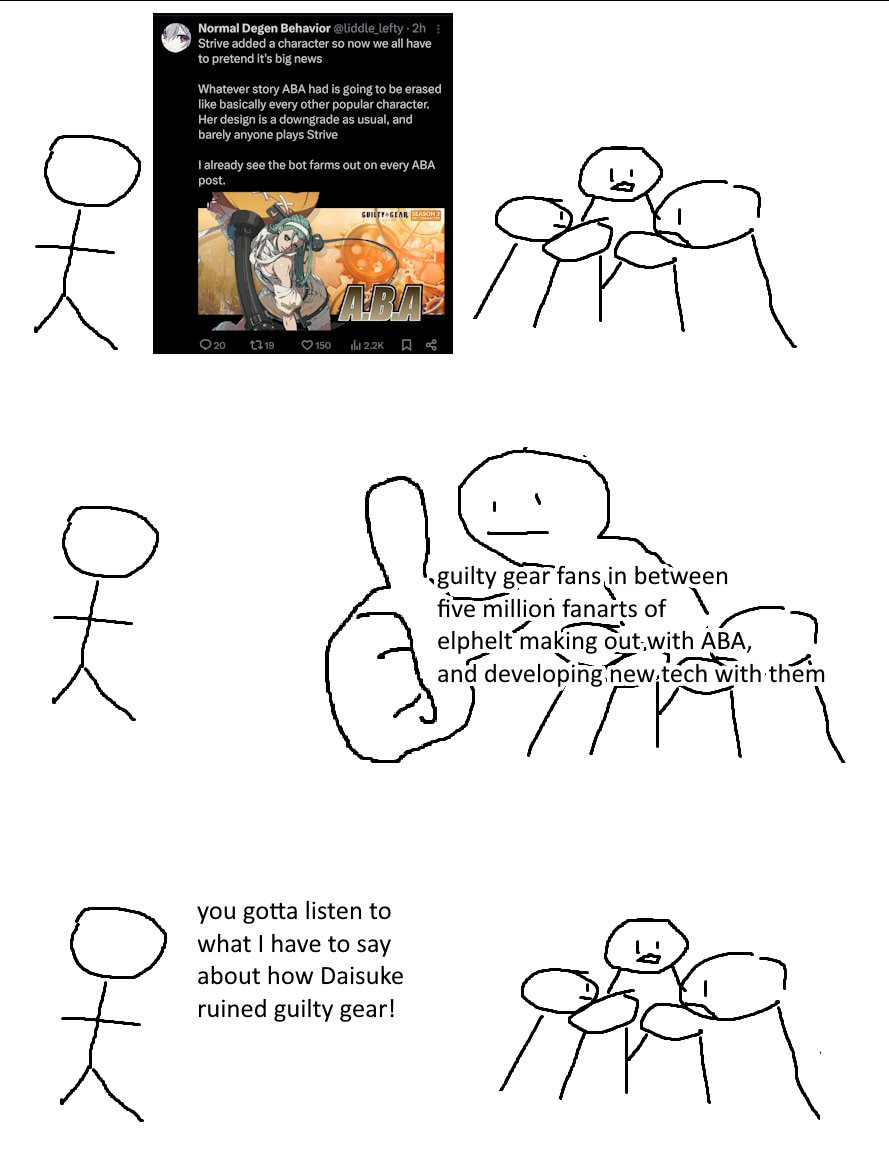
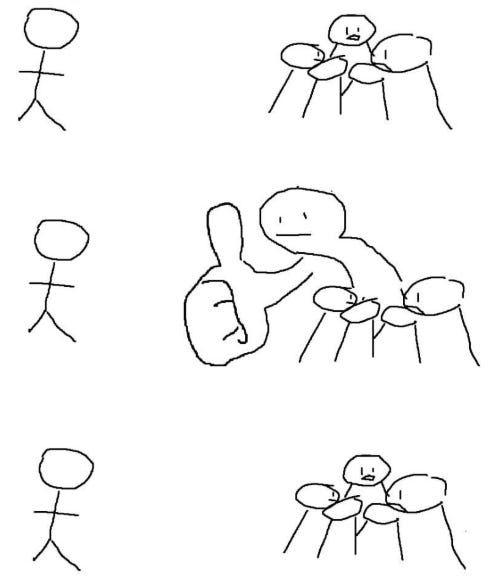
Indeed there’s an entire MEME FORMAT — the only meme as far as I can tell the left has ever successfully created for themselves — That exists solely to express that they “don’t care”

“Giant Thumb Guy”, Look at us Cool people in our group collective, and you outside it, and how we just barely acknowledge you then go back to ignoring you.

You see you can tell it’s a leftist meme format because they didn’t use any wojaks or existing memes … Also it’s poorly constructed and uses a redundant three panel format that has been on its way out in memes since 2015.

I’ve seen various leftists create elaborate Photoshops of this meme … Just to respond how little they care, because that’s what you do when don’t care.

Now admit it, Can you tell a redditor created this? Look at the alt-text that came embedded in the image. (No I don’t actually know what Guilty Gear is…but we’ll be charitable and assume its just a fun and well enough written game and not barely concealed porn)

And of course other times their innate violent impulses infect the meme:

Because escalating immediately from words to threats of violence shows how cool and unconcerned you are.

“But Kulak!?” I hear you say, in a bout of inner-Redditor cleverness, “You’re a hypocrite! You clearly care too! You’ve written this entire piece so far just going on about how you don’t care, about them not caring, about your thing that you did that they didn’t care about!!! Would you have done that if you don’t care?! A-Ha! We got you!”

Ugh … Of course I care. This is fascinating. My anthropological instincts are tickled to the core!

Simply fascinating.

My working hypothesis is that leftists, a wide cross-section of women, effeminate men, the SSRI’d, men who’ve suffered genital trauma, the unintelligent, the weak willed, and just generally those of poor inner conviction, reason, hormonal health, and disagreeable virtue (but then I’ve repeated myself many times now) … Interpret their emotions and ideas via a complex communicative social environment they maintain with each-other.

Their minds and reasoning depends on a group, or longhouse, or “Community”, or “friends” … whereas the superior Chad, Chadette, Chud, and Chudette western autists are able to forgo, for extended periods, any need for such a social mental framework or even forego such “friends” and “community” entirely.

Thus, like the apex predators they are, these noble solitary creatures are able to rely upon their own superior reason and judgement. Inside of you are two wolves … and one of them is fallacious and gay, and the superior rational man should ignore him.
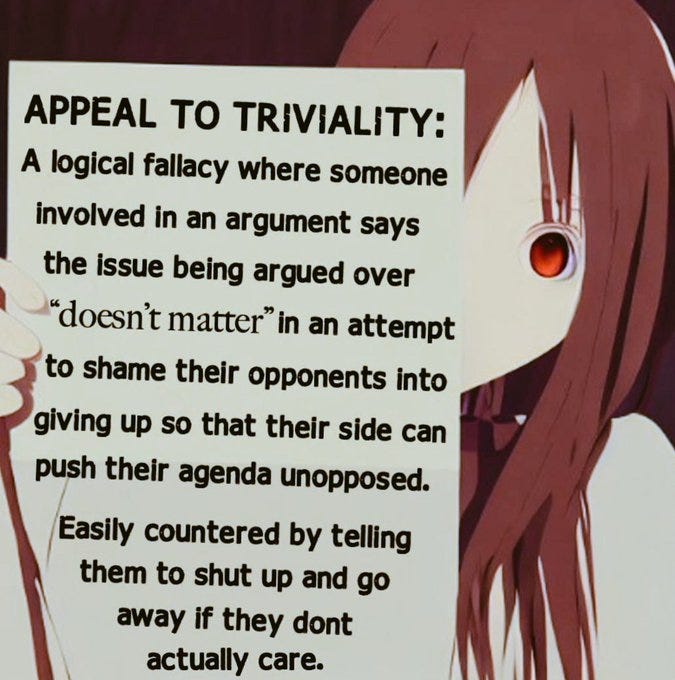
It’s a long post and covers a lot of territory, so do read the whole thing.
Nazis Are the Big Losers – Rise of Hitler 26, October-December 1932

Filed under: Germany, History — Tags: , , , , — Nicholas @ 04:00

World War Two
Published Jan 10, 2026

Adolf Hitler and the Nazi Party are forced to hit the campaign trail yet again for yet another round of elections. All this campaigning has seriously drained their finances, so they expect it to do some real good. Unfortunately for them, the November elections are very disappointing for the Nazi Party, and they lose a lot of seats in the Reichstag. Adolf Hitler is still demanding that President Hindenburg make him Chancellor, but the President still refuses time and again, although Hindenburg does have his hands full with two other Chancellors — Franz von Papen and Kurt von Schleicher, and their endless political intriguing.
(more…)

Iran in the news

Filed under: Media, Middle East, Politics, Religion — Tags: , , , , , — Nicholas @ 03:00

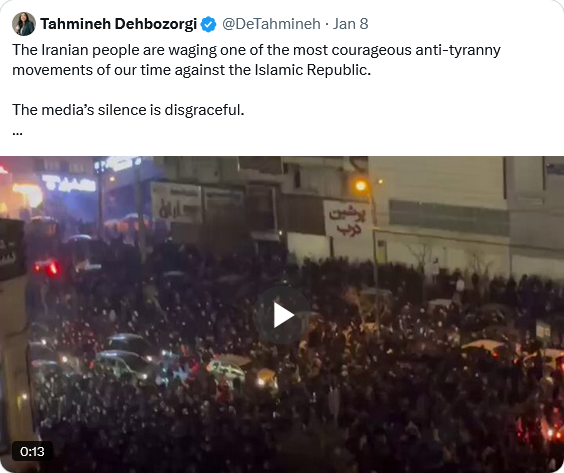
There’s a major upheaval going on in Iran, but the western media seem to be incapable of covering it with any depth — or in far too many cases, at all — even though it’s exactly the sort of thing they used to be very interested in. On the social media site formerly known as Twitter, Tahmineh Dehbozorgi provides useful context:

The Western liberal media is ignoring the Iranian uprising because explaining it would force an admission it is desperate to avoid: the Iranian people are rebelling against Islam itself, and that fact shatters the moral framework through which these institutions understand the world.

Ideally, to cover an uprising is not just to show crowds and slogans. It requires answering a basic question: why are people risking death? In Iran, the answer is simple and unavoidable. The people are rising up because the Islamic Republic of Iran has spent decades suffocating every aspect of life — speech, work, family, art, women, and economic survival — under a clerical system that treats liberty as a crime. There is no way to tell that story without confronting the nature of the regime.

Western media refuses to do so because it has fundamentally misunderstood Islam. Or worse, it has chosen not to understand it.

Islam, in Western progressive discourse, has been racialized. It is treated not as a belief system or a political ideology, but as a stand-in for race or ethnicity. Criticizing Islam is framed as an attack on “brown people”, Arabs, or “the Middle East”, as if Islam were a skin color rather than a doctrine.

This confusion is rooted in historical illiteracy. Western liberal media routinely collapses entire civilizations into a single stereotype: “all Middle Easterners are Arabs”, “all Arabs are Muslim”, and “all Muslims are a monolithic, oppressed identity group by white European colonizers”. Iranians disappear entirely in this framework. Their language, history, and culture — Persian, not Arab; ancient, not colonial; distinct, not interchangeable — are erased.

By treating Islam as a racial identity rather than an ideology, Western media strips millions of people of their ability to reject it. Iranian protesters become unintelligible. Their rebellion cannot be processed without breaking the rule that Islam must not be criticized. So instead of listening to Iranians, the media speaks over them — or ignores them entirely.

There is another reason the Iranian uprising is so threatening to Western media is economic issues.

As you know, Iran is not only a religious dictatorship. It is a centrally controlled, state-dominated economy where markets are strangled, private enterprise is criminalized or co-opted, and economic survival depends on proximity to political power. Decades of price controls, subsidies, nationalization, and bureaucratic micromanagement have obliterated the middle class and entrenched corruption as the only functional system. The result is not equality or justice. It is poverty, stagnation, and dependence on government’s dark void of empty promises.

Covering Iran honestly would require acknowledging that these policies are harmful. They have been tried. They have failed. Catastrophically.

This is deeply inconvenient for Western media institutions that routinely promote expansive state control, centralized economic planning, and technocratic governance as morally enlightened alternatives to liberal capitalism. Iran demonstrates where such systems lead when insulated from accountability and enforced by ideology. It shows that when the state controls livelihoods, non-conformity becomes existentially dangerous. That lesson cannot be acknowledged without undermining the moral authority of those who advocate similar ideas in softer language.

Western liberal media prefers not to hear this. Acknowledging it would require abandoning the lazy moral categories that dominate modern discourse: oppressor and oppressed, colonizer and colonized, white and non-white. Iranian protesters do not fit. They show that authoritarianism is not a Western invention imposed from outside, but something many societies are actively trying to escape.

That is what terrifies Western liberal media. And that is why the Iranian people are being ignored.

So the silence continues.

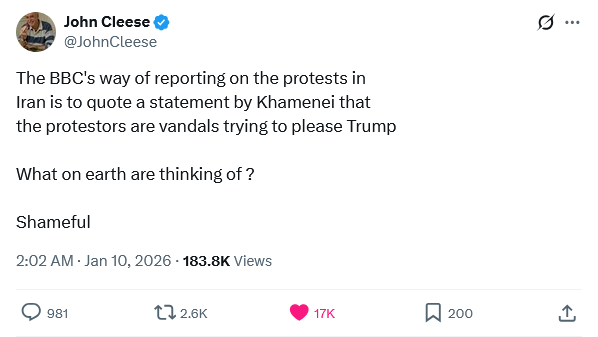
John Cleese:

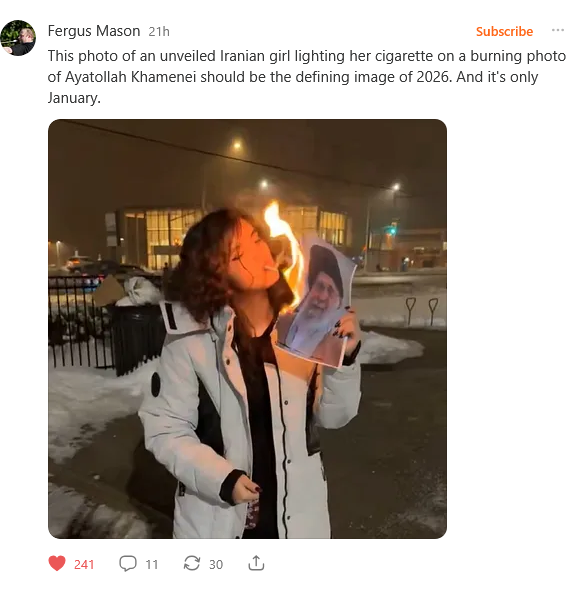
On Substack Notes, Fergus Mason shares what might be the most iconic photo of the young year:

Update, 12 January: Welcome, Instapundit readers! Have a look around at some of my other posts you may find of interest. I send out a daily summary of posts here through my Substackhttps://substack.com/@nicholasrusson that you can subscribe to if you’d like to be informed of new posts in the future.

Paul Sellers’ Thickness Guide | Paul Sellers

Filed under: Tools, Woodworking — Tags: , , — Nicholas @ 02:00

Paul Sellers
Published 19 Sept 2025

Often in our woodworking projects, we might need many repeat cuts that guide our planes to give stock of precise thicknesses, and I make guides just like this one to give me the precision I need.

They are quick and simple to make, and you can change the thickness of the strips to match the thicknesses you need.

To access the Thickness Guide drawing follow: https://paulsellers.com/thicknessing-guide-drawing-and-cutting-list/
——————–
(more…)

QotD: The limits of foreign policy realism

Longtime readers will remember that we’ve actually already talked about “realism” as a school of international relations study before, in the context of our discussion of Europa Universalis. But let’s briefly start out with what we mean when we say IR realism (properly “neo-realism” in its modern form): this is not simply being “realistic” about international politics. “Realism” is amazing branding, but “realists” are not simply claiming that they are observing reality – they have a broader claim about how reality works.

Instead realism is the view that international politics is fundamentally structured by the fact that states seek to maximize their power, act more or less rationally to do so, and are unrestrained by customs or international law. Thus the classic Thucydidean formulation in its most simple terms, “the strong do what they will, the weak suffer what they must”,1 with the additional proviso that, this being the case, all states seek to be as strong as possible.

If you accept those premises, you can chart a fairly consistent analytical vision of interstate activity basically from first principles, describing all sorts of behavior – balancing, coercion, hegemony and so on – that ought to occur in such systems and which does occur in the real world. Naturally, theory being what it is, neo-realist theory (which is what we call the modern post-1979 version of this thinking) is split into its own sub-schools based on exactly how they imagine this all works out, with defensive realism (“states aim to survive”) and offensive realism (“states aim to maximize power”), but we needn’t get into the details.

So when someone says they are a “foreign policy realist”, assuming they know what they’re talking about, they’re not saying they have a realistic vision of international politics, but that they instead believe that the actions of states are governed mostly by the pursuit of power and security, which they pursue mostly rationally, without moral, customary or legal constraint. This is, I must stress, not the only theory of the case (and we’ll get into some limits in a second).

The first problem with IR Realists is that they run into a contradiction between realism as an analytical tool and realism as a set of normative behaviors. Put another way, IR realism runs the risk of conflating “states generally act this way”, with “states should generally act this way”. You can see that specific contradiction manifested grotesquely in John Mearsheimer’s career as of late, where his principle argument is that because a realist perspective suggests that Russia would attack Ukraine that Russia was right to do so and therefore, somehow, the United States should not contest this (despite it being in the United States’ power-maximizing interest to do so). Note the jump from the analytical statement (“Russia was always likely to do this”) to the normative statement (“Russia carries no guilt, this is NATO’s fault, we should not stop this”). The former, of course, can always be true without the latter being necessary.

I should note, this sort of “normative smuggling” in realism is not remotely new: it is exactly how the very first instances of realist political thought are framed. The first expressions of IR realism are in Thucydides, where the Athenians – first at Corinth and then at Melos – make realist arguments expressly to get other states to do something, namely to acquiesce to Athenian Empire. The arguments in both cases are explicitly normative, that Athens did not act “contrary to the common practice of mankind” (expressed in realist dog-eat-dog terms) and so in the first case shouldn’t be punished with war by Sparta and in the latter case, that the Melians should submit to Athenian rule. In both cases, the Athenians are smuggling in a normative statement about what a state should do (in the former case, seemingly against interest!) into a description of what states supposedly always do.

I should note that one of my persistent complaints against international relations study in political science in general is that political scientists often read Thucydides very shallowly, dipping in for the theory and out for the rest. But Thucydides’ reader would not have missed that it is always the Athenians who make the realist arguments and they lost both the arguments [AND] the war. When Thucydides has the Melians caution that the Athenians’ “realist” ruthlessness would mean “your fall would be a signal for the heaviest vengeance and an example for the world to meditate upon”2 the ancient Greek reader knows they are right, in a way that it often seems to me political science students seem to miss.

And there’s a logical contradiction inherent in this sort of normative smuggling, which is that the smuggling is even necessary at all. After all, if states are mostly rational and largely pursue their own interests, loudly insisting that they should do so seems a bit pointless, doesn’t it? Using realism as a way to describe the world or to predict the actions of other states is consistent with the logical system, but using it to persuade other states – or your own state – seems to defeat the purpose. If you believe realism is true, your state and every other is going to act to maximize its power, regardless of what you do or say. If they can do otherwise than there must be some significant space for institutions, customs, morals, norms or simple mistakes and suddenly the air-tight logical framework of realism begins to break down.

That latter vision gives rise to constructivism (“international relations are shaped by ideology and culture”) and IR liberalism (“international relations are also shaped by institutions, which can bend the system away from the endless conflict realism anticipates”). The great irony of realism is that to think that having more realists in power would cause a country to behave in a more realist way is inconsistent with neo-Realism which would suggest countries ought to behave in realist ways even in the absence of realist theory or thinkers.

In practice – and this is the punchline – in my experience most “realists”, intentionally or not, use realism as a cover for strong ideological convictions, typically convictions which are uncomfortable to utter in the highly educated spaces that foreign policy chatter tends to happen. Sometimes those convictions are fairly benign – it is not an accident that there’s a vocal subset of IR-realists with ties to the CATO Institute, for instance. They’re libertarians who think the foreign policy adventures that often flew under the banner of constructivist or liberal internationalist label – that’s where you’d find “spreading democracy will make the world more peaceful” – were really expensive and they really dislike taxes. But “we should just spend a lot less on foreign policy” is a tough sell in the foreign policy space; realism can provide a more intellectually sophisticated gloss to the idea. Sometimes those convictions are less benign; one can’t help but notice the realist pretensions of some figures in the orbit of the current administration have a whiff of authoritarianism or ethnocentrism in them, since a realist framework can be used to drain imperial exploitation and butchery of its moral component, rendering it “just states maximizing their power – and better to be exploiter than exploited”.

One question I find useful to ask of any foreign policy framework, but especially of self-claimed realist frameworks is, “what compromise, what tradeoff does this demand of you?” Strategy, after all, is the art of priorities and that means accepting some things you want are lower priority; in the case of realism which holds that states seek to maximize power, it may mean assigning a high priority to things you do not want the state to do at all but which maximize its power. A realism deserving of the name, in applied practice would be endlessly caveated: “I hate, this but …” “I don’t like this, but …” “I would want to do this, but …” If a neo-realist analysis leads only to comfortable conclusions that someone and their priorities were right everywhere all along, it is simply ideology, wearing realism as a mask. And that is, to be frank, the most common form, as far as I can tell.

That isn’t to say there is nothing to neo-realism or foreign policy realists. I think as an analytical and predict tool, realism is quite valuable. States very often do behave in the way realist theory would suggest they ought, they just don’t always do so and it turns out norms and expectations matter a lot. Not the least of which because, as we’ve noted before, the economic model on which realist and neo-realist thinking was predicted basically no longer exists. To return to the current Ukraine War: is Putin really behaving rationally in a power-maximizing mode by putting his army to the torch capturing burned out Ukrainian farmland one centimeter at a time and no faster? It sure seems like Russian power has been reduced rather than enhanced by this move, even though realists will insist that Russia’s effort to dominate states near it is rational power-maximizing under offensive realism.

Bret Devereaux, “Fireside Friday, June 27, 2025 (On the Limits of Realism)”, A Collection of Unmitigated Pedantry, 2025-06-27.


  1. Thuc. 5.89.
  2. Thuc. 5.90.

Powered by WordPress