Quotulatiousness

January 8, 2026

Minnesota in the news

Filed under: Government, Media, Politics, USA — Tags: , , , , , — Nicholas @ 05:00

Like most people, I don’t normally pay much attention to news from Minnesota unless it involves my favourite NFL team. Thus far, thank goodness, the Vikings seem to have avoided being entangled in the latest scandals, starting with YouTuber Nick Shirley’s exposé of blatant fraud in daycare centres in and around Minneapolis that triggered Governor Tim Walz to end his re-election campaign. On the social media site formerly known as Twitter, Andrew Neil summarizes the situation so far:
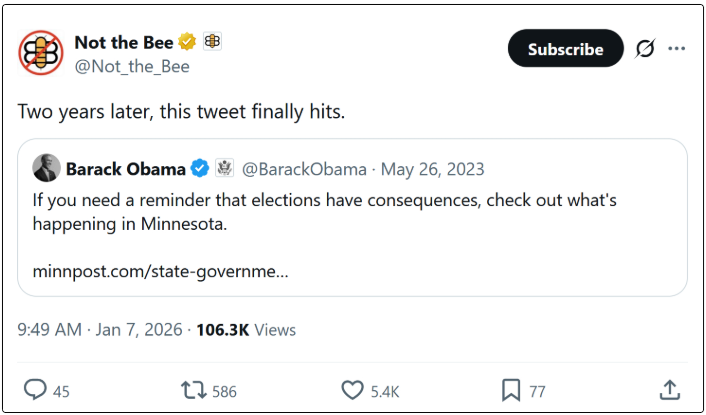
The usual suspects have been claiming on X that the Minnesota fraud scandal is no big deal and that it was racist to place Somalis at the centre of it. They lie. Some facts:

The fraud scandals in Minnesota are a very big deal, involving (so far) the theft of over $1 billion in taxpayer funds across multiple schemes, primarily from federal and state programmes meant for child nutrition, autism services and daycares during and after the COVID-19 pandemic.

Federal prosecutors have already charged almost 100 people. Dozens convicted or pleading guilty. Investigators suggest the total could exceed $9 billion in fraudulent claims.

It is already the largest pandemic-related fraud case in US history, with money siphoned off for personal luxuries like expensive cars and real estate, rather than the intended recipients — like low-income children.

The majority of those charged (around 85 out of 98 defendants in the core cases) are Somali-American. Why? Because the fraud often involved networks of Somali-owned “nonprofits” and businesses inflating claims or billing for nonexistent services.

Governor Tim Walz labeled the scandal being inflamed by “white supremacy” In fact, systemic fraud was enabled by his state’s lax controls. Walz now so discredited he won’t run for Governor again. His political career is over. How this bozo ever passed Kamala Harris’ vetting procedures to be her running mate is a mystery.

At PJ Media, Matt Margolis discusses the latest Nick Shirley video release:

Shirley’s new video dials things up to 11.

David Hoch, co-founder of Minnesotans for Responsible Government, joined him on the ground in Minneapolis, revealing an insane truth: this fraud hits hundreds of billions nationwide. Minnesota’s slice? At least $80 billion. Layers of shell companies obscure the cash trail, including 1,200 medical transport outfits in the area that do nothing while collecting taxpayer dollars.

Hoch swears by his evidence. “I have been to many of these transportation companies, and I’ve been time-stamping my photographs for a whole year at one facility in Minneapolis, and those vans in that parking lot had not moved one inch in an entire year. They’re all still sitting there.”

Hoch also revealed a widespread ballot-harvesting operation tied to Somali communities in Minnesota, claiming the scale of the activity is “way beyond anybody’s imagination,” adding that “the state doesn’t even know” and “the feds don’t even know”.

Shirley asked Hoch why a judge would allegedly defer to what he described as the “head of the Somali mafia”. Hoch responded that the influence stems from raw political power. He described the Somali community as a unified voting bloc that has effectively held Minnesota Democrats hostage. “What they say is if you do something to go against our community, we’re gonna vote for, and they all vote together, and there’s ballot harvesting, I’ve seen them do it, that, ‘We’re gonna vote for your opponent, unless you do what we tell you to do’.”

“And so it’s all purely for votes?” Shirley asked.

“Yes,” Hoch replied.

The conversation then turned to Cedar Riverside, a massive apartment complex in Minneapolis. Hoch said it was just one of many similar developments. “You’ve got 20 more just like this around the Twin Cities, and they’re all Somali,” he said. Hoch estimated “probably 100,000 or more people,” claiming they live rent-free and receive taxpayer-funded benefits. “They’re driving a vehicle that you paid for. They’re eating food that you paid for. Everything they do is, is something that you paid for,” he said.

Hoch also described how he claims the voting process works within the bloc. He alleged that a single individual collects ballots for large numbers of residents, with little oversight. “They’ll have one person go there and collect all the ballots and nobody tracks,” Hoch said. He added that apartments can claim inflated numbers of residents: “They could say they have nine people living in an apartment. They’re gonna send them nine ballots,” which are then gathered by a designated collector.

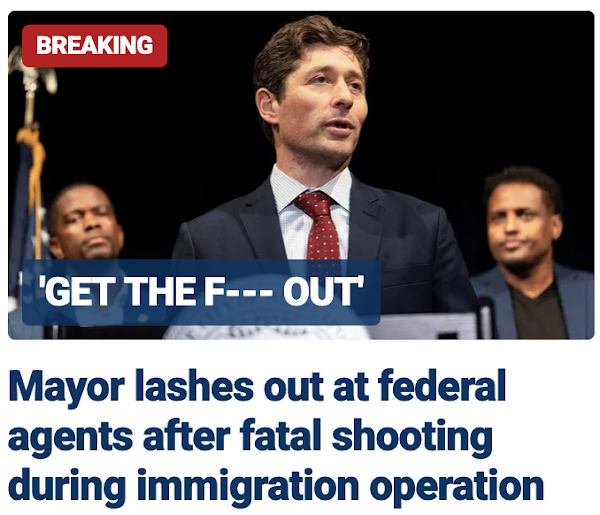
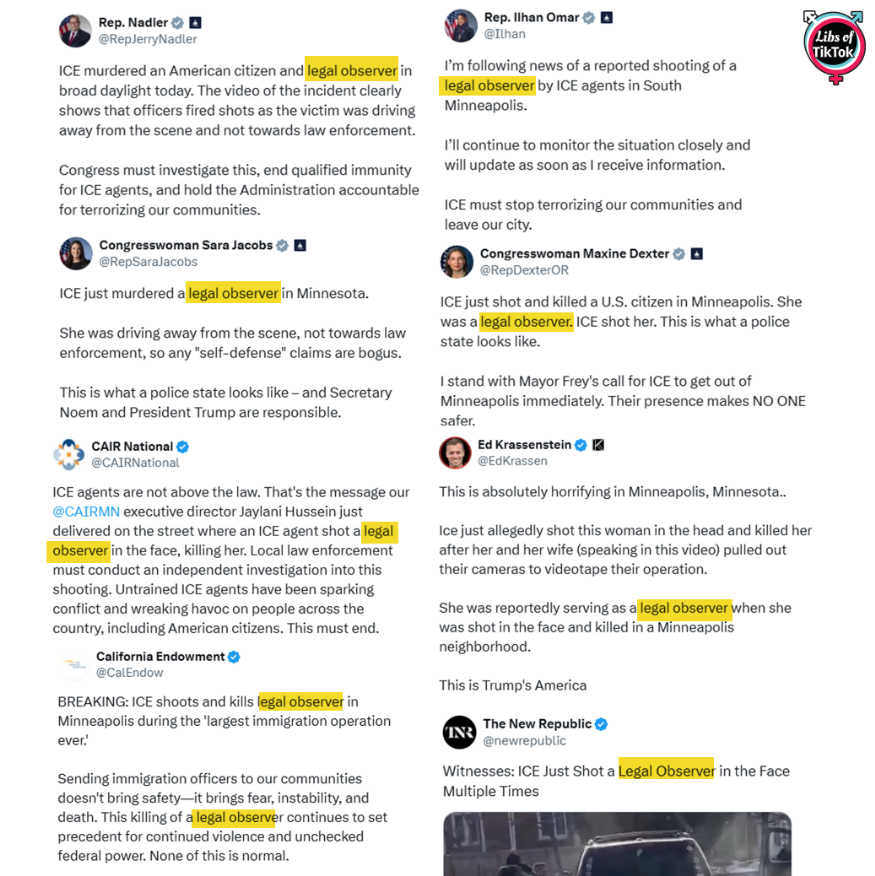
Later on Wednesday, an altercation between organized protesters and law enforcement resulted in the death of a woman after she tried to run down an ICE agent, who shot her in self-defence. The mayor of Minneapolis (Mogadishuapolis?) responded as you might expect:
The debate over this incident breaks down on the usual partisan lines. On the social media site formerly known as Twitter, Kurt Schlichter summarizes the pro-law enforcement position:
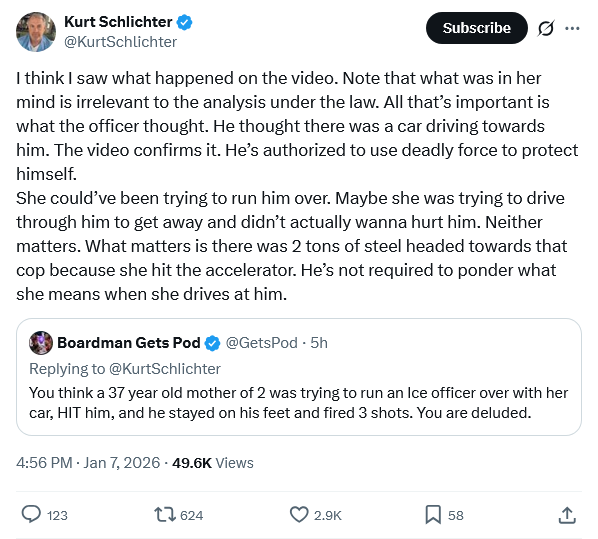
On the other hand, it’s the lockstep belief of the anti-Trump politicians and activists that the agent shot a “legal observer” in the performance of her peaceful, completely legal duties:
Drawing lessons from the Venezuelan operation

Filed under: China, Military, Russia, Technology, USA, Weapons — Tags: — Nicholas @ 04:00

Following up on an item that I shared as part of yesterday’s Venezuela post, ESR expands on the notion that China (among other potentially hostile nations) will be having a lot of time to rethink due to the noted failure of Russian SAM-300s, Chinese anti-air radar, and other high tech items fielded by the Venezuelan military:

I’ve been contemplating the reactions to this post and I realized there is an important point about which I should have been clearer. There are several different ways in which Chinese radars can just NOT FUCKING WORK. My point was intended to be that almost all of them create huge operational uncertainty for the Chinese.

I gather a lot of people thought that “not fucking work” means they’re intrinsically shitty and would fail to do their job even in the absence of countermeasures. I think this is possible, but unlikely.

There are other values of not fucking work. Including:

* Easily neutralized by ECM.

* Easily taken out by cheap anti-rad missiles or drones.

* Easily fried by some kind of monster secret HERF gun.

* U.S. anti-radar stealth is good. I mean, really, mind-bogglingly good. Better than anybody without a top-secret security clearance knows.

Out of all the possibilities, the only scenario that does not threaten the sphincter control of Chinese military planners is “Venezuelan air defense had stand-down orders”. And if that were true, I’m pretty sure it would already have leaked.

“Kidnapping the head of a sovereign state with whom you are not at war is also nuts”

Filed under: Americas, Government, Law, Media, Politics, USA — Tags: , , , , — Nicholas @ 03:00

On the social media site formerly known as Twitter, David Knight Legg responds to an Andrew Coyne post on the legality of the US operation to capture Nicolás Maduro in Venezuela:

Image from CDR Salamander

    Andrew Coyne @acoyne
    Kidnapping the head of a sovereign state with whom you are not at war is also nuts, Jason. The two go together.

Andrew @acoyne this isn’t accurate.

– Maduro was definitively not the elected President of Vanzuela. He was rejected as such by 50 nations incl the EU in 2024. He was a known narco-terrorist and cartel leader that used state capture and the army to run and enforce his drug and sanctions evasion empire.

– Biden put a $25million bounty on his head Jan 2025 for crimes against humanity and the USA cocaine trade, because destroying his nation for a decade, he fraudulently took power in 2024 and committed atrocities against his opponents after losing in a landslide so he could keep using state capture to run Venezuela — with the aid of terror groups and China Russia and Iran who protected him there and at the UN in exchange for oil, gold and a western hemisphere base of operations.

He was taken by the US to face trial just like Noriega in 1990 (on almost identical charges).

It may not suit your politics but bringing him to justice any other way had proven implausible. This is all well known.

Venezuelans around the world are celebrating wildly after two decades of socialist ruin and the worst humanitarian crisis in the western hemisphere creating 8 million refugees.

Honest question: what would you have done instead?

– status quo? let him stay in power with the help of Russia, Iran and China while actively torturing and murdering his opposition?

– more legal proceduralism at a UN Security Council where Russia and China protect him?

– bureaucratic inertia: letting people die and regional security deteriorate under the protection of another strongly worded reminder to abide by international law and stop the narco terrorism and atrocities?

There aren’t easy answers. It’s going to take a lot of work for Venezuela to come back from a deeply embedded Baathist-style state capture, but this is a critical first step for that nation.

If this is actually about Trump instead of the outcome, would you feel the same way if Biden instead of Trump had executed the same strategy to follow his bounty on Maduro?

The demise of Maduro is such an obviously good thing in so many ways it baffles me to see the debate revert to (often inaccurate) readings of legal minutiae with the underlying idea that it was better for him to be left in place …

A few days back, Daniel McCarthy suggested that the Venezuela operation reveals useful information on the “Don-roe Doctrine”:

A small detachment of Canadian “semi-professional leftist protesters” swapped out their Palestinian flags for this photo op.

President Trump is a wager of “un-war”, which confounds his critics and some of his supporters alike. The capture of Venezuelan leader Nicolás Maduro over the weekend is a case in point. The usual semi-professional leftist protesters are hitting the streets of Europe and a few American cities to decry America’s latest war – but what kind of war lasts just two-and-a-half hours?

US troops didn’t invade en masse. A handful of special forces were dropped in, they killed el presidente‘s guards, nabbed their man and got out. Whatever one thinks about the justice of the whole thing, calling it a “war” is ridiculous. If that’s what this was, then Jimmy Carter waged a war with Iran in 1979 when he launched a doomed military mission to rescue US hostages. And the US must have been at war with Pakistan in 2011 when special forces raided Abbottabad and killed Osama bin Laden.

Critics of US foreign policy have long mocked the tendency of neoconservative hawks to frame every foreign tension as a replay of 1939. Such mockery is well deserved. Yet many of the same people who perceive the idiocy of treating every dictator as a new Adolf Hitler treat every US intervention, however small or brief, as a new Iraq War. Whatever else the Venezuelan operation might be, it isn’t that.

In fact, what Trump did in Venezuela isn’t even really “regime change”: the socialist regime that began under Hugo Chávez is still in power, only with a more pliable successor to Maduro now in charge. Former vice-president and now acting leader Delcy Rodríguez, despite initial remarks condemning the US action (and who would expect her to say anything different?), appears to be willing to de-escalate and cooperate with Washington. Trump’s own record, such as his intervention last summer in the Iran-Israel war, suggests he will want to de-escalate as well. He’s now made his point.

That doesn’t mean the situation isn’t perilous, of course. This may not be a war. There’s no ongoing fighting and Venezuela has continuity of government, albeit not the same president as a week ago. But even if Rodríguez and Trump both want a thaw in US-Venezuela relations, there are a multitude of scenarios that could lead to disaster. Hardliners or malcontents within the Venezuelan regime could stage a coup against Rodríguez. Or a popular revolt, with perfect justice on its side, could lead to bloody confrontations between the government and people. Trump seems to be inclined to minimise those risks by not pushing for speedy democratisation and liberalisation, but there may be some in his administration with less patience and more idealism.

WW1: The War Begins… | EP 1

The Rest Is History
Published 25 Aug 2025

Following the declaration of war in 1914, how did the outbreak of the First World War unfold? What were the earliest military engagements of this terrible, totemic event? Who were its key political players and how did they respond? What was the attitude to the war in Germany? Were the allies unified from this early stage, or were they suspicious and frozen by indecision? And, how did the Germans, with the mightiest army in all the world, make its move on “plucky little” Belgium?

Join Dominic and Tom as they launch into one of the most consequential events of all time: the outbreak of the First World War.

00:00 – Germany: from peaceful nation to war machine
02:30 – Introduction to WWI series: scope and importance
04:16 – Was Germany uniquely responsible for the war? Historians’ debate
06:12 – Fear versus aggression: German motivations
06:46 – The July Crisis: Sarajevo, blank cheque, Kaiser’s holiday, Austrian ultimatum
08:08 – Helmuth von Moltke the Younger: personality, melancholy, moustaches
12:01 – Germany’s strategic weakness: encirclement fears, manpower and GDP
13:45 – The Schlieffen Plan explained
18:06 – Von Moltke panics
19:00 – Kaiser signs mobilization order; emotional scene in Berlin
22:53 – The problem of Belgian neutrality and Britain’s obligations
23:47 – British cabinet debates: how far into Belgium would justify war?
25:04 – German ultimatum to Belgium: demands for railways and fortresses
26:14 – Belgium rejects ultimatum; King Albert’s defiance
27:59 – “A scrap of paper”: German gaffe fuels British propaganda
28:35 – King Albert’s speech to parliament: “Determined at any cost”
29:52 – Total War Rome (Creative Assembly)
30:37 – German invasion begins
36:18 – German reprisals in Belgium
50:00 – Comparisons with Allied conduct in Ireland, colonies, and elsewhere
50:47 – The Leuven library fire: destruction of manuscripts, global outrage
52:12 – Germany’s reputation collapses: admired culture turned to “barbarism”
53:28 – Fall of Brussels: German army enters the capital
(more…)

QotD: Canned food and the early days of the Raj

Consider the history of canned food. It has obvious military applications — Napoleon famously quipped that an army marches on its stomach, and as canning was largely invented in France, he made some effort to issue food to his troops (as opposed to local procurement and / or “living off the land”). He didn’t quite get there, but the resultant revolution in logistics was as important to the conduct of war, in its way, as just about anything else. If you don’t know how armies are provisioned, you’re likely to miss something when you talk about wars.

You might even miss something culturally. For instance, there’s an entire sub-subdiscipline called “Food and Foodways”, and it’s not as silly as it sounds. Canned food was an important part of British cultural life in the Raj, for instance. File it under “Women Ruin Everything” — once it got safe enough for ladies to have a reasonable chance of surviving East of Suez, the awesome freewheeling decadence of the “White Mughals” period was replaced by dour, dowdy Victorian bullshit. Every summer the “fishing fleet” pulled into Calcutta harbor, disembarking scads of ugly British girls with a Bible in one hand and a can of spotted dick in the other, determined to snag the highest-ranking ICS man they could and, in the process, turn India into another boring suburb of Edinburgh. Anglo-Indian cookbooks are full of recipes for horrid British glop straight out of cans, and if you routinely got really, really sick from eating spoiled stuff, well, hard cheese, old chap! Heaven forbid you eat the delicious, nutritious, climate-optimized cuisine that was literally right there …

If you want to argue that the Indian Army fought so many border wars just to get away from sour, hectoring memsahibs and their godawful tinned slop, I’m not going to stop you.

Anyway, the point is, IF you are conversant enough with the relevant technical stuff, it occurs to me that you can get a snapshot of embedded cultural assumptions by looking at a period’s characteristic or representative technology.

Severian, “Assumption Artifacts”, Founding Questions, 2024-04-30.

Powered by WordPress