Tim Worstall explains that despite the usual suspects’ claims that “it’s all about the oil!”, it actually isn’t very much about the oil at all:
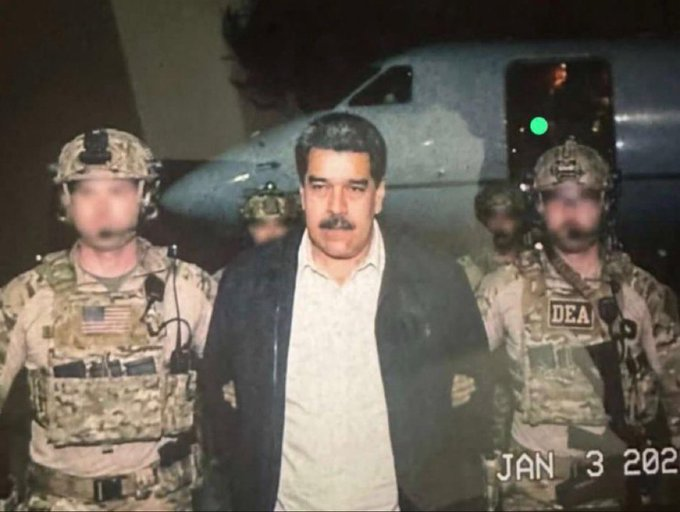
Trump taking — kidnapping, arresting, to taste — Maduro and his wife simply isn’t about the oil business. Please note, this also isn’t about whether it’s a good idea or not although I’ll admit to thinking that it’s way damn cool — getting in and out of hostile territory without, so far as we know right now, a single American casualty at all? Damn cool in that military sense.
This is about the shrieking we’re getting from the usual suspects — this is all about the oil! See! Ms. Raisin is one I’ve seen online already, there are those quoting that Counterpunch article with the idiot Michael Hudson and so on.
My point is solely and only about access to that oil.
So, travel back 10 to 15 years.
Venezuela’s Orinoco Belt oil is very “heavy”. Technically it is about viscosity but think about it as “thick”. It’s more like treacle than it is like a free flowing liquid. There are also issues with sulphur but leave that alone here. It is, in the technical parlance, “cheap shit”. So bad that it has to be mixed with much lighter (and usually “sweeter”, which means less sulphur) crude oil from different oil fields so you can pump it through a pipeline or get it into a tanker.
Venezuela used to have — still could have — fields of that light and sweet oil but they ran those fields — during and after Chavez — so badly that production fell over. So, they used to actually import US crude oil to then mix with that heavy crude so they could export. They also price petrol — gasoline — so low that they cannot possibly run refineries to make their own gasoline. So, they would import the US crude, mix it, export the blend to the US and then buy back the gasoline from those US Gulf Coast refineries. This was ridiculous, of course, but you know socialists with prices and economies.
It also meant that those US Gulf Coast refineries were adapted to use that Venezuela mix. You can change the mix a refinery uses but it’s potentially costly. The more the mix changes the more the cost rises. But the important thing to note is that the only refineries within cheap shipping distance that could use the Venezuela crude efficiently were those US Gulf Coast ones. Sure, they’d be pissed if they lost access to their supplies but they could be altered to work with other crude mixes. The reliance was much more of Venezuela upon the refineries than the refineries upon Venezuela — at least, the cost of adaptation to a change was lower for the refineries.
OK, so that was the old situation.
Over this past decade and a bit the US — under both Trump and Biden — has been saying, well, you know, we don’t think much of the Venezuelan Government. We also know the only money they get is from crude oil sales, so, if we refused to take that for those Gulf Coast refineries then we could screw with Maduro. Which is what happened — sanctions on Venezuelan oil exports which, most obviously, apply to people shipping into the US and so obeying US law.
Other people who do not, or don’t have to, obey US law haven’t, wholly, been abiding by those sanctions. OK. Maybe that’s all a good idea and maybe it isn’t — not my point here at all.
We should also note that the oil fields in Venezuela actually owned/managed by Chevron, a US company, have still been allowed to ship to the US and elsewhere under US law.
One more little fact. The US is now — as a result of fracking — a net oil exporter. This is also something done under Trump I, the lifting of the ban on crude oil exports. It can still be true that maybe buying in some Venezuelan oil — or Mexican, Canadian, whatever — meets either geographic or blend desires. We’d like some really heavy sludge, for example, or maybe Canadian oil works for Wyoming (not real examples, just ideas). But in terms of total oil production and usage the US produces more than it uses now. So any decision to import is about those marginal issues of location and blend, not urgent necessity for simple crude oil. Fracking works, d’ye see?
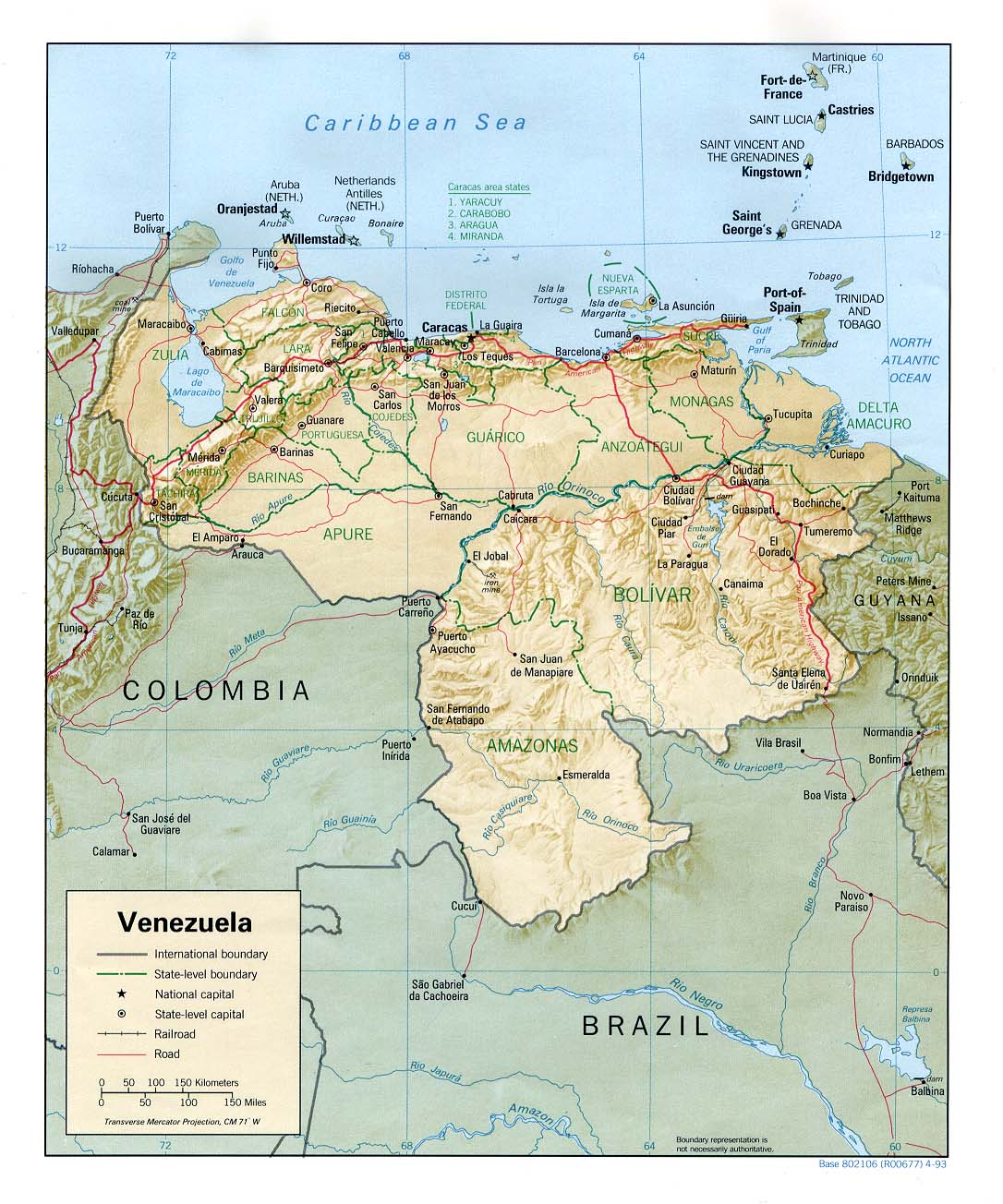
Shaded relief map of Venezuela, 1993 (via Wikimedia Commons)
On the other hand another bunch of the usual suspects are screaming about this as a violation of international law. ESR comments on the social media site formerly known as Twitter:
Since there’s a lot of screaming about the legality of black-bagging Nicolas Maduro going on, let’s talk about the game theory of international law.
Before I do that, though, I’m going to acknowledge that the Trump administration’s legal posture doesn’t even implicate international law significantly. Their theory is that Maduro stole an election, is not the legitimate head of state of Venezuela, and is a criminal drug-cartel leader; universal jurisdiction applies.
This is why a photograph of Maduro restrained by a soldier wearing a DEA patch was released.
I’m not here to state a position on whether that legal posture is valid; I want to instead outline a game theory of the “rules-based international order”, which people are complaining has been violated because the US black-bagged a head of state.
There are two different ways to establish a framework of governing law. Most people only understand one of them, which is the imposition of law by a ruler or coalition with force dominance. I’ll call this “unitary law”.
The other mechanism is mostly only understood by a handful of libertarians; it is law as a violence-minimizing equilibrium among a number of roughly equal agents playing an iterated Prisoner’s Dilemma game. In such settings, cooperation evolves naturally and doesn’t have to be handed down by a single ruler or coalition. I’ll call this “IPD law”.
“International law” is enforced by an uneasy combination of both mechanisms. This is more difficult to see than it should be because there’s also a lot of air and bullshit around “international law”, bullshit consisting mostly of wordcels trying to cast magic spells on people with guns.
The air and bullshit is why it’s common to say that international law is a mirage, or a fraud that only serves the interests of the strongest powers. This isn’t true: what is true is that if an international norm is not sustained by being a stable strategy in an IPD game, only force majeure by a dominant power or coalition can uphold it.
Here’s an example of a moral good that was established by unitary law of nations: the general abolition of chattel slavery, which happened because a dominant coalition of Western nations said “Fuck your sovereignty, we’re no longer tolerating this anywhere our militaries can reach.”
Here’s an example of a moral good that was accomplished by IPD law of nations: generally humane treatment of prisoners of war in armed conflicts. This didn’t develop because great powers unilaterally said “stop doing that”, it happened because even a great power at war with a minor one is exposed to effective tit-for-tat retaliation if it abuses POWs.
If you want to understand “international law”, you need to be able to disentangle three different things that claim to be international law: unitary law imposed by great powers, IPD law enforced by the threat of pain-inducing defections in an international tit-for-tat game, and wordcel bullshit.
The thing to bear in mind is just because there’s a lot of wordcel bullshit going around in “international law” doesn’t mean there isn’t a reality underneath.
British Prime Minister Keir Starmer rushes to distance himself from Trump’s action, for fear that someone might possibly mistake him for a vertebrate:

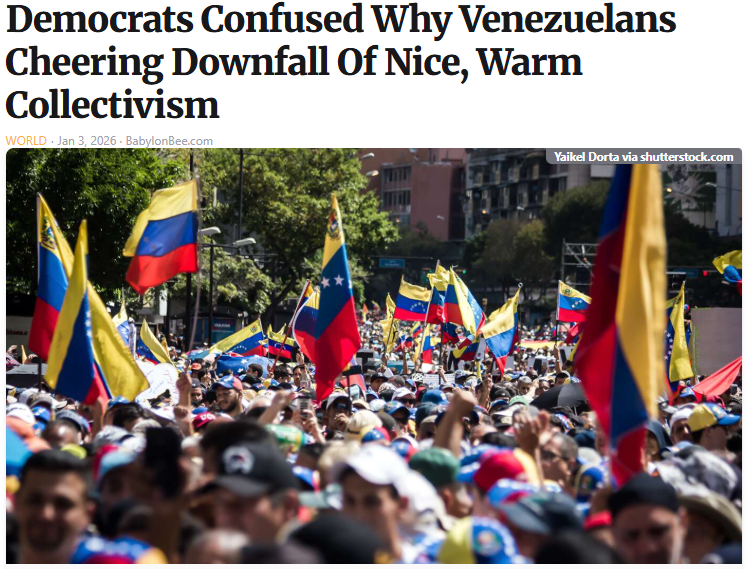
Leave it to the Babylon Bee to find the appropriate framing for a news story:
Update, 6 January: Welcome, Instapundit readers! Please do have a look around at some of my other posts you may find of interest. I send out a daily summary of posts here through my Substack – https://substack.com/@nicholasrusson that you can subscribe to if you’d like to be informed of new posts in the future.