Quotulatiousness

December 13, 2025

Misunderstanding the causes of wealth

Filed under: Economics, History — Tags: , , , , — Nicholas @ 04:00

As most economists could point out, there’s no point asking what are the causes of poverty, because poverty is the default condition. Getting people out of poverty, that is a much more interesting discussion. Tim Worstall responds to a recent video from someone who clearly doesn’t understand where wealth comes from:

From this video here. Given that Grace [Blakeley] herself posts it she must approve the content.

    Because the way that capitalism generates prosperity for some is by generating misery for others. You cannot have universal prosperity in a capitalist system. Just think about, like, this phone. What has happened for me to be able to hold this phone in my hands right now? A bunch of kids in the Democratic Republic of the Congo, at gunpoint, have been sent to scratch coltan out of the ground …

So, first thought. If the world, the economy, is a zero sum game then yes, we can only have some prosperous if others are not — some can only have more pie if others have less. On the other hand if we know how to bake the pie bigger then all can have more at the same time.

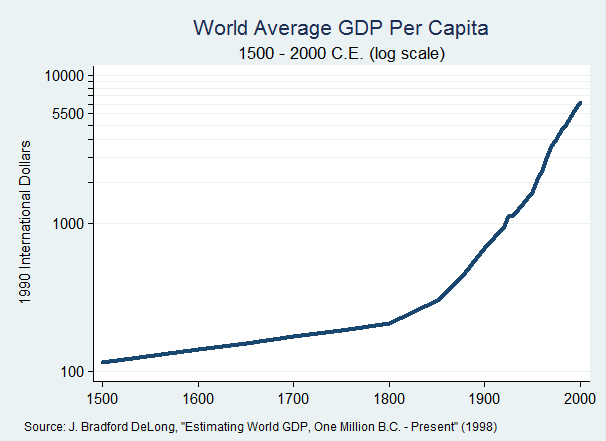
So, do we know how to make the pie bigger?

That source of Brad DeLong means yes, this is correct. Where’s that inflexion point, that bend in the curve? About where we start doing capitalism with free markets. As Marx, K himself pointed out capitalism is really very productive.

OK, so we know how to increase the size of the pie, it is possible for all to gain. It is not necessary for some to get less in order for others to gain more. The central contention is wrong. Provably, obviously, wrong.

Oh, sure, sure, it could work out that we take stuff off others in order to feed some. You know, say taxing child carers in order to pay train drivers massive salaries, as we do. But it’s not in fact necessary.

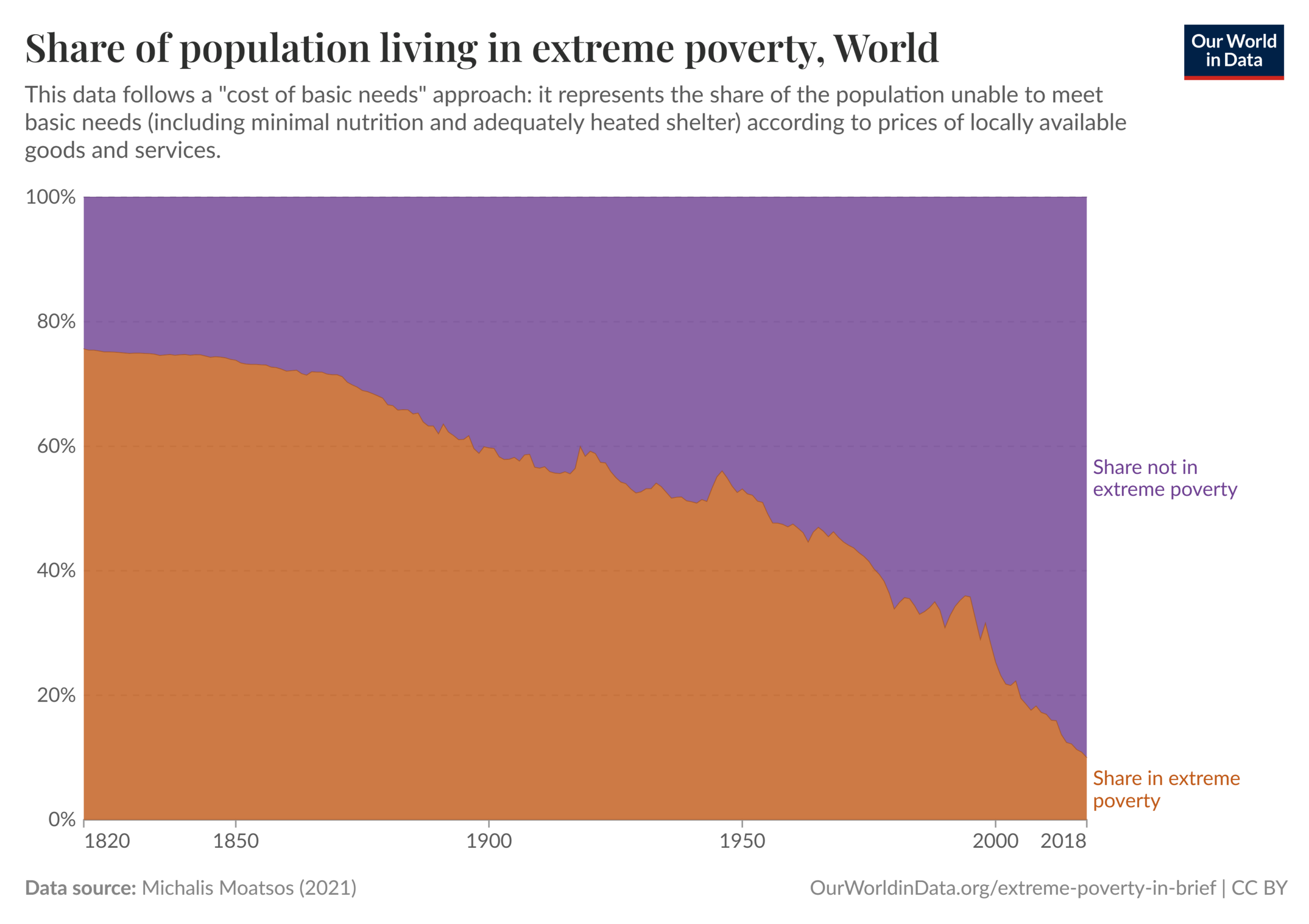
We can also check this another way:

So, lots and lots have become better off in this period of capitalism. Sure, sure, we should do better as a civilisation, we want all to do so. But while so many have got better off no, it is not possible to say that this has been done at the expense of those in extreme poverty. Because extreme poverty itself is set at the subsistence level. If you take stuff off the extreme poor then they die — that’s what subsistence level means. So that majority of humanity has not got rich by nicking it off the extreme poor. Because if they had there would be no extreme poor as they’d all be dead.

So, the overall claim is simply wrong. But it’s also wrong in specifics.
“Europe must prepare for ‘scale of war our grandparents’ endured”

Filed under: Europe, Military — Tags: , , — Nicholas @ 03:00

On the social media site formerly known as Twitter, @InfantryDort responds to the NATO Secretary General’s announcement that Europe should gird its collective loins for combat on a scale similar to the World Wars:


Fighting Like Our Grandparents, Without Becoming Like Them?

What a strange moment it is to belong to the warrior culture in the West.

To watch your society fracture in real time. To see cohesion traded for comfort. And to be told to prepare for wars of national survival while the nation itself dissolves at home.

Europe, in particular, has already spent its strongest men. Bled out across the killing fields of the 20th century. Now it is warned to fight like its grandparents once did.

The warning is correct, but not in the way people think.

Violence, chaos, entropy … these are the default state. They pull on human societies the way gravity pulls on matter. Left alone, everything falls.

Function requires resistance. A rocket escapes gravity only by burning fuel. An exoskeleton works only by pushing back. Civilization is no different.

You cannot fight a war of national survival abroad when the nation no longer coheres at home. When families are exposed, trust is gone, and the social fabric has been cut to make the room feel larger.

It’s not strength. It is just removing load-bearing walls and mistaking openness for stability.

The lesson: Our grandparents didn’t just fight with weapons. They fought with unity, discipline, restraint, and shared purpose.

Without those, you don’t get their victories. You only inherit their destruction. And all without the moral scaffolding that survived it. Wars are not won by nostalgia. They are won by societies that still function.

TLDR: Few sane men will go off to war in a far away land when hordes of their previous battlefield opponents have moved into their neighborhoods.

Update, 13 December: On the social media site formerly known as Twitter, John Carter responds to Rutte’s speech:

These are just empty rituals indulged in by the clerisy of hermetically sealed institutions. They have no ability to mobilize for war. The financialized economies they preside over have been hollowed out by deindustrialization, over-regulation, and climate hysteria. The populations of their countries are deracinated, alienated, and ethnoculturally fragmented. They did all of this themselves, deliberately and systematically, over decades, because it benefited them to do so. It made the institutions stronger, and enriched them as a class. That it came at the expense of the viability of their societies didn’t bother them in the slightest.

Membership in the institutional theocracy is predicated on absolute alignment with internal narratives. Those narratives are simply whatever the theocracy needs to believe at any given moment to justify itself. At the moment, they need to believe that nothing fundamental has shifted in Western countries since the end of WWII, in particular that it is still in principle possible to mobilize a (non-existent) industrial base for wartime production, and that it is possible to motivate an alienated population to fight. They also need to believe that the loathing with which native populations regard them is inorganic, a function of narrative warfare from the troll farms of foreign adversaries, and that this resentment can be effectively curtailed with censorship and propaganda.

Internally they see themselves as very serious people, statesmen and generals, guardians of the moral order.

From the outside, they are clowns engaged in a pantomime.

ZK 381: Czech Pre-War Prototype Battle Rifle

Filed under: Europe, History, Military, Weapons — Tags: , , , , — Nicholas @ 02:00

Forgotten Weapons
Published 28 Jul 2025

The ZK-381 was designed by Josef Koucký, his first design of 1938 (hence 381). This is one of the last of the Czech pre-war self-loading rifle projects, of which there were quite a lot. It uses a tilting bolt and a short-stroke gas piston, with ZB26 machine gun magazines and chambered for 7.92mm Mauser (although they would have been happy to offer a model in any other modern rifle cartridge). It was tested in the spring of 1938 by the Soviet Union, which liked it enough that they requested a model in 7.62x54R — and those were tested in November 1938. Ultimately domestic Russian designs were chosen instead, and tests in German, France, Spain, and Italy also led to naught.

Thanks to the Czech Military History Institute (VHU) for graciously giving me access to this one-of-a-kind prototype to film for you! If you have the opportunity, don’t miss seeing their museums in Prague:
https://www.vhu.cz/en/english-summary/
(more…)

QotD: Victorian mores, homosexuality, and the Empire

Filed under: Britain, History, India, Quotations — Tags: , , , , — Nicholas @ 01:00

The public school phenomenon, which probably isn’t a euphemism but we’ll use it as one. You know, the whole “beatings and buggery” thing, and I’m going to stop now, because of course you know what I mean. Lots of Old Boys from all tiers of the public school system really did go out to run the Empire because they wanted to escape Victorian women, who were indeed as bad as that in a lot of cases (again, think “Karen on steroids”). But how much of that “to escape women” thing was because the women were awful, and how much of it was because the Old Boys were not-very-repressed homos?

This is where modern identity politics really messes up historical analysis. We probably all know that the vast majority of Victorian homosexuals were married, because the vast majority of Victorians were married. This isn’t my professional field, but because I went to grad school I’m pretty well up on it – the ivory tower finds Victorian poofters endlessly fascinating, because they are huge homo cheerleaders (obviously), but also because of the costumes.

Women and gay men love playing dress up — have you noticed? — and Victorian dress up is the best, because it’s a) expensive, and b) time consuming, but also c) flattering to just about any body type. It was socially acceptable among the upper classes to be porky (and nobody dresses up like a chimney sweep or factory hand), so both men’s and women’s fashion in the Late Victorian era can accommodate modern bodies. (Unlike the early Victorian era, which continued Regency fashion. They’d love to dress up Regency style — there’s a reason “Regency romance” is the most popular genre of light porno books for cat ladies — but it takes a specific physical type to pull off, and they don’t have it). […]

Anyway, where was I? Oh yeah — lots of people in grad school really, really into Victorian queers, so if I seem extremely well informed on this topic, don’t read too much into it.

“Repressed homosexual” was redundant back then. Oscar Wilde, for instance, was sort of the ur-homo — he was so gay, just gazing too long at a picture of him at his dandiest could give you an uncomfortably strong urge to touch a penis. […] Oscar Wilde was also married, and had two children, because that’s how even the queerest of the queer rolled in Victorian London.

Given that, you’d expect one of two things to happen to public schoolboys once they got out into the bush. Either they’d totally let their freak flag fly — you know, given that everyone else in their social world was an equally repressed public schoolboy — or they’d bottle it up even further, because it was important to show nothing but the best image of Her Majesty’s servants to the wogs at all times.

As far as I know, the latter was almost universally the case. Before the opening of the Suez Canal (1869), you could have a nonstop bacchanalia over there … if you were straight. Those guys could, and did, rock the casbah with extreme prejudice. It started tapering off early in Victoria’s reign, but in the late 1700s you had British army officers converting to Islam (no, really) for the express purpose of getting even more tail, by marrying the Koranically sanctioned four wives (sometimes with all the age of consent queasiness that implies).

The repressed homos, on the other hand, got really into scholarship. It’s not generally known (because even then the vast majority of their works were of interest only to micro-specialists) but Anglo-Indians were insanely productive scholars, on every conceivable topic. You could fill a decent sized library with their five-, seven-, nine-volume works on Sanskrit philology, and the botany of the lower Himalayas, or the migratory habits of tigers, or pretty much anything. And if they weren’t the scholarly sort, the repressed homos simply threw themselves into their work, of which there was always an endless supply — take a look at a map of India, recall that there were at most 200,000 Britons in the whole place, and you’ll see what I mean.

So: Were they going out there to get away from Victorian women? Absolutely. Were they therefore going to turn the place into Studio 54? Absolutely not.

Severian, “Ruling Caste II”, Founding Questions, 2022-03-10.

Powered by WordPress