Quotulatiousness

December 4, 2025

“… the biggest problem facing disabled people is that they aren’t eager enough to call themselves disabled”

Filed under: Health, Media, Politics, USA — Tags: , , , , — Nicholas @ 05:00

On his Substack, Freddie deBoer decries the New York Times viewpoint that “there is no such thing as a person, only beings that exist to function as sets of interlocking identities”:

(you would find this horribly condescending too)
Image from Freddie deBoer

I’m not joking! Paula Span has produced this particular bit of scolding for The Official Publication of Liberals Who Occasionally Look Up From Their Crosswords to Disapprove of Everyone and Everything. Span writes

    Identifying as a person with a disability provides other benefits, advocates say. It can mean avoiding isolation and “being part of a community of people who are good problem-solvers, who figure things out and work in partnership to do things better”

Of course, you can enjoy those benefits without identifying as disabled, without allowing one unfortunate aspect of your life become an entire identity. But that doesn’t fly in the world of the brownstone liberals who fund and run the New York Times, who seem to believe that there is no such thing as a person, only beings that exist to function as sets of interlocking identities.

Here’s the maddening thing about this piece: it quietly smuggles in a worldview that has metastasized across the discourse, a worldview in which the biggest problem facing disabled people is that they aren’t eager enough to call themselves disabled. Not, you know, being blind or paralyzed or suffering from dementia or constantly wracked with chronic pain, no, all of that is subservient to the only question anybody seems to care about anymore, the all-devouring question of identity. The whole thing hums along with the cheery institutional conviction that the answer to every human frailty is more identitarian self-labeling. If only the elderly would embrace the capital-D Disability identity, we’re told, everything would be better — their health care would run smoother, their interactions with institutions would be less demeaning, their sense of community would blossom. Maybe they’d even be happier! The Times treats this as self-corroborating common sense, like, well, everything else argued in the New York Times.

What this kind of thinking actually represents is the natural endpoint of a cultural project that has turned medical pathology into a personality type. It’s the codification of a worldview where suffering is not something to address, treat, alleviate, or recover from, but a new kind of boutique identity, complete with community membership, branded discourse, and moral status. It turns vulnerability into a form of social currency, rewarding performance over authenticity and turning genuine suffering into a spectacle for peer validation. In doing so, it erodes the very possibility of meaningful treatment, because the focus is no longer on recovery or well-being, but on cultivating a carefully curated self-image that fixates on impairment. And what I think, as I read this person tut-tutting senior citizens for not embracing that new ethos, is “Maybe they just feel like they’re too fucking old to take part in such nonsense?”

The piece insists, without evidence or even really argument, that treating disability as an identity will improve access to accommodation. Disability accommodations matter; of course they do. But what this article is concerned with is patently not getting older adults the practical support they need. The piece is instead fixated on the idea that the real issue here is that people don’t want to be disabled in the metaphysical, self-defining sense, as though the reluctance of an 84-year-old to call herself Disabled-with-a-capital-D is some retrograde psychological failure rather than a perfectly sane human impulse born of a lifetime of struggle. Span frames this as a story about insufficiently enlightened seniors who need to be ushered into the disability “community”. But maybe the reluctance they’re describing is the whisper of something older and much wiser: the understanding that disability is not a polity you join, not a club whose membership conveys special epistemic authority, but a condition of life that you endure and attempt to mitigate. These older people don’t identify as disabled because they remember, stubbornly enough, the distinction between having a problem and being the problem. They treat disability as a practical reality, not an existential category. And they’re right to do so.

Update, 5 December: Welcome, Instapundit readers! Please do have a look around at some of my other posts you may find of interest. I send out a daily summary of posts here through my Substackhttps://substack.com/@nicholasrusson that you can subscribe to if you’d like to be informed of new posts in the future.

The Swiss vote overwhelmingly against a new wealth tax

Filed under: Europe, Government, Politics, USA — Tags: , , , — Nicholas @ 04:00

As the California government wants to impose a new wealth tax, it’s worth checking how similar schemes are viewed in other jurisdictions. The Swiss voters were given an opportunity to scalp their very richest citizens and permanent residents with a proposed wealth tax, but it went down with 78% voting against it:

“Switzerland on Sunday overwhelmingly rejected a proposed 50% tax on inherited fortunes of 50 million Swiss francs ($62 million) or more, with 78% of votes against the plan, an outcome that even exceeded the two-thirds opposition indicated in polls,” Reuters reported this week.

All Swiss cantons already tax assessed gross worldwide assets, minus debts and with exceptions, making it one of the few countries in the world to retain a wealth tax. But competition among cantons keeps the tax burden relatively low and, as the Tax Foundation notes, “the Swiss wealth tax acts as a substitute for a capital gains tax and an estate tax, which are common in other countries”. The referendum would have imposed an additional and very steep national tax.

This was actually the second recent failed attempt to impose a national wealth tax on inheritances. Seventy-one percent of Swiss voters rejected a 2015 proposal for a 20 percent tax on estates and gifts of over 2 million francs. The revenues would have been earmarked for old-age pensions.

‘Inequality in Opulence is Better than Equality in Poverty’

The 2025 tax scheme openly played to envy. It was targeted at combating “inequality” by seizing half the assets of the rich and allocating proceeds to offset the climate damage they allegedly cause.

Finance Minister Karin Keller-Sutter opposed the proposal, warning that “many wealthy people would simply emigrate to avoid the tax and keep their wealth”. She also pointed out that while all but two of the country’s 26 cantons tax inheritances, “the people have abolished inheritance tax for children and spouses in many cantons”. She added, “I think it is right that what was developed in the nuclear family can be passed on”.

Philosopher Olivier Massin, a professor at the University of Neuchâtel, criticized the motivation driving much of the campaign for the tax. He wrote that “inequality is by nature neither good nor bad” and that envy is the main driver of egalitarianism. “Envy being inglorious, we grimace in indignation, making what is ultimately only the expression of resentment a moral cause.”

Massin added that “inequality in opulence is better than equality in poverty”.

And Switzerland is undoubtedly “opulent” — or, at least, prosperous — with a per capita gross domestic product of $103,669 as compared to $85,809 for the U.S., according to the World Bank. It builds that wealth with a second-place score in the current Index of Economic Freedom (the U.S. is now ranked at 26), suggesting that less government meddling in economic matters is the best way to increase prosperity.

Don’t put a lot of trust in the “surging Canadian GDP stories” they’re pushing

Filed under: Cancon, Economics, Government, Media — Tags: , — Nicholas @ 03:00

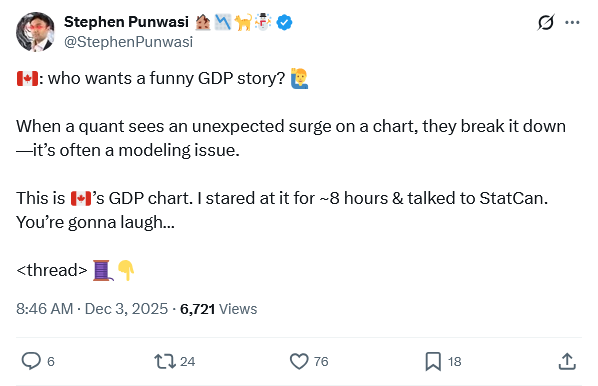
On the social media site formerly known as Twitter, Stephen Punwasi put together an interesting thread on the latest “rosy scenario” GDP numbers the state media have been making such a big deal about:

2/ What do we see? Imports contributed 0.7 points out of 0.6 points of Q3 GDP growth. The rest of the economy was a net drag.

Imports contribute to GDP as a part of net exports: exports minus imports.

Smaller imports boost net exports. Imports made the biggest drop since 2022.


3/ What we’re seeing is a phenomenon called import compression: the balance was boosted by falling imports.

It’s a superficial improvement due accounting mechanics. The only growth is actually weakness.

We figured it out. But wait — how do they get import/export data? 😬


4/ Let’s start with imports. I recalled reading about the CBSA’s new customs & revenue management (CARM) platform.

Totally normal bedtime reading for weirdos, I know.

CARM delayed data to StatCan, who had to estimate on trend & revise. I can’t recall the issue being resolved.


4/ I contact StatCan. Delays have improved but recent data is heavily impacted.

They warn to expect larger than usual revisions to September — a third of Q3. 😅

It gets funnier: 🇺🇸’s gov shutdown means 🇨🇦 can’t get data for ~75% of its exports. Trend estimate again.


5/ so all GDP growth was imports, which fell faster than exports.

Imports & exports are estimates based on trend.

But wait — what exactly is a trend? It’s based on seasonal adjustments — smoothing predictable variation.

In 🇨🇦, that means suppressing summer & boosting winter.


6/ non-predictable variations to consumption like recession & trade wars can’t be filtered out.

The adjustment over/understates. e.g. 🇺🇸 Fed research shows this overstated recovery & lengthened the financial crisis. Ditto with COVID.

It can’t be fixed until years later.


7/ let’s put this together:

– 🇨🇦’s GDP grew exclusively due to the trade balance.

– import compression — a weakness that overstates growth

– trade had to be inferred via trend

– trend overstated by irregular shock

Yup.


8/ just to clarify — none of this is StatCan’s fault.

They’re tasked w/a deadline over the past year & 🇨🇦 decided to overhaul its trade data during a trade war.

They told me Dec 11th will be when revisions for imports come in & we’ll get an update on CARM.


9/ Bonus fun facts for the pros:

– by pushing it back to the 11th, this overstatement helps suppress yields for the GoC cash management program

– the 11th is after the last auction data is provided to dealers

Fascinating combo while 🇨🇦 is asset cycling for short-term optics.


10/ anyway, full write up, direct quotes from StatCan, & a fun bonus GDP fact for the kiddos.

Also, follow @BetterDwelling if you found this interesting.

We take research & insights reserved for deep-pocketed investors & give it away to normies w/plain english explanations.

M103: The Tank With No Name

Filed under: History, Military, USA, Weapons — Tags: , , , , , — Nicholas @ 02:00

The Tank Museum
Published 1 Aug 2025

In 1950, the USA was facing a tank crisis … and the M103 was supposed to be part of the solution. But it would hardly ever be used.

After the Second World War, the USA made massive cuts to their conventional forces – declaring the majority of their tanks obsolete, with those left coming to the end of their service life. And the appearance of the Soviet IS-3 meant that the pressure was on. The US Army and the US Marine Corps wanted new tanks – and they wanted them fast. And the appearance of the Soviet IS-3 meant that the pressure was on. The USA declared a “Tank Crisis”.

The T-43 heavy tank was intended to be the response to new Soviet armour. But vehicles were being built before the bugs had been ironed out – and the delays began to mount up. Whilst the Army began to question the need for a heavy tank, the Marines went all in on the concept – ordering over 200 for their forces. But the T-43 was nowhere near ready to enter service, and the vehicles went into storage with 114 improvements needed.

Changes were made and eventually the Marines got their heavy tank – now named the M103. But its effectiveness was limited, and the M103 was only operationally deployed once. The Marines rejected replacement M60s in favour of the Future Main Battle Tank – a project that would end up being cancelled. Their existing M103AA1s were modernised using M60 parts, creating the M103A2 – which The Tank Museum has an example of in its running fleet.

The M103 is a heck of a tank: powerful, capable and incredibly imposing to be around. But did the Americans really need it? Was it the ultimate panic buy?

This is the story of the M103 Heavy Tank – and the panic that produced it.

00:00 | Introduction
00:30 | Meet the M103
03:06 | T-43 and the Tank Crisis
06:21 | Unfit for Service?
11:33 | In Service
15:26 | M103 In Retrospect

(more…)

QotD: Champagne

Filed under: Quotations, Wine — Tags: , — Nicholas @ 01:00

A single glass of Champagne imparts a feeling of exhilaration. The nerves are braced, the imagination is agreeably stirred; the wits become more nimble. A bottle produces the contrary effect. Excess causes a comatose insensibility.

Winston Churchill

Powered by WordPress