
The Korean War by Indy Neidell
Published 25 Nov 2025While there is no battle action this week, there is still a lot of fighting, as the UN forces must constantly watch their backs against the thousands of guerrillas in the hills of South Korea. At the truce talks, the Communist side accepts the UN proposal for a demarcation line — Item 2 on the agenda — but for it to be valid the other three items remaining on the agenda must be dealt with within 30 days, which seems very optimistic to most. There is also the question of post-armistice inspections teams; are they a good idea? Or will they simply provide the other side with much-needed actionable intelligence?
Chapters
00:00 Intro
00:45 Recap
01:08 Guerilla Actions
03:19 Hanley’s Numbers
05:37 The Demarcation Line
08:04 Inspection Teams
10:36 Ridgway’s Opinion
12:06 The Agenda
12:48 Summary
13:04 Conclusion
13:57 Call to Action
(more…)
November 26, 2025
The Korean War Week 75: Insurgency Behind The Lines! – November 25, 1951
The RCAF needs either F-35s or Gripens … not both
Although the Trump provocations are a unique situation for the Royal Canadian Air Force to find itself dealing with, the long-delayed decision on what the replacement for our current CF-18 fleet can’t be realistically put off for much longer. The government has committed to paying for the first 16 aircraft of an 88-plane order, but many pundits are crying out for the government to cancel the remaining portion of the order and instead purchase different aircraft … the leading contender being the Swedish Gripen. This might be the worst of all worlds for the RCAF, in needing to support two different airframes with zero parts compatibility. This two-fleet “solution” would make life much more difficult for RCAF training and logistics, but it’d be a performative eLbOwS uP to Trump, so there’s a strong chance it’ll happen despite military and economic reality. Bryan Moir makes the argument for the Gripen on his Substack:
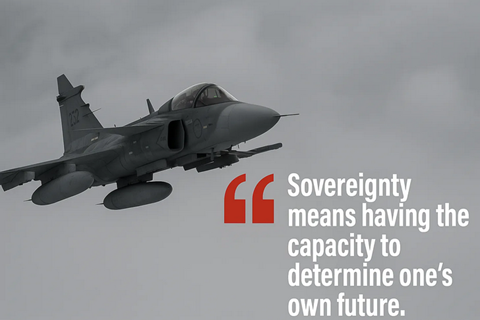
Mark Carney loves the big phrases. “Build Canada strong.” “Rewire the economy.” “Generational investments.”
It’s good branding. But slogans don’t build nations — decisions do. And right now, one decision matters more than the rest:
Will Canada assemble the Saab Gripen fighter on Canadian soil — or will we lock ourselves into permanent military dependence through the F-35?
Let’s start with the truth no one in Ottawa wants to say out loud.
The F-35 is a 56% aircraft in a 100% environment.
The F-35 fleet’s mission-capable rate sits at 55–56%. That means a country buying 16 aircraft can expect maybe eight airborne on a good day. Eight jets to defend the Northwest Passage, the Arctic archipelago, and a coastline longer than Russia’s.
This isn’t speculation; it’s physics, logistics, and accounting.
Meanwhile, the United States fields 54 F-35s at Eielson AFB in Alaska — backed by billions in supporting infrastructure: software hubs, spares depots, rapid part cycling, and multiple layers of maintenance and training.
They can sustain the F-35 in the Arctic.
Canada cannot.
And pretending that we can — or worse, pretending that it doesn’t matter — is not national defence. It’s denial.
Gripen was designed for the world Canada actually lives in.
Gripen’s core design features are the ones Canada pretends the F-35 also has:
- Cold-weather resilience
- Short runway and road-base operations
- Minimal crew requirements
- Quick turnarounds
- Low maintenance footprint
- Sovereign sustainment
Gripen isn’t just compatible with Canada.
It was built for countries whose geography forces them to be independent.
The importance of “a bicycle shop in Bermuda” to Mark Carney’s financial affairs
It’s no secret that Prime Minister Mark Carney is a rich man. When he entered politics, he put his financial holdings into a blind trust to satisfy the federal government’s ethical and conflict of interest rules. But through this arrangement, he still owns significant positions in companies whose fortunes can (and are) affected by the actions of his government. On Monday, this was discussed at some length by a Parliamentary committee in Ottawa, as reported on his Substack by Dan Knight:
On November 24, in a basement room of West Block, MPs spent two hours asking a very simple question that everyone in Ottawa is suddenly pretending is complicated:
If Mark Carney gets richer when Brookfield does better, and Brookfield is running big climate and infrastructure funds out of what one MP described as a bicycle shop in Bermuda, how on earth is that not a problem for the Prime Minister of Canada?
The man in the hot seat was Justin Beber, Chief Operating Officer of Brookfield Corporation. His job was to calm everyone down. Instead, under oath, he calmly confirmed just about everything the government would rather you didn’t think about too hard.
He started with the corporate biography. Brookfield, he reminded the committee, is a massive global investor headquartered in Toronto. It has more than 600 direct employees in Canada, more than 15,000 workers in its operating businesses, and it paid over $750 million in federal tax last year, not counting provincial and local taxes. All of that is true. None of it changes the basic conflict: the sitting Prime Minister still has long-term compensation that rises when Brookfield, and certain Brookfield funds, succeed.
Conservative MP Michael Barrett went straight there. He asked Beber whether, when Brookfield’s value increases, the value of stock options and deferred share units also increases. Beber said yes. Then Barrett asked whether that changes if those options and units are placed in a blind trust. Beber said no. It does not. The economic reality is exactly the same: if Brookfield’s share price goes up, those instruments are worth more, whether they are in Mark Carney’s brokerage account or parked with a trustee behind frosted glass.
[…]
Cooper spelled out why it matters. Carney, he said, knows what kind of public policy could improve the success of the fund. The fund’s success determines his future bonus pay. Without knowing who the investors are or all of the fund’s positions, Canadians have no way to see where those incentives may line up — or collide — with the national interest. These are not theoretical conflicts. They are simply invisible ones.
Eventually, after some confusion over terminology, Beber did confirm that Transition Fund I has invested in 20 companies and that their names are listed in the ethics annex. Only one of those firms, Entropy, is in Canada. The rest of the portfolio, and the roster of big-money investors behind it, sits offshore, beyond any serious public scrutiny, while the Prime Minister’s upside rides on how well those bets pay off.
The tax side of the story is just as revealing. Bloc MP Luc Thériault put it bluntly: tax avoidance is not a conspiracy theory, it is a business model so widespread that the OECD and G20 built an entire 15 percent global minimum tax regime to deal with it. He cited Canada Revenue Agency estimates of tens of billions of dollars in lost federal revenue each year, including billions attributable specifically to tax avoidance. He asked Beber whether Brookfield engages in tax avoidance. Beber refused to use the term. “We practice tax planning”, he said, like “any other company”. He repeated that Brookfield pays all taxes that are “due and payable” in the jurisdictions where it operates.
That phrase sounds reassuring until you remember who writes the rules that decide what is “due and payable”, and who benefits when the system can be routed through Bermuda via something that, on paper, looks like a bicycle shop.
[…]
At some point, the pattern becomes impossible to ignore. The Prime Minister of Canada left a giant global investor with standard executive incentives, kept his vested long-term instruments, retained a carried interest in a $15 billion Bermuda-run climate fund that will operate into the 2030s, and knows exactly which sectors that firm is betting on. His government is now pouring public money and regulatory support into many of those same sectors. The firm uses structures justified as “tax transparent” that just happen to run through low-tax jurisdictions, including one address a Conservative MP described as a bicycle shop in Bermuda. The man running the firm’s operations will not say the Prime Minister’s potential upside is small. He will not say the global minimum tax is being met in practice. He will not disclose who the fund’s other investors are.
You do not need to be an expert in securities law to see the conflict. You do not need to be an expert in global taxation to see why a bicycle-shop registration in Bermuda is not about cycling. You just need to watch what they are desperate not to talk about directly: the hard link between public power in Ottawa and private profit offshore, wrapped in legal jargon, buried in annexes, and shielded from sunlight by a blind trust and a lot of very careful answers.
A Tray in a Day | Paul Sellers
Paul Sellers
Published 11 Jul 2025Not every project needs to be complicated, and many can be a machineless exercise that develops hand skills and simplifies the project all the more.
People often shun plywood as a legitimate option over solid wood, but where solid wood might otherwise expand, contrary to the grain in solid wood oriented at 90º, plywood will be a perfect choice because of its stability, strength, and longevity.
I say a tray-in-a-day, but six in a day is highly possible, especially when you use only hand tools and no power equipment. Enjoy!
——————–
(more…)
QotD: Racism and social justice
A definitive proof of the evil of social “science” is that — faced with the real problem of racism — it has come up with the insane idea of racist post mortem justice; demanding that living white people compensate living black people for what some dead white people did to some dead black people. If you question the logic of this then — boom — you confirm the whole crooked theory because it’s your “privilege” that blinds you to its truth. It’s like the ducking stool as a test for witchcraft. Guilty or not, you’re done for. Oh and by the way, you can’t just ignore this piffle and quietly get on with your harmless life because “white silence is violence”.
This very American problem is poisoning the world through the dominance of US popular culture and the influence of the wealthy US universities. On this side of the Pond we have our own problems. We really don’t need a whole raft of America’s too. But white privilege is such a wonderful tool for creating and exploiting division that our leftists can’t leave it be. It’s a social A-bomb just lying there waiting to be detonated.
The Left is an immoral political movement. It seeks to divide. It seeks to promote hatred between classes and other groupings in society in order to create problems that can only be “solved” by employing legions of leftists with no otherwise marketable skills to direct us to the “correct” path. The extent to which it’s already achieved its real, unstated aim of creating a well-paid cadre of apparatchiks is visible in the present pandemic. The only jobs that are safe are of those employed by the state and rewarded by reference to almost anything other than economic contribution. Those thus paid for are “essential workers.” Those who pay for them are not. Anyone who points this scam out is monstered by a leisured army of social “scientists” and their graduates in the media — also paid for by us “inessential” saps.
Judge them by the outcomes of their policies and governance and the theorists and politicians of the Left are clear failures. The squalor in which poor black Americans live is almost invariably presided over by them just as a Labour council in Britain is a promise of continued poverty for all but its apparatchiks. If the poor are your voters, the more poverty the better. If the oppressed are your voters, the more (real or imagined) oppression the merrier.
The perfect symbol of Leftist politicians in this respect is the character of Senator Clay Davis in The Wire — perhaps the greatest TV show ever made and (among many other marvellous things) a searing indictment of American racial politics. It’s a show that couldn’t be made today because it reeks of white privilege. By the way, the fact that this concept would have prevented The Wire being made is by itself a small proof that it’s a wicked one.
Tom Paine, “Checking my privilege”, The Last Ditch, 2020-06-02.


