
World War Two
Published 15 Nov 2025At Mersa Brega a thin British screen, one reinforced battalion with guns, holds a superb defensive choke point until Stukas, artillery, and Panzer Regiment 5 grind it down. Cemetery Hill falls under bombardment, counterattacks stall, and a northern flank probe finally forces a retreat: Rommel’s first major victory in the desert, bought against strong ground and stubborn infantry.
(more…)
November 16, 2025
North Africa Ep. 8: The Forgotten Battle of Mersa El Brega
Comments Off on North Africa Ep. 8: The Forgotten Battle of Mersa El Brega
3D printing and firearms
On the social media site formerly known as Twitter, ESR discusses a recent user notification from one of the 3D printer companies to their users:
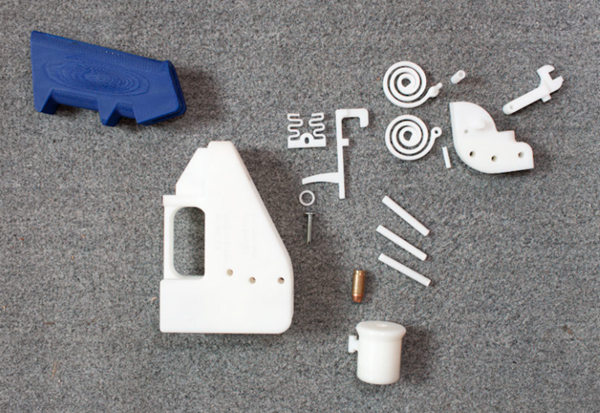
I’m told that 3D printed gun parts are far more sophisticated than this Liberator from 2013, but I’m sure nobody would actually do that, right? It would draw the attention of various government agencies for sure.
The recent flap about FlashForge attempting to forbid its customers from printing gun parts means it’s time for another reminder about technological risk.
Their weasel-worded climb-down carefully avoids stating that they never collect data on what you print. They only say they don’t collect data during your prints. The wording is so careful that I think we can conclude they do in fact ship telemetry on your print jobs when g-code arrives at the printer, immediately before printing.
So I repeat a warning I’ve given previously: never buy a 3D printer that requires an internet connection to function. And, always assume that if the printer’s firmware isn’t open-source, it is written to spy on you and could at any time prevent you from printing disapproved objects.
Oh, and never trust FlashForge again or buy their products, no matter how much groveling they do. After this, it’s safest to assume that anything they say about respecting the privacy and autonomy of their customers will be a lie. Hear that, @ff3dprinters
?We need to make a public example of FlashForge. Other vendors need to hear that shit like this will not be tolerated, that attempting to constrain what their customers print will do them permanent and irreversible damage.
It’s possible that this was merely a blunder on FlashForge’s court, and the attempts they’ve made so far to recover are compounding blunders, but they have sincerely repented of trying to control their customers. That’s too bad; in order to create the right incentives bearing on the future behavior of other vendors, we must show no mercy. We must make them hurt – ideally, to the point of being driven out of business.
And really these warnings apply to all “smart” devices, not just 3D printers. Unless you can audit the source code, the only safe assumption to make is that the firmware is spyware, controlware, and malware.
Device vendors need to know that we do not forgive, and will not forget.
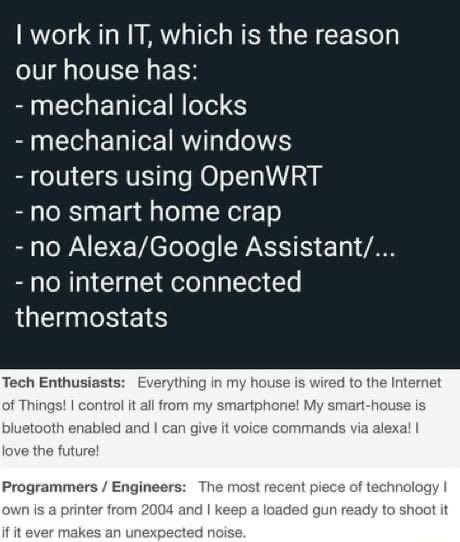
In response, Hopalong Ginsberg posted this helpful item:
Comments Off on 3D printing and firearms
Hand tool woodworkers: Are you using the wrong plane?
Rex Krueger
Published 10 Jul 2025Get your rough work plane today: https://tooltrader.net/
Compass Rose Toolworks: https://www.compassrosetools.com/
Check out my Courses: https://rexkrueger.retrieve.com/
Patrons saw this video early: patreon.com/rexkrueger
Follow me on Instagram: @rexkrueger
Comments Off on Hand tool woodworkers: Are you using the wrong plane?
QotD: Elon the gambler
Thus, despite being a large, valuable company with a very successful and profitable business, SpaceX regularly takes existential gambles that could destroy the entire company if they go wrong. By the time the Falcon 9 was up and running, SpaceX had essentially won: they could have rested on their laurels and enjoyed their monopoly for the next few decades. Instead, they bet the entire company on propellant densification (which blew up a rocket or two and indeed nearly destroyed the company).1 Then, once that was working, they bet the entire company on the Falcon Heavy rocket, whose development program nearly bankrupted the business. After that, they bet the entire company on the Starlink satellite constellation. Most recently, they have taken every bit of money and talent the company has and redirected them away from the rockets that make all their money and towards the utterly gratuitous Starship system.
Each of these bets might have been a smart one in a statistical sense, but it still requires a special kind of person to take a $200 billion market cap and bet it all on black. So why has Elon done this? Does he just not believe in the St. Petersburg paradox, like Sam Bankman-Fried claimed to do? No! It’s actually very simple: remember all that stuff about how SpaceX is less of a company and more of a religious movement, with a goal of making life multi-planetary? Elon and SpaceX behave the way that they do because they believe that stuff very sincerely. A version of SpaceX that merely became worth trillions of dollars, but never enabled the colonization of Mars, would be a disastrous failure in Elon’s eyes.
Every bit of company strategy is evaluated on the basis of whether it makes Mars more or less likely. This fully explains all the choices that look crazy from the outside. SpaceX does things that look incredibly risky to conventional business analysts because they reduce the risk of never getting to Mars, and that’s the only risk that matters. This has the nice side-benefit for shareholders that it’s revolutionized space travel several times and built several durable monopolies, but if Elon decided that actually blowing up the business increased the odds of getting to Mars, he would do it in a heartbeat. He’s said as much. This all has very important implications that we will return to in a moment.
A necessary, and to me charming, component of this approach is an utter disregard for bad press. Most corporate communications departments live in flinching terror of the slightest whiff of negative PR. Meanwhile, SpaceX’s puts out official blooper reels of exploding rockets. More seriously, one of the company’s lowest points came in the aftermath of the CRS-7 mission, when a rocket exploded two and a half minutes after launch and totally destroyed its payload. Most companies would do everything possible to minimize the risk of the following “return-to-flight” mission. SpaceX instead used it to debut a completely untested overhaul of the rocket and to attempt the first ever solid ground landing of an orbital-class booster. (It succeeded.)
Hopefully by now it’s not a mystery why SpaceX is a far more effective organization than NASA, but I think this last point is underappreciated. NASA, unfortunately, has boxed itself into a corner where it cannot publicly fail at anything.2 But if you aren’t failing, you aren’t learning, and you certainly aren’t trying to do things that are very hard. SpaceX, conversely, rapidly iterates in public and blows up rockets to deafening cheers. Permission to fail in public is one of the most powerful assets an organization has, and it flows directly from the top. This, too, is something for which Musk deserves credit.
The last thing I’ll say about Elon is that he is notably, uhhh, unafraid to disagree with people. In fact, this book literally has a chapter subheading called “Musk versus the entire human spaceflight community”.3 This quality can be a bit of a two-edged sword, but it’s safe to say that without it the company would never have gotten anywhere. Practically from the moment SpaceX came into existence, its enemies were trying to destroy it. Anybody who followed space policy in the early-to-mid 2010s knows what I’m talking about — politicians like the imbecilic NASA administrator Charles Bolden and the flamboyantly corrupt US Senator Richard Shelby did everything in their power to make life difficult for SpaceX and to smother the newborn company in its crib.
It’s a sign of how total SpaceX’s victory has been that some of those old episodes feel surreal in hindsight. Not just the antics of clowns like Bolden and crooks like Shelby, but also the honest-to-goodness competition in the form of Boeing and Lockheed, who fought dirty from the very beginning. For instance, they lobbied hard to block SpaceX from having any place to launch rockets at all, and dispatched their employees to stand around SpaceX facilities mocking and jeering while taking photographs of operations. In those early, desperate days, it would only have taken one or two successes of Boeing’s massive lobbying team to lock SpaceX completely out of government contracts and starve them of business. It was only Elon’s reputation as “a lunatic who will sue everyone” that prevented NASA from awarding the entire Commercial Crew Program to Boeing despite SpaceX offering to do it for about half as much money.4 And of course Elon actually did sue the Air Force when under intense lobbying they froze SpaceX out of the EELV program.
All of this is ancient history now. SpaceX’s competitors are no longer trying to stop the company with lawfare, because SpaceX no longer has any meaningful competition. But there are still people trying to slow down and sabotage the company; they’re just doing it for ideological rather than economic reasons. In the early days of SpaceX, the “deep state” of unelected bureaucrats who direct and control the United States government were huge supporters of the company, because back then the reigning ideology of that set was a sort of good-government technocratic progressivism and the idea of a scrappy new launch provider disrupting the incumbents genuinely pleased and excited them. A few years later, the state religion changed, and a few years after that, Musk revealed himself to be a definite heretic. And so, in utterly predictable and mechanistic fashion, the agencies that once made exceptions for SpaceX now began demanding years of delays in the Starship program in order to study the effects of sonic booms on tadpoles and so on.
One might be tempted to rage about how detrimental this all is to the rule of law. Think of the norms. Berger is certainly upset by it, and he ends his book (published in September 2024) by urging Musk to self-censor and stop antagonizing powerful forces with his political activism. Implicit to this demand is the advice, “If you just act like a good boy and stop making trouble, they’ll go back to leaving you alone.” Obviously, Musk did not take this advice. He instead further kicked the hornet’s nest by redoubling his support for Donald Trump. By October, the social network formerly known as Twitter was teeming with employees of US spy agencies and their allies demanding that SpaceX be nationalized and that Musk be deported.5 Given that Trump’s election was no sure thing, why would he take this risk?
There was a famous uprising against the Qin dynasty that happened when two generals realized that (1) they were going to be late, and (2) that the punishment for being late was death, and (3) that the punishment for treason was … also death. Elon Musk thinks being late to Mars is just as bad as being deported and having his companies taken away from him. He has already gambled the entire future of SpaceX on a coin flip five or six times, because he considers partial success and total failure to be literally equivalent. When it became clear that an FAA empowered by a Harris administration would put one roadblock after another in front of him, his only choice was to rebel and to flip the coin one more time.
When I saw Musk charging into the lion’s den back in October, I immediately thought of the Haywood Algorithm and its dreadful, stark simplicity. “Make a list of everything you need to do in order to succeed, and then do each item on your list.” When you run a normal company, the algorithm sometimes demands that you stay late at work or come in on a weekend. When you run a rocket company, the algorithm sometimes demands that you buy Twitter6 and use it to take over the United States government. It’s far from the riskiest thing Musk has done on his path to Mars. At this point, it might be wise to stop betting against him.
John Psmith, “REVIEW: Reentry, by Eric Berger”, Mr. and Mrs. Psmith’s Bookshelf, 2024-12-09.
- “Propellant densification” may sound like a nerdy topic, but it’s actually one of the most interesting subplots in the entire book. In the interest of making the Falcon 9 the highest performing rocket ever, and especially in the interest of improving the economics of booster landing and reuse, SpaceX decided to try to just pack more fuel and oxidizer into the tanks. The way you fit more of a gas or liquid into a given volume is by making it colder. So they developed a way to chill liquid oxygen down to -340 degrees Fahrenheit, way colder than anybody had ever made it before. What they weren’t prepared for was that at these temperatures, liquid oxygen starts making all kinds of horrible, eerie noises that made the engineers not want to be around it.
- Remember propellant densification? NASA considered it in the 80s and 90s, but dismissed it. Not for technical reasons, but because the need to destructively test pressure vessels might result in negative news stories.
- The subject of this section is whether it’s acceptable to fuel a rocket when the astronauts are already inside. The position of “the entire human spaceflight community” was that fueling can be dangerous, so better to complete propellant loading first, wait for everything to settle, and only afterwards being the astronauts on board. Seems sensible enough, but remember propellant densification? SpaceX’s ultra-cold liquid oxygen immediately begins heating up after loading, so the only practical way to use it is to load at the last minute and then immediately launch the rocket. Densification was vital to eking out the last bit of performance margin that makes rocket reuse possible, so Musk stuck to his guns. So far zero astronauts have died as a result.
- NASA’s pretext for favoring Boeing over SpaceX was the former’s “reliability” and “experience” and “technical superiority”. In the decade since then, SpaceX has completely dozens of missions flawlessly, while Boeing has yet to actually make it to the International Space Station and back.
- It’s hard to tell when the radical centrists mean things “seriously but not literally”, but I sincerely think that had Trump lost the best case outcome for Musk would be something like Jack Ma: chastened, humiliated, wings clipped, freedom of action greatly reduced.
- It’s become fashionable to mock Musk for running Twitter into the ground, but control over the social network’s content policies probably had a major effect on the election outcome. Even if Twitter literally becomes worth zero dollars (which given Musk’s track record I doubt), surely you can imagine how when you have a tremendous amount of money, $44 billion might seem like a small price to pay to have the President of the United States owe you some major favors.


