
Quotulatiousness

November 10, 2025

Canadian military expansion

Filed under: Cancon, Government, Military — Tags: , , , , — Nicholas @ 05:00

In the free-to-cheapskates portion of this week’s dispatch post from The Line, the editors discuss some of the implications of the significant expansion plans for the Canadian Armed Forces (with the caveat that little of these plans are funded and would be subject to major changes if the government fails to get its budget through Parliament):
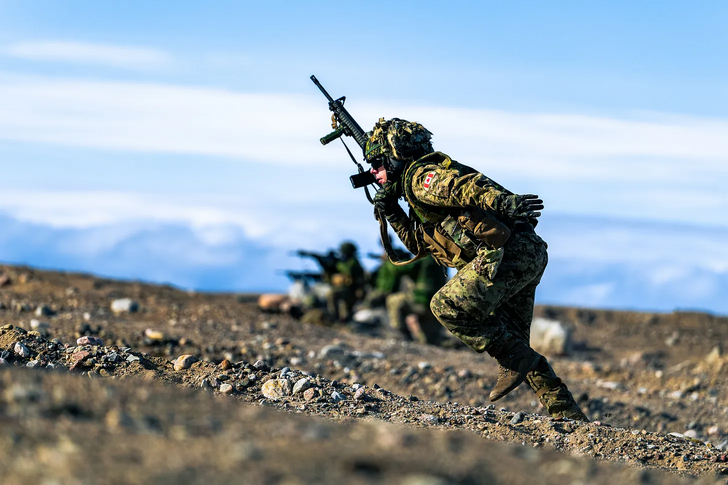
Canadian Armed Forces photo.

The amount of defence spending we’re talking about here is something that we have not thought about at all in recent generations. It’s a good thing. But it’s going to create some real challenges that we need to start thinking about, and coming up with solutions for, right away.

The numbers look something like this: the government had already announced a $9-billion influx of money into national defence, as well as a little bit of creative accounting, all with the goal of getting our spending up to the NATO two-per-cent-of-GDP target immediately, instead of on the absurdly prolonged trajectory the last prime minister deemed appropriate. A big part of this — and a welcome part — was a pay raise for members of the Canadian Armed Forces, particularly those at the lower scale of the pay grids for enlisted personnel and officers. One of the major problems the military has had in recent years is retaining trained personnel, and a pay raise is a tried-and-true way of helping address that. It also has the effect of juicing our spending at a time when our allies were looking for a tangible commitment. It’s a win-win.

But then there’s the rest of the spending: over $80 billion over the next five years, with a goal of getting up to the new NATO target of five per cent in only nine years, by 2035.

The Line supports this. We support this wholeheartedly. It makes us want to do cartwheels in the streets — and we would, if not for justified concerns for our joints and lower backs. (And dignity, though that’s less an issue.) But we do need to flag how transformative that level of investment would be.

Here’s the simplest way to put this. Almost our entire debate over defence in recent decades has been around the two-per-cent target. Nominally, the Canadian Armed Forces have certain capabilities that were suited to our national willingness to spend around two per cent of GDP. In reality, because of chronic under-funding, a lot of the capabilities we claim to have on paper didn’t really exist in reality. Units were badly undermanned. Equipment either didn’t exist or was not in serviceable condition or was long-since obsolete. Shortfalls of money and trained personnel were cutting into training exercises and basic upkeep on weapons, gear, and facilities. This prolonged fiscal starvation, combined with a fairly high level of demand on the forces for missions abroad and at home, had the effect, year after year, of hollowing out the force.

Getting spending up towards two per cent will help turn that around. This is conditional — and it’s a big condition — on fixing the military’s procurement problems. We could budget a trillion for the military, but it’s not going to make a difference if we have the same broken processes that need 10 to 15 years to actually get from an identified operational need to a signed contract. But still, if only in the big-picture sense, getting to two per cent will actually flesh out the Canadian Armed Forces into the organization that already existed on paper.

That’s good. That would be a big step up. But the problem is, as your Line editors have been screaming into the void for years, even the fully fleshed-out and realized version of the Canadian Armed Forces that existed on paper is too small for the current global environment, and lacks many critical capabilities that will be necessary to effectively fight — or even simply survive — on the battlefield. We need to do things we cannot currently do, and we need to do a lot more of all the things we’re already doing. That’s going to mean a bigger naval fleet, a larger army and a larger air force. That’s just the reality — our current force structure, even if fully manned and ready, is not large enough to meet all our needs.

That’s where the other tens of billions of dollars come in. There’s simply no way around the fact that this amount of money, combined with geopolitical reality and political rhetoric, is pointing to an inescapable conclusion: the Canadian Armed Forces are going to get a lot bigger. A lot bigger. We are looking at a substantial increase in the size of the regular forces, and probably an even larger increase in the size of the reserves.

Indeed, you may have seen this article recently in the Ottawa Citizen, by defence reporter David Pugliese. In it, he discusses proposals being prepared at National Defence Headquarters to establish a new reserve force of approximately 400,000 troops. The Line can confirm the general thrust of Pugliese’s reporting. We have no idea what the politicians will eventually sign off on, and we won’t be surprised if they get weak-kneed when some of the details are laid out before them, but discussion of a massive expansion of the Canadian Armed Forces, on a scale we haven’t seen since the Second World War, is indeed happening in certain rather important rooms in Ottawa.

Enshittification, the book

Filed under: Books, Media, Technology — Tags: , , , , — Nicholas @ 04:00

Cory Doctorow originally coined the all-too-useful name for the steady deterioration of pretty much everything in the online world and now it’s the title of his latest book:

Author and activist Cory Doctorow wants you to understand why online digital platforms are failing users, and he’s fighting for a better internet. “Enshittification” — a word he coined to describe the degradation of online platforms and services — is the slightly profane albeit funny title of his latest book.

[…]

First question from me: “What does enshittification look like in Canada?” (Try saying that word without chuckling). The country had several opportunities to lead as a global digital force to be reckoned with, Cory agrees, and in his view, “we dropped the ball on market concentration”.

“The Competition Bureau has, through almost all of its history, until last year when we got a new bill out of Parliament, been, I think, the weakest competition bureau in the world,” Cory declares, emphatically. It’s hard to refute his assessment: The merger of Shaw and Rogers, two very large telecoms in Canada, was made official in 2023, the year before Canada’s competition law was modernized.

“Wouldn’t you think, at the very least, Canada would have a robust domestic network platform available by now?” I ask. Gander Social, a made-in-Canada social media platform, designed as an alternative to large U.S.-based companies, is only now being beta tested.

“There are any number of people who would like very, very much to host a few thousand of their friends on a little Mastodon or Blue Sky server that can talk to all the other ones, and everyone can be in a conversation,” Cory counters.

“We don’t all have to be on the same server,” Cory continues. “If there’s one thing we learned from the Amazon outage, it’s that putting everyone on the same server is an incredibly bad idea, right? So we can all be on different servers in the same way we’re all on different email servers, drive on different roads. We have to live in different cities; we don’t all have to be in the same place to all talk to each other and be part of a single digital network. That’s what networks are, right?

“You know, what we don’t have, the lacuna in this plan, the thing that we need public investment in, is not the bicycles on the road, it’s the bike lanes, it’s the infrastructure, and it’s the kind of thing the private sector can’t do well,” he asserts. The pain points for small businesses, communities, large businesses, cooperatives or any entity wanting to host a social media platform, Cory suggests, include things like security audits and content moderation tools.

He also recommends “some mechanism to ease people’s passage off (existing) social media and onto a new platform”. Right now, Cory explains, “you have people building these new platforms and wondering how the people on the old platforms are going to get there. This is like West Germans building housing for East Germans in West Germany, without thinking about how they’re going to get over the wall. Except that, we built the wall. We are the ones maintaining the wall. The wall is made entirely of law. The wall could be torn down with an act of Parliament at the stroke of a pen.”

And on the related topic of artificial intelligence being crowbarred into everything we use online:

Cory’s also saying very provocative things about AI. His most-memorable quip: “AI is the asbestos we are shovelling into the walls of our society and our descendants will be digging it out for generations”. While he sees the merits of AI to support the work of radiologists or lawyers or software engineers — or nearly anyone — he doesn’t believe AI can do the job. “But,” he warns, “an AI salesman can 100 per cent convince your boss to fire you and replace you with AI”.

Somalia comes to Minnesota

Filed under: Africa, Britain, History, Italy, Religion, USA — Tags: , , , , , — Nicholas @ 03:00

Ian at The Bugscuffle Gazette provides a useful thumbnail history of modern-day Somalia and how this impacts Minneapolis, Minnesota:

In Africa national borders — and thus nations — are matters of political convenience, if not flat-out arbitrary. Only newbies to Africa even think about nationality, old hands know that tribal affiliation trumps all.

I had forgotten that.

In Somalia the borders were drawn in the late 19th century by Great Britain1 and Italy2. Make a mental note of that in case it comes up in a trivia contest somewhere, but understand that tribes and clans in that misbegotten part of the world are far more important than lines drawn on a map by 19th century British and Italian diplomats.

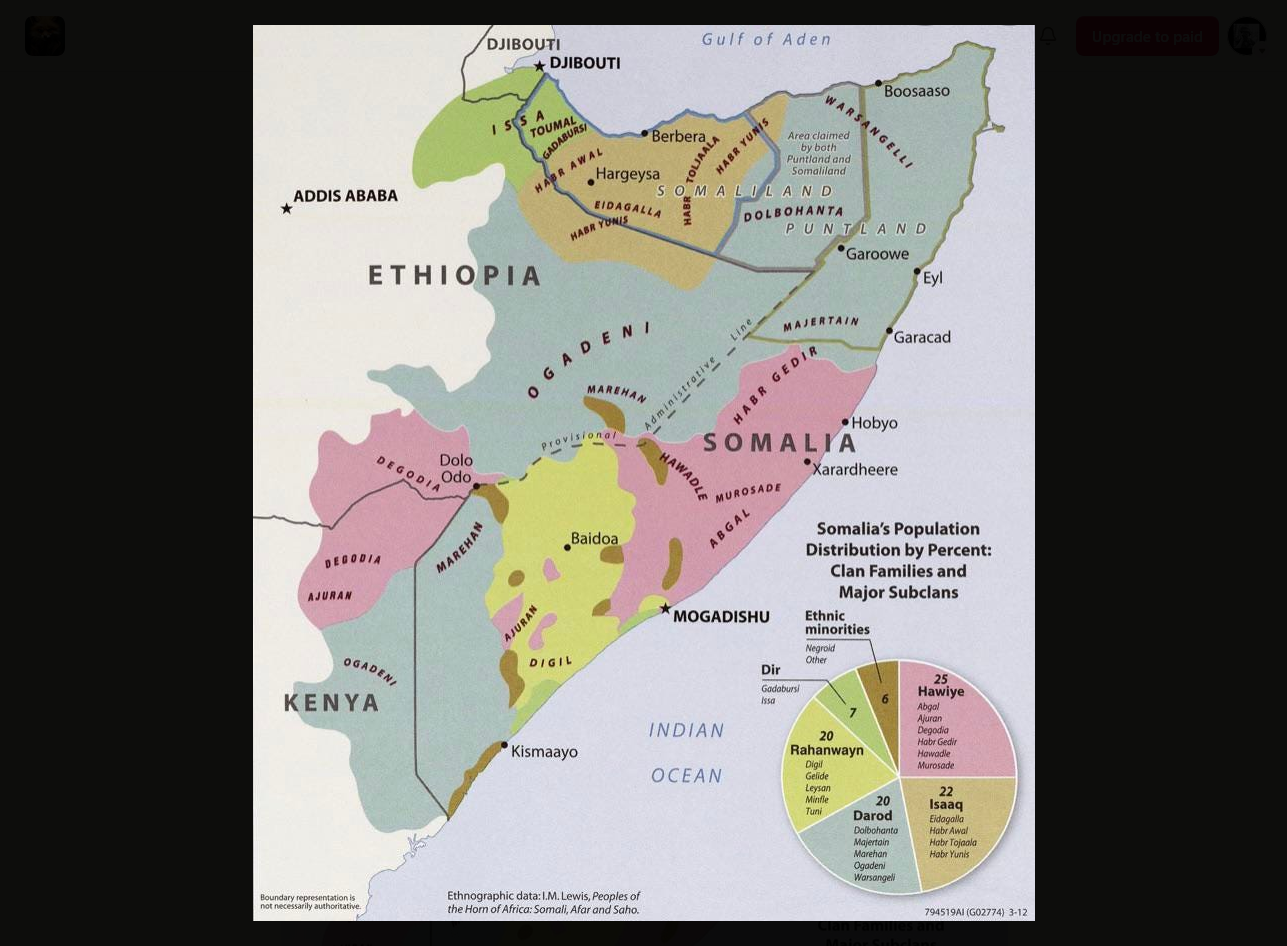
As a “for instance” let us take a look at a couple of these clans: The Daarood and the Hawiye.

The patriarch of the Daarood showed up in East Africa in the 10th Century3, and founded a clan that has become one of the largest in East Africa, and the second4 largest of the Somali clans actually in Somalia. They were the clan ruling Somalia when folks rebelled and kicked off the Somalian Civil War.5 Their current turf is sort of hourglass-shaped, with a chunk in northern Somalia, and another chunk in southern Somalia.

The Hawiye showed up in the 12th Century6, and have become the largest clan in Somalia. Their turf in Somalia is a chunk of seaside property starting at Mogadishu7 and heading north.

Yes, I know it says “Darod”. It’s properly “Daarood”.

In 1969, a Daarood bugsnipe name of Mohammed Siad Barre found hisself as HMFIC of Somalia following a bloodless8 coup-d’etat, but a whole bunch of folks Had Thoughts regarding his ascension9, and Somalia was pretty much in a constant state of rebellion from 1978 to 1991, when the full-scale Somali Civil War kicked off.

Okay, great. Fascinating even … so what does this have to do with Minneapolis of all places?

In the aftermath of that little dust-up, we imported a lot of Somali refugees. And since the clan most in need of refugee-ing was the Daaroods, we brought in a lot of Daaroods, and — being clannish — they consolidated in a clan-like fashion in Minnesota.

As a “for instance”, Ilhan Abdullahi Omar, the U.S. Representative for the 5th District of Minnesota, is a Daarood.

Things were trundling along the way they always do10 — except we’ve since imported another wave of Somalis … and these aren’t Daaroods. Any guesses as to clan affiliation? Yes! They’re Hawiye.

So. A second-generation dacoit of Daarood descent name of Omar Fateh decides he wants to run Minneapolis as warlord mayor, and he’s got the backing of his clan-mate Ihlan Omar — he’s a shoo-in!

Except a whole bunch of Hawiye in Minneapolis went, “Sod that for a game of soldiers”, and voted for the white guy.

Yay, tribal loyalty! Brings a tear to my eye, it does.

Which is all well and good11, but Omar Fateh, Ihlan Omar, and a whole bunch of Daaroods in Minnesota are capital “P” Pissed, capital “O” Off about the whole thing.

I know full well and certain how … spicy … tribal conflicts can get — and you couldn’t pay me enough to live in Minneapolis for the next few years.


  1. British Somaliland — actually a protectorate — starting in 1884, Crown Colony starting in 1920, self-governance in 1960.
  2. Italian Somaliland starting in 1884, then the Italians made the mistake of picking the wrong side during WW2, Brits took over in 1941, passed it off to the UN (whee) in 1950 (with the Italians mucking about), and formally united with British Somaliland in 1960 to form present-day Somalia.
  3. Maybe 11th — we’re not real sure.
  4. Or third, depending on whom you ask.
  5. This is important.
  6. Damned newcomers.
  7. We’re getting there.
  8. Hah! The assassination of the previous boss was insanely thorough.
  9. The fact that he styled himself “Victorious Leader” and loved himself some Marxism probably didn’t help.
  10. “Send lawyers, guns, and money …”
  11. For certain values of “well”, and certain values of “good”.

Food in the Trenches of World War One

Filed under: Britain, Food, History, Military, WW1 — Tags: , , , , — Nicholas @ 02:00

Tasting History with Max Miller
Published 3 Jun 2025

Mashed potatoes over a corned beef and onion filling with gravy

City/Region: United Kingdom
Time Period: 1914

Many of the young men headed to fight in World War I didn’t already know how to cook, so the British government set up army schools of cookery to teach some of them how to make the most of the rations they were given. Even that ancient army standby, hardtack (clack clack), is better when you can cook it into a stew or pudding.

This potato pie, kind of a simplified preserved meat version of shepherd’s pie, isn’t half bad. If I were to make changes, I would leave out the additional salt (canned corned beef is plenty salty on its own) and add some more onions. While relatively tasty as-is, if you have any HP Sauce lying around, it makes this pie delicious, and many troops would have had access to it during World War I. Delicious and historically accurate: a win-win!

    Potato Pie.
    16 1/2 lbs. meat, 20 lbs. potatoes, 1 lb. onions, 3 ozs. salt, 1/2 oz. of pepper.
    Cut up and stew the onions with jelly from the meat added; boil or steam the potatoes; when cooked mash them. Line the sides of the dish with one-third of the mashed potatoes; place the meat and cooked onions in the centre; season with pepper and salt; cover over the remainder of the mashed potatoes, and bake till the potato cover is brown. As the mashed potatoes absorb the moisture of the meat and render it dry, about 2 pints of gravy prepared from the liquor in which the onions were cooked, should be poured into the pie before serving.

    Manual of Military Cooking. Prepared at the Army School of Cookery, 1914

(more…)

QotD: “Is it a boy or a girl?”

Filed under: Books, Health, History, Quotations — Tags: , , , , — Nicholas @ 01:00

Even in our supposedly enlightened times, “Is it a boy or a girl?” is still the first question asked of nearly every newborn — and the answer continues to shape how the child is raised. Research shows that from infancy, boys and girls are touched, comforted, spoken to, and treated differently by parents and caregivers. These early experiences may reinforce sex-typical patterns of behavior that often persist into adulthood.

People are intrinsically fascinated by psychological sex differences — the average differences between men and women in personality, behavior, and preferences. Psychologists have studied this topic systematically for decades, beginning with landmark works like The Psychology of Sex Differences (1974) by Eleanor Maccoby and Carol Jacklin. That book helped spark a wave of research that continues to this day. Since then, increasingly sophisticated methods have enabled researchers to detect subtle but consistent differences in how men and women think, feel, and act.

Men and women use language and think about the world in broadly similar ways. They experience the same basic emotions. Both seek kind, intelligent, and attractive romantic partners, enjoy sex, get jealous, make sacrifices for their children, compete for status, and sometimes resort to aggression in pursuit of their interests. In the end, women and men are more alike than different. But they are not identical.

To be sure, sociocultural influences play a role in creating those differences. But environmental factors don’t act on blank slates. To understand young men and young women, we must consider not only cultural context but also evolved sex differences. We are, after all, biological creatures. Like other mammals, we share similar physiology and emotional systems, so it’s not surprising that meaningful differences exist between human males and females.

To understand why psychological and behavioral sex differences evolved, the key concept is parental investment theory, developed by evolutionary biologist Robert Trivers in 1972. The basic idea is straightforward: the sex that invests more in offspring tends to be more selective when choosing a mate. This selectivity follows basic evolutionary logic: those with more to lose are more cautious and risk-averse. To put the stakes in perspective: raising a child from birth to independence in a traditional, preindustrial society requires an estimated 10 million to 13 million calories — the equivalent of about 20,000 Big Macs. For women, reproduction is enormously expensive.

Men also incur reproductive costs, though of a different kind. On average, they have about 20 percent more active metabolic tissue — such as muscle — that fuels their efforts in competition, courtship, and provisioning. While pregnancy requires a large, immediate investment from women, men’s reproductive effort is more gradual, spread out over a lifetime. In evolutionary terms, both sexes pay a price for reproduction, but in different currencies — women through gestation and caregiving, men through physical competition and resource acquisition.

Yet while nature can inform our understanding of human behavior, it does not dictate how we ought to live. A clearer grasp of sex differences can help guide our decisions. It cannot define our values.

Rob Henderson, “Sex Differences Don’t Go Away Just Because You Want Them To”, Rob Henderson’s Newsletter, 2025-08-03.

Powered by WordPress



