Quotulatiousness

October 18, 2025

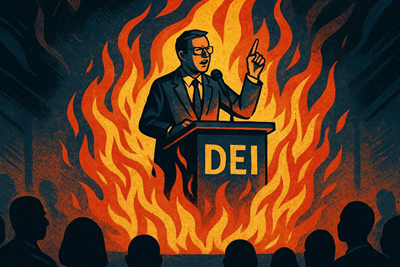
The corporate world is (slowly) backing away from DEI

Filed under: Bureaucracy, Business, Politics — Tags: , , , — Nicholas @ 05:00

On his Substack, Andrew Doyle describes what he calls the “death rattles” of the diversity, equity, and inclusion grifters:

In 180 AD, the Roman satirist Lucian wrote an account of a man called Alexander who had founded a cult of the serpent-god Glycon. According to Lucian, Alexander was much in demand as a prophet, and would charge money to answer questions from those seeking the wisdom of the serpentine deity that he had invented. Lucian records that he “gleaned as much as seventy or eighty thousand [drachmas] a year”.

Some of our modern-day Alexanders take the form of “diversity experts” who have made a fortune from the snake-god of DEI (Diversity, Equity and Inclusion). These cheerless mountebanks form part of an industry that rakes in a whopping eight billion dollars annually. According to Glassdoor, a website that provides salary estimates, a Chief Diversity Officer earns an average of $250,000 per year. Oppression is a lucrative business.

Perhaps the most egregious example is that of Robin DiAngelo, a self-proclaimed expert in “whiteness”, who charges $14,000 for every speech, and earns $728,000 every year. At one of her speeches at Coca Cola, DiAngelo’s advice to employees was to “try to be less white”. As the comedian Heydon Prowse observed: “anyone who has had the misfortune of passing a group of Eton boys at Notting Hill Carnival will know that trying to be less white is literally the whitest thing anyone can do”.

But it looks as though the gravy train might finally have been derailed. Yesterday, the This Isn’t Working podcast posted an image of a statement from Jake Graf, a regular DEI speaker who, according to his website, “works with organisations to improve LGBTQ+ representation, mental health awareness, and trans inclusion”. In his statement, posted on LinkedIn, Graf struck a sombre note:

    The pendulum of progress swings in mysterious ways. Just months ago, following the Supreme Court ruling and subsequent EHRC interim guidance, businesses rallied with open arms and vocal support for their trans team and clients. Now, that warmth has slowly given way to a worrying silence, as if someone pressed pause on the march toward inclusion.

The half-hearted poeticism barely masks the anxiety of man who fears that his racket has been exposed. The predominance of the creed of DEI, and its usurpation of meritocracy as the guiding principle in the corporate world, is a testament to the success of culture warriors. They have made plenty of know-nothings very wealthy by promoting ideology as though it were uncontested truth. But now it might well be coming to an end.

The Battle of Sedan: The Anatomy of Failure

Filed under: Britain, France, Germany, History, Military, WW2 — Tags: , , , , , — Nicholas @ 04:00

World War Two
Published 17 Oct 2025

In May 1940, a period of ten days flipped the world order on its head. France, the titan of the Great War, was carved apart by the armored fist of the Wehrmacht: Panzergruppe Kleist. Now, in this new feature-length production, we explore why it happened, whether this was ever avoidable, and whether France’s flaws stemmed from incompetence, or something far more sinister.
(more…)

Remembering GamerGate

We’ve lived through such a tumultuous decade that it’s sometimes difficult to remember what things were like in the “before times”. On Substack chat, John Carter linked to this essay by Billionaire Psycho which helps refresh memories about one of the seminal events that kicked off the political and social chaos of the last decade:

GamerGate is maybe the most important event of the past 20 years which never receives mainstream media coverage. Lomez will be publishing an in-depth history of GamerGate, to serve as an official record going forward, and that’s crucial as part of building a foundation for a new culture — fighting the narrative war over how history is remembered, how history is interpreted, what events are recognized as significant and influential moments in culture, and how Western identity is defined.

GamerGate was only possible because a generation of incompetent Leftists inherited an empire built on propaganda that came without a legible instruction manual. Leftists forgot how to run their imperial machine. Video games sedated young white men, funneling their energy into a simulation of achievement, an illusory power fantasy of digital significance. Leftists forgot that porn, video games, movies, junk food, and other passive consumption activities primarily existed to prevent young white men from doing anything useful with their lives. And this zone of sedation was viewed as another industry to conquer so that DEI activists could bully the video game industry into providing overproduced elites with fake jobs.

This event was important for several reasons.

GamerGate exposed American Sharia laws. It unveiled the shibboleths, religious taboos, and blasphemy codes which were considered more important than Constitutional protections on “free speech”. A gulf emerged between written laws, and selective enforcement.

GamerGate was maybe the first time in 50 years that Leftists suffered a real, measurable defeat.

It functioned as a generational awakening: a catalyst that activated a decentralized army of shytpoasters, bloggers, podcasters, streamers, journalists, and RW activists.

It mapped out in real-time the architecture and OODA loop of the Leftist hivemind, providing empirical data on how the swarm intelligence perceives, coordinates, reacts, propagates … and suffers damage.

It educated critics of the hegemonic monoculture that rules the Global American Empire.

But I think the most important aspect of GamerGate was that it disproved the narrative illusion that everyone more or less accepted as conventional wisdom, the bedrock of the uniparty worldview. Before GamerGate, it was taken as a self-evident fact that America was a capitalist country, and that all of the evil in the world was caused by Wall Street corporations chasing “shareholder value” and advancing “the profit-motive”. Capitalism and racism were the invisible demons which could be used as scapegoats for anything bad that ever happened at any point and at any place in American society.

Leftism could do anything it wanted, no matter how dumb, destructive, intrusive, or evil — and then blame capitalism and racism for the consequences.

This illusion was shattered by GamerGate.

[…]

There’s one important thing that’s been lost since GamerGate (GG) and the Meme War of 2016, which is the adolescent fun, transgressive irreverence, and juvenile sense of humor which once characterized the RW youth. There was a brief window when video game enthusiasts believed they could meme their way to victory (they did), win a landslide election (they did), and reverse imperial decline (they didn’t). Ten years have passed since then. Countless accounts have been banned, doxxed, deplatformed, debanked. Dissidents have been prosecuted and imprisoned. The presidency of 2016 was stalled out and subverted, the election of 2020 was stolen, the election of 2024 almost ended in an assassination on live television. Covid lockdowns crashed the economy and trapped everyone in their homes, while Antifa and Black Lives Matter rioted outside in the name of George Floyd.

At some point, it stopped being fun, and the contest turned into a forever war.

Comedy turned serious.

But it should be remembered that in the aftermath of GamerGate, humor and a playful, childish energy fueled the engine of RW victories. That’s the secret ingredient.

Samizdat is the key to winning.

Always remember to keep having fun, and keep laughing, because our enemies are ridiculous.

Gerät Potsdam: Mauser Copies the Sten Gun

Filed under: Britain, Germany, History, Military, Weapons, WW2 — Tags: , , , — Nicholas @ 02:00

Forgotten Weapons
Published 2 Jun 2025

In the fall of 1944, the Mauser company was given a contract to develop drawings of a direct copy of the British Sten gun (code named Gerät Potsdam), and to manufacture 10,000 of them. In fact, they were to make two different sets of drawings; one suitable for large factory use (like their own) and one for use with distributed small shops making parts for final assembly elsewhere (which is how much of British Sten production was done). The contract was fulfilled and 9972 guns in total were produced and accepted by the German military in November and December of 1944.

Why would Germany was a copy of the Sten? Well, they actually had a decent number of them. The Allies were air-dropping Stens all over Europe, and a lot of those drops were captured by German troops, not the resistance fighters they were intended for. By the end of the war the Germans were in desperate need of arms, and the Sten was both simple and already in some German use with the Volkssturm … so it actually was not a totally unreasonable idea to produce more of them.

Today, the Potsdam is an extremely rare gun to find. The two visible identifying features are the magazine well and barrel shroud, which are both made with a folded and spot welded seam. The barrels are also identifiable as they have 6 groove rifling, which the British did not use in the Sten.

Before the Potsdam production was finished, Mauser began working on further plans to simplify the design. That would be the Gerät Neumunster, aka the MP 3008. For that part of the story, see my video on the MP 3008:
German Sten Copy: MP 3008, aka Gerät Neumü…
(more…)

QotD: Civilizational survival after the Bronze Age Collapse

If post-Collapse Egypt is Britain, then perhaps post-Collapse Phoenicia is America: a relative backwater, dwarfed by the Great Powers of its day, that suddenly leaps to global prominence when the opportunity arises … but in doing so, changes in some very fundamental ways. Which raises a question about Cline’s subtitle, “The Survival of Civilizations”: what does it actually mean for a civilization to survive?

Sometimes the answer is obvious. The Assyrians and Babylonians clearly survived the Collapse: if you compare their architecture, inscriptions, artwork, settlement patterns, and political structures from the Late Bronze Age to the Iron Age, they are recognizably the same people doing the same things and talking about them in the same way. The Egyptians, too, are plainly the same civilization throughout their (very long!) history, even if they were notably weaker and less organized after the Collapse. The Hittites, just as obviously, did not survive (at least not outside their tiny rump states in northern Syria). But the Greeks and the Phoenicians are both murkier cases, albeit in very different ways.

On the one hand, Mycenaean civilization — the palace economy and administration, the population centers, the monumental architecture, the writing — indisputably vanished. The Greeks painstakingly rebuilt civilization over several hundred years, but they did it from scratch: there is no political continuity from the Mycenaean kingdoms to the states of the archaic or classical worlds. And yet as far as we can tell, there was substantial cultural continuity preserved in language and myth. Admittedly, “as far as we can tell” is doing a lot of work here: Linear B was only ever used for administrative record-keeping, so we can’t compare the Mycenaeans’ literary and political output to their successors the way we can in Assyria or Egypt. We can’t be sure that the character, the vibe, the flavor of the people remained. But the historical and archaeological records of the later Greeks contain enough similarities with the descendants of the Mycenaeans’ Indo-European brethren that the answer seems to be yes.

By contrast, civilization never collapsed in central Canaan. No one ever stopped having kings, writing, building in stone, or making art. The Bronze Age population centers were continuously occupied right up to … well, now. And yet their way of life shifted dramatically, to the point that we call them by a new name and consider them a different people. Cline thinks this is a success story: borrowing an analytical framework from a 2012 Intergovernmental Panel on Climate Change report, he praises their “transformation”,1 which “include[d] actions that change the fundamental attributes of a system in response to actual or expected impacts”. (The Assyrians, by contrast, merely “adapted”, while the Egyptians barely “coped”.) But does there come a point when the change is so great, so fundamental, you’re no longer the same civilization? Can the Ship of Theseus really be said to have “survived”?

In the final section of his book, titled “Mycenaeans or Phoenicians”, Cline asks how we’ll react to the societal collapse we all sort of know is coming sooner or later. Our world just is too complicated, too interconnected, to survive a really massive shock (or, as in the Late Bronze Age, a “perfect storm” of smaller ones). Even the relatively mild disruptions of the past few years have revealed fragilities and vulnerabilities that we’ve done nothing to shore up since. Of course, he has an answer: Transform! Innovate! Flourish amidst chaos! Become a new iteration of yourself, like the bog-standard Canaanite cities that reinvented themselves as an Iron Age mercantile superpower and turned the Mediterranean into a “Phoenician lake”. But at what price?

Or, to think of it another way, what would you prefer for your society five hundred years from now?

Behind Door Number One: governmental collapse, abandonment of the population centers, dramatic reduction in societal complexity, and then a long, slow rebuilding where your time and your people are remembered only as myth — but when civilization is restored, it’ll be by people whose the desires, values, attitudes, and beliefs, their most basic ways of understanding the world, are still recognizably yours. They may have no idea you ever lived, but the stories that move your heart will move theirs too.

And behind Door Number Two: expansion, prosperity, and a new starring role on the world stage — but a culture so thoroughly reoriented towards that new position that what matters to you today has been forgotten. Do they remember you? Maybe, sort of, but they don’t care. They have abandoned your gods and your altars. Those few of your institutions that seem intact have in fact been hollowed out to house their new ethos. A handful of others may remain, vestigial and vaguely embarrassing. But boy howdy, line goes up.

Obviously, given our druthers, we’d all be the Assyrians: seize your opportunities, become great, but don’t lose your soul in the doing. But if it comes down to it — if, when the IPCC’s warning that “concatenated global impacts of extreme events continues to grow as the world’s economy becomes more interconnected” bears out, the Assyrian track isn’t an option — then I’d take the Greek way.

I don’t care whether, on the far side of our own Collapse, there’s still a thing we call “Congress” that makes things we call “laws”. Rome, after all, was theoretically ruled by the Senate for five hundred years of autocracy as all the meaning was leached from the retained forms of Republican governance. (Look, I’m sorry, you can call him your princeps and endow him with the powers of the consul, the tribune, the censor, and the pontifex maximus, but your emperor is still a king and the cursus honorum has no meaning when the army hands out the crown.) I don’t even really care if we still read Shakespeare or The Great Gatsby, although it would be more of a shame to lose those than the Constitution. But I do care that we value both order and liberty, however we structure our state to safeguard them. I care that we’re the sort of people who’d get Shakespeare and Fitzgerald if we had them around. Maybe we should start thinking about it before our Collapse, too.

Jane Psmith, “REVIEW: After 1177 B.C., by Eric H. Cline”, Mr. and Mrs. Psmith’s Bookshelf, 2024-07-08.


  1. “Transformation” is always a term worth taking with a pinch of salt because so often it’s a euphemism for “total civilizational collapse”. In the chapter on the Hittites, for example, Cline quotes one archaeologist to the effect that “[a] deep transformation took place in the former core of the empire around the capital Hattusa, resulting in a drastic decrease in political complexity, a shift to a subsistence household economy and a lack of evidence for any public institutions”. Relatedly, one of my children recently transformed a nice vase into a pile of broken glass.

    In this case, though, Cline really does mean transformation.

Powered by WordPress