Quotulatiousness

October 13, 2025

Speculation that J.D. Vance “maintains a Twitter alt, that he is in fact an anon poaster”

Filed under: Media, Politics, Technology, USA — Tags: , , — Nicholas @ 05:00

The latest post from John Carter at Postcards from Barsoom includes some interesting speculation about how well J.D. Vance has handled his engagement with social media trolling and why that might be:

Gigachads on the official DHS X account only provide evidence of one poaster in the administration, but this is a poaster in a very prominent, public-facing role, who has been allowed to do this for quite some time now, obviously without rebuke. That strongly suggests that the administration smiles upon the memelord, and it also makes it more likely that the chud running the DHS X account is far from alone. An obvious question is why the DHS would be so tolerant of its social media manager posting right wing memes, when this is guaranteed to draw the ire of the left. One possible explanation is that the administration wants its anon army to understand that they have guys on the inside. Memes are a tool for informal coordination; by posting these memes, the administration is winking at the base, telling them “We’re listening to you, and as for CNN … we don’t think about them at all. Now follow our lead …”

The young men powering the new administration were acculturated within the free-wheeling environment of loosely connected online networks, in which irony and ambiguity is simply the water in which they swim, and the only hierarchy is the one established by informal influence and demonstrated ability. They are not accustomed to subordinating their activities to directives pushed down from the summits of rigid org charts. Their basic assumptions are individual initiative, freedom of action, and a magpie willingness to grab good ideas wherever they can be found and put them to immediate use without waiting for permission.

And it is not only the junior staffers and federal agents who have this mindset.

Importantly, at 41, Vance is a young man by political standards. His cultural assumptions are not those of network news, but of digital networks. When the Vance memes making fun of his weight, or riffing off of his remark to Zelensky that he never even said “Thank you”, started circulating, he didn’t get mad about them. He laughed, and rolled with it, because he understood that – coming from the online right – these memes were an expression of affection, the way you rib your friend by calling him a faggot and he pokes you back by calling you a fat retard. Naturally the feminized left does not understand this at all. They think that these memes are humiliating to Vance and so spread the memes themselves, while interpreting the popularity of the memes amongst the online right as an indication that the base loathes him. As always, the left lacks theory of mind for their opponents. Imprisoned within the iron bars of their own ideological-managerial cage, the left has completely failed to learn the lessons of participatory media, and like a general staff doggedly trying to break the trench lines with cavalry charges, continues to try to fight the current war with the weapons they used to win the last one.

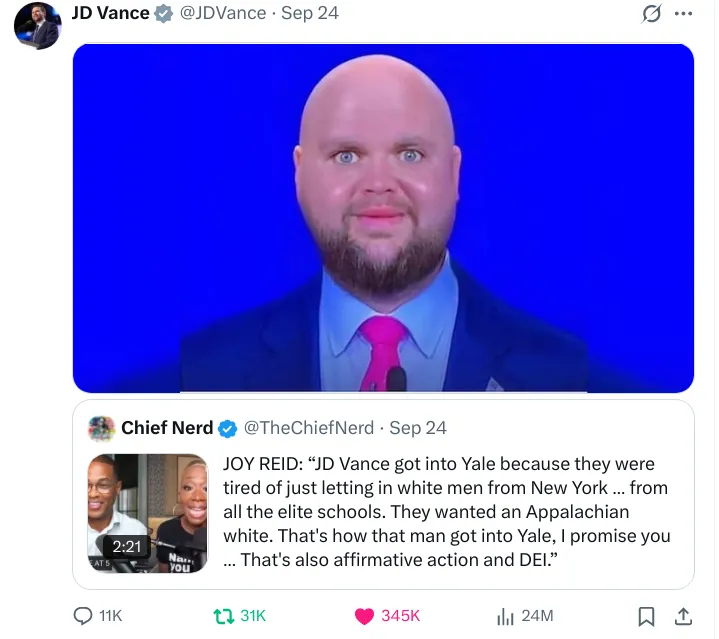
There is widespread speculation that Vance’s comfortable navigation of meme culture comes from direct experience, that he maintains a Twitter alt, that he is in fact an anon poaster. There is of course even speculation as to which account is his, although naturally, no one knows for sure, and Vance sure isn’t telling.

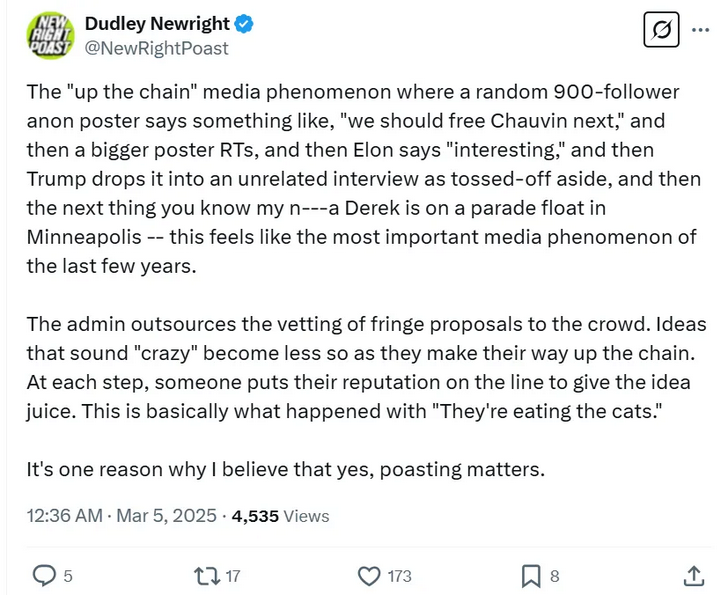
If there are poasters in the administration, we might expect them to treat policy the way they learned to handle memes. Any random small-account anon might come up with an absolute banger of post … so why shouldn’t they be able to come up with banger policies, too? Why limit themselves to adopting policies developed inside the long, tedious processes of bureaucratic committees and comfortable think tanks? If rapisthitler1488 has a good idea, well, why not use it? You can just do things. This attitude is at the heart of what Dudley Newright calls the “up-the-chain phenomenon”.

We’d also expect an administration laced with poasters to pay careful attention to the online right, using it to gauge the public mood in order to correct course. At its worst this could turn into audience capture, but at its best this enables a much more responsive reaction to public sentiment than that afforded by polling data since it is both immediate and disintermediated. Rather than waiting for the polling agency to carefully word a question to get the answer it wants, and then painstakingly call up and interview a statistically representative and unbiased sample so that it can provide rigorous Poisson errors for the answers to its biased questions, public sentiment can be analyzed as soon as people start tweeting, and evaluated in terms of the public’s own words. In essence, the poastocratic administration becomes akin to a livestreamer monitoring the chat.

Finally, we might expect to see the administration deliberately trolling the base. Experienced influencers know that outrage bait drives engagement. If you want to move in a certain policy direction but are being pressured behind the scenes not to do that, or conversely if you are being pressured to do something you know will be unpopular, an excellent way of assembling the political capital necessary to do what you want is to announce that you’re going to do the opposite. The howls of outrage from the base then provide you with the excuse you need to do what you wanted to do in the first place. “Let me check with the boss … Well, sorry, I’d really love to help you, but the boss won’t let me do that.”

OK, you say, this is all very interesting, an emergent feedback loop of cybernetic governance linking the networked hive mind to the traditional institutions of government, but is there any actual evidence beyond some meme-slop posted by the DHS in an effort to assure the base that they are getting the Got What They Voted For Award? Well, let’s get into that.

Update, 14 October: Welcome, Instapundit readers! Please do have a look around at some of my other posts you may find of interest. I send out a daily summary of posts here through my Substackhttps://substack.com/@nicholasrusson that you can subscribe to if you’d like to be informed of new posts in the future.


North Africa Ep. 3: Stukas, Submarines … and a Trap

World War Two
Published 11 Oct 2025

Feb 19, 1941 — North Africa flares up as German air and naval pressure around Tripoli and Benghazi intensifies and the first ground clashes break out near El Agheila. This episode follows X Fliegerkorps strikes, Royal Navy submarine successes (including the sinking of the cruiser Armando Diaz), and the shipment of men and matériel that leads to the new Deutsches Afrikakorps. British command, distracted by events in Greece, underestimates Axis moves, setting the scene for an ambush of Commonwealth patrols and the opening shots of the Desert War.
(more…)

Stephen Fry’s Odyssey weighed in the balance and found wanting

Filed under: Books, Greece, History — Tags: , , , , , — Nicholas @ 03:00

Bryan Mercadente received a copy of Stephen Fry’s latest foray into Greek mythology and not only is not impressed, he writes, “Every page wasted on Fry is a page stolen from the real thing. The copy my aunt has given me for my birthday is already skimmed with disgust and thrown into the dustbin: it is too disgusting for the charity shops.”

The Iliad and Odyssey are the founding works of our civilisation. They are poems of war, loss, exile, and return. The hero of The Odyssey is a liar, a man of cunning and cruelty, but also a survivor who longs for home. The Homeric poems have come to us out of the Bronze Age. They have survived the collapse of at least two civilisations, and will survive the collapse of our own. They survive because they are already perfect. The hexameters carry an austere music. Their formulaic epithets — “ῥοδοδάκτυλος Ἠώς“, “πόδας ὠκὺς Ἀχιλλεύς“, “δῖος Ὀδυσσεύς” — are the memory-tricks of a sung tradition, but they also give the poems a dignity that no one who reads them can ever forget. Like The Iliad, The Odyssey was not written to be read in comfort with a cup of tea. It was composed to be chanted in smoky halls to men who might be dead tomorrow.

Stephen Fry knows none of this. Or if he knows it, he does not care. His Odyssey is Homer without the difficulty. It is Homer stripped of his grandeur, reduced to banter and “relatable” anecdotes. The Observer praised it for bringing “contemporary relevance” to the myths. That line is damning enough. Homer does not need contemporary relevance. A book that has spoken to audiences across three thousand years already possesses the only relevance that matters. To make Homer relevant is to make him trivial.

The Guardian called the book “relatable and full of humour“. Again, the praise condemns. Relatable? Homer is not relatable. The world he describes is harsh and alien. His heroes live by honour and die by the sword. They weep like children and sacrifice to gods who may or may not answer. That strangeness is the point. It is what makes Homer worth reading. To make him “relatable” is to gut him of meaning.

The Irish Independent calls Fry “A born storyteller“. This blurb, like the others, is the language of people who cannot read. No serious critic would praise a reteller of Homer as “a born storyteller”, as if the original poet were not the greatest storyteller of them all. These blurbs are not criticism. They are advertising slogans. And they work. The book is a bestseller.

Why, then, is Fry’s book a bestseller? Not because of merit. It sells because of Stephen Fry himself. For thirty years, he has been cultivated as a “national treasure”. He is the ideal leftist intellectual: clever enough to appear learned, shallow enough never to disturb. He quotes Wilde, sprinkles in Latin tags, and sprinkles them badly. His claque tells us that he is bipolar, gay, witty, and charming. He is on panel shows, chat shows, and literary festivals. He is always agreeable, always moderate, and always applauded.

Fry has built a career on the fact that the English middle classes like to feel cultured without effort. They want Plato without philosophy, Shakespeare without metre, Wagner without subversion, Homer without Greek. They want to be reassured that the classics are not difficult or dangerous, but fun. Fry gives them what they want. He domesticates the wild. He reduces epic to anecdote. He packages civilisation as entertainment.

It is not enough to call this dumbing down. It is worse. Dumbing down implies a reduction in complexity. What Fry does is not simplification but falsification. The Odyssey is not a sequence of funny stories about gods and monsters. It is about endurance and the fragility of human life under the indifference of the divine. To make it “funny” is to destroy it. It is as if someone rewrote the Inferno as a travel blog or recast the Iliad as a football commentary. The whole point of the work is lost.

Popularity, however, is not a defence. It is an indictment. Books that sell by the million are almost always worthless. They are consumed because they flatter the prejudices of the public. They make readers feel clever without having to be clever. They make them feel cultured without culture. They are the literary equivalent of processed food: cheap, sweet, addictive, fattening.

What, then, is the harm? Why not let people have their Fry and be happy? So what if his writing is as inconsequential as his suicide attempts? The harm is that time is short. Every hour spent on Stephen Fry is an hour not spent on Homer. It is an hour subtracted from Gibbon, Johnson, or Shakespeare. It is an hour less of life. The opportunity cost is everything. Bad books are not neutral. They are parasites. They feed on the hours that might have been spent on good ones.

Communism, Socialism, and Star Trek

Filed under: Economics, Media, Politics — Tags: , , , , , , — Nicholas @ 02:00

Feral Historian
Published 23 May 2025

There’s a long history of Star Trek being equated with communism, both in praise and condemnation. But is it really mappable to modern politics, given that it assumes a different set of socioeconomic conditions? More to the point, is socialism (in the Marxist transitional sense) just a dead-end?

00:00 Intro
00:51 What’s Capitalism?
04:00 Communist, not Socialist
07:14 Theory and Practice
08:51 Goals and Process

🔹 Patreon | patreon.com/FeralHistorian
🔹 Ko-Fi | ko-fi.com/feralhistorian
Obligatory shameless plug for Ninti’s Gate
🔹 https://www.amazon.com/dp/B0CYXH9BWD

QotD: Christian observance in the late Middle Ages

It’s hard to convey just how overwhelming spiritual life was in the late Middle Ages, but I’ll try. If you can find a copy for cheap (or have access to a university library), browse around a bit in Eamon Duffy’s The Stripping of the Altars. I can’t recommend it wholeheartedly, not least because I never managed to finish it myself — it’s dense. This is not because Duffy is a bad writer or meager scholar. He’s a titan in his field, and his prose is pretty engaging (as far as academic writing goes). It’s just that the world he describes is mind numbing.

Everything is bound by ritual. Hardly a day goes by without a formal religious ceremony happening — over and above daily mass, that is — and even when there isn’t, folk rituals fill the day. Communal life is almost entirely religious. Not just in the lay brotherhoods and sisterhoods that are literally everywhere — every settlement of any size has at least one — but in the sense that the Church, as a corporate entity, owns something like 30-50% of all the land. In a world where feudal obligations are very real, having a monastery in the vicinity shapes your entire life.

And the folk rituals! The cult of the saints, for instance — reformers, both Lutheran and Erasmian, deride it as crudely mechanical. There’s St. Apollonia for toothache (she had her teeth pulled out as part of her martyrdom); St. Anthony for skin rashes; St. Guinefort, who was a dog (no, really), and so on. The reformers called all of this gross superstition, and it takes a far more subtle theologian than me to say they’re wrong. But the point is, they were there — so much so that hardly any life activity didn’t have its little ritual, its own saint.

And yet, as suffused with religion as daily life was, the Church — the corporate entity — was unimaginably remote, and unfathomably corrupt. Your local point of contact with the edifice was of course your priest, who was usually a political appointee (second sons went into the Church), and, well … you know. They probably weren’t all as bad as Chaucer et al made them out to be (simply because I don’t think it’s humanly possible for all of them to be as bad as Chaucer et al made them out to be), but imagine having your immortal soul in the hands of a guy who’s part lawyer, part used car salesman, part hippy-dippy community college professor, and part SJW Twitter slacktivist (with extra corruption, but minus even the minimal work ethic).

Severian, “Reformation”, Founding Questions, 2022-03-07.

Powered by WordPress