
Quotulatiousness

September 19, 2025

What’s the next thing to be devoured on Trump’s menu? Ah, Antifa it is …

Filed under: Government, Media, Politics, USA — Tags: , , , , , , — Nicholas @ 05:00

Again leaning heavily on the social media site formerly known as Twitter, ESR has several posts on Donald Trump’s announcement that Antifa is in his crosshairs:

Next comes the part where every NGO/nonprofit implicated in funding a major terrorist organization gets a proctological exam by people with no sense of humor at all.

As I have emphasized several times in the last week: the long game in taking down a terrorist network is to smash its funding chain.
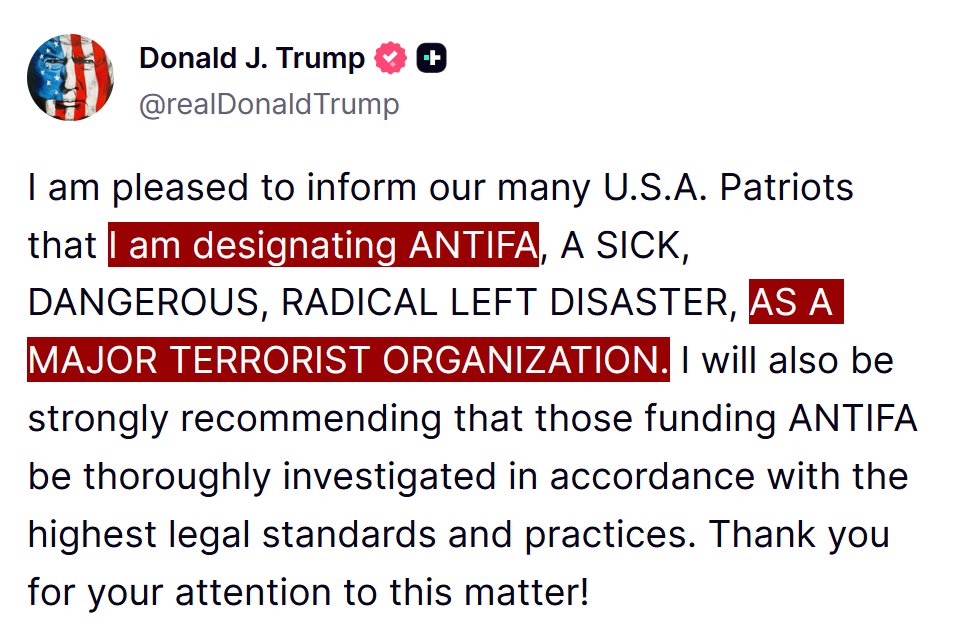
ESR’s analysis begins thusly:

Antifa has just been declared a “major terrorist organization”. Putting on my intelligence-analyst hat again, I’m going to examine its strategic options in the new political and legal conditions following the assassination of Charlie Kirk.

I’m going to start with a briefing on what Antifa is and what it does.

A reminder: Antifa is not a unitary conspiracy. It’s a cluster of horizontally-networked cells, some visible aboveground, some semi-covert, possibly some that are fully underground. By design it doesn’t have a central command.

So we’re really asking what range of behaviors Antifa cells normally choose, or can choose.

Before we can explore that we have to identify what Antifa is for and how it fits into the political ecology of the U.S.

None of what I’m about to tell you is speculation. It can be verified by reading Antifa’s propaganda and watching its behavior.

Antifa is an organization of Communists and Left-Anarchists; thus the red and black flags in the main Antifa logo. Its ultimate goal is a violent anti-capitalist revolution that will destroy American constitutional government. The Communists and Left Anarchists have agreed to argue about the shape of what comes afterwards after the revolution.

In practice, Antifa acts as willing street muscle for a range of associated Communist and Socialist organizations, most notably the DSA (Democratic Socialists of America), CPUSA (Communist Party of the USA), the SWP (Socialist Workers Party), and various SWP splinter groups.

Antifa also takes strategic direction from the left wing of the Democratic Party. My readers can make their own judgments about whether there is anything remaining in the Democratic Party other than a left wing; the answer to that question is not relevant to the rest of this analysis.

An important point is that the links between the Democratic party and Antifa are personal and deniable. They probably do not run through the Democratic National Committee. A good place for counter-terror analysts to look (and I’m sure Palantir already has this mapped) would be the politicians known as “the Squad” and their close associates.

The strategic sub-goal that was being executed when Charlie Kirk was shot was the creation of a climate of fear that would inhibit public speech by conservatives. This is an explicit goal of Antifa direct action.

Antifa’s funding is deliberately obscure. Before USAID was dismantled, a significant percentage of it was probably coming from the American taxpayer through several layers of shadowy NGOs.

It is very likely that one way or another most of its money comes from low-profile liberal dark money groups such as Arabella, the Tides Foundation, and the Open Societies Foundations.

The effectiveness of Antifa as a political actor has always depended on its ability to act as a terror instrument for left-wing American politicians while maintaining deniability that the politicians’ rhetorical hate-targeting of opponents ever cashes out as violent action.

The first major constraint on Antifa’s future behavior is that this deniability is going to be much more difficult to maintain from now on. Because while the deliberate diffusion of its structure makes legal proof that something called “Antifa” shot Charlie Kirk difficult, it also made Antifa affiliation of any left-wing assassin impossible to effectively deny.

In my next post, I will examine the consequences of this shift.
Continuing the discussion:

Mafia families don’t have membership cards.

Why am I bringing this up now? Because one attempt to head off the hammer coming down on Antifa that we’re hearing from its aboveground allies is that Antifa doesn’t exist.

It’s just an idea. There’s no central command. No common funding. No membership cards. No way to tell who’s a member and who isn’t.

The reductio ad absurdum of this bullshit is to point out that, following the argument, the Mafia cannot possibly exist. Which would be interesting news to all the people it murdered.

Historical note: there was a period when the Mafia was structurally different from Antifa in that it had a Boss of All Bosses, but the position was abolished by assassination in 1931.

In reality, when you’re dealing with a criminal or terrorist conspiracy that doesn’t have membership cards, you identify members of it the same way that other members do: by their willingness to cooperate with each other on shared projects.

And sometimes, by their participation in shared bonding rituals like a Cosa Nostra initiation ceremony or a “bash the fash” demonstration.

None of this is difficult, and it’s exactly the kind of situation that the RICO (Racketeering and Corrupt Influence) laws were written to address.

From Trump’s public statements, I’m guessing that they’re going to go right past RICO to a Foreign Terrorist Organization designation.

This won’t be difficult either. If you have any doubt that at least some Antifa chapters are funded by Chinese Communist money, you really need to get out more.

The announcement clearly didn’t come out of the blue:

Still wearing my intel-analyst hat, and have realized something.

Trump’s announcement that Antifa is being designated a “major terrorist organization” doesn’t make any sense unless law enforcement is already holding evidence that the assassination of Charlie Kirk was an Antifa op.

Otherwise, the risk of political blowback from that announcement would be way too high. Trump can be erratic, but he’s cunning about stuff like this and obviously has a shrewd sense of what he can get away with.

So, yep. The most likely scenario was the correct one. The hoofbeats really were horses, not zebras. Everybody still in denial about this is destined for more pain.

And back to the analysis:
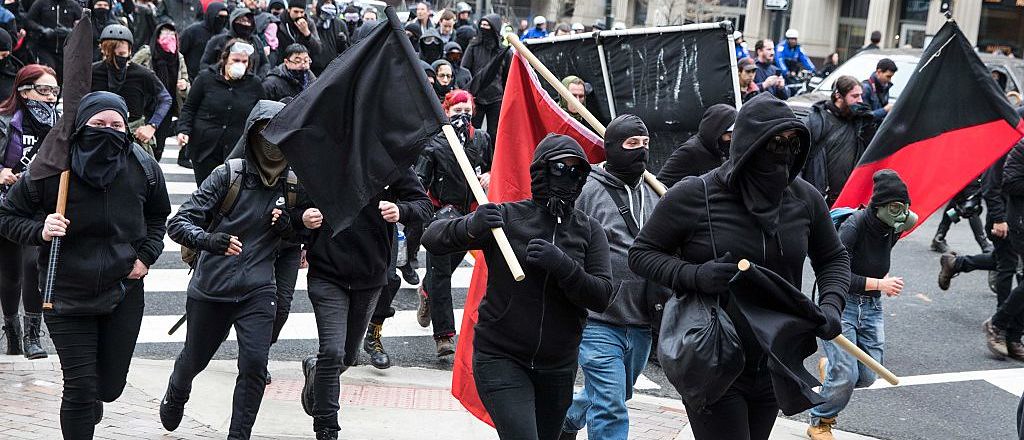
“antifa 8973ag” by cantfightthetendies is licensed under CC BY 2.0

Continuing my analysis of Antifa’s strategic options following the Charlie Kirk assassination. These have changed yet again — narrowed considerably — following President Trump’s declaration yesterday.

The Federal Government has legal instruments that it can employ. The RICO (Racketeering and Corrupt Influence) laws were specifically designed to attack a different headless network of horizontally connected nodes — organized crime. The fact that Antifa doesn’t have membership cards or a unitary command structure isn’t even going to slow the Feds down.

I think that it’s likely the Feds will designate Antifa a foreign terrorist organization, zeroing in on Chinese Communist funding of some Antifa chapters. This will allow the direct use of the CIA, which is normally heavily restricted from operations on American soil.

Nothing Antifa itself can do as an organization will be able to prevent or deflect a massive multi-agency investigation. It is very likely that Palantir already has their core membership identified and their communications channels mapped. Fusion centers will be capturing an unknown but probably large percentage of Antifa message traffic.

(They’ll be helped by the fact that Antifa’s communications security is terrible — it uses Discord for most comms, which is strictly amateur-hour. To be fair, the inner membership is likely to be savvy enough to be using Signal.)

Antifa’s only hope is pressure by its aboveground allies in politics and media. The cells with intelligent leaders will understand that they must cease all direct actions in order to avoid putting those allies in any position of appearing to support assassinations.

Unfortunately for Antifa, in order for hunkering down to work, every single cell has to have leadership that is both strategically patient and capable of restraining its more mentally unstable footsoldiers.

A related problem is that subversive and terrorist organizations that don’t act tend to develop morale problems. A certain minimum level of satisfying violence is required to keep their troops engaged.

Antifa probably has a worse issue here than the average terrorist organization because they recruit so heavily from sexual deviants and borderline mental cases who are likely to have other MBD-related issues including impulsivity and high time preference.

Over time, external pressure for Antifa to look easy for its aboveground allies to defend will remain steady or increase. This is especially so if the Democratic Party line remains Joe Biden’s “Antifa is just an idea”.

At the same time, internal pressure for direct action will increase. Antifa’s survival may depend on how long it is able to manage that pressure.

Antifa needs the investigation to be stalled out and paralyzed by Democratic lawfare before its stupidest cells do something too public and violent for its allied mainstream media to willfully ignore or suppress.

Longer-term, if Antifa survives, it faces a different problem. It dreams of revolution, but is only capable of operating on the sufferance of a general public that largely dismisses it as a LARP for nose-ringed freakazoids. Having committed a gaudy murder of an Everyman figure, it is not likely to get that sufferance back.
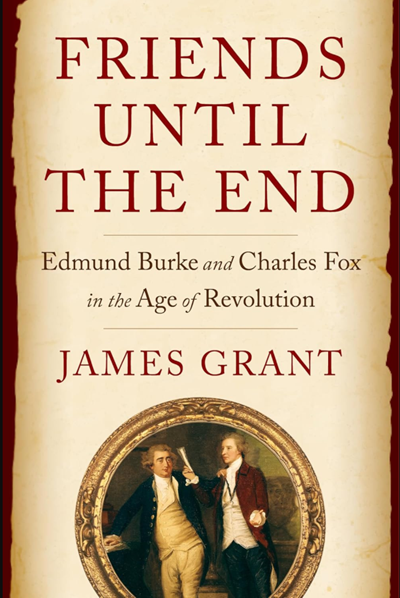
Edmund Burke, lawfare, and the East India Company

In The Coolidge Review, Amity Shlaes discusses “the most outrageous campaign of lawfare in the history of the Anglosphere”, as Edmund Burke assailed Warren Hastings, the first governor general of India:

Why do even principled statesmen — and there are some in this administration, too — not dig in their heels and try to arrest the chain of revenge? Why do even cautious, logical men and women succumb to the passion of lawfare?

The most outrageous campaign of lawfare in the history of the Anglosphere, the impeachment and trial of the first governor general of India, Warren Hastings, was mounted by Mr. Incrementalism himself, Edmund Burke. The father of modern conservatism spent nearly a decade of his time in Parliament—from 1787 to 1795—crusading against Hastings, antagonizing allies all around.

Impeaching the “Wicked Wretch”

There were reasons to investigate what was going on in India: Hastings exploited the fact that the East India Company was, at that time, an adjunct of the Crown. That connection between a powerful company and a government — a far more powerful company than, say, Intel — was the trouble, for as Burke would put it, it created “a state in disguise of a merchant“.

Burke chose to prosecute Hastings — and failed. The “wicked wretch”, one of Burke’s slime phrases for Hastings, emerged from the ordeal with a pension, not a conviction. Burke biographer Russell Kirk has argued that the public flaying of Hastings served posterity — in England at least. After Burke’s death, at “every grammar and public school”, the story of Burke and Hastings “impressed upon the boys who would become colonial officers or members of Parliament some part of Burke’s sense of duty and consecration in the civil social order”. That slowed another chain, the chain of abuse by Britons of Indians. After Burke, England recognized that, as Kirk puts it, she had a “duty to her subject peoples in the East”.

Still, even Kirk’s excellent biography leaves readers wondering: Was Hastings truly the archest of the arch villains, as Burke maintained? And is this the right way to go about it all? A book that Burke penned in the same years that he waged his Hastings war, Reflections on the Revolution in France, influenced a far greater number, and in a greater number of lands, than the Hastings story. Burke might have had the same reach with a Reflections on the Abuses of the East India Company.

All the more welcome then is James Grant’s Friends Until the End, which gives the best-yet account of the chain reaction in Burke’s soul that drove him to weaponize government, what his crusade cost him, and what such crusades may cost all of us.

[…]

Next, however, came a challenge that deeply frustrated Burke. Scanning the empire’s horizon for a place to commence a model reform, Fox and Burke settled on the East India Company, which abused the some thirty million Indians it oversaw with the same admixture of plunder, condescension, and cruelty familiar to Catholics of Ireland. The pair put their hearts into the Indian reform: Fox promised a “great and glorious” reform to save “many, many millions of souls”. They also put their minds into the project. To track the East India Company, Burke personally purchased sufficient shares to win him rights to attend and vote at quarterly meetings. He steeped himself in knowledge of a land he’d never seen, learning names of “numerous Indian nawabs, rajas, nizams, subahs, sultans, viziers, and begums“.

Such prep work, as Grant points out, enabled the Whigs to identify the correct solution: de-mercantilization. “Separate the company’s two incompatible missions: sovereign rule and moneymaking”, Grant writes. The compromised statute that emerged from the House of Commons was not as neat: A seven-man commission would rule India, while a board would govern East India’s commercial operations. But the commercial board would be a subsidiary to the commission. And in marshaling their votes for the measure, the pair still confronted the formidable obstacle of East India shareholders in Britain, furious at the threat to their fortunes that such reform represented. Fox might emancipate Hindus, their opponent William Pitt warned, but he must also “take care that he did not destroy the liberties of Englishmen”.

The king and his allies in any case defeated Fox’s India Bill, as it was known, in the House of Lords. The king, who had that prerogative, booted Fox and Burke from paid posts. In the 1784 general election, Burke held on to his seat in Parliament, as did Fox (by a hair), but so many Whigs, now labeled “Fox’s martyrs”, were ousted by voters from Parliament that the Whigs’ opponent, Pitt, became prime minister. Burke’s disillusionment ran deep: “I consider the House of Commons as something worse than extinguishd”, he wrote.

It was thus, at the age of fifty-nine and merely an opposition parliamentarian, that Burke risked his high-stakes lawfare. He commenced impeachment proceedings with a four-day anti-Hastings polemic. Of course, Burke universalized his point: The Hastings trial was “not solely whether the prisoner at the bar be found innocent or guilty, but whether millions of mankind shall be made miserable or happy”. And of course he raised the stakes for fellow lawmakers by appealing to their honor: “Faults this nation may have; but God forbid we should pass judgment upon people who framed their laws and institutions prior to our insect origin of yesterday!” The House must join him in impeachment, the Lords convict Hastings.

The House did join him, handing to the Lords charges that Hastings had “desolated the most flourishing provinces”, “pressed, ruined, and destroyed the natives of those provinces”, and violated “the most solemn treaties”. In thousands of hours of speeches before a jury from the House of Lords, the eager prosecutor, Burke, dwelt on Hastings’s cruelty to the Rohillas, an Afghan tribe from land bordering Nepal. He also charged that Hastings had taken revenge on a crooked tax collector, Nandakumar, for alleging that he — Hastings — had taken a bribe, seeing to it that Nandakumar was convicted and hanged for forgery. Not all of this was proven. And, as the jury of Lords slowly considered the charges, as the months and years passed, Burke found himself more and more isolated. Fox, Burke’s initial ally in the undertaking, faded. By the time the Lords’ jury voted not to convict, eight years on, a full third of their original number had already passed away.

After the Charlie Kirk assassination, here are three possible futures

Filed under: Government, Media, Politics, USA — Tags: , , , — Nicholas @ 03:00

On the social media site formerly known as Twitter, ESR lays out what he sees are the three most likely short-term futures for the United States after the assassination of Charlie Kirk:

I’m a student of history. Here are three possible futures following the assassination of Charlie Kirk. They’re based on historical examples of what happens when a Communist subversion campaign or insurgency overplays its hand and triggers broad popular resistance.

1. Popular revulsion against aboveground leftists celebrating the murder gives the Trump administration political cover to go after Antifa and its shadow funding network hard. Both are smashed.

Communist agents of influence in the mainstream media and academia continue to self-discredit.

Relatively few Communists are arrested, but their millions of aboveground tools become isolated and demoralized.

Propelled by a huge swing in voter registrations that we are already seeing happen, the Democrats get crushed in the 2026 midterms.

The long period of fever, madness, and Left ascendancy that began with the assassination of JFK by a Soviet agent in 1963 ends not with a bang but with a whimper.

This is the best case scenario for everybody, including the Communists who don’t get thrown out of helicopters or shot down in the streets.

If things don’t go this way it will likely be because Democratic lawfare prevents the counter-subversion push from being fully effective. An obvious index of this failure would be another high-profile political assassination or attempt against a conservative target after about 4 months out.

What happens in the event of that failure, especially if the third public attempt to kill Trump succeeds:

2. A period of Caudillismo. A charismatic strongman rides popular anger into power. If this happens, the Left better pray that the strongman is an infuriated JD Vance, because any alternative to him is likely to be worse for them.

The crackdown against the Communist network becomes brutal and routinely uses extra-Constitutional means, possibly thinly covered by a declared state of emergency.

At the harder end of this range of possibilities, right-wing death squads not exactly formed by government but winked at by it go after Communist public figures that are out of reach of the law because they’ve carefully preserved deniability. Many journalists are at the top of this target list.

It is not likely that the Communist network can survive this future. The only way it happens is if they have enough popular support to develop a semi-militarized resistance — in effect making certain parts of the country no go regions for Federal agents.

Going by historical precedents, the index of this failure would be a resurgence of banditry by armed groups, initially with overtly political goals but decaying into general predation.

This would land us at:

3. Low-grade civil war, a la Bosnia or the Irish troubles. Anybody wishing for this has no idea how bloody, ugly, and brutal it would probably be. Especially if the Left succeeds at what it will with absolute certainty try to do, which is racialize the conflict.

I don’t think there is any realistic scenario in which the Communists win any of these confrontations. Not in the U.S., not in the 21st century. The question is how much blood and agony the rest of us will go through before they are finally defeated.

Update, 20 September: Welcome, Instapundit readers! Please do have a look around at some of my other posts you may find of interest. I send out a daily summary of posts here through my Substackhttps://substack.com/@nicholasrusson that you can subscribe to if you’d like to be informed of new posts in the future.

What Medieval Fast Food Restaurants Were Like

Filed under: Britain, Food, France, History — Tags: , , , , , — Nicholas @ 02:00

Tasting History with Max Miller
Published 15 Apr 2025

Golden brown fried pastries filled with a fruit and spice paste

City/Region: Paris
Time Period: c. 1393

Fast food has been around since the Middle Ages, and while a lot has changed in food production and cooking in the last six hundred years or so, then, as now, you could get a fried apple pie.

Rissoles were fried filled pastries (modern versions are usually some kind of filling rolled in breadcrumbs and fried), and they could be made savory or sweet. These ones are made with roasted apples, raisins, figs, and sweet spices. I chose cinnamon, ginger, and nutmeg, but you can choose whatever spices you like.

    It is common that rissoles are made of figs, raisins, roast apples, and nuts peeled to imitate pine nuts, and powder of spices [and a little fine salt]; and let the paste be well saffroned and then let them be fried in oil [and sugar them].
    Le Ménagier de Paris, c. 1393

(more…)

QotD: The sub-generations of Generation X

Filed under: Media, Quotations, Technology, USA — Tags: , , , , , , — Nicholas @ 01:00

… “Gen X” is actually a misnomer, as there are at least three distinct subgroups. There’s the very earliest Xers, the guys who were in high school in the late 1970s. They often get lumped in with the Baby Boomers, too, though they’re as different from the Boomers as they are from us, the “mid” Xers. Think Wooderson from Dazed and Confused. Brian Niemeier calls them “Generation Jones”, and while I don’t like that tag I don’t know what else to call them (except maybe “Woodersons”), so roll with it.

Then there’s the group that was in high school in the late 1980s. I squeak into this group (barely). We’re the mid-Xers. The real “grunge” generation. If Dazed and Confused is a pretty decent late-90s approximation of late-70s high school kids, then the best description I can give you of a “grunge” kid is the movie Deadpool. Made in 2016, by guys who were born in the mid-1970s. That’s grunge, in a way Kurt Cobain couldn’t even imagine. Fourth wall breaks! Sarcastic asides about the fourth wall breaks! Profanity! Masturbation jokes! And snark, snark, snark — unrelenting snark, about everything, all the time. Every second of that movie screams “I can’t believe you fags are amused by this, but since you obviously do, here’s lots more! Choke on it!!!”

The writers obviously wanted to work on Buffy the Vampire Slayer, but Joss Whedon was too cool for them — imagine the twisted psyche of a person who thinks Joss Whedon is cool — and Sarah Michelle Gellar just laughed at them, so they made Deadpool out of spite.

Then there’s the late Xers. They were in high school in the late 1990s, which is why us oldsters call them “Millennials” (as the term is now used, it seems to mean “those born around 2000”, i.e. the generation just now getting out of college. We took it to mean “those who were just getting out of college around the turn of the century”). Obviously I use the Internet. I’m using it now, but I’m not on the internet, and I’m certainly not an Internet Person. The very late Xers are Internet People. The very first Internet People; they invented the concept of Internet People. Mark Zuckerberg (born 1984) is a late Xer. The people behind Twitter (Jack Dorsey born 1976; Biz Stone 1974; Evan Williams 1972) are mid-Xers; they were ahead of the curve.

Severian, “Addendum to Previous”, Founding Questions, 2022-02-24.

Powered by WordPress



