Quotulatiousness

August 20, 2025

“All politics is local” … except when it isn’t

Filed under: Economics, Europe, Government, Media, Politics — Tags: , , , , — Nicholas @ 05:00

Lorenzo Warby on a recent study of the vast chasm between what European voters want in areas like crime and immigration and what their elected representatives want:

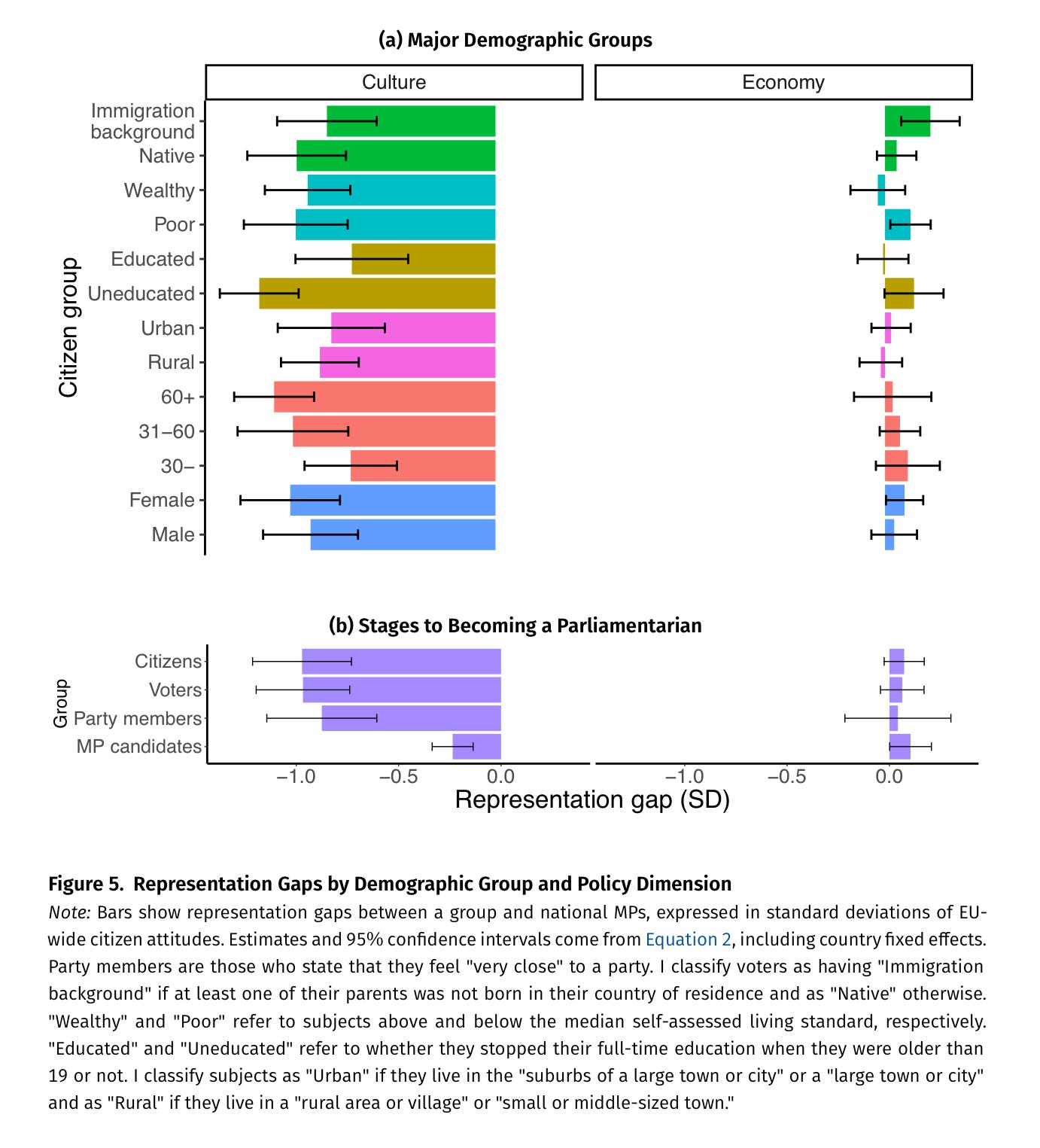
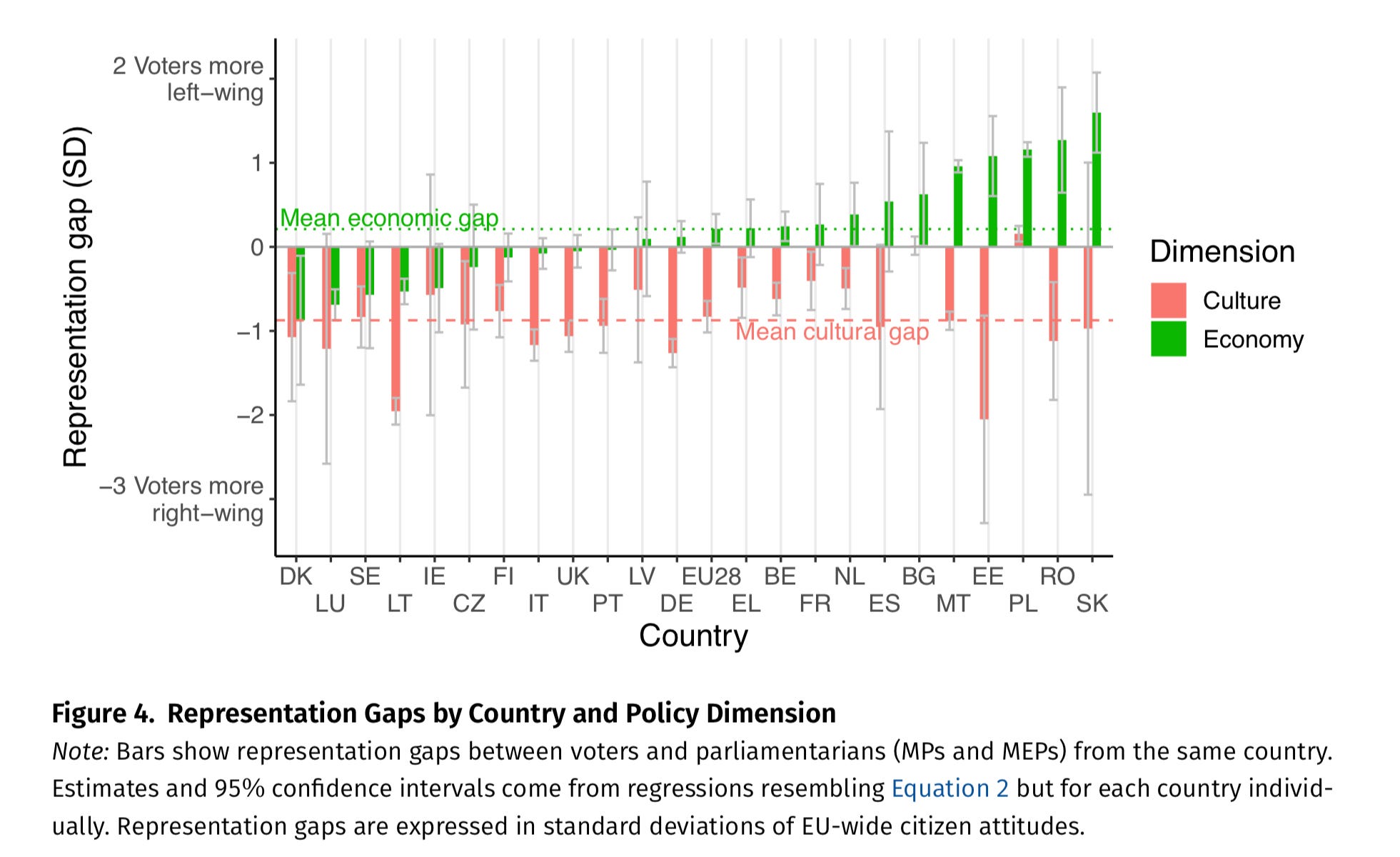
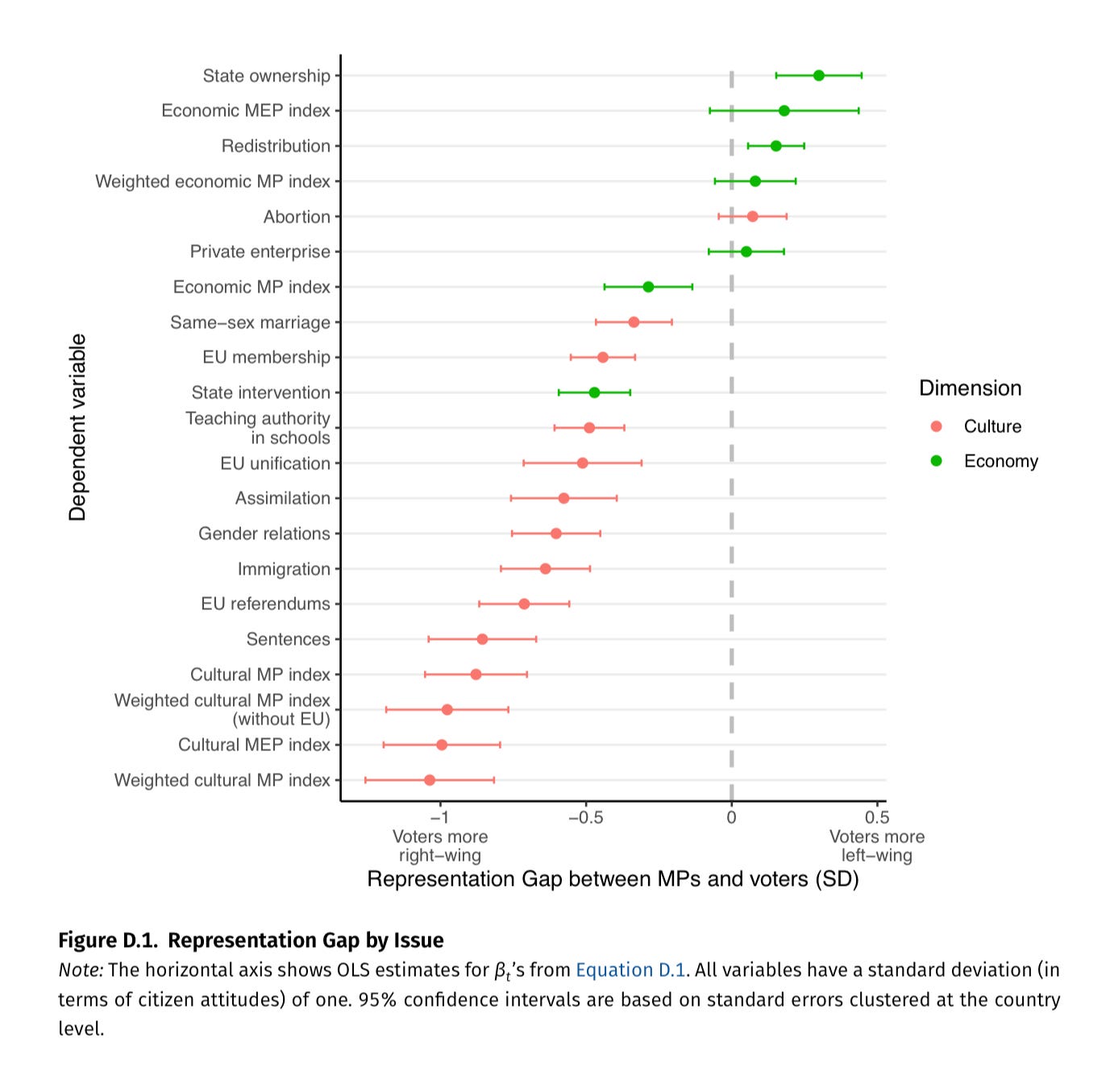
Economist Laurenz Guenther has performed the very useful exercise of quantifying how unrepresentative the views of European politicians are of their voters on cultural issues, such as crime and immigration. This is not true of economic issues, where the views of politicians tend to be quite representative of their voters.

In the case of economic issues, in some countries the politicians are more pro-market (“right”) then their voters, in others they are more dirigiste (“left”) than their voters, in others still they are very similar to their voters. There is simply no consistent pattern, and the average gap between voters and politicians across European countries on economic issues is fairly small.

With cultural issues, such as crime and immigration, we get a very different pattern. There, politicians are consistently more socially liberal (“left”) than their voters and by a considerable margin. While education levels explain some of this difference, they do not explain very much, as politicians are significantly more socially liberal than even university-educated voters.

Moreover, politicians are unrepresentative even of their own Party members/base on cultural issues and, again, in being much more liberal than their core supporters. There is some factor or factors specific to being a contemporary politician that systematically separates them out from voters on cultural issues yet does not operate with economic issues.

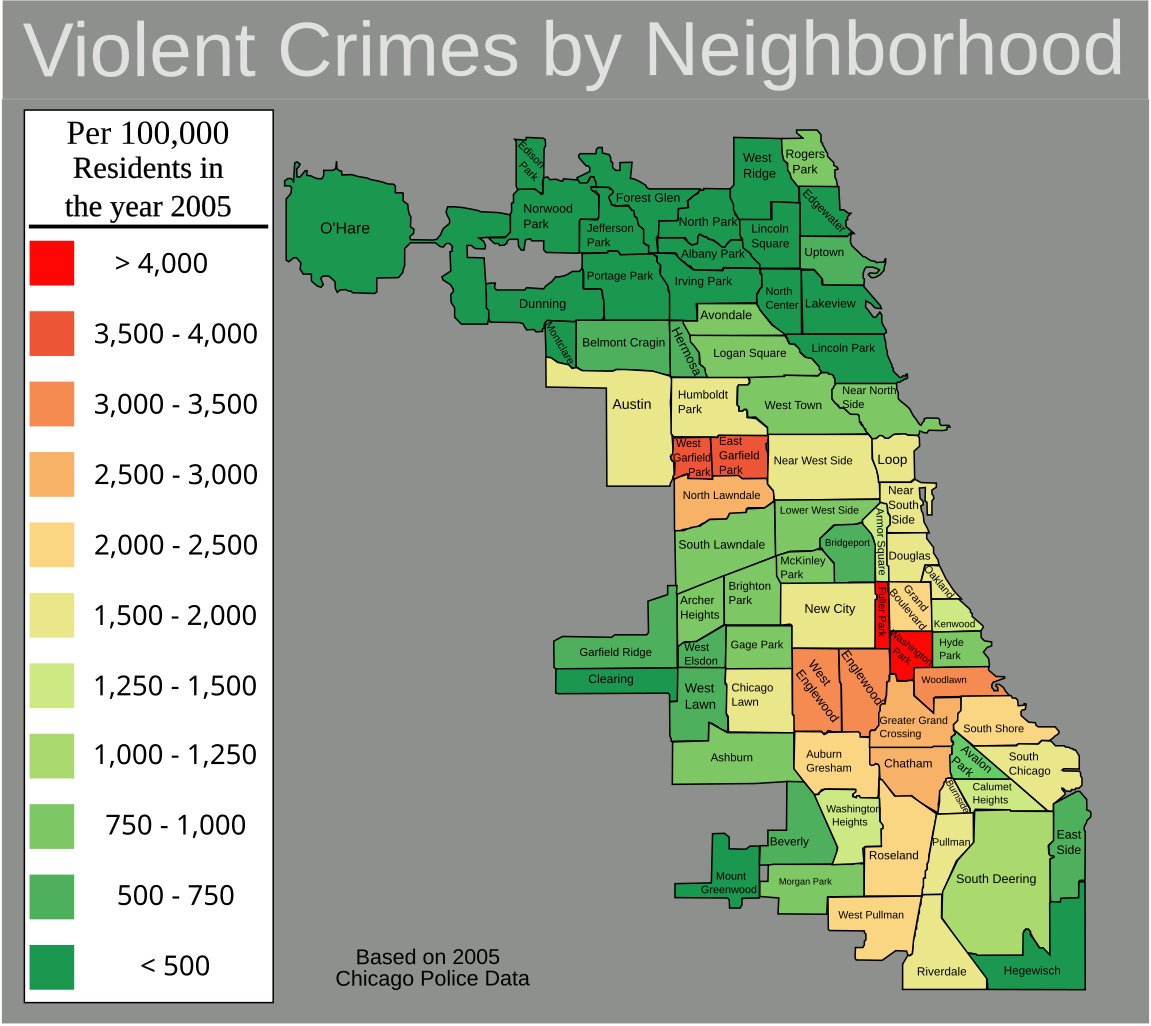
Veteran politician Tip O’Neill famously said that all politics is local. This is particularly true of cultural issues such as crime and immigration, where the effects vary wildly by location. This is much less true of economic issues, which are much more economy-wide in their operation.

There are various features we can identify here. First, executive function(s) — including such features as patience (aka time horizon) — varies between people and is highly heritable. Localities that have lots of people with poor executive function operate very differently from those where it is very much normal for people to have strong executive function.

As the combination of physical robustness and weak executive function predicts criminal behaviour, this has a great deal to do with why crime varies so dramatically by locality. This is especially as crime is very much a power law phenomenon, where a small minority of (overwhelmingly) men commit the vast majority of violent crimes.

Source – Wikimedia Commons.

It also means that people who have spent their lives in social milieus full of people with high executive function can have little or no sense of what happens when one has to deal with weak executive function folk. This is the people unlike me problem that so bedevils contemporary politics and commentary.
The Korean War Week 61: The South Koreans Strike as Ceasefire Talks Stall – August 19, 1951

Filed under: China, History, Military, USA — Tags: , , , , — Nicholas @ 04:00

The Korean War by Indy Neidell
Published 19 Aug 2025

After two months of inactivity, 8th Army begins new offensive operations this week, and it is the South Korean forces doing the fighting. Meanwhile, the Kaesong peace talks are ever more threatened by continuing neutral zone violations.

Chapters
00:00 Hook
00:48 Recap
01:13 Neutral Zone Violations
02:17 The UN Defense System
06:59 The ROK Attacks
10:38 Summer Diseases
12:48 Summary
13:33 Conclusion
15:20 Call to Action
(more…)

California’s ever-receding High Speed Rail dream

Chris Bray provides an on-the-ground update of California’s ultra-expensive high speed rail project which still has yet to deliver a single passenger from one station to another after nearly 20 years of funding:

Start with a description: “In 2008, California voters approved $9.95 billion of state bond funding as seed money to build an 800-mile high-speed rail (HSR) network connecting Los Angeles and San Francisco, and the Central Valley to coastal cities, at speeds of up to 220 miles per hour, with an expected completion date of 2020.”

Construction started in 2015. Pause for a moment and really notice the date.

Ten years later, the project has consumed $18 billion, and an effort to connect Los Angeles and San Francisco has turned into a much more modest “Phase One” plan to connect the cities of the Central Valley, well east of the coast. The modest declared cost of the proposed LA-to-SF bullet train now looks like this for the much shorter line: “a cost range of $89 billion to $128 billion.” The Trump administration has declined to provide more federal funding for the project, but California is suing to try to keep the federal spigot open.

[…]

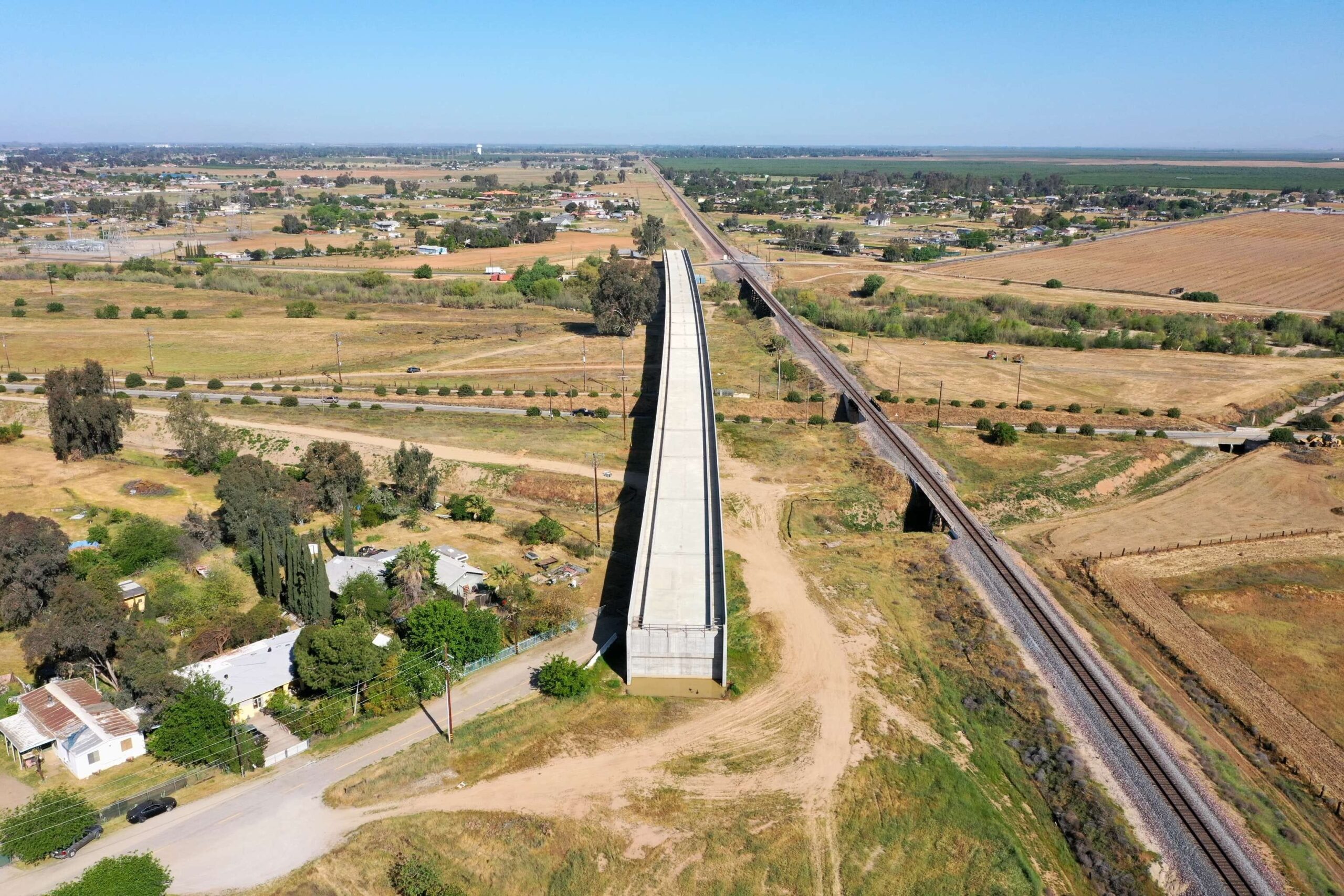
Famously, the California High-Speed Rail Authority has been posting pictures of its huge construction successes on social media:

See, that’s … almost a whole rail line for a bullet train. Obviously!

So!

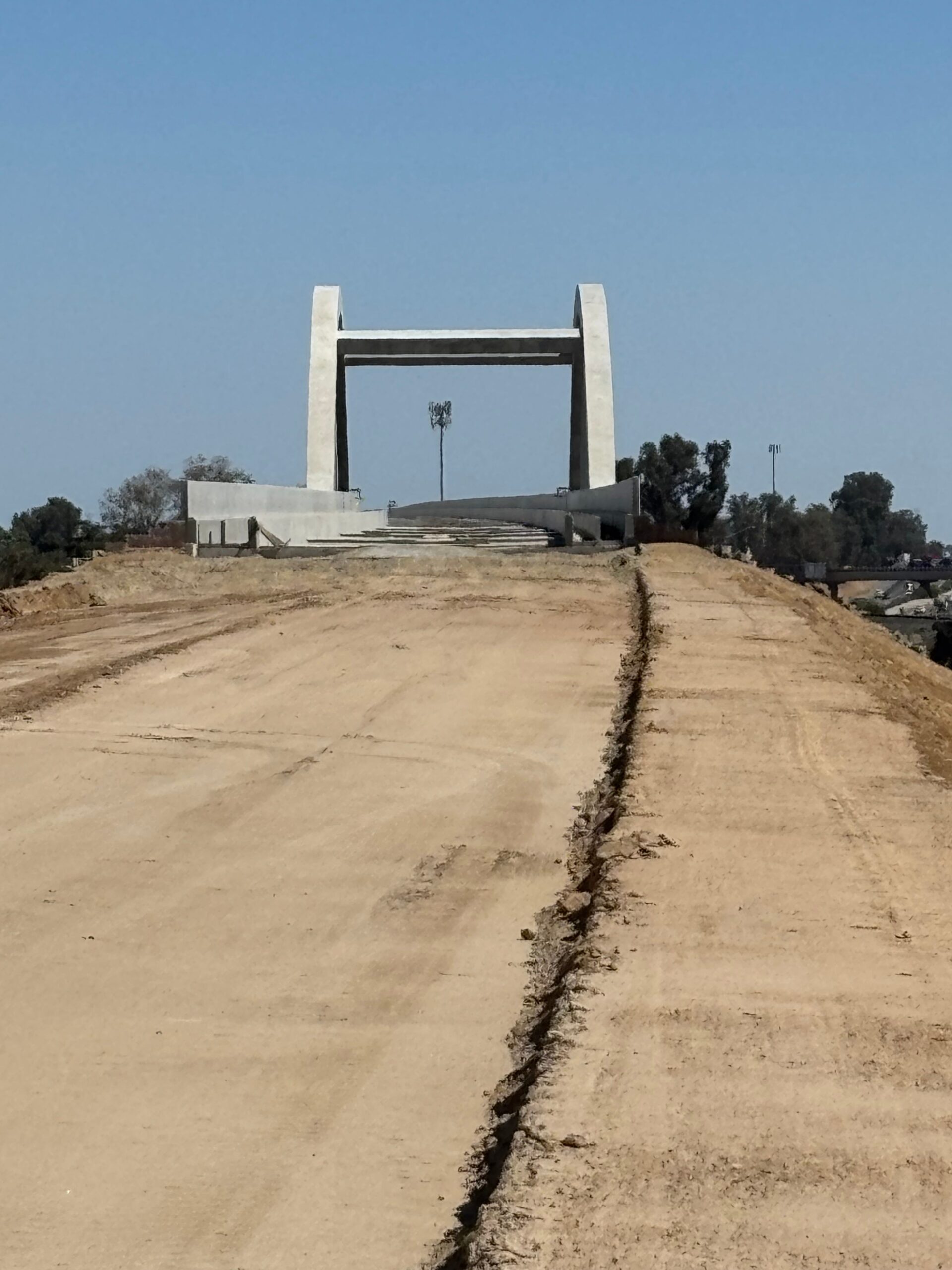
If you ever find yourself in Fresno, and I sincerely hope you don’t, the structures that have been built for “high-speed rail” are surprisingly easy to access. There are several places where those structures aren’t fenced in or guarded. At all. […] So when you see this:

…it’s not that hard to just head up onto the thing. It’s also very dangerous, legally dubious, and something you definitely shouldn’t do. Since it’s an elevated construction site, there are a lot of places without guardrails where you can just fall off the thing, and it’s a long way down.

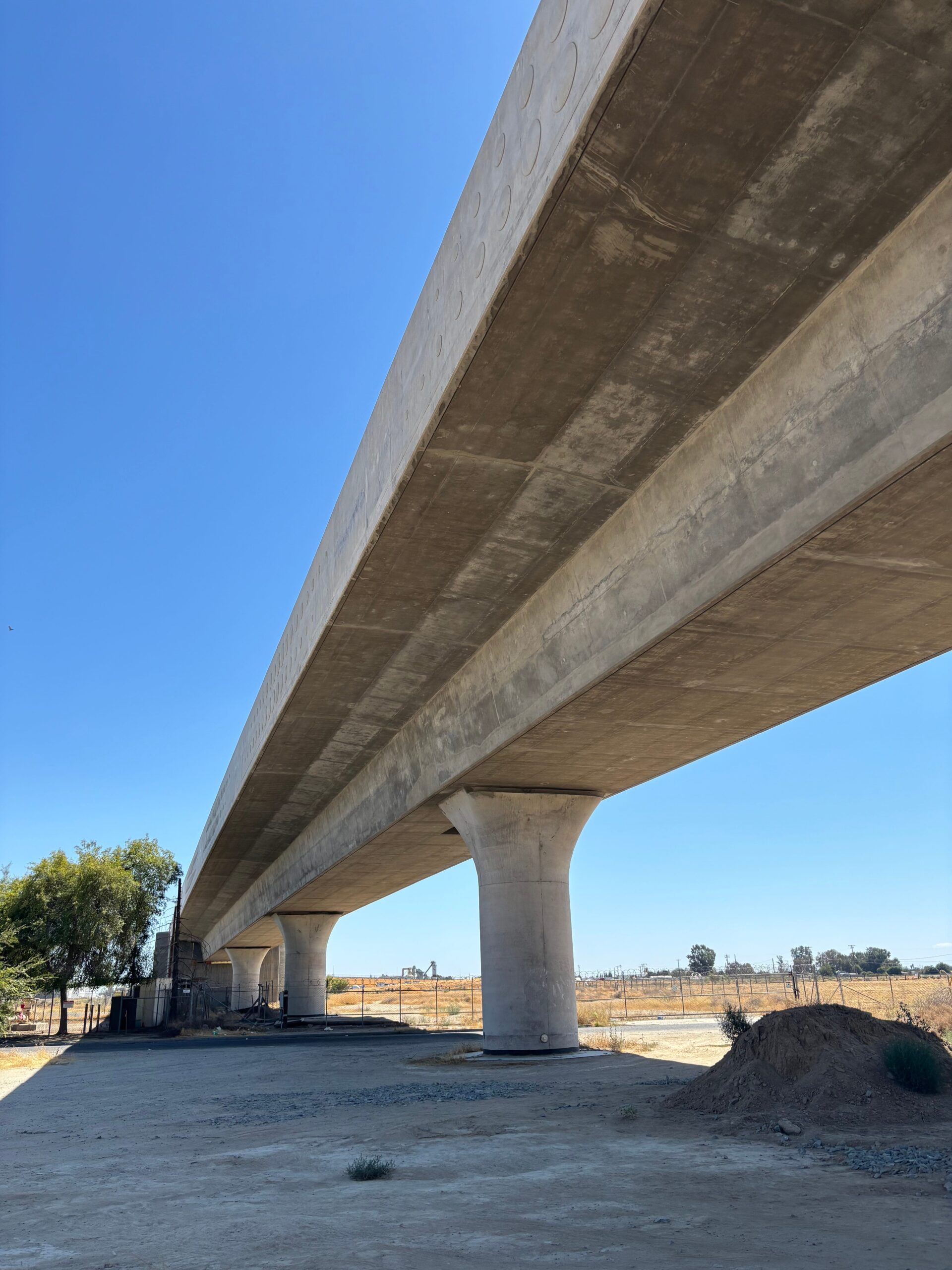
Everyone see this part: Don’t go up there. It’s dangerous. You can fall and die. […] But if you were to climb up onto the thing, which you absolutely should never do, you would see a whole bunch of this:

That’s a section at the northern end of Fresno, looking south.

Of course, California isn’t the only jurisdiction struggling to complete big infrastructure projects: Toronto’s long-awaited Crosstown LRT project got started in 2007 and still has no confirmed completion date, although a faint possibility exists that a portion of the line may open later in 2025.

UK vz.59 Czech Universal Machine Gun: History and Mechanics

Filed under: Europe, History, Military, Weapons — Tags: , , , , , — Nicholas @ 02:00

Forgotten Weapons
Published 21 Mar 2018

In 1952, Czechoslovakia adopted a whole new family of small arms, including the vz.52 pistol, vz.52 rifle, and vz.52 light machine gun. The rifle and LMG were both chambered in the Czech 7.62x45mm cartridge, and both would be adapted to the Soviet standard 7.62x39mm a few years later, in 1957. Very shortly thereafter, the Czechs would also introduce a heavier universal machine gun version in 7.62x54mmR under the designation UK vz.59 (universal machine gun model 59).

The UK 59 was basically a scaled up sibling of the vz.52 and vz.52/57 machine guns, although it fed from a belt only, where its smaller predecessors had allowed either belt or magazine feed. It used a pivoting locking block system much like the Walther P38 and Beretta pistols, in conjunction with a long stroke gas piston much like that of the vz.26 light machine gun.

The weapon did not see much interest outside of Czechoslovakia, although it does remain in service in that region in the modernized 7.62x51mm iteration.

Thanks to Marstar for letting me examine and shoot their UK vz.59!

QotD: Most “mass movements” really do need that “vanguard” to start moving

Filed under: History, Politics, Quotations — Tags: , , , , , , — Nicholas @ 01:00

Let us stipulate that Socialism’s appeal to the proles is “I offer you a good time”. Orwell takes this as read, but it also follows from the premises laid out earlier in the essay. Orwell equates “ease, security and avoidance of pain” with “comfort, safety, short working-hours, hygiene, birth-control and, in general, common sense”. The Commies explicitly promise the proles those things; he could’ve lifted that phrase straight from the Webbs’ most doe-eyed propaganda leaflet.

And yet, as Orwell knows better than anyone, the proles can’t do it on their own. You really do need a vanguard of the proletariat. As Orwell himself notes, Hitler was backed by the big industrialists, and if you really want to needle the eggheads in your life, point out how quickly and thoroughly the German professors knuckled under […] They couldn’t wait to lick his jackboots, any more than his British and American colleagues could wait to kiss Stalin’s ass. They called themselves a “workers’ party”, but in the early days [German fascists] were almost exclusively found among the dueling fraternities – and professors! — of the German university system.

In other words, maybe the proles don’t need nothin’ but a good time, like the old song says, but though the proles are the “mass” of “mass movement”, the “movement” part gets started considerably higher up the social ladder … that is, with guys like Orwell. Guys who know, deep in their bones, that there’s more to life than hygiene, short working hours, birth control, etc. Because he’s one of the great prose stylists, it’s not as apparent in Orwell, but in lesser hands than his you can smell the contempt dripping off every sentence an egghead writes about the proles …

It’s not that the proles want hygiene, birth control, etc. It’s what they need. What they deserve, when you come right down to it, because that’s what you do with livestock — keep ’em clean and well fed, and of course control their breeding. You could take the most purple passage of “animal rights” eco-lunacy and set it side by side with the Webbs’ Soviet Communism: A New Civilization, and see no difference at all. Sure, every aspect of our lives is managed for us by Our Betters, but at least we’re free range!

Severian, “Bonfire of the Vanities II”, Founding Questions, 2021-12-29.

Powered by WordPress