… Mycenaean Greece was as much an outlier as sub-Roman Britain: the civilizational collapse in the Aegean was unusually prolonged and severe compared to the fates of many of the other peoples of the Late Bronze Age. Here I have helpfully reformatted Cline’s chart of how resilient the various societies proved:
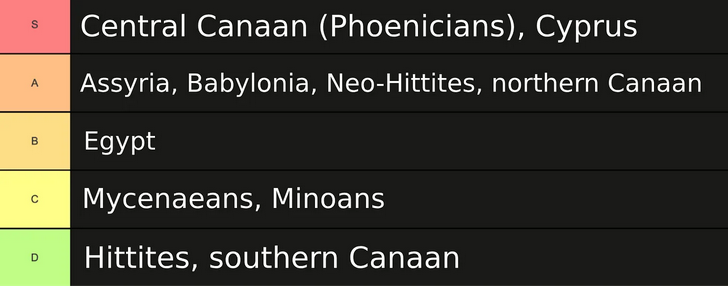
Let’s take a brief tour through the various fates of these societies. I’ll come back to the Phoenicians at the end, because their example raises interesting questions when considered in contrast with the Mycenaeans. For the moment, though, let’s begin like civilization itself: in Mesopotamia.
Before the Late Bronze Age Collapse, the Assyrian and Babylonian empires had numbered among the Great Powers of the age: linked by marriage, politics, war, and trade to the other mighty kings, they spent much of their time conducting high-level diplomacy and warfare. As far as we can tell, they did well in the initial collapse: there’s a brief hiatus in Assyrian royal inscriptions running from about 1208 to 1132 BC, but records resume again with the reign of Aššur-reša-iši I and his repeated battles with his neighbor to the south, the Babylonian king Nebuchadnezzar I (no relation). But although the kings of the late twelfth century continued much as their Bronze Age predecessors had — waging war, building palaces, going hunting, accepting tribute, collecting taxes, and ordering it all recorded in stone and clay — the world had changed around them. No longer were there huge royal gifts sent to and from fellow great kings, “My Majesty’s brother”1 overseas; now their diplomatic world consisted of tiny petty kings of nearby cities who could be looted or extorted at will.
Mesopotamia didn’t escape unscathed forever: beginning around 1080 BC, texts begin to record severe droughts, invading Aramaeans, and total crop failures. There was a major drought in 1060 BC, and then both the Assyrian and Babylonian records record further drought every ten years like clockwork — sometimes accompanied by plague, sometimes by “troubles and disorder” — until the end of the eleventh century BC. Most of the tenth century was equally dire, with chronicles recording grain shortages, invasions, and a cessation of regular offerings to the gods.
But unlike the Mycenaeans, and in spite of real suffering (ancient Babylonia is estimated to have lost up to 75% of its population in the three hundred years after the Collapse), both Mesopotamian empires were able to hang on to civilization. There were still kings, there were still scribes, and there were still boundary stones on which to record things like “distress and famine under King Kaššu-nadin-ahhe”. And when conditions finally improved, Assyria and Babylonia were both able to bounce back. When at last the Assyrian recovery began under Aššur-dan II (934-912 BC), for example, he (or more realistically, his scribe) was able to write: “I brought back the exhausted people of Assyria who had abandoned their cities and houses in the face of want, hunger, and famine, and had gone up to other lands. I settled them in cities and homes which were suitable and they dwelt in peace”. Clearly, Assyria still retained enough statehood to effect the sort of mass population transfer that had long been a feature of Mesopotamian polities.2
Over the next few centuries, the Neo-Assyrian Empire would come to dominate the Near East, regularly warring with (and eventually conquering) Babylon and collecting tribute from smaller states all over the region. At its peak, it was the largest empire history had ever known, covering a geographic extent unsurpassed until the Achaemenids. The Babylonians had to wait a little longer for their moment in the sun, but near the end of the seventh century they overthrew their Assyrian overlords and ushered in the Neo-Babylonian Empire. (Less than a century later, Cyrus showed up.)
So how did Babylon and Assyria hold on to civilization — statehood, literacy, monumental architecture, and so forth — when the Greeks lost it and had to rebuild almost from scratch? Unfortunately, Cline doesn’t really answer this. He offers extensive descriptions of all the historical and archaeological evidence for the diverse fates of various Late Bronze Age societies, but only at the very end of the book does he briefly run through the theories (and even then it’s pretty lackluster). He does have a suggestion about the timing — the ninth century Assyrian resurgence lines up almost perfectly with the abnormally wet conditions during the Assyrian megapluvial — but why was it the Assyrians who found themselves particularly well-positioned to take advantage of the shift in the climate? Why not, say, the Hittites?
Sometime around 1225 BC, the Hittite king Tudhaliya IV wrote to his brother-in-law and vassal, Shaushgamuwa of Amurru, that only the rulers of Egypt, Babylonia, and Assyria were “Kings who are my equals in rank”.3 A mere thirty years later, though, his capital city of Hattusa would lie abandoned and destroyed. Modern excavators describe ruins reduced to “ash, charred wood, mudbricks and slag formed when mud-bricks melted from the intense heat of the conflagration”.
And with that, the Hittites essentially vanished from history.
They were so thoroughly forgotten, in fact, that when nineteenth-century archaeologists discovered the ruins of their civilization in Anatolia, they had no idea who these people were. (Eventually they identified the new sites with the Hittites of the Bible, who lived hundreds of years later and hundreds of miles to the south, out of sheer ¯\_(ツ)_/¯.)4
What happened to the Hittites? Well, Cline suggests the usual mélange of drought, famine, and interruption of international trade routes, as well as a potential usurpation attempt from Tudhaliya’s cousin Kurunta, but the actual answer is that we’re not sure. Given the timing, they may have been the first of the Late Bronze Age dominos to fall; given the lack of major rivers in central Anatolia, they may have been uniquely susceptible to drought. Hattusa may have been abandoned before the fire — its palaces and temples show little sign of looting, suggesting they [may] already have been emptied out — but many other sites in the Hittites’ central Anatolian heartland were destroyed around the same time, and some of those have bodies in the destruction layer. But whatever the order of events, Hittite civilization collapsed as thoroughly and dramatically as the Mycenaeans’ had done, and with a similar pattern of depopulation and squatters in the ruins. Unlike the Mycenaeans, though, the Hittites would never be followed by successors who inherited their culture; the next civilization of Anatolia was the Phrygians, who probably arrived from Europe in the vacuum following the Hittites’ fall.
There was one exception: in the Late Bronze Age, cadet branches of the Hittite royal family had ruled a few small satellite statelets in what is now northern Syria, and many of these “Neo-Hittite” polities managed to survive the Collapse. A tiny, far-flung corner of a much greater civilization, they nevertheless outlasted the destruction of their metropole and maintained Hittite-style architecture and hieroglyphic inscriptions well into the Iron Age.5 (They would be swallowed up by the Neo-Assyrian Empire in the late eighth century BC.) And though the Neo-Hittite kings ruled over tiny rump states, we’re now able to translate inscriptions in which they referred themselves by the same titles the Bronze Age Hittite “Great Kings” had employed. The records of their larger neighbors, which had a much greater historical impact, seem to have followed suit: the Neo-Hittites in Syria probably actually were the Hittites of the Bible! Chalk up another one for nineteenth century archaeology.
Jane Psmith, “REVIEW: After 1177 B.C., by Eric H. Cline”, Mr. and Mrs. Psmith’s Bookshelf, 2024-07-08.
1. I really think we should bring back monarchs referring to themselves as “my Majesty”. So much cooler than the royal “we”. Or combine them: “our Majesty”!
2. The Babylonian Captivity, much later in the Iron Age, was far from historically unique.
3. The list actually reads, “the King of Egypt, the King of Babylonia, the King of Assyria, and the King of Ahhiyawa” — the strikethrough appears in the original clay tablet! A generation earlier, under Tudhaliya’s father Hattusili III, the Hittite texts had consistently referred to the king of Ahhiyawa as a “great King” and a “brother”, but apparently the geostrategic position of the Mycenaean ruler had degraded substantially.
4. We now know that the Hittites spoke an Indo-European language and referred to themselves “Neshites”, but the name has stuck.
5. I went looking for a good historical analogy for the Neo-Hittite kingdoms and discovered, to my delight, the Kingdom of Soissons, which preserved Romanitas for a few decades after the fall of the Western Roman Empire. The Neo-Hittites lasted a lot longer.