
Quotulatiousness

August 3, 2025

20th century advertising alchemy rediscovered

Filed under: Business, Media, Politics, USA — Tags: , , , , , — Nicholas @ 05:00

Much sound and fury has been devoted to the ritual denunciations of American Eagle and their new ad campaign featuring blatant Nazi ideology and imagery, er, I mean Sydney Sweeney:

Whenever I endure a sentence which trespasses into a jibe about whiteness or men or some other illusory bugbear, I stop reading and launch the laptop through the window. This week, I’ve cleaned out eBay. As one delivery driver lugs a fresh laptop to my front door, another scoops up the last to fall from the sky.

Those all-too-common laments about skin colour or genitalia are the scarlet letter imprinted on the chest of the thoughtless bore. It’s a mind virus without antidote. Screeching “whiteness!” upon snapping one’s shoelace betrays sound psychological health.


Take Sydney Sweeney, an American actress blessed with a merciless, unfair genetic inheritance. This week, Sydney broke the internet. Her crime? She’s rather attractive. Worse yet, Sydney flaunts her icy, Scandinavian beauty.

In an advert for American Eagle, the dewy, lissom blonde squeezes her gymnastic body into a pair of denim jeans. Smouldering before the camera, Sydney flutters her “great genes”.

Those great genes sashay around a classic Mustang — 400 horses of unapologetic masculine energy. Sydney pats her hypnotic behind. She fires up that climate-melting engine. The infernal marriage of masculine-feminine consummates as she roars off into the distance.

Advertisers know what they did. Diana, Roman goddess and huntress of men. Her chariot, the male appendage made steel and exploding gasoline. A combination to light our monkey brains on fire. The symbolism hijacks our amygdala: buy these jeans, and she’s yours. Or, for the other sex, buy these and manipulate them.

I’m sorry to be so blunt, reader. Those claims, as primitive as they may appear, are the animating spirit of advertising. Back in the 1920s, Freud’s nephew, Edward Bernays, transplanted Uncle Siggy’s theories into the advertising business. Out went staid adverts praising a product’s utility. In went adverts selling visions of your unconscious, insatiable self. Bernays transformed the public relations and advertising worlds. He sold products that stirred the galloping herds of the subconscious mind.


Take cigarettes. Before Bernays, smoking was a decidedly male pursuit. Tobacco giants, keen to double their potential customer pool, turned to him. Bernays transformed smoking from a vulgar, unladylike pastime into a symbol of freedom and female empowerment. Men buy Patek Phillipe watches for the same reason. As Dave Chappelle put it: “If a man could fuck a woman in a cardboard box, he wouldn’t buy a house”.

In just a few moments, Sweeney’s serpentine hips lulled advertising away from overt wokeness to its subliminal witchcraft. It worked. American Eagle’s stock surged fifteen percent.

For research, I studied the ad twenty-seven times. Your humble narrator bought thirty-seven pairs of jeans and then signed over his entire inheritance to Ms Sweeney.

The reaction on the identitarian left authored five additional chapters to the upcoming edition of the Diagnostic and Statistical Manual of Mental Disorders.

By teasing the words “genes” and “jeans”, Sweeney called for the annexation of Poland and the Sudetenland. MSNBC excelled itself, even birthing a new pidgin English indecipherable to 97 percent of native speakers:

“Sydney Sweeney’s ad shows an unbridled cultural shift towards whiteness”.

Well, that’s one way to think about it.
The Running Man: Prescient Subversive Shlock

Filed under: Media, Politics, USA — Tags: , , — Nicholas @ 04:00

Feral Historian
Published 1 Aug 2025

Most of the satire in this film is so on the nose that commentary is redundant, but there are a few subtleties that are often missed in the bombastic spectacle of it all. More than that, many of the film’s best elements come from the ways it deviates from the book it’s based on.
(more…)

“Even when accused men win, they lose”

Filed under: Cancon, Law, Media, Politics, Sports — Tags: , , , , — Nicholas @ 03:00

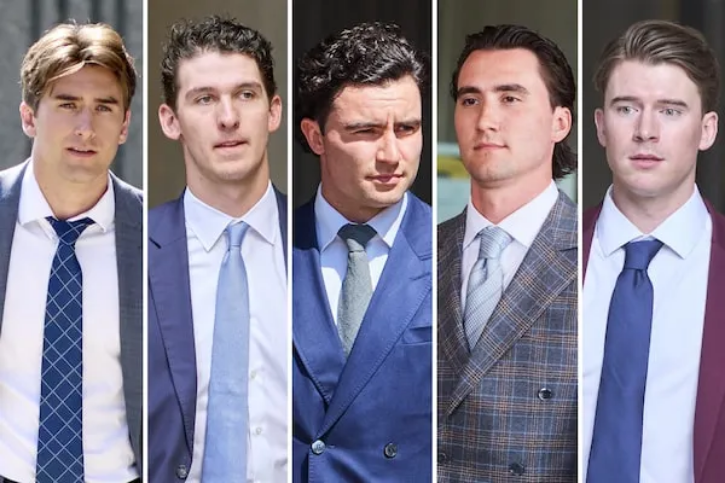
Janice Fiamengo on the recent court decision that acquitted five former junior hockey players of sexual assault charges in a London, Ontario court:

The acquittal, last week, by Justice Maria Carroccia of five former members of the Canadian World Junior Hockey Team charged with sexual assault has provoked the usual exaggerations and question-begging from feminist advocates.

A common theme has been the alleged negative impact of the verdict on “survivors”. Canada’s state broadcaster, the CBC, titled an article “Hockey Canada trial outcome a ‘crushing day’ for sexual assault survivors, says prof“. The Globe and Mail had the same focus: “After the Hockey Canada verdict, advocates fear survivors will fall silent“. For CTV News, also, “Advocates worry about message to survivors following Hockey Canada sex assault trial“. It seems that any not-guilty finding — no matter the accuser’s proven lies and venality — is said to constitute an assault on rape victims everywhere.

Our era’s motto: Better 100 innocent men go to prison than one potential accuser hesitate to come forward.

Many commentators also gushed about the courage of the woman, still identified only as E.M., who took the witness stand to proclaim her truth. E.M.’s lawyer, Karen Bellehumeur, called her “a remarkable person and truly a hero“. Professor Daphne Gilbert credited E.M. with provoking important public conversations at enormous personal cost. Supporters on the courthouse steps carried signs saying “We believe E.M.”

It’s hard to fathom that those declaring their anguish at the verdict and their admiration for E.M. have actually read Judge Carroccia’s 90-page judgement.

That judgement, far from revealing the judge’s failure to understand E.M.’s fear, as one feminist organization alleged, should cause any unbiased observer to question how the case was ever allowed to go to trial in the first place.

It had been found to be a loser when police first looked into it back in 2018. The story was that E.M. had met a hockey player, Michael McLeod, at Jake’s Bar in London, Ontario; McLeod was in town with his team to celebrate their World Junior Championship victory at a ring ceremony and gala dinner. E.M. agreed to go back to McLeod’s hotel room, but once there, he invited many other players to the room, where they took turns sexually assaulting her. She went home crying, and when her mother asked her what had happened, she told her. Her mother called the police.

The problem was that the complainant’s story was full of holes. Questioned by investigators in the days following, she couldn’t say she hadn’t consented, confessed that she may have enjoyed the sexual attention of the players, admitted she could have left the hotel room at any time, and never mentioned fear or intimidation as factors in her actions. London police closed the case in early 2019 without laying any charges. Over time, it seems, E.M. constructed a more compelling story to explain herself in a way that would be acceptable to her mother and to E.M.’s boyfriend.

In 2022, a police investigation was reopened after it was reported that Hockey Canada, the sport’s national governing body, had paid out millions in settlement money to women like E.M. who had alleged sexual misconduct on the part of players. E.M. herself received an undisclosed settlement amount in 2022 after suing for 3.5 million dollars.

Charges were ultimately laid, in early 2024, against five men, all of whom had by then launched careers in the National Hockey League: Dillon Dubé, Alex Formenton, Carter Hart, Callan Foote and Michael McLeod. Their NHL careers are now in tatters while their accuser has enriched herself with a false accusation.

ZB37: Czechoslovakia’s Super-Heavy Machine Gun

Forgotten Weapons
Published 12 Mar 2025

The ZB37 began in 1930 as a design by none other than classic Czech arms designer Vaclav Holek. The Czechoslovakian military was still using the Schwarzlose heavy MG, and wanted something to replace it. To fill all the roles intended, there would eventually be three different models of the ZB37 — one for infantry, one for fortresses, and one for vehicle mounting.

Note that the factory designation for this gun at Brno began as the ZB50, and iterated to the final version being the ZB50. However, it was identified by the military as the ZB37 (for 1937, the year of adoption).

After a series of redesigns, an early version of the gun is finally adopted in 1935 as the ZB35. A series of improvements leads to the final ZB37 model. About 500 of the early ZB35s were produced, and most of these were used to fill export sale contracts. By the time World War Two begins, the Czechoslovak military has about 5,000 of the guns in its possession.

Interestingly, the gun uses a hybrid recoil and gas operating system, with a tilting bolt. It has two rates of fire that can be chosen, and uses the rear spade grips as the charging handle. It is belt fed, using continuous 100- and 200-round metallic belts and chambered for the 8x57mm Mauser cartridge.

During the war, both German and British forces made substantial use of the ZB37. The Germans purchased ongoing production from Brno, and the British had actually purchased a production license before the war began. For the British, the gun was called the BESA and used in several armored vehicles (still in 8mm Mauser) — with about 57,000 being made during the war. A number of export sales were also made, including Romania, Persia, China, and several others. In 1946 another 3,000 were ordered and manufactured for fortress use in the Czech Republic, serving until the end of Communist control of the country.

Thanks to Sellier & Bellot for giving me access to this example to film for you!
(more…)

QotD: Undermining cultural taboos

One of the longest running debates on this side of the great divide is about how best to work through the thicket of taboos created and maintained by the ruling class. Because so much of observable reality is now off limits, it is nearly impossible to contradict the prevailing orthodoxy and maintain a position in the public square. For example, there can be nothing interesting said about crime, because no one is allowed to discuss the demographic reality of crime. The facts themselves are taboo.

One side of the debate argues that the only way to break a taboo is to break a taboo, so the only way forward to is to talk frankly about these things. In the case of crime, for example, the dissident must always interject the demographic facts about crime into the debate, even if it makes the beautiful people shriek. Since most people know the facts, the shrieking by the beautiful people actually advances the cause. This line of reasoning is extended to all taboo subjects universally.

The other side of the debate points out that the taboo breakers always end up in exile or condemned to some ghetto. In fact, their deliberate breaking of taboos ends up reinforcing the taboo, as no one wants to end up like the heretics. Instead, this camp argues the dissident must come up with clever language that subtly mocks the taboos, but narrowly adheres to the rules. The recent use of the word “jogger” is an example of complying with the taboo, while undermining it.

The taboo breakers counter that this just results in an endless search for approved language to hint at unapproved things. It is just a form of self-deception, where the clever think they are in revolt when in reality they are just asking permission. The optics guys counter this by pointing out the obvious. The taboo breakers are removed from the process, so in reality their tactic is just quitting the game. Rather than take on the system in a meaningful way, they mutter epithets in their ghetto.

The Z Man, “Strategy, Tactics & Discipline”, The Z Blog, 2020-05-19.

Powered by WordPress



