
Quotulatiousness

August 1, 2025

Australia saw Britain’s awful Online Safety Act and said “hold my beer”

In The Freeman, Nicole James discusses how Australia’s attempt to protect young, innocent eyes from the terrors of the internet seems to be having all kinds of unforeseen impacts on adults:
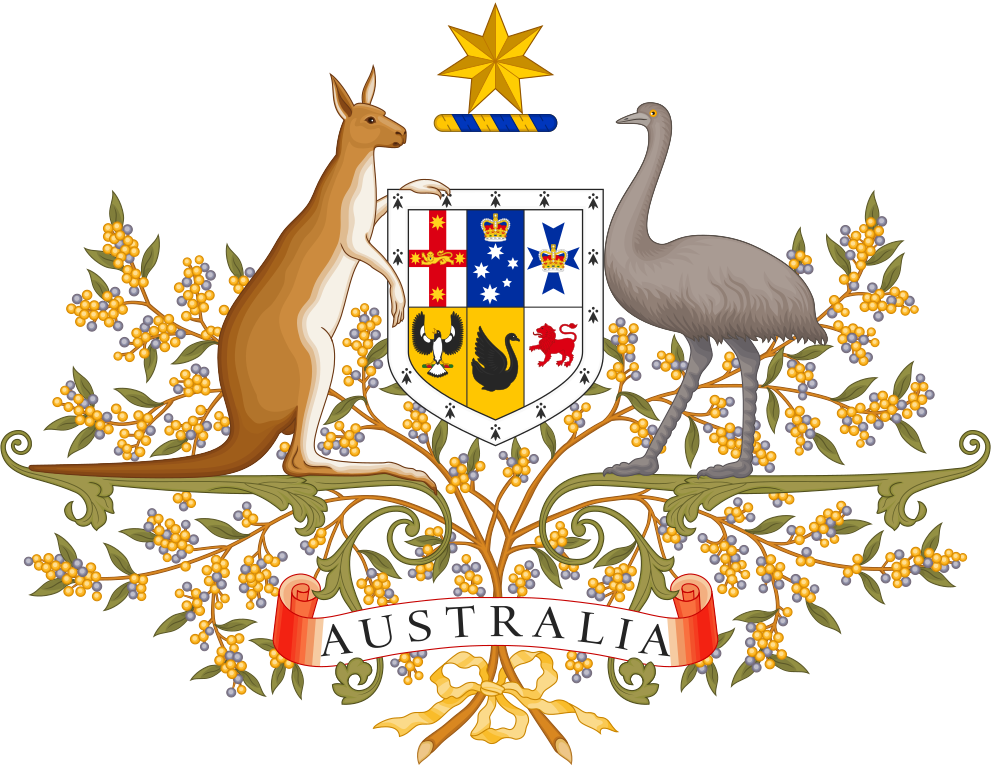
Commonwealth Coat of Arms of Australia (1912).
Quarterly of six, the first quarter Argent a Cross Gules charged with a Lion passant guardant between on each limb a Mullet of eight points Or; the second Azure five Mullets, one of eight, two of seven, one of six and one of five points of the first (representing the Constellation of the Southern Cross) ensigned with an Imperial Crown proper; the third of the first a Maltese Cross of the fourth, surmounted by a like Imperial Crown; the fourth of the third, on a Perch wreathed Vert and Gules an Australian Piping Shrike displayed also proper; the fifth also Or a Swan naiant to the sinister Sable; the last of the first, a Lion passant of the second, the whole within a Bordure Ermine; for the Crest on a Wreath Or and Azure A Seven-pointed Star Or, and for Supporters dexter a Kangaroo, sinister an Emu, both proper.

Once upon a time, not so long ago, children roamed freely through the pixelated wilderness of the Internet, posting dog memes, finding kindred spirits in weird little corners of Tumblr, and learning how to contour like Kylie Jenner. It was all chaotic, noisy, and entirely normal.

Now? Well, welcome to Australia in 2025, where the new Online Safety Amendment (Social Media Minimum Age) Bill has galloped through Parliament like a runaway Shetland pony, banning under-16s from social media. This is a full-blown digital eviction. And the ban isn’t limited just to TikTok and Snapchat. It also extends to YouTube (yes, YouTube), where apparently autoplay is now considered a gateway drug.

And how will they enforce this sweeping national grounding? Age verification, of course. Potentially through facial recognition. Not for the kids, mind you; they’ll simply be locked out. It’s everyone else who’ll need to prove they’re not children. Because nothing says “welcome to adulthood” like having to scan your actual face just to post a birthday shoutout or watch a slow-cooker recipe reel. All to reassure a tech platform that you’re not a rogue 14-year-old with strong opinions and a ring light.

The bill’s spiritual mother, eSafety Commissioner Julie Inman Grant, who, fun fact, once interviewed for a job at the CIA to analyze serial killers, gave a passionate speech at the National Press Club called “Swimming Between the Digital Flags”. It sounded very beachy and breezy until you realized she meant regulatory flags, and not the ones you’d use at Bondi. Her point was clear: the online world is full of rips and sharks and emotional jellyfish, and children must be protected from being dragged under.

Which is noble. Obviously. But somewhere between “protect the kids” and “build a biometric panopticon”, the line got a little smeared.

And where, you might ask, were parents in all this? Sitting quietly in the back, apparently, while Canberra (Australia’s Washington, DC) appointed itself Mum, Dad, the school principal, and possibly even the family dog. Because this isn’t just about safety; it’s about who decides what kids can see, say, share, and, in the case of a few bold young TikTokers, lip-sync while delivering motivational speeches to two mildly traumatized budgies.

The idea behind the project is that children are being harmed online, and honestly, yes, some are. The Internet is not all kittens and cake recipes. But rather than investing in education or digital literacy, the government has opted for a full blackout. It’s like banning scissors because one kid snipped their fringe into a reverse mullet.

And here’s the kicker. The bill had a consultation period of just 24 hours. That’s less time than it takes to read the terms and conditions you just agreed to without reading. (Don’t lie, we’ve all done it.)

In that tight little window, more than 15,000 submissions were made, and while some were supportive, the vast majority sounded the alarm. LGBTQIA+ organizations warned of disconnected teens losing safe spaces. Indigenous advocates pointed out the risks of further digital exclusion. Psychologists, educators, digital rights groups, and even a Community Soccer Club raised concerns.


When Stalin and Hitler Teamed Up – Prussia 1931 – Rise of Hitler 20, August 1931

Filed under: Germany, History — Tags: , , , , , , — Nicholas @ 04:00

World War Two
Published 31 Jul 2025

August 1931: Prussia becomes the battleground as a bizarre alliance of Nazis, Communists (under Stalin’s orders), right-wing elites, and President Hindenburg tries to topple Germany’s last major democracy. With foreign meddling, political violence, and backroom deals, the fate of the Weimar Republic hangs by a thread. Against all odds, the democratic coalition prevails — at least for now. But with chaos spreading and the world watching, can democracy survive the next assault?
(more…)

The sad saga of the CH-148 Cyclone helicopters in Canadian service

Filed under: Cancon, Government, History, Military, Weapons — Tags: , , , — Nicholas @ 03:00

In the National Post, Tom Lawson and Gaëlle Rivard Piché argue for the Canadian government to learn from long and bitter past experiences while they “reconsider” the F-35 purchase for the RCAF … specifically the mind-numbing and depressing saga of obtaining helicopters for the Canadian Armed Forces. First, a quick recap of the helicopter story from a post back in 2012:

Pre-delivery Sikorsky CH-148 Cyclone helicopter, 4 April, 2012.
Photo by Gerry Metzler via Wikimedia Commons.

  • In 1963, the CH-124 Sea King helicopter (a variant of the US Navy S-61 model) entered service with the Royal Canadian Navy.
  • In 1983, the [Pierre] Trudeau government started a process to replace the Sea Kings. That process never got far enough for a replacement helicopter to be ordered.
  • In 1985, the Mulroney government started a new process to find a replacement for the Sea Kings.
  • In 1992, the Mulroney government placed an order for 50 EH-101 Cormorant helicopters (for both naval and search-and-rescue operations).
  • In 1993, the Campbell government reduced the order from 50 to 43, theoretically saving $1.4B.
  • In 1993, the new Chrétien government cancelled the “Cadillac” helicopters as being far too expensive and started a new process to identify the right helicopters to buy. The government had to pay nearly $500 million in cancellation penalties.
  • In 1998, having split the plan into separate orders for naval and SAR helicopters, the government ended up buying 15 Cormorant SAR helicopters anyway — and the per-unit prices had risen in the intervening time.
  • In 2004, the Martin government placed an order with Sikorsky for 28 CH-148 Cyclone helicopters to be delivered starting in 2008 (after very carefully arranging the specifications to exclude the Cormorant from the competition).
  • Now, in 2012, we may still have another five years to wait for the delivery of the Cyclones.

A few data points in addition to that list:

  • In 2009, the government granted Sikorsky two more years to begin deliveries … and waived the penalty fees for late delivery.
  • In 2011, the government announced it would impose late delivery fines on Sikorsky.
  • In 2012, Sikorsky announced the delay of the first batch of “interim” helicopters until 2013.
  • In 2015, the first six helicopters were delivered so RCAF crews could begin training, with two more later in the year.
  • In 2018, the first operational deployment of a Cyclone had the helicopter embarked on HMCS Ville de Quebec as part of Operation Reassurance.
  • In 2021, 19 of the 23 helicopters delivered were taken out of service for cracks in the tail assemblies.
  • In January 2025, the 27th helicopter was delivered to the RCAF.

Based on this lengthy and expensive process, Lawson and Piché write:

In 1992, the Progressive Conservative government signed a $4.8-billion contract with a European consortium to replace the aging Sea King helicopters deployed aboard Royal Canadian Navy (RCN) ships. For purely political reasons, when the Liberals came to power the following year, they cancelled the deal — incurring $500 million in termination penalties — and set out to find a more politically acceptable solution. That search dragged on for over a decade, culminating in a 2004 contract with Sikorsky to procure 28 CH-148 Cyclone helicopters.

What the government failed to realize — or chose to overlook — was that Sikorsky was not offering a ready-made military platform. Instead, it proposed to adapt its civilian S-92 model into a maritime helicopter fit for military use, with the hope of replicating the global success of its venerable Sea King.

But developmental issues plagued the project from the outset. The original delivery schedule of 2009 slipped repeatedly, prompting then-minister of national defence Peter MacKay to call the procurement “the worst in the history of Canada”. By 2014, the program was on the brink of cancellation. Only a tense meeting between senior ministers and Sikorsky’s president salvaged the deal, leading to a revised agreement that saw the Cyclone finally enter operational service in 2018.

Yet the challenges did not end there. The Cyclone has consistently posted poor serviceability rates. A crash that cost the lives of six Canadian Armed Forces members in early 2020 was linked to inadequate documentation and flawed software. More recently, the fleet has again been largely grounded — this time due to a shortage of spare parts. The Commander of the RCN has voiced public frustration over the shortage of deployable helicopters, even threatening to replace them with drones if necessary.

To be fair, Sikorsky is not solely to blame. It offered an attractive idea: a modern fly-by-wire maritime helicopter based on a successful civilian platform. The government accepted, underestimating the complexity of the transformation. The key lesson here — one that directly applies to the current fighter jet debate — is that there is enormous risk in buying aircraft, like the Cyclone, that exist in limited numbers worldwide.

The best path forward with the Cyclone may now be to phase out the fleet and absorb the sunk costs. A more reliable option could be the MH-60 Seahawk, also made by Sikorsky. Unlike the Cyclone, the Seahawk is a proven design, with nearly 1,000 units in active service with the U.S., Australian and some NATO navies. While it would be politically awkward to cancel a Sikorsky platform only to purchase another from the same manufacturer, pragmatism must prevail. Perhaps a deal could be struck to return the Cyclones for parts, recouping some value through the civilian S-92 supply chain.

How to make flat boards straight, smooth and square (stock preparation part 2) | Paul Sellers

Filed under: Tools, Woodworking — Tags: , , , — Nicholas @ 02:00

Paul Sellers
Published 28 Jul 2013

In this video Paul Sellers shows how to prepare a flat smooth board from rough stock. He does this with winding sticks and a no. 4 plane.

Part 1 is here: How to make square stock straight, sm…

Someone asked about the can Paul uses to lubricate the sole of the plane. You can find out how to make one here: http://paulsellers.com/2011/10/recycl…

To find out more about Paul Sellers and the projects he is involved with visit http://paulsellers.com

QotD: The self-serving mythology of Britain’s NHS

… it is a matter of common experience that members of the middle classes are far better able to derive benefits from the system than the lower classes. They complain where the lower orders swear, and bureaucrats are aware that articulacy is a more dangerous enemy than assaults on staff can ever be.

The interesting question of why the NHS should continue to hold the affection of the British people, when it is at best mediocre in its performance and frequently unpleasant to deal with, is one that should be of interest to all political scientists. The answer is not pleasing to those who believe in human rationality.

The affection represents the triumph of rhetoric over reality. This rhetoric contains an implicit historiography, in which the pre-NHS era is akin to that of jahiliyya, the era of ignorance before the advent of Muhammad, in Islamic historiography: in short, that there was no healthcare for most of the population before the NHS. This historiography has for decades been continuously and successfully insinuated into the minds of the population. It has been Britain’s pale imitation of totalitarian propaganda. Intentionally or not, Boris Johnson recently reinforced the mythological status of the NHS. And when, in the present crisis, retired doctors such as I were asked to return to work if they were able, it was to help the NHS. This was like asking a soldier to lay down his life for the sake of the Ministry of Defence. It says something about the credulity of the public that the response to slogans like “protect the NHS” was dull compliance, rather than outraged demands as to why it wasn’t protecting us.

I suspect also that the sheer unpleasantness of the NHS is reassuring to the British population. It evokes the Dunkirk spirit: we are all stranded on the beach of illness together. And if we cannot all live in luxury, we can at least all die in squalor. Justice is served.

Theodore Dalrymple, “Empire of conformists”, The Critic, 2020-04-29.

Powered by WordPress


