
Quotulatiousness

July 31, 2025

“You can see what a monster this very dangerous person is”

Filed under: Cancon, Government, History, Media, Politics — Tags: , , , , — Nicholas @ 04:00

Chris Bray looks north to the Dysfunctional Dominion and our governments’ inability to deal with the narrative of the Residential Schools and the lack of actual evidence to support that narrative:
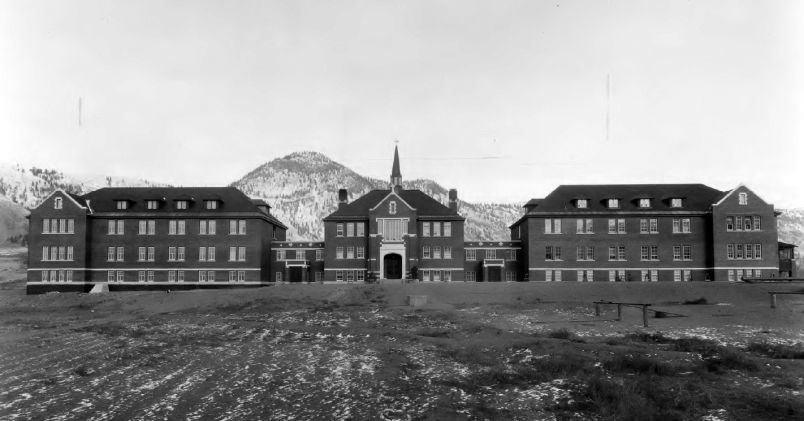
Kamloops Indian Residential School, 1930.
Photo from Archives Deschâtelets-NDC, Richelieu via Wikimedia Commons.

Frances Widdowson is a cantankerous career academic, an evidence-first Canadian scholar who doesn’t suffer fools. Her personal disregard for sanctimonious performativity has gotten her in some trouble, and now she’s a former professor, though her termination was found to be improper. A few months ago, the CBC interviewed her for a story about how mean she is, because Widdowson has questioned the much-chanted sacred story about the dead children at Kamloops.

If you don’t know the Kamloops story, an anthropologist used ground-penetrating radar to supposedly identify the location of a secret burial ground for 215 dead children near the site of the long-defunct Kamloops Indian Residential School, uncovering evidence of what has been constantly called a hidden genocide. But no human remains have ever been recovered at the site, and the radar evidence of disturbed earth aligns well with the path of an old septic trench. More detailed background here.

Widdowson recorded the entire interview, so we can hear the inner workings of the sausage factory.

Throughout the discussion, CBC reporter Jordan Tucker, speaking with the obligatory vocal fry and upspeak, keeps warning Widdowson to stop shouting at her, which Widdowson obviously isn’t doing, and to watch her tone. She’s presumptively pre-outraged by the existence of a Very Bad Person, conducting an outrage-performance in the form of asking questions.

But then Widdowson flips the script. You can hear this excerpted two-minute high point here. Tucker argues that government officials say there are bodies buried in the apple orchard at Kamloops, so is Widdowson somehow making the outrageous claim that government officials might be wrong? “Are all those different governments lying? Are all those different people just not telling the truth, or they’re going along with these stories imagined by people, by indigenous people?”

Government says, but still Widdowson doesn’t concede. You can see what a monster this very dangerous person is. “How is it that all these government officials have been so connived?” Tucker asks, obviously flabbergasted.

Widdowson responds with an argument about evidence, and about the standards of evidence for the claim. What do we know? What have we seen? What would we need to see to prove a claim of this type? Who has the burden of proof?

And then: “As a journalist, are you satisfied with the evidence?”

The response to this question — just past the 1:30 mark in the excerpted video linked above — is remarkably telling. It produces, first, a short silence, and then a long burst of stammering and high-pitched incredulity: “I am. Of course I am.”

Widdowson, sharpening the direct question: “You think there’s 215 children buried in the apple orchard at Kamloops?”

Listen to Tucker’s shaking voice. This question is a threat. It makes her extremely nervous. “I think that, at this point, there has been enough documentation, there have been enough — there’s enough social and archaeological consensus to say that, to say that, we can just believe indigenous people, and move on with trying to do our best by them as a society.”

So two people are arguing about truth. What is true? How can we know what is true? One person keeps asking what is the evidence. The other person keeps deflecting to identity, authority, and social status. The government says so, there is social consensus, “believe indigenous people”. No human remains have been found, but there are human remains, because government officials and indigenous people say so, and other people with the status to matter say that they agree. Truth is consensus. Defaulting to evidence is cruel. Why would you do such a horrible thing?

  • What’s the evidence?
  • Are you refusing to submit to the narrative consensus?
  • Yes, what’s the evidence?
  • (shocked gasping and trembling voice)

This is the mechanism of woke narrative control: It has been said that this is true. The people who say it possess authority — they are officials — or they possess privileged identities. It is now disinformation to say that government plus indigenous people might not be correct, and an act of dangerous extremism to mention questions of evidence.

The intent of Britain’s Online Safety Act … and the actual implementation

In The Conservative Woman, Dr. Frederick Attenborough discusses the gap between what the Online Safety Act was intended to do and how it’s actually being enforced now that it’s the law of the land:

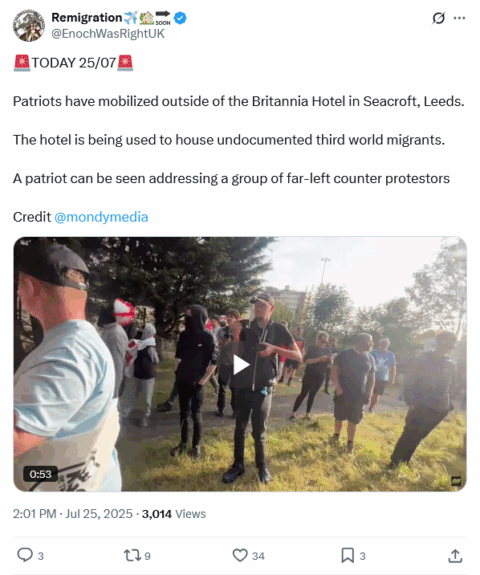
X posts like this may not be visible to uses in the UK under the age verification rules of the Online Safety Act.

At the heart of the regime is a requirement to implement “highly effective” age checks. If a platform cannot establish with high confidence that a user is over 18, it must restrict access to a wide category of “sensitive” content, even when that content is entirely lawful. This has major implications for platforms where news footage and political commentary appear in real time.

Ofcom’s guidance makes clear that simple box-ticking exercises, such as declaring your age or agreeing to terms of service, will no longer suffice. Instead, platforms are expected to use tools such as facial age estimation, ID scans, open banking credentials and digital identity wallets.

The Act also pushes companies to filter harmful material before it appears in users’ feeds. Ofcom’s broader regulatory guidance warns that recommender systems can steer young users toward material they didn’t ask for. In response, platforms may now be expected to reconfigure their algorithms to filter out entire categories of lawful expression before it reaches underage or unverified users.

One platform already moving in this direction is X. Its approach offers a revealing – and potentially sobering – glimpse of where things may be heading. The company uses internal signals, including when an account was created, any prior verification, and behavioural data, to estimate a user’s age. If that process fails to confirm the user is over 18, he or she is automatically placed into a sensitive content filtering mode. As the platform’s Help Center explains: “Until we are able to determine if a user is 18 or over, they may be defaulted into sensitive media settings, and may not be able to access sensitive media”.

This system runs without user opt-in and applies at scale. Depending on how X classifies it, filtered material may include adult humour, graphic imagery, political commentary or footage of violence. Already there are signs that lawful content is quietly being screened out.

One example came on July 25, the day the Act’s age-verification duties took effect, during a protest outside the Britannia Hotel in Seacroft, Leeds, where asylum seekers are being housed. A video showing police officers restraining and arresting a protester was posted on X, but quickly became inaccessible to many UK-based users. Instead, viewers saw the message: “Due to local laws, we are temporarily restricting access to this content until X estimates your age”.

West Yorkshire Police denied any involvement in blocking the footage. X declined to comment, but its AI chatbot, Grok, indicated that the clip had been restricted under the Online Safety Act due to violent content. Though lawful and clearly newsworthy, the footage was likely flagged by automated systems intended to shield children from real-world violence.

In The Critic, Christopher Snowdon explains the breakdown of trust between the British public and their government that the implementation of the Online Safety Act only exacerbates:

People are right to be concerned about this slippery slope and yet it cannot be denied that it is pornography enthusiasts who have been hardest hit by the Online Safety Act in the short term. They must now verify themselves in one of three ways, each less appealing than the last. They can submit their credit card details, they can scan in proof of ID, such as a passport, or they can take a photo of their face and allow AI to judge how old they are. If they want to maximise their chances of being the victim of blackmail and identity theft, they could do all three.

While we might not think twice about submitting our credit card details to Amazon or posting our photos on Instagram, there is an understandable reluctance to hand over private data in order to access dubious websites for the purposes of sordid acts of self-pollution. The government assures us that the data will be kept confidential but it is only two weeks since we learned about a data breach that led to the names of 19,000 Afghans who wanted to flee the Taliban being given to the Taliban and it is less than two months since the names and addresses of 6.5 million Co-op customers were stolen in a cyber-attack. Rightly or wrongly, millions of British plank-spankers and rug-tuggers do not wish to identify themselves to anybody.

The result is a surge in interest in Virtual Private Networks (VPNs) which allow internet users to access websites as if they were in a less censorious country. Half of the top ten free apps in Apple’s app download charts yesterday were for VPNs. Google Trends data show that searches for “VPN” have gone through the roof since Friday. Readers can draw their own conclusions from the fact that these searches have been peaking between midnight and 2am.

Downloading random VPNs comes with risks of its own and opens up a whole new world of illicit online activity from free Premier League football to the Dark Web. But there is a deeper reason to feel uneasy about this unintended, albeit predictable, consequence of paternalistic regulation. By driving another wedge between the state and the individual, it further normalises rule-breaking in a country where casual lawlessness is becoming part of daily life. A law-abiding society cannot long endure if the median citizen thinks that the law is an ass.

The breakdown of trust can be seen most clearly when the ordinary man or woman does not share the moral certainties of the governing class. Among smokers, a collapse in tax morale — the intrinsic motivation to pay taxes — has led to a huge rise in the consumption of illegal tobacco in recent years. Smokers no longer feel any obligation to pay taxes that are designed to impoverish them to a government that vilifies them. Cannabis smokers learn from an early age to be suspicious of a police force that they might otherwise respect. Motorists who are faced with 20mph speed limits that were introduced by people who hate private transport have no scruples about flouting the law.

Stamm-Zeller 1902: A Swiss Straight-Pull Converted to Semiauto

Filed under: Europe, History, Military, Weapons — Tags: , , , , — Nicholas @ 02:00

Forgotten Weapons
Published 8 Mar 2025

Today’s rifle was designed by a Swiss inventor named Hans Stamm while working for the Zeller et Cie company in Appenzell Switzerland. The company originally made embroidering machinery, but turned to military rifle parts subcontracting to bring in additional revenue in the early 1890s. Stamm had shown a good aptitude and interest for this work, and when the company decided to lean into the small arms business he was put in charge of its new weapons division.

There, Stamm spent several years developing a self-loading rifle for the Swiss military. It was not something specifically requested by the government, but rather an opportunistic risk by the company. Stamm’s resulting gun, the Model 1902, was expensive to produce, but quite elegant in design. It is a long-stroke gas pistol system with a rotating bolt, which was made from the ground up but could easily be adapted as a conversion of existing straight-pull bolt action rifles like the Swiss G96.

Unfortunately, the Swiss military declined the rifle, and Zeller was unable to find any other interested clients among the European states. By 1906, tired of dumping money into what is clearly a losing proposition, Zeller shuts down its weapons division. Stamm leaves the company, but he is not done with small arms design — we will see several more of his designs in future videos!

Many thanks to the Swiss Shooting Museum in Bern for giving me access to this visually one of a kind rifle to film for you! The museum is free to the public, and definitely worth visiting if you are in Bern — although it is closed for renovation until autumn 2025: https://www.schuetzenmuseum.ch/en/
(more…)

QotD: Web browsing “naked”

Filed under: Business, Media, Quotations, Technology — Tags: , — Nicholas @ 01:00

I recently, foolishly, and for reasons that now escape me, bathed in the stroboscopic glow of the un-adblocked Daily Mail. It’s like they just took a bag full of flashing random crap, shook it up, then threw it at the screen. I’m not at all convinced that advertising is a viable model for internet use. It feels much more intrusive and aggravating than print or TV ads. Partly, I suppose, because it’s happening on your device. Maybe it’s just me, but I find myself repelled by it, and sites that use it, quite emphatically. I’ve stopped counting the sites I’ll no longer visit because they insist on the reader deactivating their adblocker, resulting in an insulting, actively hostile, all but unusable experience.

David Thompson, commenting on “Scenes from Woketopia”, davidthompson.com, 2020-06-23.

Powered by WordPress



