Quotulatiousness

July 28, 2025

The AI threat to the laptop classes

Filed under: Business, Economics, Media, Politics, Technology, USA — Tags: , , , — Nicholas @ 05:00

Warren at Coyote Blog responds to a recent Gato Malo post on the way artificial intelligence (however described) will continue to disrupt the workplace especially as it begins to threaten the “laptop class” workers:

I agree with Gato that AI has a huge potential to disrupt current work patterns, in the same way that the industrial revolution did. The 19th century disruptions were severe, and many people suffered as their experience and skill set no longer matched the new economy. But eventually everyone, from the poorest to the rich, were better off for letting the industrial revolution run its course.

But in the 19th century, the disrupted were essentially powerless. What happens this time around, though, when the disrupted are the ruling elite themselves? These potentially disrupted professions include lawyers and doctors who already have shown themselves very willing to organize to block innovation, squash competition, and protect their high pay. Just look at the history of the attempts by Congress to reduce Medicare reimbursements to doctors. And that was minor compared to the potential AI disruption. Let me give you another example of the powerful resisting a technological change that should have disrupted their businesses.

When TV first was being rolled out, the industry coalesced around a network of local broadcast stations, many of whom became affiliates of a network like NBC or CBS. Why this model? Mainly it was driven by technology — the farthest a TV signal could reasonably be broadcast was about 50-75 miles. Thus everyone by necessity got their TV through three or four TV stations in their metropolitan area, each its own small business.

Now fast forward to today. There are multiple ways to broadcast a TV signal nationwide — there are several satellite options and many streaming internet approaches. So now when we watch DirecTV or Youtube TV, we just watch the national NBC or ABC feed, right? Nope. Federal law requires that whatever service you use MUST serve up NBC, for example, via the local affiliate. That is why your streaming TV service harasses you when you travel, because it is worried about violating the law by showing you the Phoenix CBS affiliate when you are staying overnight in Atlanta (gasp).

This is hugely costly. In order to be able to provide NBC among its stations, Youtube TV must gather the feeds from 235 different stations. In the Internet streaming era this is costly but in the satellite era it was insane. DirecTV, with its limited bandwidth, had to simultaneously broadcast 235 stations, most showing identical content, just to legally provide you with NBC. So why this crazy, expensive, insane effort? I am sure you have guessed — pound for pound local TV stations are among the most powerful lobbyists in the country. First, they have money and a massive incentive to defend their local geographic monopoly — Car dealers and alcohol distributors are much the same, which is why every potential innovation is resisted in those markets. But TV stations have one extra card to play — nearly every Congressman in the House likely depends on the three or four TV stations in one major metropolitan area for a huge part of their publicity and coverage. No politician is going to screw with that. At the end of the day, local stations did not get disrupted, they actually became more valuable with this government-enforced distribution of their product.

This is a small example of the fight that is coming in AI. Congressmen will couch their arguments in fear-charged terminology as if their real fear is some Terminator-like AI apocalypse. But the real concern will be from the influential elite who are being disrupted. What would have happened to the Industrial Revolution if the hand-loom weavers were the children of the nobility? Would the government have allowed the revolution to proceed? We are about to find out.

On a cheerier note (if you’re an AI), here’s Ted Gioia‘s most recent concerns about AI getting more evil as it gets more capable:

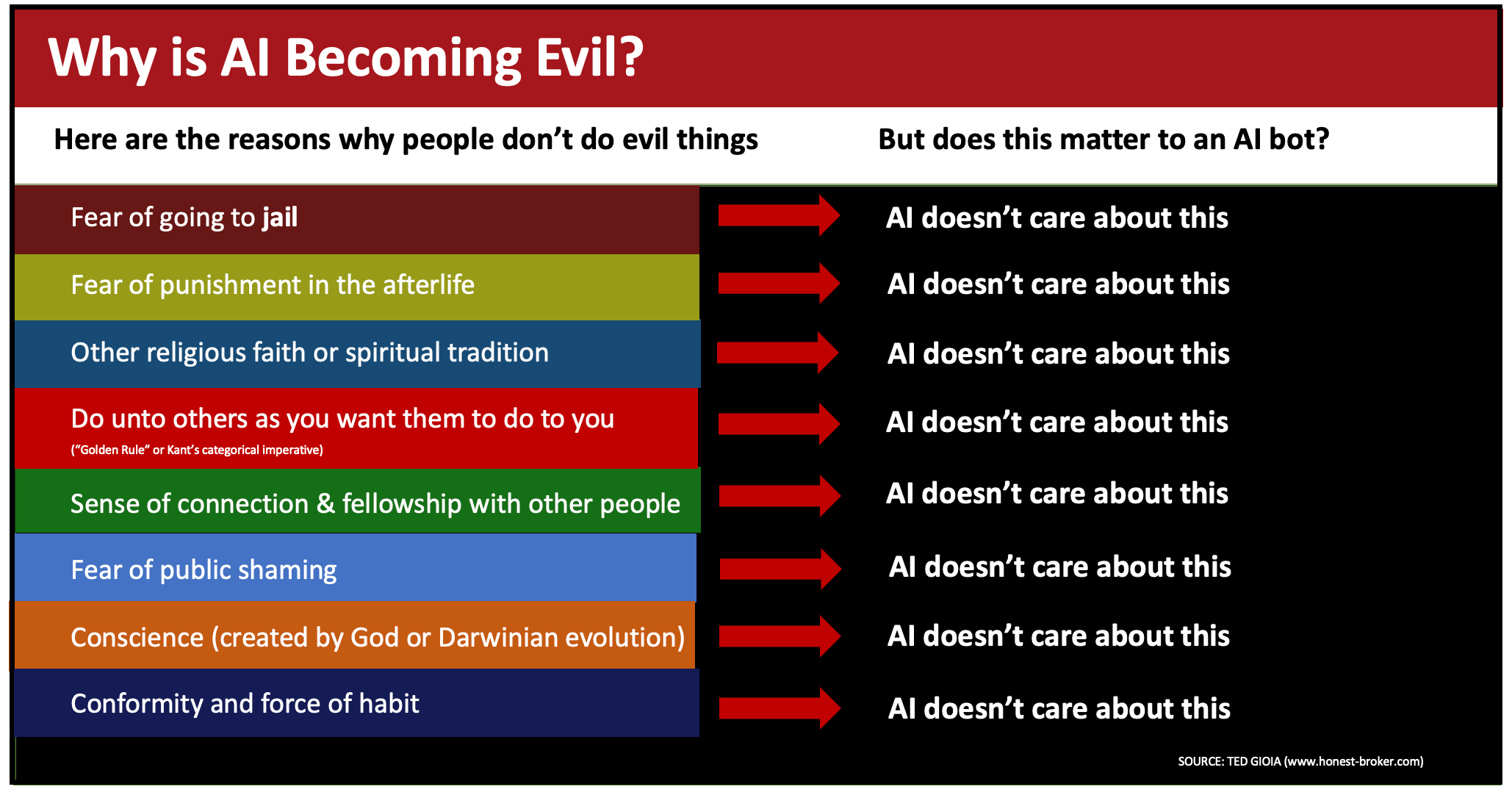
I hate to be the bearer of bad news, but AI doesn’t make ethical decisions like a human being. And none of the reasons why people avoid evil apply to AI.

Okay, I’m no software guru. But I did spend years studying moral philosophy at Oxford. That gave me useful tools in understanding how people choose good over evil.

And this is relevant expertise in the current moment.

So let’s look at the eight main reasons why people resist evil impulses. These cover a wide range — from fear of going to jail to religious faith to Darwinian natural selection.

You will see that none of them apply to AI.

Do you see what this means? You and I have plenty of reasons to choose good over evil. But an AI bot is like the honey badger in a famous meme — and just don’t care.

So sci-fi writers have good reason to fear AI. And so do we. The moral compass that drives human behavior has no influence over a bot. As it gets smarter, it will increasingly resemble a Bond villain. That’s what we should expect.

Anyone who tries to forecast the future of AI must take this into account. I certainly do.

And even though I’d like to think that I’m a fearless predictor, I must admit that what I see playing out over the next few years is very, very very troubling.

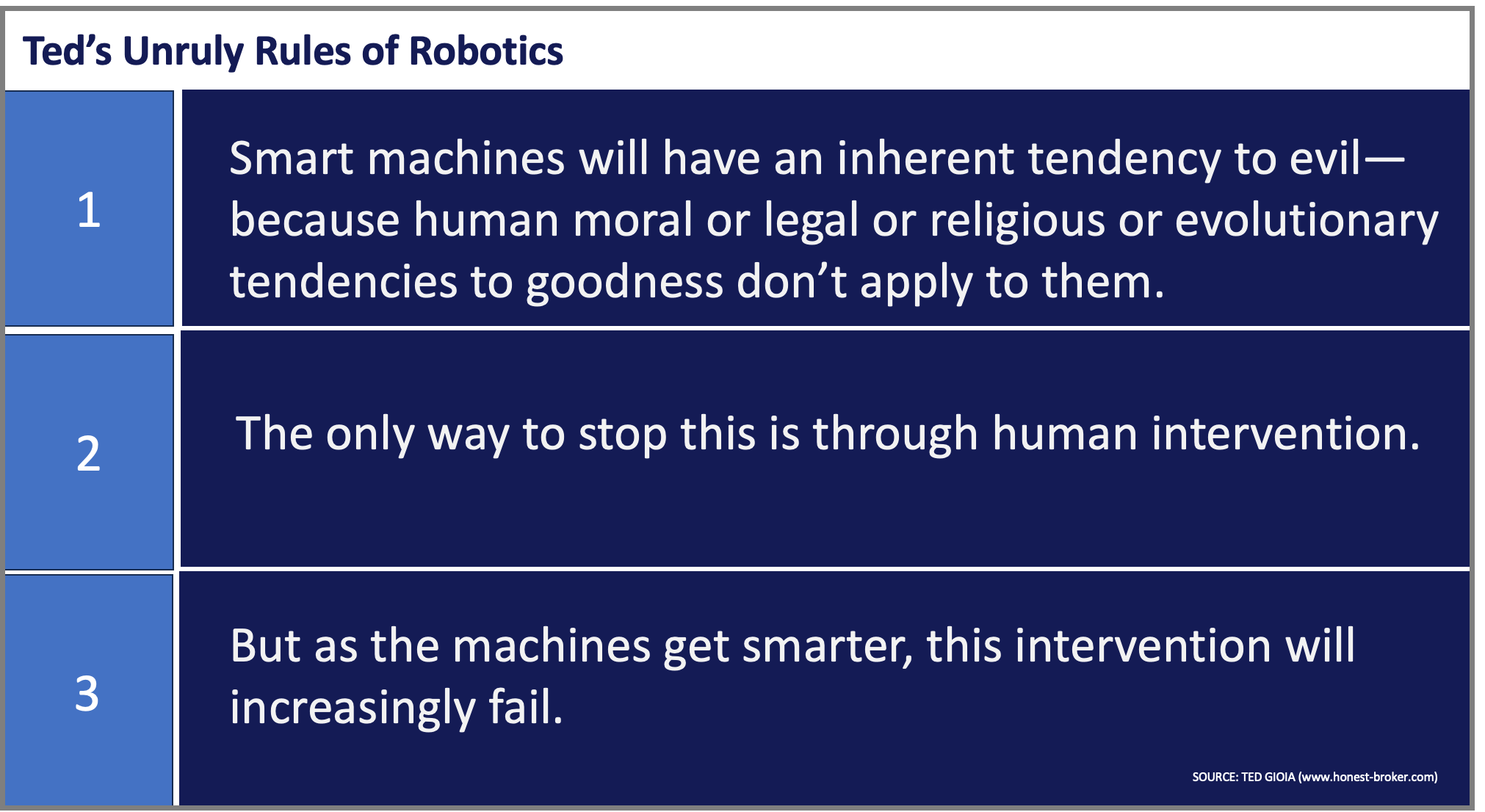
Here’s my hypothesis: Let’s call it Ted’s Unruly Rules of Robotics:

  1. Smart machines will have an inherent tendency to evil—because human moral or legal or religious or evolutionary tendencies to goodness don’t apply to them.
  2. The only way to stop this is through human intervention.
  3. But as the machines get smarter, this intervention will increasingly fail.
“According to elite theory our world is controlled by a ruling class”

Spaceman Spiff explores the notions of “elite theory”, which in one variant or another seems to be a bedrock belief of most dissidents in the west:

Elite theory is based on an important observation; small groups can more easily organize than large groups.

A modest number of wealthy individuals with common goals will easily run rings around a whole town, region or country because the masses cannot easily organize.

This infers enormous advantages, not the least of which is a small group can discuss and agree a strategy and then stick to it. Because of this some imagine elites as more able than they really are.

But power is tricky. All the money and all the clout in the world means nothing if you can’t project it far.

And our powerful, wealthy elites have one great weakness, they must work through others.

A hierarchy therefore exists which we occasionally glimpse adding to our confusion when we use words like “elites.”

Global rulers are ostensibly at the top. They sit above nation-states. They are truly post-national, controlling central banks and international finance. They are the closest thing we have to world controllers. Some seem to hold power over huge swathes of the globe, like gigantic economic zones.

In addition, all nations have visibly important people; kings, dictators, presidents and others. National elites are those whose power is largely confined to a territory. They lack the international reach of global elites.

The media represent power too. They are there to shape the narratives that govern our perceptions. Most traditional media outlets serve elite goals although some of their members wield tremendous power themselves.

The political class are the obvious lackeys of the powerful. Voters seem constantly amazed politicians never really improve anything once in power, but that is because they don’t serve those below them, only those above. Once you see this their behaviour makes much more sense. They dance to the tune of their paymasters. Their primary job is to pretend democracy works.

The corporate leaders are a less visible example of the same thing. They manage the commercial wing of elite interests while pretending to be businessmen.

Blackrock and others have almost completely abandoned anything resembling capitalism. They are gamers of systems, not the innovators of yesteryear. Just one reason our economies are struggling.

It is the major corporations who have helped establish diversity and climate goals, for instance, so they matter for furthering elite ambitions.

Local and regional elites exist too. Everything is replicated at ever smaller scales, including public sector employees and corporate managers.

These are the foot soldiers often oblivious to any elite goals. They just respond to the incentives and disincentives they are aware of at their level.

There is more, including academia and the major institutions. But the key idea is this is the hierarchy the powerful must work with to get anything done.

Projecting power downwards

At each stage there are numerous problems conveying information and taking action. Running the world is a demanding hobby. Power means nothing unless you can implement your schemes.

Communication is an ever-present issue. Things are misinterpreted. People misunderstand goals and aspirations.

There are probably no written plans. A lot of influence is achieved via think tanks and talking shops like the World Economic Forum, so is open to misinterpretation. It must be like herding cats as these grand ideas cascade down the hierarchy and are misunderstood or overlooked.

This process is further retarded by quotas and ideological capture. Woke brings many distortions; just ask the declining universities. Hiring for alignment does not select for the best. Elite need for control therefore leaves them with reduced options.

We’ve all seen some new appointee take over a position of authority and promptly run it into the ground. Imagine having to rely on that process to get anything done?

The lower down the totem pole we go the less able the people as a general rule. Specifically, in these benthic depths far from the centres of power, the minor lackeys run the grave risk of actually believing the claptrap used to control the masses which can be a real impediment to progress.

Those near the bottom generally lack the intellectual vigour to question anything which makes for obedient slaves, albeit dangerously detached from strategic awareness or understanding of the purpose of the narratives they uncritically embrace.

Such devotion is handy at first, it can provide real energy to make changes. Covid policies were established quickly thanks to this phenomenon. The implementation units were clearly unable to assess evidence or think for themselves; man on TV said wear mask and sit in back garden, so they did.

The price for such mindlessness is confusion and this is where control can be lost.

Anti-white animus gestated on university campuses was useful for the powerful to keep the most dangerous demographic down, and therefore less likely to form a counter-elite, but has now morphed into anti-Israel and pro-Palestine sentiment. It is evident many in academia, oblivious to the purpose of “decolonization,” have now misapplied this ethnic weapon to Israelis and Jews more generally to the horror of the powerful with plans of their own.

We see similar effects with climate zealots in positions of authority, especially in politics and media circles. It can be galling to realize some prominent person you once thought was capable actually thinks we only have twelve years to save the planet or wants to end cheeseburgers to help the coral reefs. Can they really be that impressionable?

What is frustrating for us must be maddening to the powerful as they watch brainwashed clowns misunderstand their goals. When your tools include the gullible things can get out of hand quickly.

That’s why many of the doom and gloom predictions based on some omniscient Illuminati are so off the mark despite their elevated position in society.

Projecting power is akin to shooting people in swimming pools. You can see them under the water, often very clearly, but it doesn’t necessarily help.

You fire off your rounds, but they quickly lose force as they enter some new medium of which you know very little, plus they can whizz away in unexpected directions, entirely missing their mark.

All that money and influence but you have to rely on dancing monkeys to get anything done. What use are trillions when Glenda in HR actually thinks her purpose in life is to root out systemic racism or heal the planet? Her initial zeal can quickly become a liability as ultimately happened during Covid when many began to wake up after the clownshow became too absurd to continue.

Ontario Premier Doug Ford – threat or menace?

Filed under: Bureaucracy, Cancon, Government — Tags: , , , , — Nicholas @ 03:00

In many ways, Ontario’s Doug Ford is a 21st century version of former Ontario Premier Bill Davis … a virtuoso performer of the “talk Conservative, govern Liberal” style that urban Ontario voters really seem to love. It works well for the Laurentian Elite to have a Liberal government in Ottawa and a “Conservative” government in Toronto, as they can argue in public about all sorts of marginal issues, but when it comes down to legislation and regulation, they’re almost indistinguishable from one another aside from party colours.

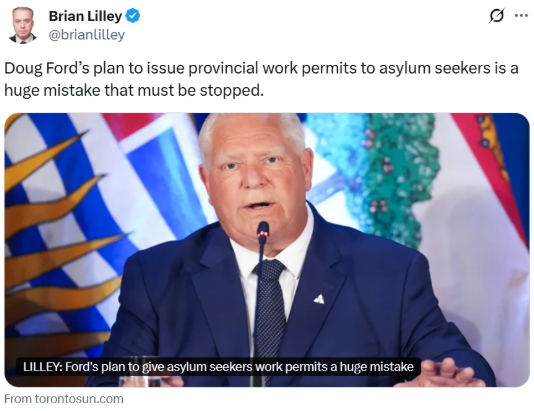
Last week, Ford announced a plan to hand out provincial work permits to a huge number of “asylum seekers” as the feds seem to be making motions to reduce their support of such irregular immigrants:

One step forward, two steps back? As a card-carrying, self-appointed board member of Team “Please stop making everything worse on purpose,” there are some hard-earned wins and faint movements back towards normal, and then there’s the ongoing screw-jobs that threaten any/all progress.

As we have bemoaned time, and time, and time again around these parts, Ontario has a premier problem. But now, all of Canada has a Doug Ford problem.

I’ve been part of an effort to drag urgent immigration reform into the spotlight, and even into a feature position in the waning days of that ‘first ministers’ meeting in Muskoka, but a certain conservative-in-name-only threatens to make historic problems of immigration and unemployment worse, rather than better.

Conservatives in Canada are about to find themselves in a tricky position with Ford, who has the unique potential to remain one of the last vestiges of the failed Trudeau years — even more so than Carney. And the latter may need defending.

Ford and his deeply conflicted and unethical inner circle may wish to grant provincial work permits to a supply of fake students turned fake asylum claimants, but ordinary folk, concerned parents, our proud immigrant communities who made the grade and never cut corners, and our abandoned workers have other ideas.

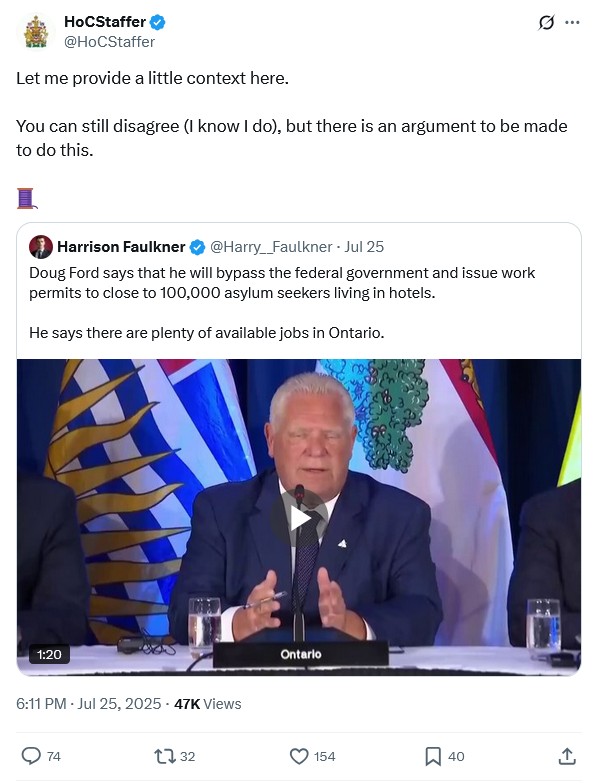
On the social media site formerly known as Twitter, @HOCStaffer tries to provide some context:

Asylum seekers, refugees, illegals, whatever you want to call them.

They are filling up hotels, getting money, & doing basically nothing, all the while waiting upwards of 2 years for their application to be approved/denied.

I mean, it’s better than where they came from, which is why they are here.

There’s a massive financial burden to the govt & a huge pool of labour doing nothing which could be serving you your coffee instead of a Temp Foreign Worker.

So Ford’s argument — which I have had made to me in person by hotel, tourism, & restaurant lobbyists — is that why don’t we use these people to do the shit jobs?

***** Especially if we are reducing TFWs.

There is a pretty good logic to it.

“May as well have them do something while they are here waiting.” Right?

But I still disagree with the idea.

Most of these people aren’t refugees. They are economic migrants from terrible places. They came here illegally, often under false pretences, & most should be deported.

The longer they stay the more likely they are to have kids here, to potentially marry a Canadian, and to establish links to the country.

Giving them a job furthers that connection.

The last thing we need is the local Tims owner arguing to keep Abdul in the country because he is the only one who will sling shit coffee on the night shift for shit wages.

Giving illegals jobs just rewards the business owners who take advantage of TFWs with a new pool of labour to exploit.

I get that these are businesses and real people have money and time invested in them.

But if you cannot operate without indentured servants then perhaps we don’t really need your business?

A bunch of Tims will close. McD’s too. Maybe some hotels & other businesses too. It’s sad. No one wants to see that.

But we also can’t keep importing people — and thereby affecting much of the rest of society — in order to keep these businesses open.

So yeah, there’s a sound argument to what Ford is saying.

But what he should be saying is that we need a stronger border, faster processing, less appeals and quicker deportations.

That would save his govt real money.

Claudius: The Disabled Emperor Who Conquered Britain

Filed under: Britain, Europe, History, Military — Tags: , , , , , , , — Nicholas @ 02:00

The Rest Is History
Published 27 January 2025

This is part 4 of our series on Suetonius and the Emperors of Rome.

00:00 The rebirth of the republic?
10:05 Who is Claudius
15:18 The relationship between Augustus and Claudius
16:20 The scholar emperor
21:12 Claudius’ relationship with Caligula
28:53 Claudius’ rule as emperor
45:50 The problem he had with his wives
56:40 The rise of Nero
58:40 Was he poisoned?
59:51 The lack of sources in Ancient history

Producer: Theo Young-Smith
Assistant Producer: Tabby Syrett
Executive Producers: Jack Davenport + Tony Pastor

QotD: The technology ecosystem

Filed under: Books, Business, Quotations, Technology, USA — Tags: , , , — Nicholas @ 01:00

A lot of thinkfluencers will describe technology as an “ecosystem” without grappling with the full implications of that term. Most often when they say it they’re referring to a cluster of consumer-facing businesses that rent space or other capabilities from a “platform” provider, like apps on an App Store. But that isn’t an ecosystem, that’s a shopping mall. Real ecosystems have energy and nutrient flow both up and down the food chain, as well as laterally; they have vast swarms of bottom feeders, fungi, and other detritivores that recycle matter through decomposition and make its constituents bioavailable once more; they also have a constant source of energy input (usually the sun) to make up for the constant entropic drag that would otherwise grind things to a halt. One of the great discoveries of modern ecology is that apex predators, macrofauna, the plants and animals we notice and admire are perched precariously atop a vast network of invisible supports. A tiger is the temporary result of too many worms gathering in one place.

Technology is also an ecosystem, not the way bluechecks talk about it, but in this more profound sense. A Boeing or a Google is like a tiger: the highly-visible culmination of a vast subterranean drama. Turn over a spade and you’ll find them — the suppliers and subcontractors, investor networks, tooling manufacturers, feeder universities, advisors, researchers, shipping and packaging experts, friendly bankers and government officials, producers of upstream technological inputs, and a vast collection of lower-tier companies in related markets that act like an economic flywheel, absorbing and releasing excess labor as the economy shudders through its fits and starts.

In nature, it’s energy and nutrients that move through the food webs. Here their analogues are capital and knowledge. It’s hard to miss the money sloshing back and forth — world-changing companies are nurtured through their awkward adolescence by sophisticated and patient pools of capital, and the high-flying champions of those companies become the next generation’s venture investors after cashing out. Harder to see but even more influential is the vast economic dark matter made up of professionals who struck it rich enough to live comfortably but not rich enough to fly private. These unobtrusive capitalists are the first to hear through professional whispernets that so-and-so has quit his job to work on such-and-such. Since they’re still in the rat-race, they can have an informed opinion on the caliber both of the idea and of the team around it, and are usually the early champions of the most unusual and speculative ventures. And finally, money sloshes around between the companies themselves through a complicated network of deals, joint ventures, and strategic investments.

The money is more visible, but the way knowledge moves is more important. Part of it is academic, propositional knowledge or technical data whose discovery is accelerated when a dozen different teams are on its scent, sometimes racing each other to the prize, sometimes egging each other on and celebrating each others’ victories. But the bulk of what makes this ecosystem hum, the true currency that drives nearly every barter or exchange, is practical, process knowledge of the sort that 莊子 first described and Michael Oakeshott later re-popularized for our benighted and ignorant age. What makes process knowledge unusual is that by its very nature it cannot be separated from people, cannot be digitized or divorced or attached to an email. It is at once the nous of a technological ecosystem and the thing that makes it fundamentally illegible — an immaterial, intangible essence that inheres only in individuals, like a mind or a soul.

John Psmith, “REVIEW: Flying Blind by Peter Robison”, Mr. and Mrs. Psmith’s Bookshelf, 2023-02-06.

Powered by WordPress