Quotulatiousness

July 26, 2025

The desperate narcissism of the “Cool Professor”

Filed under: Education — Tags: , , — Nicholas @ 05:00

Freddie deBoer on the pathetic academic specimen sometimes known as “Bob” or “Biff” or “Lizzie” — the dreaded self-imagined “cool professor”:

“heh, probably never expected to have a professor with full sleeve tattoos, huh? well, that’s not the last time your mind’s gonna be blown this semester …”
Image and caption from Freddie deBoer’s Substack

Let me tell you about the saddest figures in the American university. They wear black jeans and Chuck Taylors to class, except maybe on the first day, when they stroll in wearing semi-ironic suits designed to contrast with their ample tattoos. Their syllabuses are printed in Helvetica. They mention Chappell Roan in the first fifteen minutes of the first day of class. They tell their students, with a wink, that they don’t believe in grades — why, who are they to judge their students! They encourage everyone in class to call them by their first names, or perhaps a contrived nickname. They hope to blow everyone’s minds when they theatrically announce that in their classes, students pick the readings, because the students are the ones who really know what’s worthy of their time. They describe themselves as “friends” or “guides” or “partners”, not as teachers or professors. They disdainfully invoke the words “rigor” and “standards” only with ironic scare quotes and want you to know that they don’t believe in deadlines. They subtweet the provost on BlueSky. They are the Cool Professors. And they are frauds.

The Cool Professor fundamentally does not want to teach, as teaching requires the teacher to sometimes be the bad guy. The Cool Professor can’t stand to be the bad guy, chafes at the very idea. That’s the core of all of this. The posture, the cultivated aesthetic of rejection, the performance of cool — none of it’s about students, even though Cool Professors will not shut the fuck up about how they run a “student-centered classroom”. Their affect isn’t about pedagogy. It’s about insecurity and narcissism, their desperate need to be perceived as the rare exception, the rogue academic, the anti-institutional rebel. Cool Professors aren’t trying to liberate students. They’re trying to be loved, and in being loved by students stave off their horror about growing old. And if that means letting students drift intellectually, if that means mistaking chaos for creativity, if that means failing to ever give anyone a hard but necessary lesson, then so be it. Because the thing the Cool Professor wants to avoid at all costs is being perceived as an authority figure, and that is precisely what students most need them to be.

It’s a common misunderstanding, particularly among faculty who feel alienated from the bureaucracy of the university or who fancy themselves transgressive thinkers, that teaching should never be hierarchical. The idea is that it’s somehow oppressive to know more than your students or to presume to evaluate their performance; that knowing more than your students and evaluating their performance are publicly understood to be core parts of being a teacher typically goes ignored. Many who consider themselves modern or progressive in the academy insist that education should be horizontal, an equal exchange between learner and guide, that the classroom is a site of resistance or liberation. But these ideas, while maybe flattering to the professor’s ego and superficially appealing to a certain kind of idealist, are incoherent. They’re built on a fundamental category error: mistaking the classroom for a club meeting, or a dinner party, or a DSA breakout session. The classroom is none of those things. It’s a site of instruction, and in a site of instruction one party knows more than the other; one party evaluates the other; one party is, necessarily, in charge.

(And, for the record, the fundamental dictate of critical pedagogy is always and forever self-defeating: if you inspire your students to rebel against your authority in your own classroom, they’re still following your lead and thus not rebelling at all. The ubiquitous goal of prompting students to resist top-down education, whatever that means, is unachievable, because if you do prompt them to resist, they’re actually complying with your desires, not resisting them. It’s a good old fashioned paradox and not one you can bluff your way out of with abstruse academic vocabulary.)

The plain fact that a teacher must necessarily have some sort of control over the classroom space that the students do not makes people uncomfortable. Authority always does. But then, the job of a teacher is not to minimize discomfort; indeed, a good teacher will necessarily make their students uncomfortable, on occasion, as it’s often only in the space of genuine discomfort that we’re inspired to achieve our deepest growth. The professor’s job to be responsible for the intellectual development of students, which inevitably involves making judgments: what is true, what is false, what is well argued, what is sloppy, what is insightful, what is clichéd. If you aren’t willing to say those things, if you shrink from judgment, you’re abandoning the role you signed up for, you’re copping out. You’re indulging yourself, and your own flattering self-mythology, at the expense of the people you’re supposed to be teaching.
The unaffordable luxury of a second-best army

Filed under: Europe, France, History, Military — Tags: , , , , — Nicholas @ 04:00

At History Does You, Secretary of Defense Rock considers the downfall of Prussia’s vaunted army at the hands of Napoleon in a blink-of-the-eye campaign in 1806:

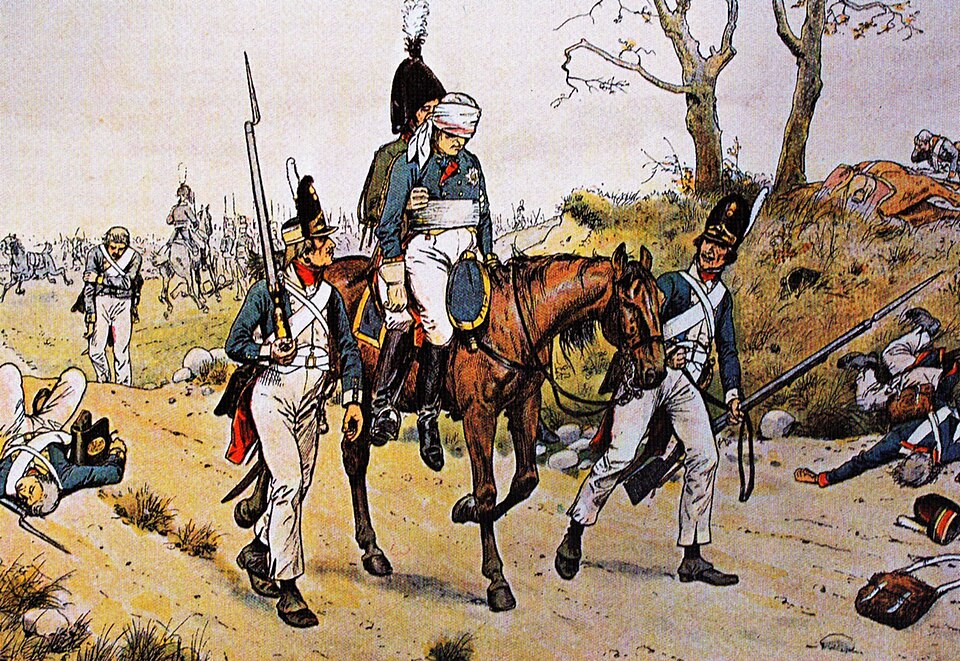
“Prussian wounded and stragglers leaving battle [after the battles of Jena and Auerstadt]. The mortally wounded Duke of Brunswick is the prominent figure in the painting.”
Painting by Richard Knötel (1857–1914) via Wikimedia Commons.

    A vain, immoderate faith in these institutions made it possible to overlook the fact that their vitality was gone. The machine could still be heard clattering along, so no one asked if it was still doing its job.1
    – Carl von Clausewitz on Prussia in 1806

In the autumn of 1806, the Kingdom of Prussia, “The Iron Kingdom”, suffered one of the most rapid and humiliating military defeats in modern European history.2 The twin battles of Jena and Auerstedt shattered not only its army but the myth of invincibility that had surrounded the legacy of Frederick the Great. For the young Carl von Clausewitz, then a junior officer in the collapsing Prussian forces, this moment marked a personal and national catastrophe that would shape his life’s work. Clausewitz would come to see the defeat not simply as a failure of generalship or tactics, but as the exposure of a more profound institutional and societal crisis; one in which a state had grown complacent, a military rendered obsolete, and a society stripped of civic vitality falling apart during “the most decisive conflict in which they would ever have to fight”.3 In that collapse and Clausewitz’s later reflections, one finds an unsettling parallel to present-day America, a powerful nation outwardly strong, yet increasingly vulnerable to the same internal rot.

Prussia’s disaster in 1806 was the formative experience for the author of On War. How the armies of Frederick the Great and the state that he painstakingly built collapsed like a house of cards was a question that bothered Clausewitz for many years.4 It was a comprehensive disintegration of a system that had, since the mid-eighteenth century, claimed a position of prominence in European military affairs based on its discipline, linear tactics, and centralized command. Yet by the turn of the nineteenth century, these very strengths had calcified into weaknesses. Clausewitz foresaw disaster. Even as a young lieutenant, he was already warning of the Prussian army’s growing detachment from reality. In his early writings, he criticized military exercises as highly scripted performances, lacking genuine tactical challenge, unpredictability, and creativity.5 The number of steps marched in a minute of the cadence, what awards should be placed on a uniform, how a rifle should be cleaned for parade, all of this he feared, was cultivating a “lassitude of tradition and detail”.6 Clausewitz understood that rehearsing war under artificial constraints produced not readiness but ritual. Even though he later wrote, “no general can accustom an army to war”, he worried, presciently, that when confronted by a real enemy operating under real conditions, the army would collapse, and in 1806, it did.7

Whatever reservations he may have held, Clausewitz fulfilled his duty. He led a battalion of grenadiers at the battle of Auerstedt and managed to withdraw with most of his men intact in the chaotic aftermath of defeat. His escape was short-lived; however, he was captured on October 28, 1806, and subsequently marched into captivity in France, where he would spend the next year as a prisoner.8 Napoleon’s campaigns revealed that war had been transformed: faster, larger, and fundamentally political. Clausewitz wrote, “War was returned to the people, who to some extent had been separated from it by the professional standing armies; war cast off its shackles and crossed the bounds of what had once seemed possible”.9 The levée en masse and the corps system shattered the static paradigms of eighteenth-century warfare. Yet the Prussian high command, clinging to the geometries of the past, failed to respond with imagination or speed with any kind of seriousness.

Clausewitz’s later concept of friction — the unpredictable resistance that disrupts even the best plans — emerged directly from this experience.10 The Prussian army collapsed not for lack of courage, but because its institutional mindset could not withstand the volatility of an age that demanded adaptability, political intelligence, and creative command.


    1. Carl von Clausewitz, Historical and Political Writings, ed. and trans. Peter Paret and Daniel Moran (Princeton, NJ: Princeton University Press, 1992), 32.

    2. Christopher Clark, Iron Kingdom: The Rise and Downfall of Prussia, 1600–1947 (Cambridge: Belknap Press, 2006).

    3. Clausewitz, Historical and Political Writings, 81.

    4. Frederick the Great ruled from 1740-1786 and is usually credited as turning Prussia from a regional power to a continental power.

    5. Peter Paret, Clausewitz and the State (Oxford: Oxford University Press, 1976), 92-93.

    6. Clausewitz, Historical and Political Writings, 36.

    7. Carl von Clausewitz, On War, trans. Michael Howard and Peter Paret (Princeton: Princeton University Press, 1984), 122.

    8. Partet, 126.

    9. Clausewitz, Historical and Political Writings, 287.

    10. Clausewitz discusses this concept in Chapter 7 in On War, 119-121.

VIA Rail’s premier passenger train, The Canadian

Filed under: Cancon, History, Railways — Tags: , , , , — Nicholas @ 03:00

In the National Post, Raymond J. de Souza discovers the aging crown jewel of VIA Rail’s passenger services, The Canadian, which VIA inherited from Canadian Pacific Railway when the country’s long-distance and intercity rail passenger services were merged into a single Crown Corporation in the 1970s:

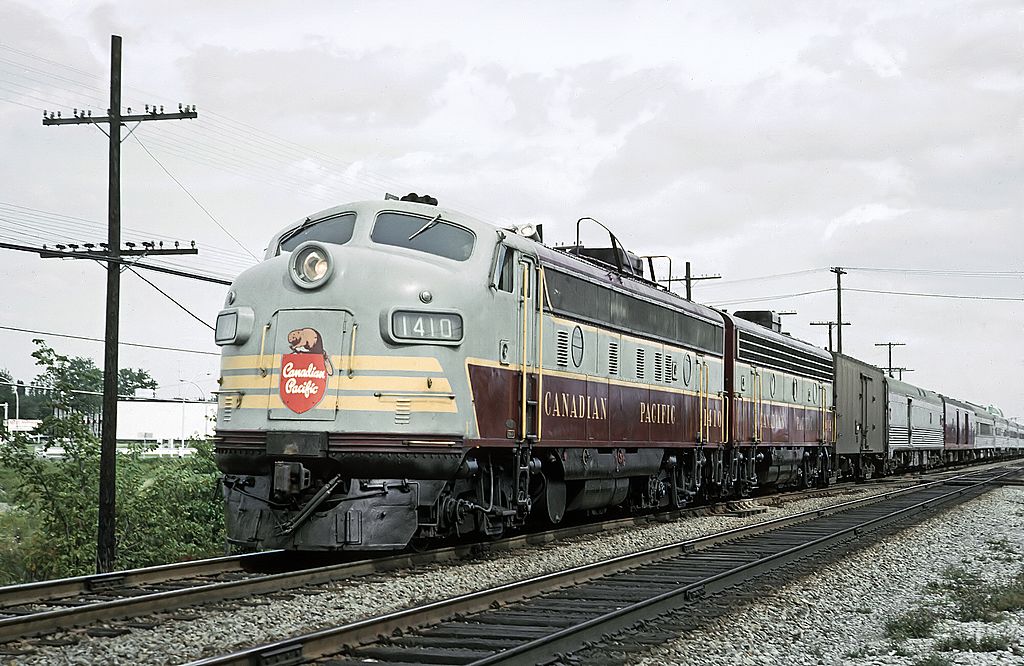
Canadian Pacific FP7 locomotive 1410 at the head of The Canadian stopped at Dorval, Quebec on 6 September, 1965. The Canadian was Canadian Pacific’s premier passenger train before VIA Rail was formed.
Photo by Roger Puta via Wikimedia Commons.

What did I learn after four days and four nights, some 4,500 kilometres, from Vancouver to Toronto on board Via Rail’s The Canadian? Many things, as it happens.

I learned that The Canadian attracts train aficionados the world over for one of the last great rail journeys on one of the last great trains. The stainless steel rolling stock is 70 years old, the cars having been upgraded along the way, but still rolling as a living part of railway history.

Part of the cultural history Via Rail preserves is superlative meals thrice daily, served in fine style in the dining cars. Four dinners: rack of lamb, beef tenderloin, AAA prime rib, bone-in pork chop. Delicious desserts. Canadian wines and craft beers. Fish eaters and vegans also had options. The question arises ineluctably: Why is the Via Rail food between Montreal and Toronto so horrible?

Perhaps it would be too expensive; The Canadian in sleeper class certainly is. Expense was really the question in the 1870s.

“Could a country of three and a half million people afford an expenditure of one hundred million dollars at time when a labourer’s wage was a dollar a day?” asked Pierre Berton in his 1970 chronicle of that decision, The National Dream.

The cost of not building was greater, argued Sir John A. Macdonald. It was the price of remaining a sovereign continental country. Part of the financing was creative; the Hudson’s Bay Company gave Rupert’s Land to Canada, and Canada paid the contractors partly in free land.

Growing up in Calgary, I presumed that the greatest challenge was putting the Canadian Pacific Railway (CPR) through the mountains. And it is true that the most spectacular scenery on the route is the Fraser Canyon and the mountains of the Yellowhead Pass. (The Canadian now travels the northern route of the Canadian National (CN) Railway, not the original southern route of the CPR.)

Yet it was the Canadian Shield, thousands of lakes and muskeg atop the hardest rock on earth, that was the real obstacle. John Palliser, one of the 1860s expeditioners between Thunder Bay and the Rockies, reported back that while getting through the mountain passes could be done, the impenetrable land north of Lake Superior was the insuperable problem. And without getting around the Shield, Canada would be constrained, cooped up, with the prairies and mountains and west coast inaccessible.

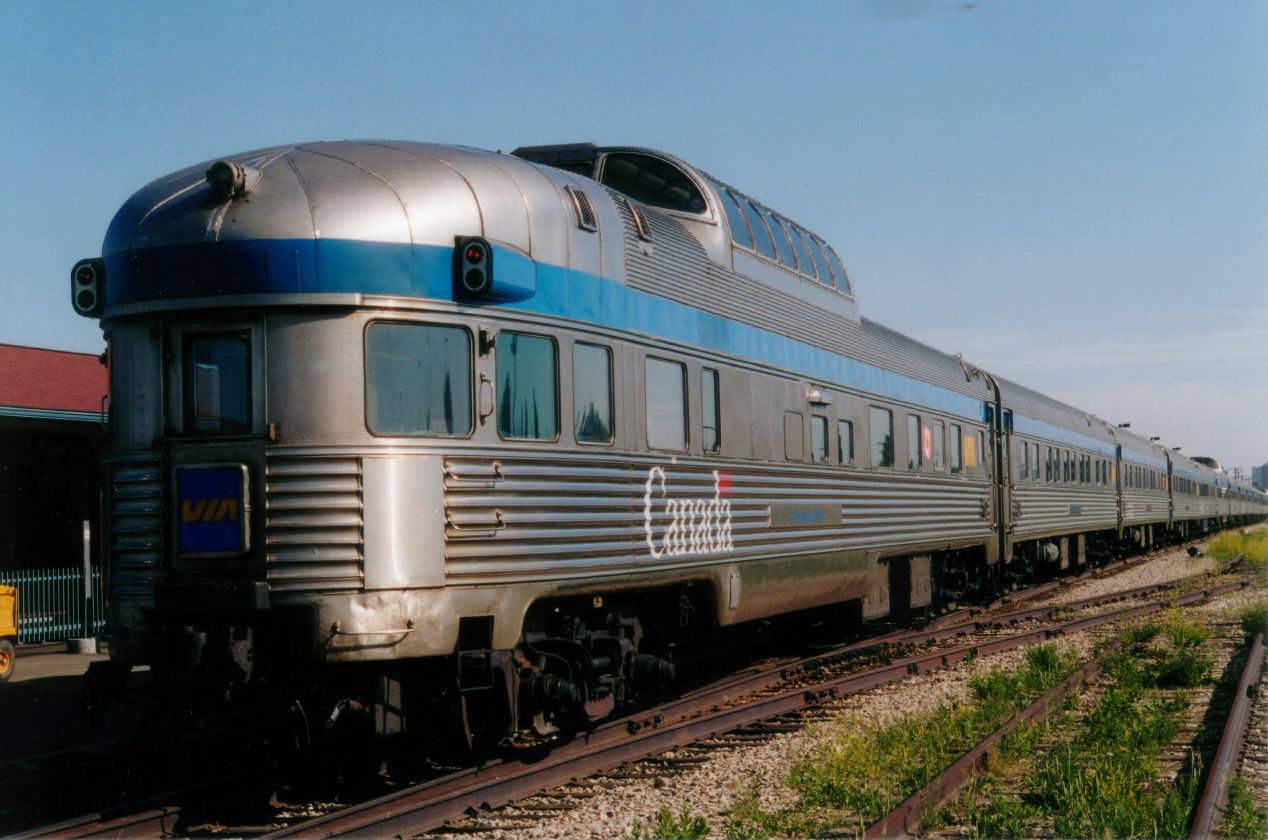
VIA dome observation car on The Canadian in 2007. The best views are available from the domed seating on the upper level.
Photo by Savannah Grandfather via Wikimedia.

I’d always hoped to travel The Canadian at some point, but I was never able to afford the tickets at the same time that I had available time to travel, and there’s no hope I’ll ever be able to scrape up the money these days. According to VIA Rail’s website, the trip from Toronto to Vancouver would be between C$5860 to $9460 per person.

The Julio-Claudians – The Conquered and the Proud 15

Adrian Goldsworthy. Historian and Novelist
Published 26 Feb 2025

This time we take a look at the reigns of Augustus’ successors — Tiberius, Gaius Caligula, Claudius and Nero, referred to collectively by scholars as the Julio-Claudian dynasty. We think about the whole question of the succession, and trace how each diverged from Augustus when it came to the style of governing.

QotD: The accumulated friction of bureaucratic growth

Bureaucracies all succumb very quickly to some kind of “Malthusian progression”. I’m not sure what to call it, I suck at naming stuff (please take your shot in the comments), but you all know what I mean: A bureaucracy’s tasks increase arithmetically, but the amount of effort each task requires increases geometrically.

[…] In the early Republic, raising a legion was as simple as a patrician calling his clients to service, or the Senate issuing a conscription decree. One task: the summoning of free men, with their own equipment, and there you go — Legio I Hypothetica.

By the late Empire, though, all those freeholds had been turned into slave-worked Latifundia, so the effort of raising a legion increased enormously. Now the bureaucracy had to go out and hire freemen (if it could even find them), equip them at State expense, train them (again at State expense), and so on. In itself, the number of tasks isn’t that large — we’ve identified three — and they only increase at the rate of n+1.

But the effort each task requires increases to the power of n, such that if you could somehow express the effort expended in physical terms — joules or kilowatts or whatever — you’d see that the creation of Legio I Hypothetica under Scipio Africanus took 10 kilowatts, while raising the same legion under Diocletian took 10,000,000.

This isn’t (just) corruption. Sure, everyone at every level of the Imperial Bureaucracy was getting his beak wet, that goes without saying, but it’s the nature of bureaucracy itself that’s most to blame.

Severian, “Collapse II”, Founding Questions, 2021-12-09.

Powered by WordPress