
Quotulatiousness

July 19, 2025

No issue is so important that we can’t have a proper debate on the merits

Filed under: Government, Media, Politics — Tags: , , , , , — Nicholas @ 05:00

On Substack, Lorenzo Warby refutes the claim that some issues are just too important/too urgent/already decided:

One of the features of the “progressive” politics of the unaccountable classes — those who are just paid for turning up — is the demand that there be “No Debate” about various issues. The most obvious instances are “No Debate” about Trans and “No Debate” about climate change — hence demands that climate scepticism be outlawed.

All such “No Debate” claims are crap. First, any “No Debate” claim is presumptive evidence that what you are pushing is either not true or, slightly more subtly, is a mountain of bullshit erected on a molehill of truth. Robust cases for claims about the world are not afraid of debate.

Various moral urgency claims are mounted to support such “No Debate” claims. How do we determine moral urgency? From the evidence. If the evidence is clear, debate will not threaten that alleged urgency. On the contrary, it will reveal the urgency more clearly.

The underlying philosophical dynamic underlying “No Debate” claims is Critical Constructivism — the claim that reality is socially constructed; that all statements and knowledge claims are, in fact power claims; and that the righteousness of a claim can be determined by their (alleged) effects on (morally differentiated) social groups.

The underlying social dynamic is the use of affirmed beliefs to determine and display righteousness. If affirming X shows one to be one of the righteous, then not believing X shows one to be of the unrighteous. This is typically expressed in various terms of moral abuse (racist, Transphobe, Islamophobe, etc) whose use in media and academe has soared since 2014.

This is not because Western societies have become more bigoted — on any reasonable measure they have become far less so over time — but because the politics of Righteous Affirmed Belief has dramatically surged and so has therefore the stigmatisation of dissent.

To claim that affirming X shows ultimate moral propriety requires stigmatising not-X. For something is morally proper — indeed morally trumping — only if the opposite is morally improper. Thus is moral propriety is enforced by stigmatisation. Hence silence is violence — one must profess righteousness. Hence also words are violence — if affirmation of belief is the ultimate marker of righteousness then expressed disbelief becomes the ultimate marker of abusive malevolence. These dynamics lead to a great deal of preference falsification — people publicly affirming, or at least not opposing, claims that they do not privately believe.
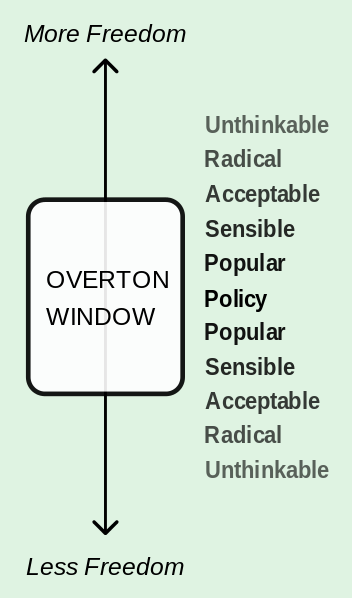

Old and tired: the Overton Window … New and hot: the Trump Door

Filed under: Government, Media, Politics, USA — Tags: , , — Nicholas @ 04:00

In The Line, Mike Colledge considers how Trump has managed to change the political environment that used to be fairly well described by the Overton Window:

Diagram of the “Overton Window”, based on a concept promoted by Joseph P. Overton (1960–2003), former director of the Mackinac Center for Public Policy. The term “Overton Window” was coined by colleagues of Joe Overton after his death. In the political theory of the Overton Window, new ideas fall into a range of acceptability to the public, at the edges of which an elected official risks being voted out of office.
Illustration by Hydrargyrum via Wikimedia Commons

The Overton Window, named after Joseph Overton of the Mackinac Center for Public Policy, is used to explain how policy ideas gain acceptance and move from idea to policy. The “window”, as Overton saw, could include a wide range of ideas from those with little to no support to those that have matured, gained public traction, and could be supported by the public as legitimate policy options for governments. The “window” was not static. It could — and did — shift, expand, or contract based on social movements, economic pressures, cultural trends, and/or the actions of leaders in the public and private sectors.

Those who wanted to push ideas into the window and gain acceptance and support usually had to spend considerable effort — and sometimes years — promoting and making the case for their cause and moving it into the mainstream. Al Gore’s documentary An Inconvenient Truth and Greta Thunberg’s ongoing efforts to push for action on climate change are examples of leaders using their profile to push and keep climate change action in Overton’s Window.

Lately, though, it feels like the Overton Window has been replaced by the Trump Door. While Overton observed and studied what was happening, Trump is more of an active participant. Overton provided us with an analytical framework; Trump’s door is more of a tactical approach.

And this is a big change. The world moves much faster than it did in the mid-90s when Overton first created his “window”. The democratization of communications and the speed of communications means anyone can comment, report, or share an opinion instantly (and often without considering the consequences). Increased polarization means that leaders looking to act and to reinforce support for their desired policies do not have to wait for a majority to support a given policy before they act. They merely need a vocal plurality of their own supporters to move forward with an idea.

Trump hasn’t so much smashed the window as he has replaced it with a large swinging Western saloon-style door. He has shown no interest in framing and positioning an issue for the public’s consideration in hopes of building support from a majority. He is throwing ideas into and out of the public-consideration saloon as fast as possible. Some ideas he throws in as distractions. Others he throws in as announcements of his intent regardless of the public’s perspective.

To those of you saying in your head “I don’t think Trump thinks this deeply about what he is doing,” you could be correct. But the net impact of his actions is the creation of a Trump Door that, unlike a window, is not transparent and, again unlike Overton’s Window, is not about building public acceptance. It is a tool to achieve his goals as fast as possible. When obstacles require a shift in policy — given there is no need to engage the public — he simply throws another idea into the saloon.

Trump administration records huge increase in tariff revenues

Filed under: Government, Media, Politics, USA — Tags: , , — Nicholas @ 03:00

Oddly, most of the coverage on the US government’s surge in tariff income fail to emphasize two relevant facts: first, that the money is largely being paid by American consumers and second that it’s a surge driven by the fact that higher tariffs will kick in soon. J.D. Tuccille reports:

I have no idea where I saw this meme, but it makes me laugh

Last Friday, U.S. Treasury Secretary Scott Bessent took a victory lap as his department reported an unexpected increase in receipts from tariffs. The revenue undoubtedly came from a surge in imports to the U.S., which led to payments that filled federal coffers. It would seem to be a win for an administration that has staked an awful lot on waging a trade war with the entire planet to (take your pick) redress wrongs done to America, raise revenue for the government, and encourage domestic manufacturing and employment. But that victory lap comes too soon; the tariff windfall more likely represents efforts by U.S. firms to accumulate inventory before tariff rates rise even higher.

[…]

That mention of “higher prices on imported goods paid by US consumers and firms” deserves to be emphasized because it highlights the fact that tariffs are taxes on Americans. Ultimately, most of the burden of high rates is shouldered by companies and individuals within the U.S. As the Tax Foundation’s Alex Durante pointed out in February, “rather than hurting foreign exporters, the economic evidence shows American firms and consumers were hardest hit by the Trump tariffs”.

The Yale Budget Lab agrees, estimating in May that “the price level from all 2025 tariffs rises by 1.7% in the short-run, the equivalent of an average per household consumer loss of $2,800” in 2024 dollars. In particular, the Yale economists found “consumers facing 15% higher shoe prices and 14% higher apparel prices in the short-run”.

Even Walmart, which had vowed to absorb as much as possible of the tariff burden, conceded two months ago that prices would have to rise because of the trade war.

This week, the Federal Reserve Bank’s “beige book” noted that “in all twelve Districts, businesses reported experiencing modest to pronounced input cost pressures related to tariffs” and that “many firms passed on at least a portion of cost increases to consumers through price hikes or surcharges”.

Penn Wharton’s concerns, mentioned above, about “lower economic growth” are shared by the Tax Foundation and by the Yale Budget Project. The Tax Foundation’s Erica York and Alex Durante forecast that the Trump administration’s tariffs would “reduce US GDP by 0.8 percent” before taking foreign retaliation into account. Yale economists see a similar GDP reduction of 0.7 percent.

If the courts issue a final ruling against Trump’s use of the International Emergency Economic Powers Act (IEEPA) to impose tariffs, that will reduce the negative effects on the economy. But it will also take a chunk out of the revenues the administration expects to collect.

So, Secretary Bessent’s victory lap on tariff revenues was a little premature. And so are hopes that the trade war won’t damage commerce and the U.S. economy.

Pineapples – The Most Expensive Fruit in History

Filed under: Britain, Food, History — Tags: , , , , , , — Nicholas @ 02:00

Tasting History with Max Miller
Published 18 Feb 2025

Mini tarts with a buttery crust and syrupy pineapple and wine filling

City/Region: England
Time Period: 1736

For hundreds of years, the pineapple was a status symbol for the very wealthiest of European royalty and nobility. A single pineapple could cost $10,000 in today’s money, and pineapples turned up in architecture, tableware, paintings, clothing, and accessories. Many knew what pineapples looked like, but few had actually tasted one.

And that’s a real shame, because these tarts are absolutely delicious. The crust is good, but the real showstopper is the filling. Pineapple is the main flavor, but the wine gives it a wonderful complexity. You could even make just the filling and serve it with some whipped cream or ice cream and it would be amazing. If you have any leftover syrup, it would go great in some cocktails.

    To make Paste. From Mrs. Peasly.
    …If you would have a sweet Paste; then take half a Pound of Butter, and rub it into about a Pound of Flour, with two or three Ounces of double-refined Sugar powder’d, and make it a Paste, with cold Milk, some Sack and Brandy. This is a very good one.

    To make a Tart of Ananas, or Pine-Apple. From Barbadoes.
    Take a Pine-Apple, and twist off its Crown: then pare it free from the Knots, and cut it in Slices about half an Inch thick; then stew it with a little Canary Wine, or Madera Wine, and some Sugar, till it is thoroughly hot, and it will distribute its Flavour to the Wine much better than any thing we can add to it. When it is as one would have it, take it from the Fire; and when it is cool, put it into a sweet Paste, with its Liquor, and bake it gently, a little while, and when it comes from the Oven, pour Cream over it, (if you have it) and serve it either hot or cold.
    The Country Housewife and Lady’s Director by R. Bradley (6th Edition), 1736

(more…)

QotD: William Wilberforce and the anti-slavery movement

Filed under: Books, Britain, History, Liberty, Quotations — Tags: , , , , — Nicholas @ 01:00

“What Wilberforce vanquished was something even worse than slavery,” says [Eric] Metaxas [in Amazing Grace], “something that was much more fundamental and can hardly be seen from where we stand today: he vanquished the very mindset that made slavery acceptable and allowed it to survive and thrive for millennia. He destroyed an entire way of seeing the world, one that had held sway from the beginning of history, and he replaced it with another way of seeing the world.” Ownership of existing slaves continued in the British West Indies for another quarter-century, and in the United States for another 60 years, and slave trading continued in Turkey until Atatürk abolished it in the Twenties and in Saudi Arabia until it was (officially) banned in the Sixties, and it persists in Africa and other pockets of the world to this day. But not as a broadly accepted “human good”.

There was some hard-muscle enforcement that accompanied the new law: the Royal Navy announced that it would regard all slave ships as pirates, and thus they were liable to sinking and their crews to execution. There had been some important court decisions: in the reign of William and Mary, Justice Holt had ruled that “one may be a villeyn in England, but not a slave,” and in 1803 William Osgoode, Chief Justice of Lower Canada, ruled that the institution was not compatible with the principles of British law. But what was decisive was the way Wilberforce “murdered” (in Metaxas’ word) the old acceptance of slavery by the wider society. As he wrote in 1787, “God almighty has set before me two great objects: the suppression of the slave trade and the reformation of manners”.

The latter goal we would now formulate as “changing the culture” — which is what he did. The film of Amazing Grace shows the Duke of Clarence and other effete toffs reeling under a lot of lame bromides hurled by Wilberforce on behalf of “the people”. But, in fact, “the people” were a large part of the problem. Then as now, citizens of advanced democracies are easily distracted. The 18th-century Church of England preached “a tepid kind of moralism” disconnected both from any serious faith and from the great questions facing the nation. It was a sensualist culture amusing itself to death: Wilberforce goes to a performance of Don Juan, is shocked by a provocative dance, and is then further shocked to discover the rest of the audience is too blasé even to be shocked. The Paris Hilton of the age, the Prince of Wales, was celebrated for having bedded 7,000 women and snipped from each a keepsake hair. Twenty-five per cent of all unmarried females in London were whores; the average age of a prostitute was 16; and many brothels prided themselves on offering only girls under the age of 14. Many of these features — weedy faint-hearted mainstream churches, skanky celebs, weary provocations for jaded debauchees — will strike a chord in our own time.

“There is a great deal of ruin in a nation,” remarked Adam Smith. England survived the 18th century, and maybe we will survive the 21st. But the life of William Wilberforce and the bicentennial of his extraordinary achievement remind us that great men don’t shirk things because the focus-group numbers look unpromising. What we think of as “the Victorian era” was, in large part, an invention of Wilberforce which he succeeded in selling to his compatriots. We, children of the 20th century, mock our 19th-century forebears as uptight prudes, moralists and do-gooders. If they were, it’s because of Wilberforce. His legacy includes the very notion of a “social conscience”: in the 1790s, a good man could stroll past an 11-year-old prostitute on a London street without feeling a twinge of disgust or outrage; he accepted her as merely a feature of the landscape, like an ugly hill. By the 1890s, there were still child prostitutes, but there were also charities and improvement societies and orphanages. It is amazing to read a letter from Wilberforce and realize that he is, in fact, articulating precisely 220 years ago what New Yorkers came to know in the Nineties as the “broken windows” theory: “The most effectual way to prevent greater crimes is by punishing the smaller.”

Mark Steyn, The [Un]documented Mark Steyn, 2014.

Powered by WordPress



