In the headline, you should read the unstated “surprising to far too many mainstream economists and political commentators”, but full credit to Noah Smith for admitting that Milei’s radical agenda has started to make life much better for ordinary Argentinians:

Javier Milei at CPAC in National Harbor, Maryland 20 February, 2025.
Photo by Gage Skidmore via Wikimedia Commons.
So to be clear, when I say that criticism of free markets has been overdone, I’m partly talking to myself. A couple of months ago, horrified by Trump’s tariff policies, I wrote an apology to libertarians, admitting that I had failed to see the political usefulness of their project in terms of maintaining economic sanity on the Right.
But it’s not just the political benefits of free markets that have been undersold; I think the purely economic advantages are also too often ignored.
Exhibit A is Javier Milei’s track record in Argentina. A year and a half ago, when Milei was elected President of Argentina, a bunch of left-wing economists warned darkly that his radical free-market program would lead to economic devastation:
The election of the radical rightwing economist Javier Milei as president of Argentina would probably inflict further economic “devastation” and social chaos on the South American country, a group of more than 100 leading economists has warned … [S]ignatories include influential economists such as France’s Thomas Piketty, India’s Jayati Ghosh, the Serbian-American Branko Milanović and Colombia’s former finance minister José Antonio Ocampo …
The letter said Milei’s proposals – while presented as “a radical departure from traditional economic thinking” – were actually “rooted in laissez-faire economics” and “fraught with risks that make them potentially very harmful for the Argentine economy and the Argentine people” … [T]he economists warned that “a major reduction in government spending would increase already high levels of poverty and inequality, and could result in significantly increased social tensions and conflict.”
“Javier Milei’s dollarization and fiscal austerity proposals overlook the complexities of modern economies, ignore lessons from historical crises, and open the door for accentuating already severe inequalities,” they wrote.
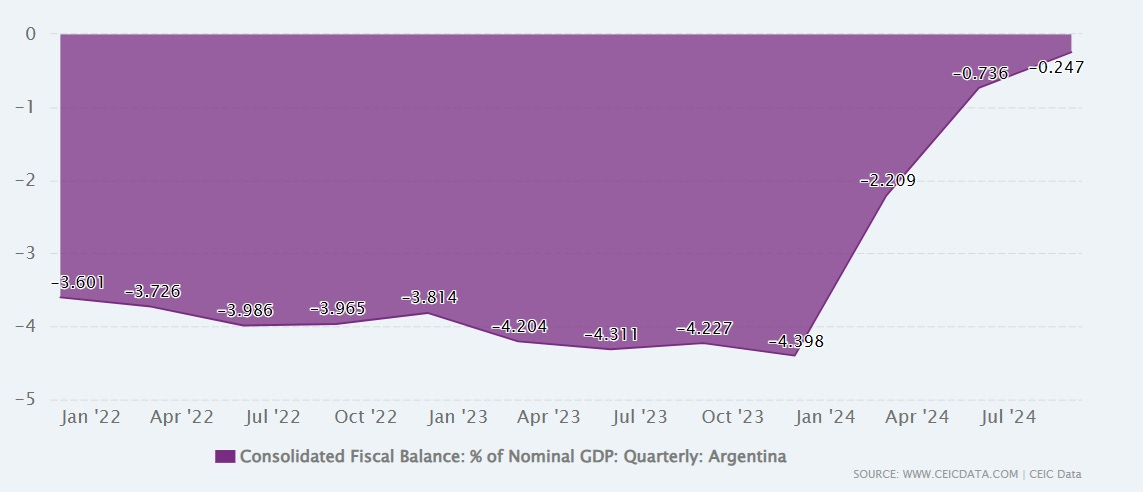
Milei won anyway. His first big policy, and the one the lefty economists fretted about the most, was deep fiscal austerity. Argentina’s long-standing economic model, created by dictator Juan Peron in the 1950s, involved a large and complex array of public works projects and subsidies for various consumer goods like energy and transportation. Milei slashed many of these, as well as cutting pensions, civil service employment, and transfers to provinces. Overall, he cut public spending by about 31%, resulting in a near-total elimination of Argentina’s chronic budget deficit:
The point of all this cutting wasn’t just to remove state intervention in the economy — it was to stop inflation. Basically, macroeconomic theory says that if deficits are high and persistent enough, then they convince everyone that the government will eventually inflate its debt away by printing money (which becomes a self-fulfilling prophecy). And most or all countries that experience hyperinflation end up escaping it only when they get their fiscal house in order. Perpetual deficits were part of Argentina’s “Peronist” system, and it’s probably a good bet that this has been responsible for the periodic bouts of hyperinflation that it experiences.
[…]
But still, Milei’s success so far should make us somewhat more confident about free-market policies — especially when we evaluate them against the new socialist ideas that have been gaining currency in the U.S. In the past, socialists and other left-leaning economic thinkers advocated central planning and nationalization of industry; in recent years, they have taken to calling for expansion of the state through fiscal policy, mixing macroeconomic justifications with micro. At all times, they call for deficit-financed expansion of social programs; when fiscal hawks want to tame the deficits, the lefties warn of the short-term macroeconomic harms of austerity.
If you’re always more terrified of austerity than you are of deficits, expansion of the state — and of the deficit — becomes a one-way ratchet. This approach is very different than Keynesianism, which advocates stimulus to overcome recessions, followed by austerity during boom times. You’ll recognize it as bearing a distinct similarity to MMT; that pseudo-theory has largely fallen out of favor, but there are plenty of more respectable progressive types whose ideas nonetheless have a lot of this “macroleftist” flavor.