Quotulatiousness

July 11, 2025

The 1st Canadian Infantry Division in Operation Husky, 10 July 1943

Filed under: Britain, Cancon, History, Military, WW2 — Tags: , , , — Nicholas @ 05:00

For Project 44, Nathan Kehler describes the role of the 1st Canadian Infantry Division as the western-most part of Montgomery’s 8th Army landings on the southern tip of Sicily:

In the days leading up to Operation Husky, the Canadian contingent suffered two major losses – one in leadership and one in logistics. Though the landings would ultimately succeed, these events cast a shadow over the operation before a single boot touched Sicilian soil.

The Death of General Salmon

On July 2, 1943, Major-General G.G. Salmon, commander-designate of the 1st Canadian Infantry Division for the Sicily campaign, was tragically killed when his Hudson aircraft crashed near Barnstaple, Devonshire, shortly after takeoff from Hendon Airfield. Also on board were several senior officers, including Rear-Admiral P.J. Mack, the Canadian naval force commander, and Lt.-Col. C.J. Finlay, the newly appointed senior logistics officer for the division. All were killed.

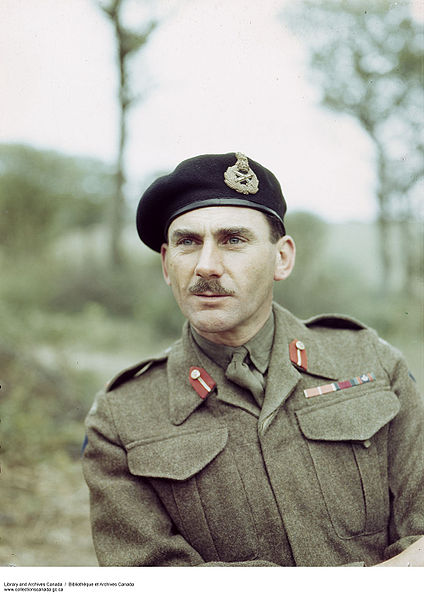
Major General Guy Simonds, commanding 1CID.

General Salmon had been hand-picked to lead Canada’s first major amphibious campaign. His death, just days before the invasion, shook the command structure. With no time to replace him formally, Major-General Guy Simonds was appointed in his place. Simonds was known for his drive, discipline, and tactical focus. The loss of Salmon meant an abrupt shift in leadership style and planning assumptions on the eve of battle.

Sinking of Canadian Troop Ships

Only days later, Canadian forces suffered another blow. Between 4–5 July, as convoys moved across the Mediterranean from North Africa toward Sicily, Axis submarines attacked Allied shipping near the Algerian coast. Three ships were torpedoed: the St. Essylt, City of Venice, and Devis.

While the first two sinkings resulted in relatively few casualties, the loss of the Devis was severe. Carrying 261 Canadian troops, the ship was hit and engulfed in fire. Fifty-two Canadians were killed, with many trapped in the holds below deck. In total, the convoy lost over 500 vehicles and 40 guns, along with critical headquarters and signals equipment. Divisional Headquarters suffered particularly heavy equipment losses, forcing last-minute improvisation in communications and command coordination.

Despite these losses, the Canadian Division adapted quickly, and the operation went forward as planned. These early setbacks, however, underscore the high cost and uncertainty of even reaching the battlefield in the Second World War.

Canadian Beaches

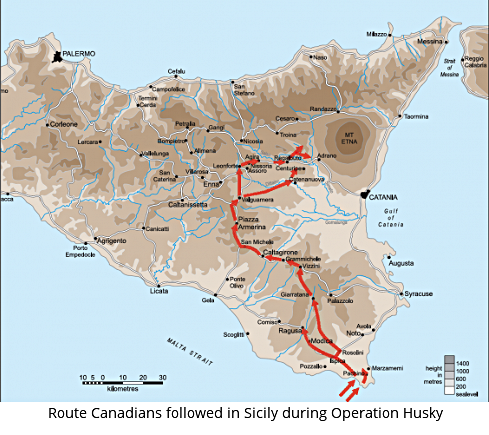
On 10 July 1943, the 1st Canadian Infantry Division landed in southeastern Sicily as part of Operation Husky – the Allied invasion of Europe’s “soft underbelly.” The division’s assault was split across two main beaches: “Roger” Beach to the east and “Sugar” Beach to the west of the village of Le Grotticelle. These beaches formed the right flank of the British Eighth Army’s landings.

General Simonds’ plan for the Canadians was a two-brigade front:

  • The 1st Canadian Infantry Brigade would land on Roger Beach and push inland to destroy a coastal battery near Maucini, seize the Pachino airfield, and establish contact with nearby British forces around Pachino town.
  • The 2nd Canadian Infantry Brigade would land on Sugar Beach, clear beach defences, support the adjacent British Special Service Brigade landing on the far left, and advance north past the Pantano Longarini marshes.
  • The Special Service Brigade (British Commandos) would land west of Punta Castellazzo, eliminate enemy resistance in their zone, and cover the Canadians’ western flank from elevated ground north of the marshes.

The landings were scheduled for 2:45 a.m., with Commandos hitting the shore ten minutes earlier. Objectives were clear: knock out coastal defences, secure strategic positions, and quickly link up with Allied forces to expand the beachhead.

The Landings

Despite rough seas from a storm the day before, the landings went ahead as planned in the early hours of 10 July 1943. Just after 1:00 a.m., British Commandos began landing west of the Canadian sector, encountering only light resistance. By 1:34 a.m., the 2nd Canadian Infantry Brigade – the Seaforth Highlanders of Canada and Princess Patricia’s Canadian Light Infantry – were heading for Sugar Beach under covering fire from naval guns, including the 15-inch guns of HMS Roberts.

Navigation errors caused the Seaforth Highlanders to land to the right of the Patricias, reversing their intended order. But the heavy surf helped carry landing craft over a false beach, and both units came ashore with minimal opposition. They quickly cleared light beach obstacles and scattered Italian machine-gun posts. By 3:00 a.m., both battalions had successfully landed and were advancing inland toward their objectives.

On Roger Beach, however, the 1st Canadian Infantry Brigade faced delays. Their assault relied on DUKWs and landing craft (LCTs) arriving from Malta. When these were delayed, Brigadier Howard Graham initiated a backup plan, switching to Landing Craft Assault (LCAs). Confusion and the heavy swell caused further delay, with some units landing as late as 5:30 a.m. – nearly three hours behind schedule.

Despite the setbacks, the Hastings and Prince Edward Regiment and the Royal Canadian Regiment landed successfully. The Hastings had one reserve company land 5,000 yards off target in the Commando sector but regrouped without major issue. Both units met minimal resistance. The RCR encountered light shelling from the Maucini battery, but naval gunfire quickly silenced it.

By 6:45 a.m., all three lead brigades had secured their assigned beachheads, with support units and armour – including Shermans from the Three Rivers Regiment – beginning to land. The 48th Highlanders of Canada and The Edmonton Regiment followed their respective brigades ashore, some accompanied by pipe bands.

Opposition during the landings was light overall. Many Italian defenders withdrew as the naval bombardment and confusion of the assault overwhelmed them. However, isolated machine-gun fire and limited artillery shelling still resulted in several Canadian casualties, primarily on Roger Beach.
The pre-invasion loss of ships to enemy submarine or air attack was taken fully into account during the weeks before the convoys set out. But as with all military planning, the enemy gets a vote too.

Why Didn’t France and Britain Stop Germany’s Secret Rearmament? – Out of the Bullpen 001

Filed under: Britain, France, Germany, History, Military, Russia — Tags: , , , , — Nicholas @ 04:00

World War Two
Published 10 Jul 2025

In this special “Out of the Bullpen” episode, we answer your burning questions about Weimar Germany’s most turbulent years. From clandestine military pacts with the Soviets to the creative ways Germany sidestepped Versailles, we dig into aspects which shaped a republic on the brink.
(more…)

William F. Buckley

Filed under: Books, Media, Politics, USA — Tags: , , , , , , , — Nicholas @ 03:00

In Quillette, Ronald Radosh reviews the long-awaited biography of arch-conservative William F. Buckley by his friend Sam Tanenhaus, Buckley: The Life and the Revolution That Changed America:

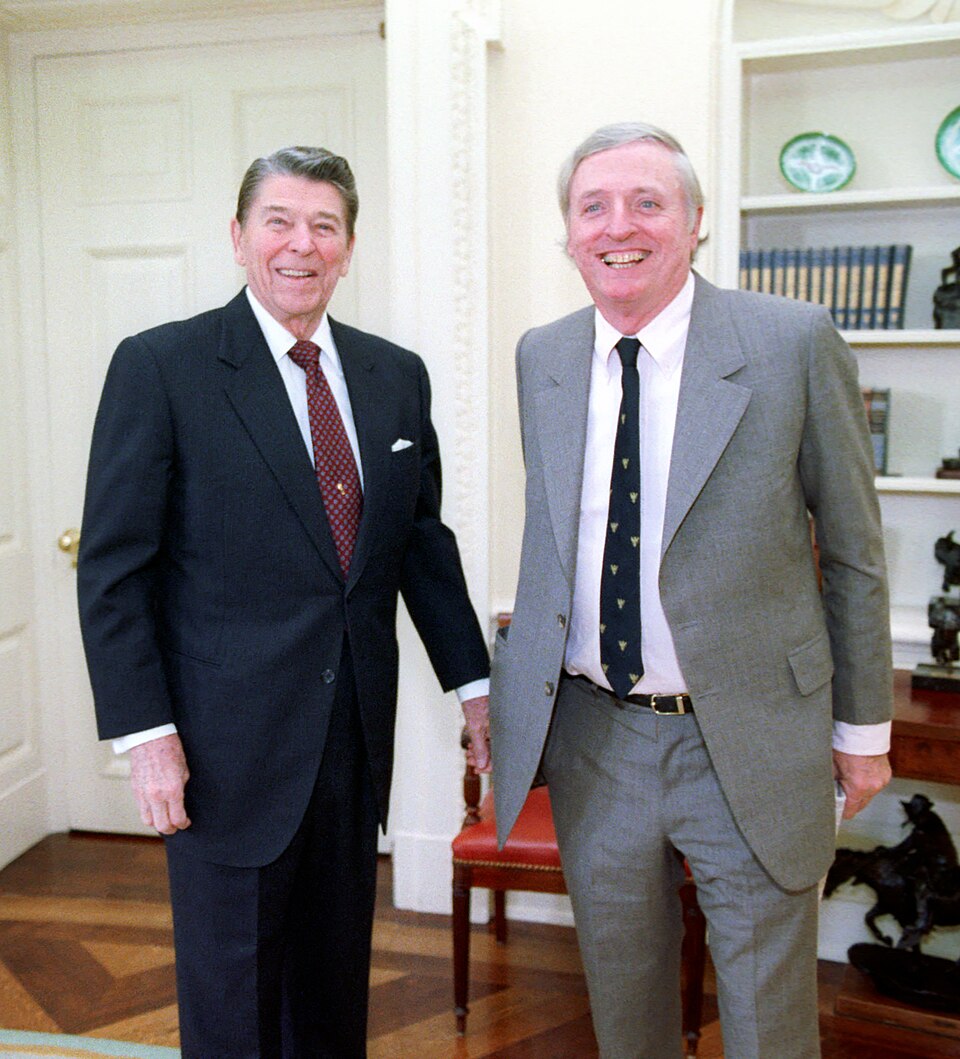
President Reagan meeting with William F. Buckley in the White House, 21 January, 1988.
Photo from the White House Photographic Collection via Wikimedia Commons.

William F. Buckley Jr. was a polymath of unusual erudition. The author of scores of books (including nearly two dozen novels), Buckley was an ardent apostle of conservatism at a moment when American liberalism was ascendant. But he was also an accomplished musician who played the harpsichord, a sailor who entered competitions and spent most summers on the sea, and an avid skier who spent his winters on the slopes of Gstaad after a morning of writing. Most Americans knew him as the host of a weekly television talk show called Firing Line, in which he interviewed and debated a wide range of politicians and intellectuals, most of whom he vehemently but politely disagreed with. (Many of these episodes are now available to view on YouTube.)

Television allowed Buckley to display his not inconsiderable wit and charm. He interviewed prominent socialists like both Norman Thomas and Michael Harrington, but he invited fellow conservatives onto his show as well. He had fellow conservatives on his show too, but he particularly relished debates with ideological opponents like Julian Bond (the young black leader of the Student Nonviolent Coordinating Committee), author Norman Mailer, journalist Christopher Hitchens, Ramparts editor Robert Scheer, and leaders of the Black Panther Party. The only people he would refuse to debate, he told the TV network, were communists lest he lend them legitimacy. Agents of the Soviet Union, he maintained, were not worth engaging with.

Buckley’s other major accomplishment was founding and editing America’s first nationwide conservative magazine. The bi-weekly National Review was the conservative counterpart of the influential liberal publications of the day, including the New Republic, The Nation, The Reporter, and the New Leader. Those liberal magazines all had rather small circulations but they also had the field to themselves until Buckley’s NR came along. Buckley hired a roster of old-style conservatives and ex-communists, including the former Trotskyist James Burnham, the former Communist agent (and accuser of Alger Hiss) Whittaker Chambers, Willi Schlamm, and Frank Meyer. As time went by, he added prominent young conservatives to the magazine’s masthead, many of whom would go on to become political leaders in the new American conservative movement. His prize protégé may have been Gary Wills, who eventually left NR‘s ranks and, much to Buckley’s disappointment, became an influential American liberal. Other NR contributors went on to become important American essayists and authors in their own right, like Joan Didion, George Will, and John Leonard, who edited the New York Times Book Review during the 1970s.

Buckley was the scion of a wealthy Connecticut family with a great estate in Sharon, Connecticut, that his father William F. Buckley Sr. named “Great Elm”. However, Buckley Sr. was also a Texan who identified closely with the American South, and after he made his fortune speculating in oil in Mexico and Venezuela, he purchased a mansion in Camden, South Carolina, for use during the cold Eastern winters. He named it Kamchatka, and the neighbouring residents, Tanenhaus writes, embraced the family “as Southerners who had come home”. Kamchatka had previously been the home of a Confederate general and senator who left office when Lincoln was elected President in 1860, but Camden would play an important role in the civil-rights movement.

By the 1950s through the ’60s, Tanenhaus writes, “the institution of Jim Crow — the legacy of slavery, the Civil War and Reconstruction — was being shaken at its foundations”. In the ’50s, the nation learned about the brutal murder of fourteen-year-old Emmet Till and massive protests by the black population began to appear across the South. The liberal magazines of the day covered the rise of the civil-rights movement and did what they could to mobilise Northerners in support of Southern blacks. In the deep South, activist efforts culminated in the famous Freedom Summer movement for black-voter registration in 1964. Camden, too, became the centre of a massive resistance movement.

Yet all this political and social upheaval never received a word of positive coverage in the pages of National Review. The reason for this was not complicated. Buckley’s family believed that “race was a settled question” and that racial separation was justified “as a matter of law as well as custom”. The Buckley family, of course, hired black help for their Camden mansion, whom they treated with respect and support. But members of the “Negro” race, as blacks were then called, had to know their place. So, Buckley wrote a number of unsigned editorials in February 1956 defending the South’s “deeply rooted folkways and mores”. The South, he argued, “believes that segregation is the answer to a complex situation not fully understandable except to those who live with it”, just as his own parents and siblings did. He vigorously objected to the Supreme Court’s verdict in 1954 outlawing segregated schools in Brown v. Board of Education, and he wrote editorials arguing that the Court’s decision was not an interpretation of the Constitution but rather “a venture in social legislation.”

In Camden, meanwhile, the Buckley family started and financed a newspaper called the News, which was meant to be a vehicle for the white South’s racist population and their “Citizens’ Councils”. Instead of burning crosses and lynching, the Councils preferred to use “legal threats, economic harassment, and public denunciation” in defence of segregation. In one case, a business owned by a black protestor was destroyed and his family harassed by the Council, after the owner tried to register to vote. As the violence in Camden became more extensive and widely reported, Buckley responded with an unsigned NR editorial on 10 January 1957 in which he argued that “the Northern ideologists are responsible for the outbreak of violence”. He did also condemn the “debasing brutality” of the white population’s behaviour, and for years, that remark remained his strongest condemnation of white violence. He continued to ignore the support provided to the Councils by South Carolina authorities.

One of Tanenhaus’s most stunning revelations is that, in 1956, Buckley dispatched an NR contributor to report on the National States’ Rights Conference in Memphis. The man he sent was one Revilo Oliver, whom Tanenhaus correctly describes as “a fanatical racist and anti-Semite”. The following year, NR published Buckley’s most infamous editorial, titled “Why the South Must Prevail”. The white community, he wrote, had a right to defend segregation because “for the time being, it is the advanced race”. The white South, he wrote, “perceives important qualitative differences between its culture and the Negroes’; and intends to assert its own”. And since NR “believes the South’s premises are correct”, the black population could justifiably have its interests thwarted by “undemocratic” but “enlightened” means. That editorial, Tanenhaus rightly notes, “haunts [Buckley’s] legacy, and the conservative movement he led”. Buckley also believed that if suppression of the black vote violated the terms of the Fourteenth Amendment, then that and the Fifteenth Amendment should be considered unconstitutional — “inorganic accretions to the original document, grafted upon it by victors-at-war by force”.

History of Britain V: Roman Conquest of Britain

Filed under: Britain, Europe, History, Military — Tags: , , — Nicholas @ 02:00

Thersites the Historian
Published 5 Feb 2025

The emperor Claudius felt insecure about his standing in the Roman world, so he sent four legions to Britain. The result was that Britain officially joined the Roman world and was now a peripheral part of the Roman Empire rather than an independent land of Celts.

QotD: Pyrrhus arrives in Magna Graecia to support the Tarantines

Filed under: Greece, History, Italy, Military, Quotations — Tags: , , , , — Nicholas @ 01:00

The Roman response to Pyrrhus’ initial arrival was hardly panic. Military operations in Etruria for 280, under the consul Tiberius Corucanius, continued for the year, while the other consul, Publius Valerius Laevinius, went south to fight Pyrrhus and shore up Rome’s position in Southern Italy. We don’t have clear numbers for the size of the armies at Heraclea – Plutarch stresses that they were big (Plut. Pyrrh. 16.3) – but I think it is fair to suppose that Lavinius probably has a regular consular army with two legions and attached socii, roughly 20,000 men. It has sometimes been supposed this might have been a double-strength army (so 40,000 men) on the basis of some of our sources (including Plutarch) suggesting somewhat nebulously that it was of great size.

There are a few reasons I think this is unlikely. First, sources enlarging armies to fit the narrative magnitude of battles is a very common thing. But more to the point, Pyrrhus has crossed to Italy with 28,500 men total and – as Plutarch notes – hasn’t had a chance to link any of his allies up to his army. That may mean he hasn’t even reabsorbed his scouting force of 3,000 and he may well have also had to drop troops off to hold settlements, secure supplies and so on. Pyrrhus’ initial reluctance to engage (reported by Plutarch) is inconsistent with him wildly outnumbering the Romans, but his decision to wait for reinforcements within reach of the Romans is also inconsistent with the Romans wildly outnumbering him. So a battle in which Pyrrhus has perhaps 20-25,000 men and the Romans a standard two-legion, two-alae army of 20,000 give or take, seems the most plausible.1

The two forces met along the River Siris at Heraclea on the coastal edge of Lucania, Laevinius having pushed deep into southern Italy to engage Pyrrhus. As usual for these battles, we have descriptions or partial descriptions from a host of sources (in this case, Plutarch, Dionysius of Halicarnassus, Zonaras, Florus) which don’t always agree, leaving the modern historian in a bit of a pickle. Generally, we assume that a lot of the later Roman narratives of a famous defeat are likely to have been tailored to try and minimize the embarrassment, either by implying the battle was closer than it was or that Pyrrhus was a very impressive foe (or both) or other “face-saving” inventions. Worse yet, all of our sources are writing at substantial chronological distance, the Romans not really having started to record their own history until decades later (though there would have been Greek sources for later historians to work with). Generally, Patrick Kent tends to conclude that – somewhat unusually – Plutarch’s moralizing focus renders him more reliable here: Plutarch feels no need to cover for embarrassing Roman defeats or to embellish battle narratives (which he’d rather keep short, generally) because his focus is on the character of Pyrrhus. Broadly speaking, I think that’s right and so I too am going to generally prefer Plutarch’s narratives here.

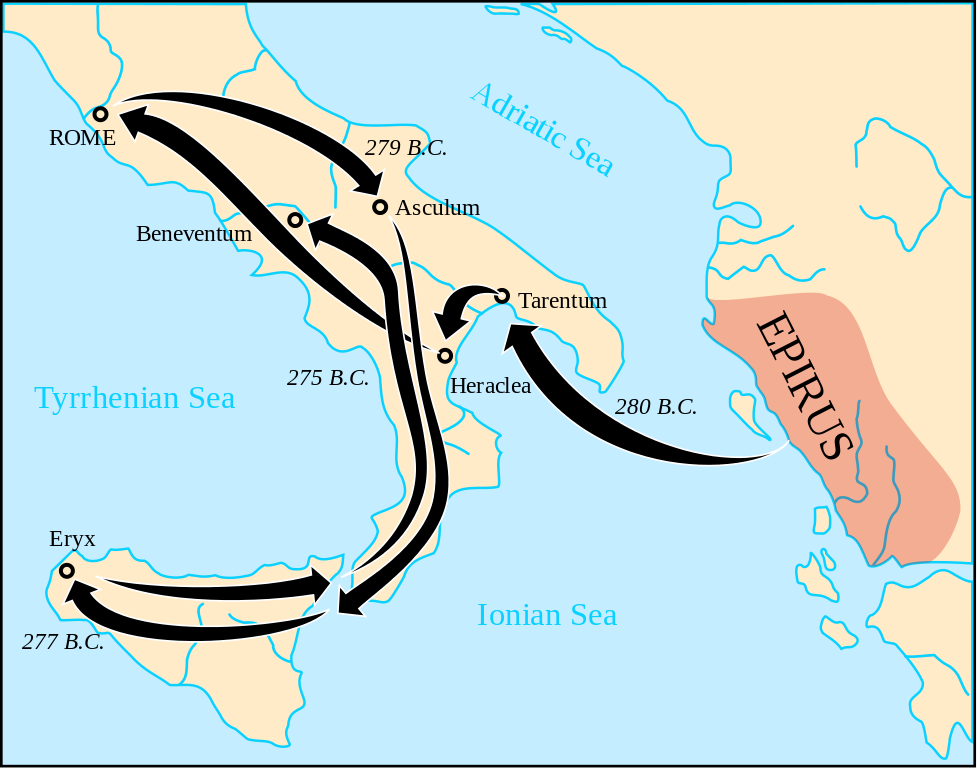
A fairly handy map of Pyrrhus’ campaigns (though some of the detail is lost in the big sweeping arrows). What is notable is, apart from Pyrrhus’ lightning raid into Latium in 280, he is almost invariably fighting in “friendly” territory, either in Lucania (Heraclea), Apulia (Asculum) or Samnium (Beneventum), the lands of his allies. Pyrrhus never fights an actual pitched battle on Roman-controlled territory, which I think speaks to his strategic intent: to carve out a kingdom in Greater Greece, not to conquer the whole of Italy.
Wikimedia Commons.

The battle was defined by Pyrrhus’ use of terrain – Pyrrhus thought delay might be wiser (to link up with his allies) but left a blocking force on the river (the Romans being on the other side). The Romans responded by forcing the river – typical Roman aggression – but Plutarch at least thinks it caught Pyrrhus by surprise (he hadn’t fought Romans before) and so it leaves him in a scramble. He charges his cavalry (Plut. Pyrrh. 16.5) to give his main phalanx time to form up for battle resulting in what seems like a cavalry engagement near the river. Pyrrhus nearly gets himself killed in the fighting, but survives and falls back to his main infantry force, which then met the Romans in an infantry clash. The infantry fighting was fierce according to Plutarch and Pyrrhus, still shaken from being almost killed, had to come out and rally his troops. In the end, the Romans are described as hemmed in by Pyrrhus’ infantry and elephants before some of his Greek cavalry – from Thessaly, the best horse-country in Greece – delivers the decisive blow, routing the Roman force.

It is, on the one hand, a good example of the Hellenistic army “kit” using almost all of its tactical elements: an initial – presumably light infantry – screen holding the river, followed by a cavalry screen to enable the phalanx to deploy, then a fierce and even infantry fight, finally decided by what seems to be flanking actions by cavalry and elephants. Plutarch (Pyrrh. 17.4) gives two sets of casualty figures, one from Dionysius and another from Hieronymus; the former says that the Romans lost 15,000 to Pyrrhus’ 13,000 killed, the latter that the Romans lost 7,000 to Pyrrhus’ just a bit less than 4,000 killed. The latter seems almost certainly more accurate. In either case, the Roman losses were heavier, but Pyrrhus’ losses were significant and as Plutarch notes, his losses were among his best troops.

Even in the best case, in victory, Pyrrhus had lost around 15% of his force (~4,000 out of 28,000), a heavy set of losses. Indeed, normally if an army loses 15% of its total number in a battle, we might well assume they lost. Roman losses, as noted, were heavier still, but as we’ve discussed, the Romans have strategic depth (in both geography, political will and military reserves) – Pyrrhus does not. By contrast, Alexander III reportedly wins at Issus (333) with just 150 dead (and another 4,802 wounded or missing; out of c. 37,000) and at Gaugamela (331) with roughly 1,500 losses (out of c. 47,000). The Romans will win at Cynoscephelae (197) with just 700 killed.

This isn’t, I think, a product of Pyrrhus failing at all, but rather a product of the attritional nature of Roman armies: even in defeat they draw blood. Even Hannibal’s great victory at Cannae (216) costs him 5,700 men, according to Polybius (more, according to Livy). But the problem for Pyrrhus is that his relatively fragile Hellenistic army isn’t built to repeatedly take those kinds of hits: Pyrrhus instead really needs big blow-out victories where he takes few losses and destroys or demoralizes his enemy. And the Roman military system does not offer such one-sided battles often.

Nevertheless, Pyrrhus shows that a Hellenistic army, capable handled, could beat a third-century Roman army, albeit not cleanly, and that is well worth noting.

Bret Devereaux, “Collections: Phalanx’s Twilight, Legion’s Triumph, Part IIIb: Pyrrhus”, A Collection of Unmitigated Pedantry, 2024-03-08.


    1. I should note, this is Kent’s assessment as well.

Powered by WordPress