
The Korean War by Indy Neidell
Published 1 Jul 2025Over a year has passed since North Korean forces crossed the 38th Parallel and invaded South Korea, and while the war has seen the advantage switch hands time and again, one thing it has not seen is any sort of cease fire or peace negotiations. However, that might change soon, as this week both the Chinese and the Americans indicate their willingness to sit down and talk. South Korean President Syngman Rhee, however, is against any cease fire talks that do not set out to meet a big variety of his demands, demands which which the other warring parties do not see as being in their own best interests.
(more…)
July 2, 2025
The Korean War Week 54 – The War is One Year Old – July 1, 1951
Comments Off on The Korean War Week 54 – The War is One Year Old – July 1, 1951
“In short order, Trudeau was describing his own country with the kind of apocalyptic rhetoric one typically associates with, say, the Holocaust, Holodomor, or Rwandan Genocide”
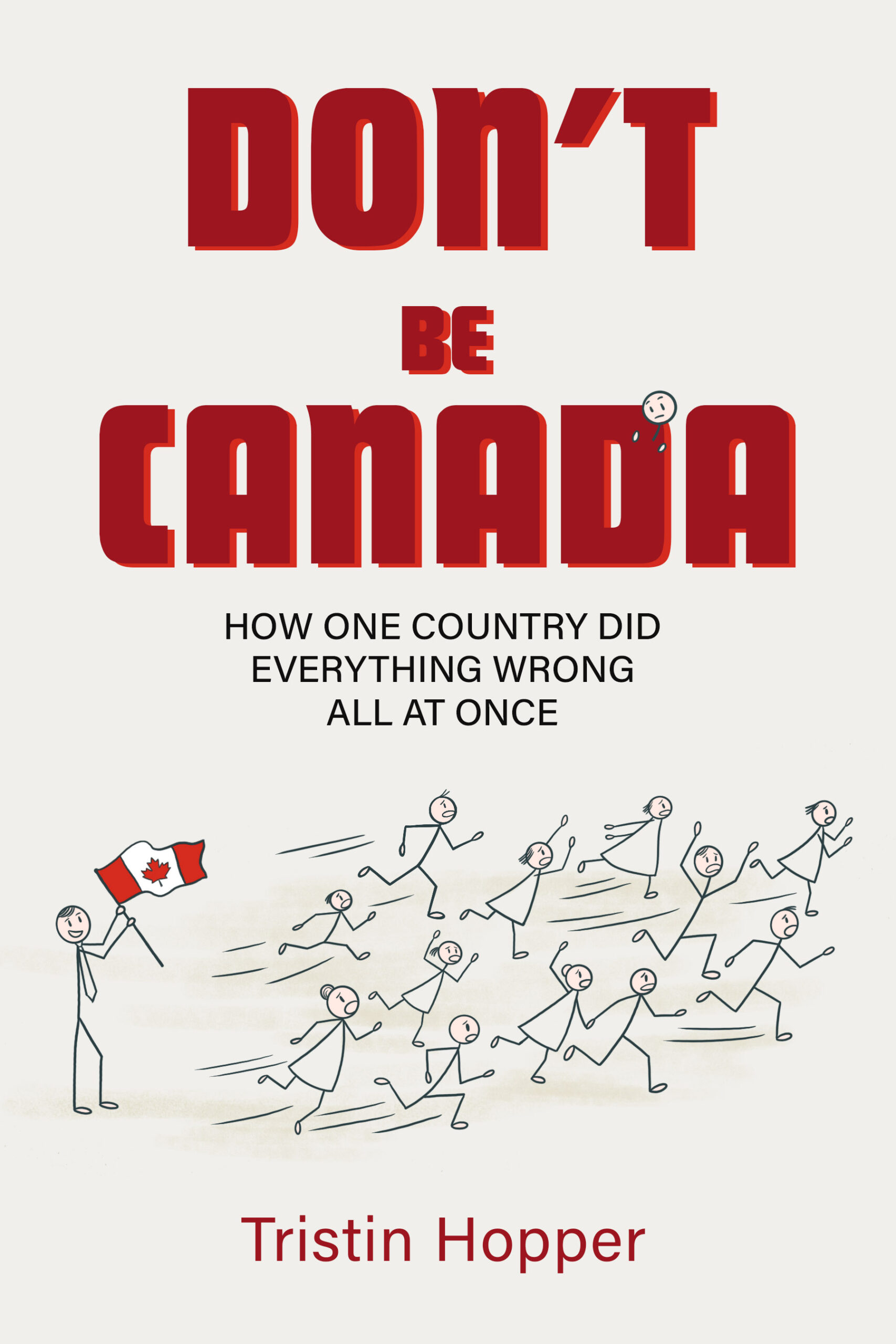
In Quillette, Tristin Hopper provides some excerpts from his book Don’t Be Canada: How One Country Did Everything Wrong All At Once, published earlier this year:

Prime Minister Justin Trudeau holding a teddy bear in the proximity of a soil disturbance in a field at the site of a former residential school in Cowessess First Nation, Saskatchewan.
July 6, 2021.
This is the story of how, in 2019, Canada became the first (and, to this day, only) country to declare itself guilty of committing an ongoing genocide against its own citizens.
To outsiders, who (correctly) view Canada as a humane democracy, the tale will seem bizarre. But to Canadians, there was a certain twisted political logic to it — at the time, at least.
In the late 2010s and early 2020s, back when my country was still ruled by Justin Trudeau, Canada’s progressive elites bought into then-ascendant social-justice manias with a born-again fervour that was arguably unmatched in any other nation. This was a time, readers will recall, when college students were busily confessing their internalised white supremacy and racist thought crimes to one another on social media. Seeking to ingratiate his Liberal Party with this young demographic, Trudeau extrapolated their cultish movement on a national scale.
His rhetorical style became increasingly manic, as one social-justice slogan led to another; with each being rapturously liked and retweeted on social media. In short order, Trudeau was describing his own country with the kind of apocalyptic rhetoric one typically associates with, say, the Holocaust, Holodomor, or Rwandan Genocide.
In this regard, Trudeau’s first truly epic act of national self-incrimination took place at a 2019 women’s conference in Vancouver. The PM had just been handed the final report of the National Inquiry into Missing and Murdered Indigenous Women and Girls (MMIWG), a probe he’d authorised as a means to investigate the high rates of homicide committed against Canada’s female Indigenous population.
As it turned out, however, the MMIWG report authors’ most prominent demand had nothing to do with the technical details of criminal investigation. Instead, they were focused on language: They wanted homicides targeting Indigenous women and girls to be described as an ongoing “race-based genocide” perpetrated by Canadian society at large.
Murder wasn’t the government’s only instrument of genocide, the authors claimed. Higher rates of Indigenous heart disease and suicide attempts were also described as foreseeable results of Canadian policies that are “explicitly genocidal”.
Canadians tend to feel guilty about the genuinely shameful way their country treated Indigenous peoples at many historical junctures (more on this below). Because of this high baseline guilt level, it is often seen as taboo (especially among journalists) to push back against even the most obviously counterfactual claims made on behalf of Indigenous peoples. And the MMIWG report was a case in point: the inquiry’s insistence that Canada was in the midst of an active genocide was reported uncritically by most media outlets.
Some public figures did speak out against this hyperbolic use of language — such as Roméo Dallaire, the retired general who’d been in Rwanda during that country’s (actual) genocide in 1994. Yet Canada’s most important public figure — Trudeau himself — accepted the inquiry’s conclusions without reservation; even if this meant that he was now signalling his status as leader of a nation that, day in, day out, under his own watch, was committing a genocide against its own population.
“Earlier this morning, the national inquiry formally presented their final report, in which they found that the tragic violence that Indigenous women and girls experienced amounts to genocide,” he told his Vancouver audience. Trudeau then paused for nine seconds to accommodate his desired reaction — which consisted of cheers and applause.
Comments Off on “In short order, Trudeau was describing his own country with the kind of apocalyptic rhetoric one typically associates with, say, the Holocaust, Holodomor, or Rwandan Genocide”
History of Britain IV: Caesar in Britain, Reconnaissance in Force, 55-54 BCE
Thersites the Historian
Published 29 Jan 2025Caesar’s landings in Britain illustrate his willingness to take risks, even unnecessary ones. The questionable decision-making, however, also led to the first surviving detailed description of people and events in Britain.
(more…)
Comments Off on History of Britain IV: Caesar in Britain, Reconnaissance in Force, 55-54 BCE
QotD: The bane of socialism — boredom
… even the Yankee Leviathan at the very height of its powers couldn’t have made Socialism work long term, for as the Bolshies discovered, there’s more to life than just shit, shoes, and bread. The old proverb says “A man with an empty belly has one problem; the man with a full belly has a thousand”, and like most old proverbs it’s 100% true. It’s no surprise our modern cat ladies — of both sexes and all however-many-we’re-up-to-now genders — don’t realize this, as you can overfeed a housecat into total somnolence, but anyone who has ever had so much as a dog knows what happens when all its immediate physical needs are satisfied: it grows bored.
Most “bad” dogs aren’t actually bad. They’re not misbehaving because they’re willful, or mean, or whatever. They’re just bored out of their fucking skulls, because the kind of bugman who gets a dog these days has no idea that you actually have to play with it, and pet it, and interact with it, in much the same way you have to interact with a young human. Given a dog’s limited intellect, the only thing it can think of to do to alleviate its boredom is chew on things, or dig in the yard, or piss on the rug, or, if all else fails, chew its own fur off.
Being slightly more complex critters, humans have more options, but bore a human enough — overfill his material needs, so that he’s stuffed to somnolence, but take his sense of purpose away — and you’ll see the exact same dog behaviors. Why do you think they shove all that metal shit in their faces? And no, I am absolutely not joking. Why all the huge, gaudy, gross tattoos? The constant changes of hair color and style?
Have you ever asked them?
Again, I’m 100% not joking. I know most of y’all avoid SJWs like the plague, and that’s a smart move, can’t blame you for it, but if you do, you’ll just have to trust me: I was in academia for a long time, so I was around not just SJWs, but bleeding-edge lunatic SJWs, and I asked them about it. One must be discreet about this, of course — hey, I’m thinking of getting a roll of toilet paper tattooed on my bicep, to remind me that We’re In This Together, what do you think? — but it’s fairly easy to do. And every time, they’d spin me some elaborate tale of how deep and meaningful it all is.
No, really. By some mental process I can’t begin to reproduce, getting Ruth Bader Ginsburg’s face tattooed on your calf is, to them, striking a blow at ambient civilization. That is the literal truth of their motivation. It’s the same reason the dog digs in the backyard, or pisses on the rug, or chews its own fur off: That’s the only agency it has, the only purpose it can find.
Severian, “Purpose”, Founding Questions, 2021-12-06.
Comments Off on QotD: The bane of socialism — boredom


