
Quotulatiousness

June 12, 2025

Why it’s economically impossible for Walmart to “eat the tariffs” as Trump demands

Filed under: Business, Economics, Government, Politics, USA — Tags: , — Nicholas @ 04:00

At FEE, Peter Jacobsen shows the clear financial reason why Walmart and other big US retailers are passing along the price increases due to Trump’s tariffs rather than “eating them”:
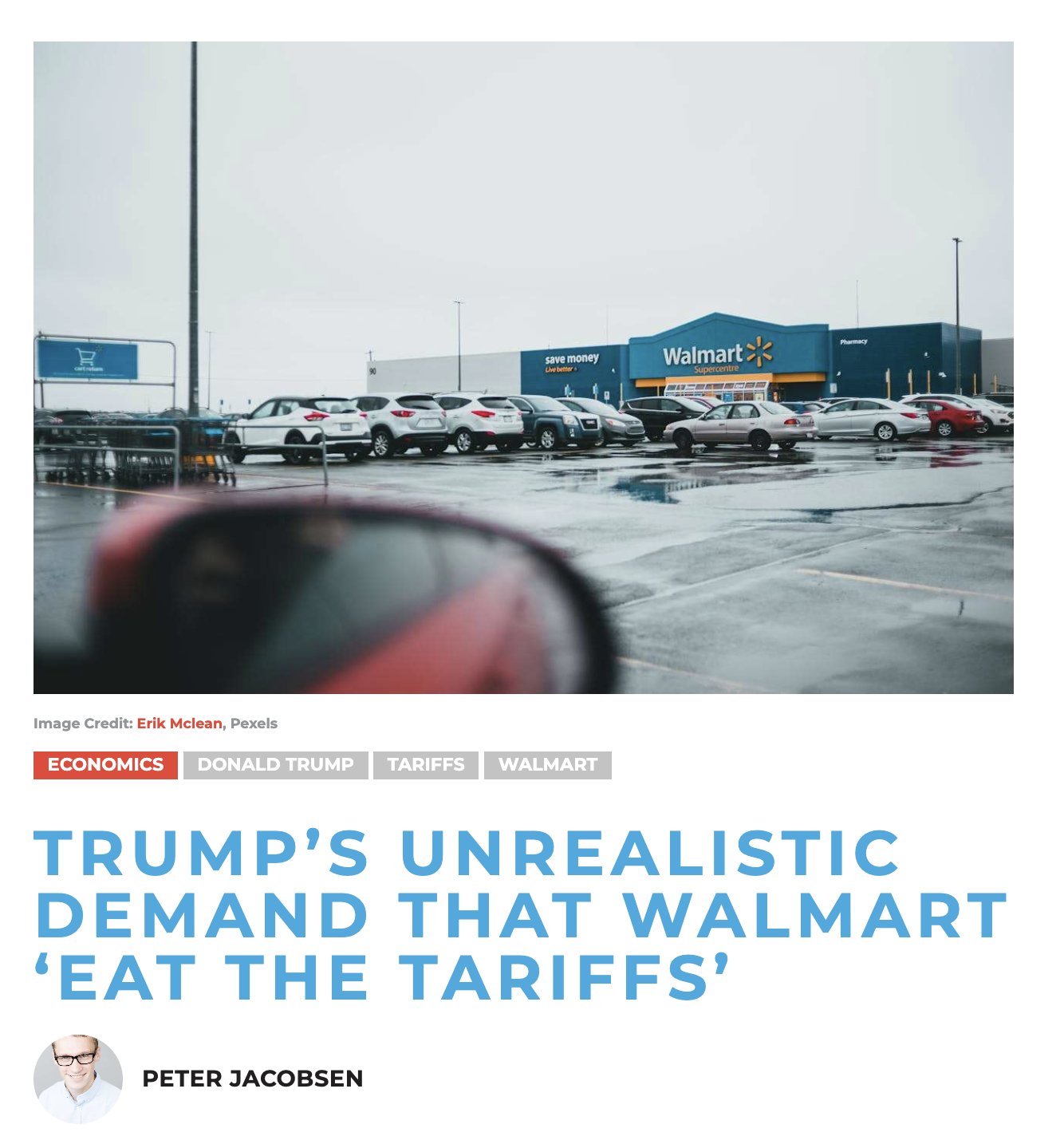
Recently, a post from President Trump on Truth Social went viral. An attempt to convince retail giant Walmart to keep prices down despite the tariffs, it read:

    Walmart should STOP trying to blame Tariffs as the reason for raising prices throughout the chain. Walmart made BILLIONS OF DOLLARS last year, far more than expected. Between Walmart and China they should, as is said, “EAT THE TARIFFS”, and not charge valued customers ANYTHING. I’ll be watching, and so will your customers!!!

Trump’s demand here is, simply put, unreasonable, and it reflects a basic misunderstanding of how pricing decisions are made in a market economy. Let’s unpack why.

Walmart’s Thin Margins

The biggest problem with the President’s view is that it doesn’t pass a basic numbers test. To break it down, let’s look at Walmart’s financials.

It’s true that Walmart generates billions of dollars in revenue each year, but revenue alone doesn’t tell us how much Walmart makes.

To understand that, we need to consider profit, which accounts for the company’s costs. More specifically, we want to look at Walmart’s net profit margin, because that’s an extremely important indicator of whether Walmart could realistically “eat the tariffs”.

Depending on the source, Walmart’s net profit margin is somewhere between 2% and 3%. Let’s split the difference and say it’s 2.5%. What does that mean?

That means, if Walmart sells you $1 of goods, it only keeps 2.5 cents in profit. That’s right, 97.5 cents goes toward inventory, employee wages, store maintenance, and a variety of other operating costs.

Put another way, if you spend $100 at Walmart, they make $2.50 in profit.

Now let’s say you buy a $100 television that Walmart imports. A $20 tariff is imposed — an added cost Walmart has to pay to import the TV. Before the tariff, Walmart was making $2.50 in profits. After the tariff, it’s now taking a $17.50 loss.

The only way Walmart can still sell this TV is by raising the price.

At this point, a tariff supporter might respond: “The easy way to fix this is to buy US-made TVs instead!”

Sure — you can avoid tariffs by only buying domestic, but the problem is that domestic TVs tend to be more expensive. If they weren’t, Walmart wouldn’t be importing them in the first place. So even if Walmart pulls international TVs off the shelves and replaces them with US-made ones, the prices still increase.

Here’s the key point: “eating” the tariffs is not an option. Walmart operates on slim margins, barely making pennies on the dollar — there isn’t room to eat 20% cost increases!


There definitely used to be a gender pay gap

Filed under: Britain, Business, Economics, Technology — Tags: , , , — Nicholas @ 03:00

I’m sure activists will keep slinging around the “women are paid 82 cents for every dollar men are paid” factoid, because it’s politically useful (if statistically untrue in the way most people interpret it). But it used to be true that women were systematically paid less for doing the same work as men:

Dame Stephanie Shirley, entrepreneur, IT pioneer, philanthropist, at her 80th birthday party in September 2013.
Photo by Lynn Hart via Wikimedia Commons.

At which point enter Dame Stevie:

    Dame Stephanie Shirley, 91, is a tech pioneer and philanthropist who came to Britain on the Kindertransport in 1939. She built a £3 billion business, Freelance Programmers (later renamed F International), and 70 of her staff became millionaires due to its shared ownership structure. Since retiring in 1993 she has donated more than £70 million to charity. She was made a dame in 2000 and became one of the prestigious few members of the Order of Companions of Honour in 2017.

Back when she was building F1 the sexism in industry was such that she called herself Stevie, not Stephanie. You know, deniably pretending to be male sorta thing. Also, given that background, something of a tough nut and certainly nobody’s fool. F1, among other things, did the programming on the Black Box for Concorde. Proper, serious, company.

The sexism in industry was such that there really was a gender pay gap. A general assumption — to the point of rigid rule — was that wimmins didn’t work after marriage and certainly not when they had children. So, Stevie went out and hired all those birds who had been programmers before parturition, set ’em up with a home terminal and paid ’em peanuts. Then went around winning vast contracts with her price advantage.

This worked. To the extent that Stevie is on record as saying the Equal Pay Act was the worst thing ever for her business (note, not societally wrong, but bad for her business).

Which actually gives us a nice test of something that bastard neoliberals like me insist upon. Or as Gary Becker pointed out. If it is true that wimmins is underpaid in our capitalist bastardry patriarchal society then it must also be true that it’s possible to deliberately and specifically hire women and so gain a price advantage.

Dame Stevie did this and did so very successfully. Which is a nice proof that the first part of the contention works. If women are underpaid then hire them and make a fortune. Cool!

The apparent fact that nobody else has done this is a strong indicator that there isn’t a significant gender wage gap these days.

Type 30 Arisaka

Filed under: History, Japan, Military — Tags: , , , — Nicholas @ 02:00

Forgotten Weapons
Published 22 Jun 2015

Most people are familiar with the Type 38 Arisaka, which was one of the two very distinctive Japanese rifles of World War II (along with the Type 99). The Type 38 was an outstanding rifle in large part because it was the result of several years of experience and development which began in 1897 with the Type 30 “Hook Safety” Arisaka. This first Japanese smallbore military rifle was designed by a committee (led by Col. Arisaka) from the best elements of other rifles being made at the time. It used a bolt which was significantly more complex than the elegant Type 38 bolt which would follow later.

QotD: Napoleon Bonaparte, arch-meritocrat

Filed under: Books, France, History, Military, Quotations — Tags: , , , , — Nicholas @ 01:00

John: … When did this change? I am tempted to blame it, like everything else, on the rise of meritocracy.

Jane: But Napoleon was a meritocrat, in the strictest and most literal sense. He made himself emperor through sheer excellence, and the men he elevated were the same. I mean, let’s look at his first set of marshals: Augereau is the son of a fruit-seller, Ney’s father was a cooper, Masséna’s father was a shopkeeper, and Bessières’ was a doctor (in an era when that was a lot less prestigious than it is today). Bernadotte starts out the son of a provincial prosecutor and ends up king of Sweden. Only Davout had an aristocratic background. Obviously this was sort of inevitable, because the previous elite had been literally decapitated and a new one had to come from somewhere. Maybe it’s just what happens when you have a particularly profound disruption: people end up in power because they’re better than anyone else at making war to get the power in the first place. Just like you can’t follow the lineage of any European aristocrat back farther than the Germanic conquerors of the early Middle Ages. (The Psmiths, as is well attested, trace descent from the Viking Psmiðr who came to Normandy with Rollo in the 8th century.) But I think it’s more than that. Napoleon set up all kinds of meritocratic institutions outside the military: he had his competitive examination lycées, he was constantly promoting the talented young auditeurs he ran across in the Conseil … (Can you tell I liked the civil administration chapters better than the battle chapters? #thetwogenders)

So what is the difference between Napoleonic meritocracy and our present sort? I think the real difference is that in his case there was someone doing the choosing. This is important for a couple of reasons: first, because it takes a certain amount of talent to recognize excellence. You can get away with being a Salieri, but you need to have something. I think we’ve all seen institutions whose HR departments were so packed with drones that they couldn’t have recognized a genius if one fell into their laps, let alone wanted to work for them. And it’s way, way harder to keep around an institution full of competent intelligent people with correctly aligned incentives than it is to just … be good at identifying talent, personally. Second, a person exercising judgment can take a way more holistic view than any standardized metric. This is what college admissions claims to be trying to do when they’re not just using it as an excuse to keep out Asians. But a well-functioning meritocracy — or an emperor picking his men — should be searching for excellence. Studying hard and doing well on a test not only fails to reliably indicate excellence, it actually encourages and cultivates habits of mind that undermine excellence.

But the biggest reason this is important, I think, brings us back to Napoleon again, and might be the key to what you described as the strange inconsistency between his loving concern for his men and his willingness to send them to a hideous death. Because I don’t actually think it’s an inconsistency at all! And it has to do with mission. What’s the deal with our current meritocratic system? “We want to have the smartest people in power”. Okay but why? “So they can be effective”. Effective at what?

No one ever had to ask Napoleon “effective at what”.

He was willing to throw himself, and his closest friends, and the meanest infantryman whose boots he nevertheless obsessed over, into some of the most hellish experiences yet devised by men1 in service of something greater. And you can be snide and say the something greater was “Napoleon”, and that’s sort of true, but to him and to France “Napoleon” had come to stand for law and knowledge and liberty and order and greatness itself. Napoleon’s meritocracy worked because it had a telos. Our meritocracy is the idiot fluting of a blind inhuman blob.

Jane and John Psmith, “JOINT REVIEW: Napoleon the Great, by Andrew Roberts”, Mr. and Mrs. Psmith’s Bookshelf, 2023-01-21.


    1. Another book recommendation! The Face of Battle.

Powered by WordPress


