Sir Humphrey on the appointment of Royal Marine General Sir Gwyn Jenkins as the top flag officer of the Royal Navy — the first RM general officer to hold this position:
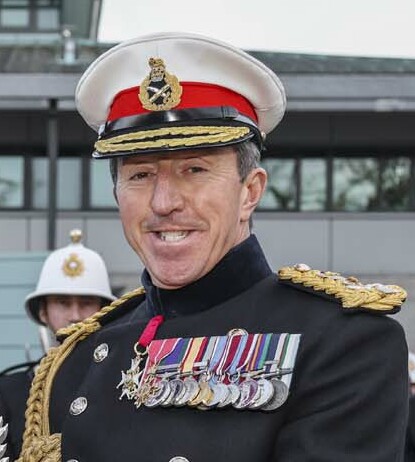
Vice Chief of the Defence Staff, General Sir Gwyn Jenkins in Lympstone, 2022.
Photo credit – LPhot Barry Swainsbury – https://www.royalnavy.mod.uk/-/media/royal-navy-responsive/images/news/new/221128-new-commandant-general-royal-marines-appointed/2.jpg, OGL 3, Link
General Sir Gwyn Jenkins has taken over as the professional head of the Royal Navy, the first Royal Marine to occupy the role of “First Sea Lord and Chief of the Naval Staff”. This is a move which is to be warmly welcomed, although the General will have many challenges ahead of him during his tenure.
While most have welcomed the move, there has been some mild hysteria on social media at the idea of a General heading the Royal Navy – what madness is this? The argument seems to be that apparently because Royal Marines haven’t commanded ships, they are somehow not able to lead the Royal Navy. Such an argument is fatuous nonsense.
The RN is a surprisingly tribal organisation of roughly 30,000 people, with its regular personnel broadly divided into four fighting arms – the Surface Fleet, the Submarine Service, the Fleet Air Arm and the Royal Marines. The surface fleet is the closest to being a “generalist” branch, although in its own way it is intensely tribal with different branches, organisations and structures. The Submariners and the FAA are unsurprisingly a bit of a closed shop, due to their missions, role and locations – it is not quite a “private navy”, but it would be rare for many personnel to serve at both Faslane supporting submarines and then to Culdrose or Yeovilton supporting aircraft. It is better to think of these fighting arms as smaller versions of the RN, each with its own culture, ethos and experience, and very different ways of bringing the fight to the enemy.
There have been First Sea Lords from the Surface Fleet, Submarine Service and FAA – no one has questioned the ability of an admiral who may have spent large parts of their career within a tribal part of the Service to lead all of it appropriately. Yet some seem to think that the General is somehow unable to do this due to his Royal Marines past. This makes very little sense – surely if this were true, how could any 1SL lead the Royal Marines effectively given they have, to the authors knowledge, never held a green beret?
The role of the 1st Sea Lord is not to stride the bridge in battle and fight wars against the enemy. He (and hopefully soon She) is the professional head of a complex organisation, employing tens of thousands of service personnel, reservists, civil servants and contractors on every continent. There are Royal Navy personnel based around the globe, from the Arctic to the Antarctic, and from the depths of the ocean to the skies far above. This role is about leadership, delivering the Government of the day’s desired defence policy outcomes, setting strategic direction for the Service and ensuring that it can deliver on its responsibilities.
The role of 1SL is part CEO, part diplomat, part public engagement and orator, and part politician. They need to be able to set a vision but accept their ability to deliver it is limited due to the time taken for naval procurement – while HMS VENTURER was rolled out of the yard today (27 May) some 10 years after the Type 31 was conceived, there have been no less than five permanent 1SL incumbents in this time. The post holder is also ultimately responsible for the delivery of operations, including the Deterrent, to the Prime Minister, and in providing advice to No10 on naval military matters.