
Quotulatiousness

May 20, 2025

Joe Biden’s cancer diagnosis

Filed under: Health, Media, Politics, USA — Tags: , , , — Nicholas @ 05:00

News broke the other day that former President Joe Biden is suffering from a highly advanced cancer and it only reinforces the questions about who was really performing the role of the President during Biden’s term in office:

Well, now it almost isn’t funny anymore.

Here’s the progression of the Democrats’ desperate attempts to shame you out of talking about Joe Biden’s mental and physical health:

“Stop talking about this because it’s not true.”
“Stop talking about this because he’s not the president anymore.”
“Stop talking about this because he has cancer.”

You may notice a pattern.

I think it was Andrew Klavan who made me realize the First Commandment of the Democratic Party: Thou shalt STFU. All their gaslighting, shaming, whataboutism, and other dishonest rhetorical techniques are attempts to stop you from talking about whichever lie they’re telling at that particular moment.

Why would they stop at cancer?

A lot of medical professionals are pointing out that a prostate cancer diagnosis doesn’t just come out of the blue like this. It’s easily detectable in blood work, it takes years and years to progress, and it should’ve been detected at his last annual physical.

Even Dr. Ezekiel Emanuel (an oncologist, Rahm’s older brother, and certainly no MAGA-head) says Biden must have learned of this diagnosis many years ago.

If Biden was undergoing cancer treatments during his presidency — remember all those unexplained trips to Delaware? — it would explain a lot of his behavior. “Chemo brain”. And of course he and Jill would keep it under wraps, because it would only strengthen a 25th Amendment challenge.

Who else knew about this, and when did they know it?

And who the hell was performing the duties of the president of the United States for four years?

Keep in mind that Joe Biden loves using his personal tragedies as a Get Out of Jail Free card. We heard it in that just-released Robert Hur audio from October 2023, when Biden deflected a question he didn’t want to answer about his handling of classified documents by complaining that his son Beau died. He couldn’t remember the exact year, but he used it as an excuse anyway.

If he’ll use his dead son, why wouldn’t he use a cancer diagnosis?

eugyppius also notes that such an advanced case can’t have just popped up recently, reinforcing the notion that his term in office was partially or completely a “regency”:

Yesterday evening, Joe Biden’s office announced that the former president had been diagnosed “with an aggressive form of prostate cancer that has spread to his bones“. Biden must have had this cancer for a long time for it to have spread that far, and thus it seems very strange that someone receiving presidential levels of medical care should have been diagnosed only just last week. Many in our circles posit that insiders have known about Biden’s illness for years, but that they have kept his diagnosis and treatment under wraps for political reasons. Among other things, they argue that this explains a July 2022 gaffe in which Biden complained that environmental pollution is “why I and so damn many other people I grew up with have cancer“.1

In fact, I think a simple cover-up is the most harmless possibility here. It’s likely that doctors have diagnosed Biden’s cancer so late because the former president was subject to a high degree of isolation and medical neglect while in office. Perhaps family and close advisers carefully managed Biden’s annual physicals to avoid any inconvenient findings as part of a broader campaign to hide his dementia. Alternatively, it’s possible that signs of cancer were discovered at some point, but that Biden’s inner circle avoided confirming the diagnosis or pursuing treatment. Either way, the late diagnosis and the advanced cancer together suggest that Biden has been left sick and untreated for a long time.

As I wrote last year, Biden’s presidency was an informal and unacknowledged regency. Biden himself did not have the mental capacity to rule on his own, and so a confined circle of close advisers and family effectively directed the actions of the presidential office on his behalf.

Importantly, this regency was not “the White House” or “Biden’s staff” or “the Democratic Party” in general. It was much smaller than all of those things. The regents worked hard to obscure Biden’s dementia from Congress, from large parts of Biden’s own campaign, from the Democratic Party and from many others within Biden’s White House. They ensured that even internal meetings unfolded in highly scripted and predetermined ways, so that cabinet and other officials could not gain a clear idea of Biden’s mental state. They berated and intimidated anyone voicing concern about the president’s health behind the scenes. And they had very simple reasons for doing all of this: If Biden’s dementia were to become common knowledge and not merely an object of private suspicion (however widespread), the regency would be shown up as illegitimate and potentially broken.

Regents exercise power by restricting access to their charge and restricting their charge’s access to information and the outside world. It is thus unsurprising to find that Biden’s regents subjected him to strict social isolation, particularly towards the end of his term …


    1. The White House clarified that Biden was referencing his earlier diagnoses for non-melanoma skin cancer.
The Death of Marat

Filed under: France, History, Politics — Tags: , , , , , — Nicholas @ 04:00

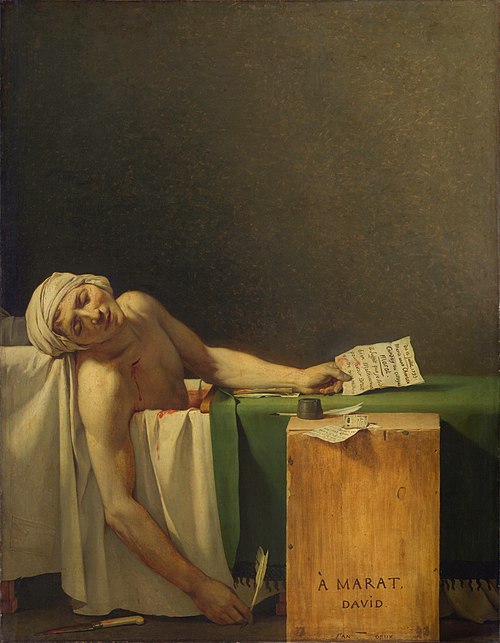
Daniel Jupp uses the famous Jacques-Louis David painting of the 1793 assassination of French revolutionary leader Jean-Paul Marat by Charlotte Corday to illuminate the twisted dealings of the various radical factions within the larger revolutionary movement:

La Mort de Marat (The Death of Marat) by Jacques-Louis David (1748-1825)
From the Royal Museums of Fine Arts of Belgium via Wikimedia Commons.

One of the most famous and celebrated works of art in European history is a painting about a political assassination. That painting is The Death of Marat (La Mort de Marat in French) by Jacques-Louis David. It was painted in 1793. David was already one of the most respected French artists of the 18th century, a leader of French Neoclassical art. He was also himself a political figure, a prominent member of the Montagnard faction (itself a subset of the Jacobins) and a member of the revolutionary Committee of General Security.

It’s an overtly political painting in every way, created by a man who was as much a French Revolutionary politician as he was an established and esteemed artist. It’s about a shocking political event, and it was crafted as an exercise in propaganda. […] The painting shows us Marat in his bath, immediately after being assassinated by Charlotte Corday on the July 13, 1793. It is a beautifully composed image of political martyrdom. Marat’s posture, for anyone with the slightest awareness of Western art traditions, immediately shows where the sympathies of the artist lie (and also, where the sympathies of the artist lie).

Marat’s pose is, of course, a deliberate mirroring of the pose of Christ in hundreds if not thousands of Western art traditional depictions of the Crucifixion. The pale, slim but muscular figure, marked by the assassin’s blade but in a manner that might be compared to the puncture wound inflicted by the Spear of Longinus or to the stigmata nail wounds of crucifixion on Christ himself, has that peculiar serenity in death that other artists place in depictions of Jesus. The blood is present as proof of supreme sacrifice, but artistically minimised, prevented from distracting from the clean, shining, almost marble-like flesh of the deceased, who is already a kind of heroic statue in repose, fixed for the admiration of the ages. The dead man has a gentle, compassionate smile on his lips, as if interrupted in the process of forgiving his murderer. The angle, the gentleness, the delicacy of it all suggests Christ-like self sacrifice, as if Marat has chosen his death knowingly, given his life willingly.

Here is the martyr of the Revolution. A new Christ, as good as the old one … if not better.

[…]

It’s at this point that we should mention the central dishonesties here. Christian self sacrifice and martyrdom is a very different thing to one politically radical extremist being murdered by another. Marat was, in reality, about as far away from this movingly gentle depiction of him as one could imagine. As one of the most radical and zealous figures of the Revolution, Marat was a lesson for the ages in the exact opposite way to the one that David depicts. He wasn’t a gentle figure of self sacrifice. He wasn’t a Lamb bringing Peace in the manner of Christ. He wasn’t an innocent. He was a brutal, grasping, rapacious sadist. He was one of the leaders of the storming of the Bastille, and that too has symbolic and practical importance – the terrible monarchical regime had hardly anyone in its most hated prison, whereas the Revolutionary “liberators” soon stuffed it full of their political enemies.

Even at a point where many murders were already being committed, Marat was noted as an unusually brutal proponent of Revolutionary excess. His assassin was from a rival, supplanted Jacobin faction, the Girondists. The Girondists too had supported the earliest uses of violence, riot and uprising within France, and were a “war party” who wanted to export the Revolution abroad and topple monarchical dynasties across Europe. These two factions did not really differ on whether you should murder your political enemies or not, but the Girondists were at times embarrassed by Montagnard violence when it was at its most indiscriminate. The Girondists tended to be the most intellectualised of the Revolutionaries. They were the writers of pamphlets and doctrines of great length and increasingly mind-numbing tediousness. Marat, although also a street-level gutter pamphleteer, was much more of a bloody handed man of action, more akin to a modern terrorist. But the two were aligned in the creation of the bloodshed, even if the Girondins wanted it to be more focused and controlled and ultimately directed outside France:

    Temperament largely accounts for the dividing line between the parties. The Girondins were doctrinaires and theorists rather than men of action. They initially encouraged armed petitions, but then were dismayed when this led to the émeute (riot) of 20 June 1792. Jean-Marie Roland was typical of their spirit, turning the Ministry of the Exterior into a publishing office for tracts on civic virtues while riotous mobs were burning the châteaux unchecked in the provinces.

The split between the two factions came to a head as a fall out from the September Massacres of 1792. Marat, a leader of the peasant sans-culottes mobs, was personally engaged in the orgy of bloodshed. Girondist leaders were alarmed, already sensing that previously aligned Revolutionaries or widespread mob violence could turn on them. Typically, the Girondists took defensive measures that were mainly concentrated on written statements, declarations or on bureaucratic ministries, whereas the Montagnards gradually took control of revolutionary militias and the people who were prepared to actually decide, at the point of a sword or via the barrel of a musket, who got killed and when. Neither side could be described as moderates, but one side were more ruthlessly pragmatic, which is why it was the Girondists who ended up being put on the execution lists of the Terror.

At the time that Corday assassinated Marat, Girondists had already been ousted from positions of power and arrested. Marat, along with Danton and Robespierre, was one of their three most prominent denouncers and enemies. Corday stated that she had “killed one man so that 100,000 could be saved”. It’s clear that she had hoped her action would save her arrested Girondin allies and personal friends, but it had the opposite effect and sealed their subsequent trial and executions.

Gen Z is blaming Capitalism for the sins of Cronyism

Filed under: Bureaucracy, Cancon, Economics, Media, Politics, USA — Tags: , , , , , — Nicholas @ 03:00

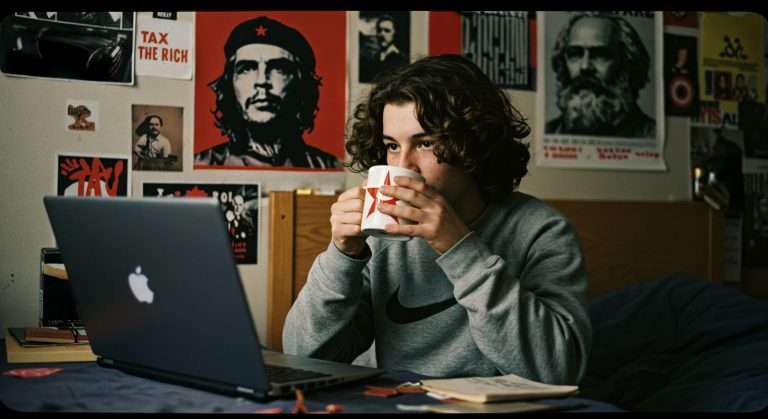
Lika Kobeshavidze at the Foundation for Economic Education explains why angry Gen Z’ers are blaming capitalism but should instead be blaming crony capitalism for the economic plight they find themselves in:

Image Credit: Custom image by FEE

Across college campuses, on TikTok feeds, and in everyday conversations, a familiar narrative is gaining steam: capitalism is broken.

Rising rents and stagnant wages fuel the claim among some young people that free markets have failed an entire generation. According to a 2024 poll by the Institute of Economic Affairs, more than 60% of young Britons now view socialism favorably. In the United States, the trend is similar, with Generation Z increasingly skeptical of capitalism’s promises.

But much of this idealism is rooted in distance — many of the young people romanticizing socialism have never lived through the economic dysfunction or political repression it often brings. For those who experienced Soviet shortages, Venezuelan collapse, or East Germany’s surveillance, the word socialism doesn’t suggest fairness or opportunity — it suggests fear, failure, and control. There’s a reason so many fled those systems to come to freer countries. What sounds utopian in theory has too often turned dystopian in practice.

But blaming capitalism misses the mark. The real culprit is cronyism, the unholy alliance between big government and big business that twists markets, blocks competition, and rewards political connections over genuine innovation.

[…]

Cronyism is not limited to one country or one political party. Across the United States and Europe, the symptoms are the same.

In the US, Canada, and the UK, the dream of homeownership slips further away for young people. Sky-high housing prices are blamed on “market failure”, but the real cause lies in layers of government-imposed barriers: restrictive zoning laws, burdensome permitting requirements, and endless bureaucratic delays. Big developers who can afford to navigate or influence the system survive. Everyone else gets locked out.

In Europe, the pattern repeats. France’s labor laws, designed to protect workers, instead stifle opportunity. Hiring becomes risky and expensive, especially for young people. Large corporations, with the resources to manage compliance costs, consolidate their dominance. Small firms and startups never get off the ground.

There’s also a persistent myth that big business fears government intervention. In reality, the largest corporations often embrace it, because it keeps them on top. Tech giants like Facebook and Google now lobby for more regulation, knowing that complex new rules will strangle smaller competitors who can’t afford fleets of compliance officers. Green energy subsidies, meant to combat climate change, often end up showering billions on well-connected firms while locking out emerging innovators.

Cronyism doesn’t reward the best ideas. It rewards the best lobbyists.

The Battle of Aquino

Filed under: Cancon, History, Italy, Military, WW2 — Tags: , , , — Nicholas @ 02:00

Canadian Tank Museum
Published 13 Jan 2025

You may know about AQUINO Tank Weekend at our Museum, but what was the Battle of Aquino? When did it take place? What happened to the Ontario Regiment RCAC during that action?

Enjoy this short documentary with our Curator Sam Richardson as he gives you a detailed look at the situation in May 1944 during the Italian campaign of the Second World War. Learn more about the soldiers that took part, the battle that took place and why it remains important to our Regiment and our Museum.
(more…)

QotD: The autohagiography of the NHS

The propaganda in favour of the NHS has been more or less continuous since its foundation in 1948, though it has become ever shriller, as propaganda tends to do, as it departs further and further from reality. Indeed, one might surmise that the purpose of propaganda in general is to forestall any proper examination of reality in favour of simplistic slogans convenient to political power.

I grew up, for example, in the inculcated belief that the National Health Service was, according to the slogan of the time, “the envy of the world”. Millions of people believed this, and indeed it was an assertion heard for many years whenever the subject of health care came up. The slogan was last wheeled out in any force in 2008 for the 60th anniversary of its founding.

Oddly enough, it never occurred to the people who repeated the slogan to examine the basis of the claim. Who, exactly, were the people doing the envying — not just one or two of them, but en masse? It is no doubt true that immigrants from very poor countries were pleased enough to receive care under the NHS, comparing it with what they would have received at home. But is it really much of an achievement for a developed country to have health care better than that offered in Somalia or Bangladesh?

A war of anecdotes, while always gratifying to the human mind, is not the way to decide important questions such as the superiority or inferiority of a system of health care.

It never occurred to those who repeated the “envy” slogan to look to comparable countries across the Channel or North Sea to see whether, in fact, those countries had anything to envy. In fact, between 1948 and 1975, even Spain under Franco performed better in the matter of improving the health of the population than did Britain. In most respects, in fact, Britain lagged or limped behind other countries, always in the rear and struggling to catch up.

What eventually struck me, then, was the willingness of so many people to repeat and believe a slogan without any compulsion whatever to do so, and without the slightest inclination to examine its truth — indeed without any awareness of the need for such an examination. There was no oppressive force to prevent or deter them from intellectual inquiry, but they preferred the comfort the slogan offered to the effort and possible discomfort of finding the truth. The NHS, or rather the idea of the NHS, played the role of teddy bear to a population with many anxieties.

True enough, many individuals may have experienced deficiencies in the service — long waiting times, offhand or disagreeable interactions with the bureaucracy, etc. But like Russian peasants of old who believed that the Tsar knew nothing of the oppression which they suffered, and would have put an end to it if he had known, the British continued to believe that the National Health Service had been born with original virtue and that the defects they experienced were exceptions. Repeated scandals of gross neglect or sub-standard treatment were shrugged off in the same way. And in a certain dog-in-the-manger way, the British were inclined to believe that if the NHS was unpleasant to negotiate, at least (being more or less a monopoly) it was equally unpleasant for everyone. Fairness and justice were equated with equal misery. Anyway, being ill is always unpleasant, so what did anyone expect?

Theodore Dalrymple, “Worshipping the NHS”, New English Review, 2020-05-07.

Powered by WordPress



