
[Jane:] So what do you think? Why don’t more people [have kids]? Why are we so weird?
John: I am a simple man, and prefer simple (preferably materialist) explanations. It’s effective birth control, duh.
Oh, I’m sure all the stuff [Family Unfriendly author Timothy P.] Carney talks about in his book plays some role. All the economic factors and the regulatory factors and the changed social expectations and the lack of sidewalks, and the blah blah blah. But why did those things all happen, all of a sudden? It’s actually very simple — now you can have sex without children necessarily resulting.
The correct way to view all the changes that Carney lists is as a sort of transmission belt that has slowly and inexorably propagated and magnified the effects of the one, very simple technological change that occurred. The story goes something like this: birth control is introduced, but large families are still normative and supported by generations of cultural accretion. So people still have an above-replacement number of kids, because they remember their mothers and grandmothers having 10 or 12 kids, and because society is still basically set up for families. But time passes, and culture gradually shifts to accommodate material reality. Law and economics follow culture. The next generation remembers their parents having 3 or 4, and maybe manages 1 or 2 themselves. The fewer people are having lots of kids, the less of a constituency there is for having lots of kids, and the harder society makes it, further turning the screws on marginal parents.
One objection from those who disdain the simple, materialist explanation is that the change didn’t happen overnight. The transmission belt theory nicely addresses this — it doesn’t happen overnight because societies have culture, and culture has inertia. Even insanely messed-up cultures that are inimical to human flourishing are hard to change. A residual, pro-childrearing cultural hangover can last for a while after the facts on the ground shift, and means people keep having babies for a little while. But it can’t last forever. Eventually it crumbles.
The other big objection to this theory, one Carney raises himself, is that if you do surveys of people, especially women, they report having fewer children than they want. So, the argument goes, it can’t just be birth control, because if it were people would have all the kids they want. But the answer to this is so obvious I’m shocked it isn’t apparent to Carney. People have high time-preference. People procrastinate. People are really bad at doing things which are hard in the short-term but make you happy in the long-term. The great thing about unprotected sex is that it connects your short-term and long-term happiness. As soon as you have the option to not have a baby right now, this time, it’s awfully tempting to say: “you know, I totally want all the diapers and spit-up eventually, but not this time, maybe next time”. In other words, people only reach the actual number of children they want via happy accidents or, in the old days, by having all thoughts of long-term consequences banished by good old-fashioned lust. This is literally why evolution made sex fun. The position of having to make an affirmative decision to have a baby is completely unnatural, and sometimes I’m amazed that anybody does it at all.
So you wind up with people like the friend I mentioned at the end of this book review (who, by the way, a year and a half later is still no closer to having a baby). Desperately wanting a child, sort of, but too neurotic or hesitant or conflicted or something to do it. In the old days, it would have been simpler, because they wouldn’t have had a choice. Biology would have made the decision for them, and a few years later they’d be happily bouncing a baby on their knee (or miserably bouncing a baby, whatever, the point is they’d have a baby). I really think that’s all there is to it. What truly blows my mind is that Carney wrote an entire book about this stuff while barely mentioning birth control (and only discussing its second-order cultural effects when he did). Presumably he had orders from his Jesuit masters to avoid the topic lest his cover be blown.
Jane and John Psmith, “JOINT REVIEW: Family Unfriendly, by Timothy P. Carney”, Mr. and Mrs. Psmith’s Bookshelf, 2024-10-14.
April 23, 2025
QotD: Why most westerners aren’t having kids
Germany’s extremely extreme extreme right AfD now the most popular party
Friedrich Merz, the leader of the “main” right-wing party in the Bundesrat seems to have a problem with math, as he keeps promising to cut the AfD support in half, yet ends up doubling it:
Many years ago – in 2018, to be precise – a man named Friedrich Merz was in the running to succeed Merkel as chairman of the CDU.
Merz said many interesting things back then. On 14 November 2018, for example, he gave an interview to BILD, in which he denounced Alternative für Deutschland as a party “that does not distance itself from the right” and said that “this makes them unsuitable for any coalition”. Merz pledged to win back all the CDU voters who had defected to the AfD over the years. “In the short term,” he said, “it will probably be impossible to get rid of the AfD,” but if he were chosen to succeed Merkel, he pledged that he could “cut their support in half“.
The very next day he tweeted the exact same thing – promising to lead the CDU back to 40% in the polls and to “halve the AfD“.
At a regional CDU conference around this time, Merz yet again promised to “cut the AfD in half,” adding that “this really is possible”. If I looked harder, I could probably find even more examples of Merz repeating this exact same promise. He made it such a core component of his campaign for the party chairmanship that the Frankfurter Allgemeine Zeitung observed in retrospect: “The whole idea of Merz as party chairman was based on the notion that he would win back votes that Angela Merkel had lost“.
[…]
The latest Forsa poll (conducted for RTL and ntv) has Alternative für Deutschland at a cool 26%. That is their best result in history, and it makes them the strongest party in the Federal Republic. This is the second such poll that places AfD in first place, following an Ipsos survey from 9 April that pegged them at 25%.
Merz has indeed done something to AfD support involving the operand of 2. It’s just not exactly what he imagined.
Now all of that rhetoric we one once heard from the cartel parties – about the importance of dealing with the AfD on the issues and of making convincing appeals to the “democratically inclined” among AfD voters – have become yesteryear’s pablum. They are going to try to ban the AfD now. Because they can’t beat them in any other way, and because they believe Germans shouldn’t be allowed to cast their votes beyond the narrow confines of the political cartel that runs the Federal Republic, they’re going to try to remove the AfD from the board via legal trickery.

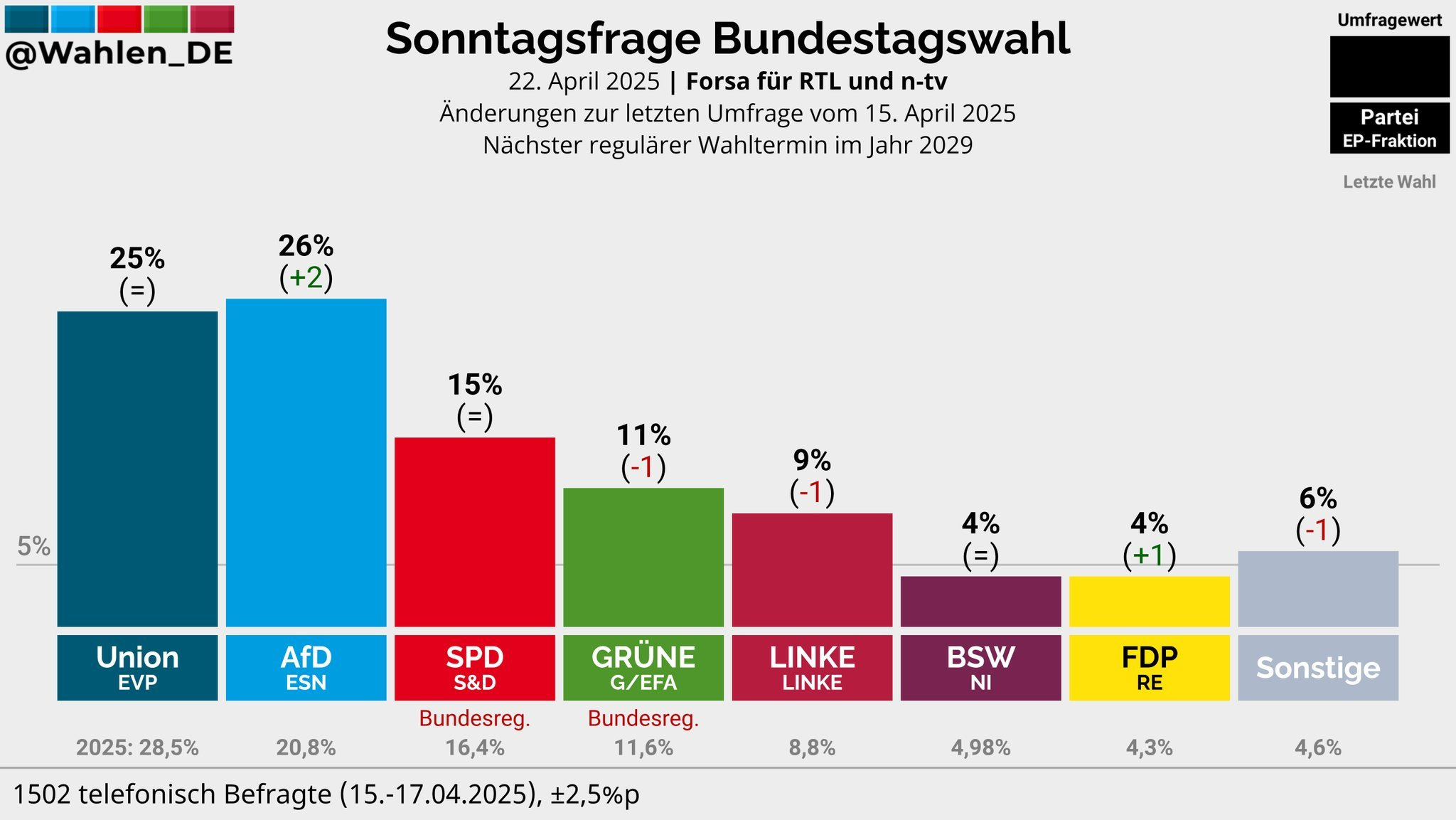
Of course, if the AfD is now the most popular party in Germany, it must be suppressed ASAP, and the individual members of the party must be punished “to save democracy”:

In Germany, owning guns is a privilege that can be taken away — not for breaking the law, but for holding the wrong political opinion.
Members and supporters of the right-leaning Alternative für Deutschland (AfD) party are now facing mass gun license revocations. The reason? The German government has labeled the AfD a “right-wing extremist” group — a political designation that suddenly makes its members “unreliable” under the country’s gun laws. And just like that, firearms must be surrendered or destroyed.
If that sounds outrageous, it should. But it’s not surprising.
[…]
In 2021, Germany’s domestic intelligence agency, the Bundesamt für Verfassungsschutz (BfV), designated the entire AfD as a “suspected threat to democracy”. That move allowed the government to surveil, wiretap, and investigate the party and its members.
It didn’t stop there.
Courts have now upheld revoking gun licenses from AfD members, based solely on their political affiliation. In one case, a couple in North Rhine-Westphalia lost legal ownership of over 200 firearms. They weren’t criminals. They weren’t accused of wrongdoing. They were just AfD members.
Another court in Thuringia blocked a blanket gun ban for all AfD members — but left the door wide open for revocations on a case-by-case basis.
In Saxony-Anhalt, officials are reviewing the gun licenses of 109 AfD members. As of last fall, 72 had already been targeted for revocation, with the rest under active review. The justification? Supporting a party the state now claims is “working against the constitutional order”.
And the courts are backing it up. According to a March 2024 ruling, former or current AfD supporters “lack the reliability” required to legally own firearms.
The Korean War Week 44 – Mac’s Lies Boil Truman’s Blood – April 22, 1951
The Korean War by Indy Neidell
Published 22 Apr 2025The stage is set for the Chinese Communist Forces’ next big offensive in Korea, but that is not where American eyes are fixed this week. Instead, focus swings to Washington D.C. where the recently-fired Douglas MacArthur arrives and proceeds to address crowds and Congress alike. It soon becomes clear that he will not go gentle into that good night.
Chapters
00:00 Intro
00:58 Recap
01:46 Soviet Intervention?
04:22 Operation Rugged
07:01 Task Force 77
09:36 South Korean Porters
11:02 MacArthur and McClellan
13:55 Summary
14:13 Conclusion
(more…)
“Liberals have never met a crisis they didn’t think they could spend their way out of”
Jesse Kline refutes Mark Carney’s recent diss against libertarians:

The Liberal Boomer in his natural state (spotted on social media, 20 April, 2025).
“The capacity of the federal government to invest in the economy, to support businesses and individuals, will ensure that we bounce back strongly.”
That was Prime Minister Justin Trudeau announcing an $82-billion support package at the beginning of the COVID-19 pandemic, but it could just as easily have been Carney, who said over the weekend that, “In a crisis … government needs to step up.”
At a Saturday news conference, the Liberal leader unveiled his party’s election platform, which includes $130 billion in new spending over four years to fend off the threats posed by U.S. President Donald Trump.
“It’s said there are no atheists in foxholes, there should be no libertarians in a crisis,” Carney argued to justify the continued spending spree.
This offends me as both a libertarian and an atheist. In fact, Canada would be in much better shape today if there were a few libertarians in the room when the Liberals were dealing with the numerous emergencies they’ve faced over the past decade.
The problem with crises is that there’s no way to predict when the next one will hit. But a prudent government should expect the unexpected and leave some fiscal room in the budget to address unforeseen events, while working to fortify the economy during good times so it can withstand the bad. This is not what the Liberals have done.
They took a $1.9-billion surplus in the 2014-15 fiscal year and turned it into a $25-billion deficit in 2016-17.
[…]
And so, we got more Big Government programs that we could ill afford, while Trudeau turned away world leaders looking to Canada to help solve an energy crisis resulting from Russia’s invasion of Ukraine.
Now, as Carney prepares to launch another massive spending spree to deal with the effects of U.S. tariffs, he’s pledging hundreds of millions of dollars for unnecessary programs, including permanent funding for the Sexual and Reproductive Health Fund to make it easier to abort babies, and $400 million for IVF treatments to create new ones in a test tube.
Needless to say that if there were some libertarians around the cabinet table during the crises of the past 10 years, we likely wouldn’t be facing a major economic upheaval with a $40-billion budget deficit, which Carney wants to increase to $62 billion, and a national debt approaching $1.26 trillion.
Spending always appeals to the voters at election time, and the Liberals have been past masters of using that to get into power. But even though there may be a lot of ruin in a nation, even the biggest of nations eventually runs out of money. According to a report from Policy Horizons Canada, an in-house government think tank, we’re well on the way to reaching that ruin and nobody will like what that looks like:
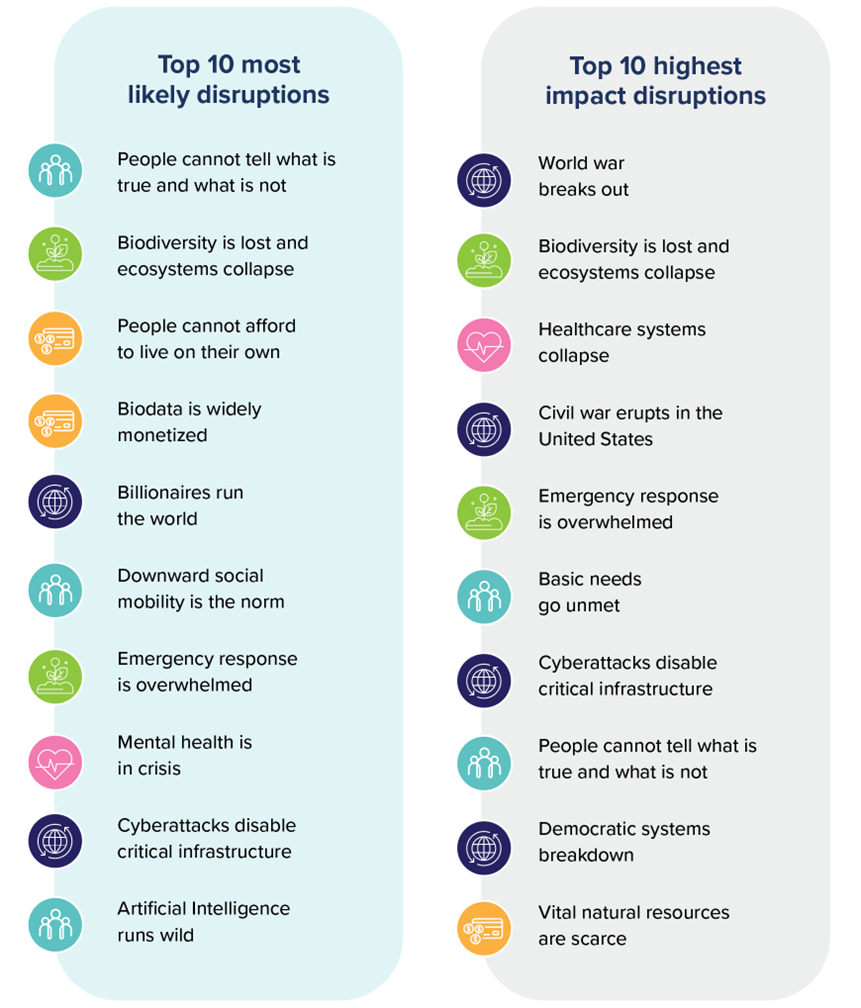
The report warns that by 2040, housing affordability is essentially limited to the wealthy or those with family help; most new homeowners get help from family, some depend on intergenerational mortgages and have several generations of family living together, and others enter “alternative” household mortgages with friends, with a growing percentage of homeowners also owning rental properties.
“Inequality between those who rent and those who own has become a key driver of social, economic, and political conflict,” reads the report.
Moreover, the report highlights a growing dependence on intergenerational wealth, noting that by 2040, inheritance is widely seen as the only reliable path to prosperity. “Society increasingly resembles an aristocracy,” it states, as family background — particularly property ownership — becomes the defining factor in determining one’s opportunities.
Canadians in this future rarely mix with others of different socio-economic status, and there is a clear disconnect between the aspirations of the country’s youth and economic realities, which leaves most with limited expectations of success.
And finally, the rapid propagation of artificial intelligence has dramatically reshaped the labour market. By 2040, the rise of artificial intelligence will have significantly diminished the availability of jobs in creative and knowledge-based professions, once seen as stable paths to upward mobility.
[…]
As a result of the six factors, Canada’s economy could shrink or become less predictable, with the consumer economy shrinking in size, and a higher proportion of very wealthy, older people holding the capital capacity for investment in new businesses. Labour unions could also grow in power and size from a frustrated population. The mental health of Canadians could suffer from living cost challenges.
With these upward mobility issues, Canada may become a less attractive destination for immigrants, and there could be an exodus of young workers, which would exacerbate the issues with supporting the public and social services that support the country’s growing cohort of seniors. This could also result in a labour shortage in industries where artificial intelligence is most difficult.
Perhaps most dystopian is a partial reversion of Canadian society to a trade-and-barter and neo-hunter-gatherer society by 2040, in response to declining trust in formal systems and reduced access to traditional economic opportunities.
[…]
The report’s vision of a future Canada — where trust in institutions collapses, effort no longer yields reward, and people yearn for systemic change — carries echoes of that dangerous historical crossroads, where ideological extremes once flourished in the face of prolonged despair.
With all that said, how likely is this precarious scenario of Canadian society in just 15 years from 2025?
According to Policy Horizons Canada, its “research suggests that it is plausible and would create challenges across a range of policy areas.”
This Way Toward Enemy – How The Bomb Didn’t Quite Go Boom
HardThrasher
Published 17 Feb 2023I can do nothing about the way I say Nuclear. If that upsets you please don’t bother commenting
A brief history of the many ways that nuclear weapons nearly killed us all
(more…)


