
Quotulatiousness

July 7, 2024

More on the British general election results

Filed under: Britain, Media, Politics — Tags: , , , , , — Nicholas @ 05:00

At Postcards from Barsoom, John Carter has some further thoughts on the Sunak implosion on the 4th of July:
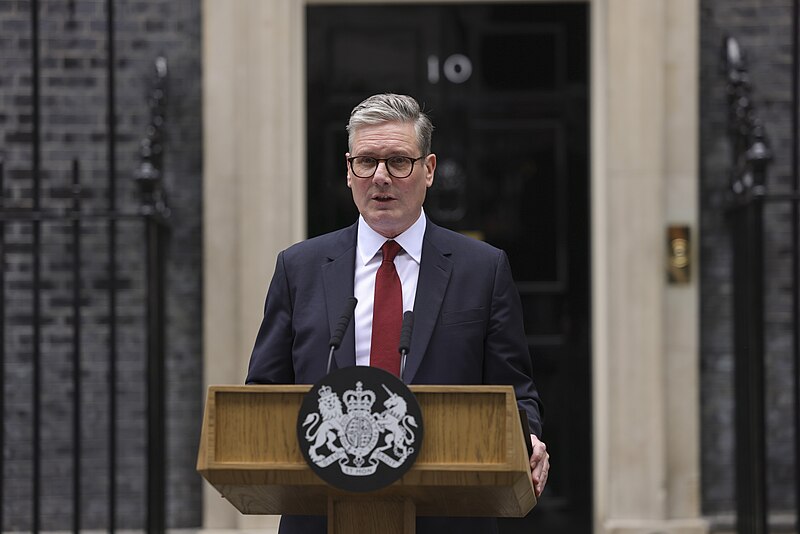
Sir Keir Starmer speaking to the media outside Number 10 Downing Street, 5 July, 2024.
Picture by Kirsty O’Connor/ No 10 Downing Street via Wikimedia Commons.

The Conservative wipeout was disappointingly not the annihilation that early polls predicted. The Tories were successful in scaring a critical mass of boomers in a last minute get-out-the-vote effort. At the same time, I suspect that some incidents late in the election that were used to paint Reform as raving Nazis were successful in driving down the Reform vote. One such incident involved a marginal Reform candidate caught on microphone being extraordinarily vulgar, who later turned out to be an actor that specialized in playing precisely the sort of character he was portraying for the media, which is of course all rather suspicious.

As a result, Reform only got 4 seats. This was less than the 13 that were predicted by the BBC based on exit polling, which prediction was revised to the 4 that Reform in fact won partway through counting, as the models’ Bayesian priors were updated accordingly, no doubt. That said, among those 4 seats is Nigel Farage, who is now a sitting member of Parliament.

That Parliament is now, in all likelihood, in the hands of the weakest massive majority government in its history, and if that’s not true (British history in its entirety being rather extensive), certainly close to it.

Keir Starmer’s Labour has 412 seats of Parliament’s total 650, giving it an unassailable majority. This is not because of a sudden surge in their popularity: their share of the popular vote didn’t budge, from around a third of the population. Turnout was moreover unenthusiastic, about 59% of the population I think, which while not as wince-inducing as the nearly 50% participation that the BBC was claiming throughout most of the counting period, is still nothing to write home about. The total number of people who voted for Labour decreased by 600,000. Labour cannot claim any sort of popular mandate, and they know it.

Not that Labour — or any western political party elected under these circumstances — could be expected to take it into consideration. From their point of view, all that matters is the seats in the House of Commons, and they’ve got them in spades.

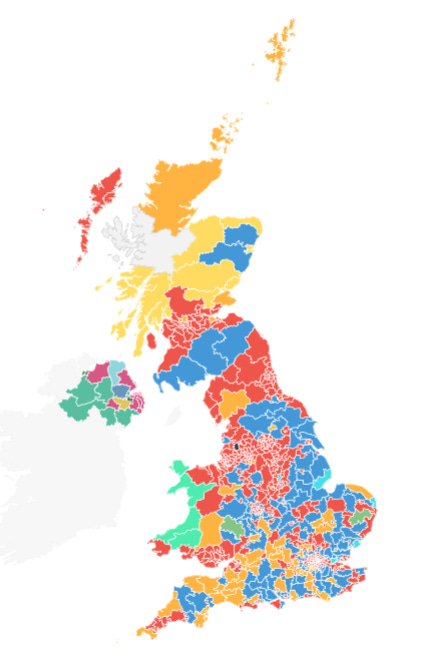
Reform and the Lib Dems were not the only beneficiaries of the Conservative collapse. This can be seen immediately in the crazy quilt of the electoral map, which despite Labour’s two-thirds majority, is planted with the flags of all sorts of weird political tribes.

My favourite part is Northern Ireland, where Sinn Fein held its 7 seats (making it the fifth-largest party after the SNP), and the rest of it is split up in an impenetrable jumble of splinter parties vaguely associated with different reasons for remaining part of the UK and/or the EU. Wales has been painted bright green by Plaid Cymru, the Party of Wales, who doubled their presence in parliament to 4. This is the same number of seats as Reform got, despite Plaid Cymru having gotten just under 200,000 votes, as compared to Reform’s 4.1 million, yet another perversity of first-past-the-post.

To everyone’s disappointment, first-past-the-post did not deliver a seat into the hands of the Monster Raving Loony Party, who received only 5,814 votes, a dismal 0.02% of the total 28.4 million votes cast. I do not know what kind of person votes for the Monster Raving Loony Party, but I bet they are absolutely fascinating. They should consider moving to one of Britain’s remote underpopulated islands, the Orkneys perhaps, where they might just be able to take over a seat. Having a strong, concentrated regional presence seems to be the best way to get members into Parliament in a first-past-the-post system, and having a sitting member for the Monster Raving Loonies would be even funnier than having Nigel in there.

First-past-the-post gets a lot of hate, and I’ve been ripping on it here, but it actually seems well-suited to an island which is shared by a bunch of squabbling ancient tribes. While it tends to produce majorities quite easily due to the winner-take-all nature of the contest within each riding, this also allows areas with strong regional identities to assert a disproportionate presence in parliament, despite getting a measly percentage of the vote. Not that that especially matters, given the aforementioned tendency for the system to hand out crushing jackpot majorities to the dominant players, as it has indeed done once again.

With the sole exception of Reform, there has not been any wave of enthusiasm for any of the parties in parliament. Large numbers of voters simply stayed home, whether tuning it all out or punishing their home parties while failing to see anything they wanted to vote for. It is as though the tide has gone out, exposing the sand and rocks of the sea shore. Whether this is a regular tide, which will gently slosh back in again in time, or a tsunami, remains to be seen. Certainly it feels that the water has receded very far indeed, exposing more of the seafloor’s surface than one normally sees. Say, is that Doggerland over there?
Aussies Land on Borneo – WW2 – Week 306 – July 6, 1945

Filed under: Australia, History, Japan, Military, Pacific, USA, WW2 — Tags: , , , , , — Nicholas @ 04:00

World War Two
Published 6 Jul 2024

Australian forces land at Balikpapan to hopefully secure the oil facilities there; In Burma, the Japanese try a diversion to allow some troops to escape the country, but the timing is not what it should be; in the Philippines there is an American landing on Mindanao, but behind the scenes there are those wondering if they really need to push Japan for complete unconditional surrender.

00:00 Intro
00:31 Recap
00:55 Landings On Balikpapan
03:23 A Diversion In Burma
06:10 Luzon And Mindanao
07:39 Unconditional Surrender?
11:18 Polls And Polling Numbers
15:25 Notes
15:48 Conclusion
16:56 Us Army’s 11th Airborne Division Memorial
(more…)

Ontario’s LCBO strike may be both justified and counterproductive

Filed under: Business, Cancon, Government, Wine — Tags: , , , , , — Nicholas @ 03:00

Ontario’s main importer and distributor of wine, beer, and spirits is now facing its very first actual strike, as the negotiators couldn’t come to an agreement by the strike deadline on Friday morning. On the face of the dispute, the union certainly has some solid grounds for the strike, as pay hasn’t been keeping pace with (official) inflation and far too many of the LCBO’s workforce are on work schedules that keep them from earning full-time wages. On the other hand, over the last decade or so, both Liberal and Progressive Conservative provincial governments have been making piecemeal changes to the market so that the LCBO is far from the only place Ontario drinkers can purchase their preferred booze. Just off the top of my head, here are some of the alternative options now available to Ontario consumers:

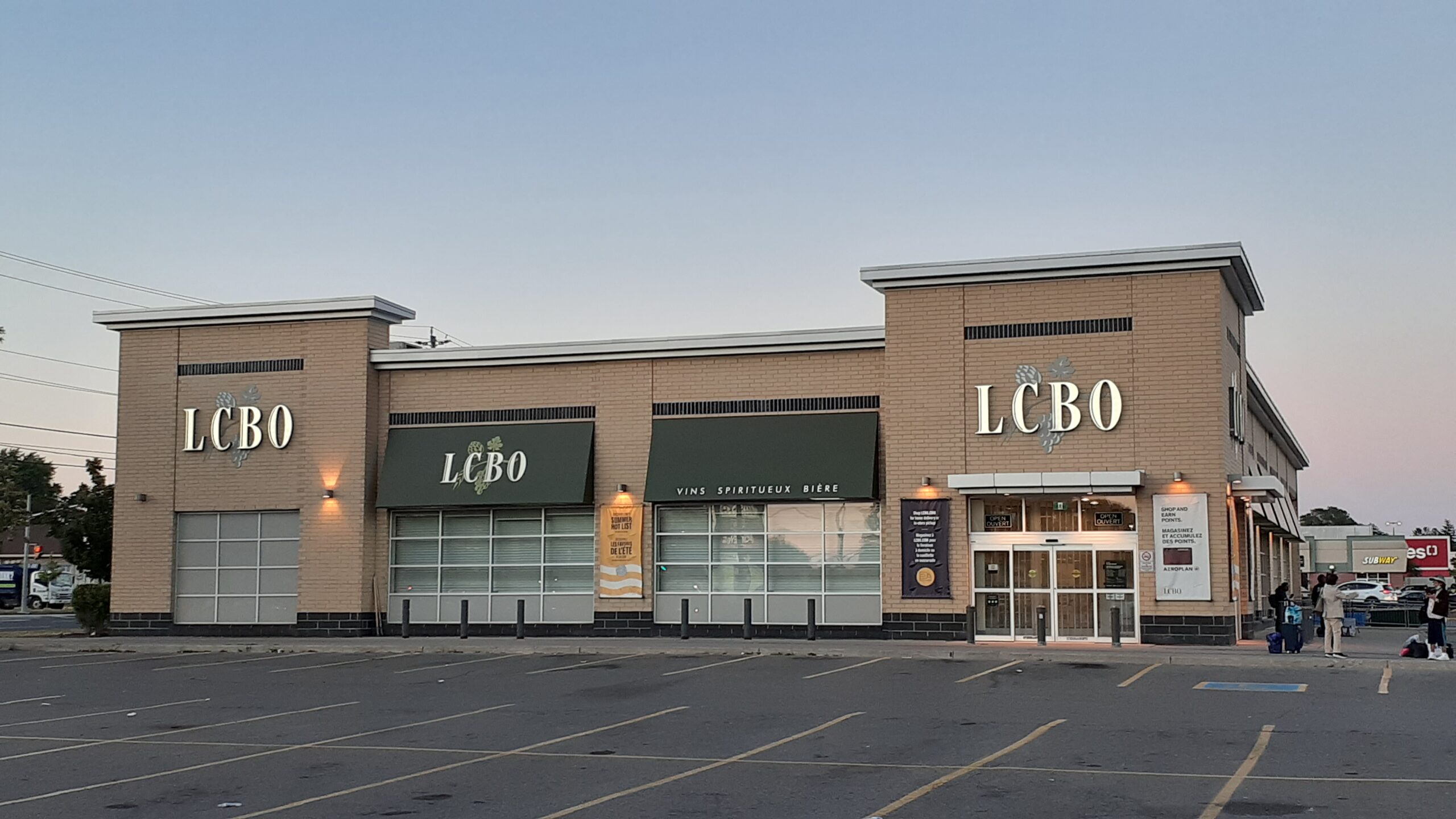
“LCBO at Parkway Mall” by Xander Wu is licensed under CC BY-SA 4.0 .

  • The Beer Store, Ontario’s other (foreign-owned) booze oligopoly for beer and cider is still operating normally at all their retail locations and agency stores. They also have online ordering for delivery available to ordinary consumers.
  • The LCBO is still offering online sales — not same-day, but free delivery.
  • Ontario’s vast array of craft brewers are still able to sell individual cans or bottles of beer from their bottle shops or storefront locations (pre-packaged 6-, 12-, 24-container or other types are still limited to the Beer Store oligopoly, of course).
  • Ontario’s wineries are similarly still operating normally for retail sales at the winery or (for a few older wineries who still have grandfathered privileges from earlier licensing regimes) stand-alone retail stores.
  • Ontario’s much smaller — but growing — number of distilleries are also operating normally and are able to sell their locally produced whiskey, gin, vodka, etc. from their tasting rooms/bottle shops.
  • Many, many grocery stores in the province now sell wine, beer, or both, and are all operating normally. They may be slower to replenish the shelves as the LCBO’s limited number of non-union staff will be handling re-supply.

In addition, if the strike continues for more than two weeks, the LCBO will open a select number of their stores for limited hours across the province (again, limited by the number of non-unionized staff available to operate the stores). With all of this (and I’m sure I’m missing some options in my list), consumers may begin to draw the conclusion that the LCBO isn’t as essential as it once was:

On Thursday evening, Colleen MacLeod, chair of the team bargaining on behalf of government liquor-store employees, declared the summer of 2024 utterly ruined.

“Tonight, (Premier Doug) Ford’s dry summer begins,” said MacLeod, of the Ontario Public Service Employees Union (OPSEU), hours before the first ever strike in the Liquor Control Board of Ontario’s (LCBO) history became official.

Desperate? Delusional? That’s up for debate. OPSEU’s press release announcing the strike suggests “delusional.” At one point it claims the LCBO is “Ontario’s best-kept secret.”

What could that possibly mean?

The release then quotes OPSEU president J.P. Hornick as follows: “We told Ford not to ruin everybody’s summer, but now he’s closed the Science Centre and forced a dry summer for Ontarians by refusing to offer a deal that would be good for LCBO workers and Ontario.”

The Ontario Science Centre is a tired old children’s destination in North Toronto that has been neglected in every way by consecutive provincial governments. I’m quite sure few people in Ottawa, Windsor or Thunder Bay have ever even heard of it. Mashing it together with the LCBO, just because OPSEU represents employees at both, suggests the union really doesn’t understand the fight it’s getting into.

If the Ford government is willing to dig in its heels and fight — which isn’t something it’s particularly known for — this could be a great win for the Ontario consumer.

It’s not 1990. The LCBO shutting the doors to its retail stores is really only a minor pain in the rear end, thanks to years of piecemeal, needlessly complex and and too-slow but nevertheless significant liberalization that really kicked into gear under former Liberal premier Kathleen Wynne. (Ford is often mocked for being obsessed with alcohol, but Wynne was nearly beyond parody. If her government woke up in a crisis Monday morning, it was safe to say she’d find herself announcing more beer and wine in supermarkets by Thursday afternoon.)

Anecdotally, as I was in on Thursday picking up a small selection of wine and beer, I overheard a conversation with one of the staffers and another customer where the staffer didn’t believe there’d actually be a strike and that the only result of the brinksmanship at the bargaining table would be that they would have to do more re-stocking next week after the (understandably) higher sales during the past week.

Electrolux Charlton: Washing Machine Company Converts Bolt Action to Semiauto

Filed under: Australia, Britain, History, Military, Weapons, WW2 — Tags: , , , , — Nicholas @ 02:00

Forgotten Weapons
Published Mar 25, 2024

The Charlton was a conversion of a bolt action Lee rifle into a light machine gun, designed by New Zealander Phillip Charlton. Some 1500 were made in New Zealand, but a bit later it appears that there was an effort to also produce the gun in Australia. The Electrolux company (the same one that makes washing machines and other home appliances today) made a few prototypes.

The Electrolux version is different from the original in a couple ways. While the basic conversion mechanism is the same, the Electrolux is more refined, with a shorter gas system and a fairly clean action cover over the working parts. It is also semiautomatic only, intended to be a shoulder-fired rifle where the original was made for the LMG role. Electrolux also used standard No1 MkIII rifles as its base, where the originals were made from a variety of mostly worn out Lee Metfords and Long Lees.

The Electrolux contract was cancelled in June 1944, and only a few prototypes were made. This example is in the British Royal Armouries collection, to whom I am grateful for the access and the trust to take it apart for you!

My video on the standard production Charlton:
https://forgottenweapons.vhx.tv/video…
(more…)

QotD: Musical criticism

Filed under: Media, Quotations — Tags: , — Nicholas @ 01:00

Nine-Inch Nails [is] inspirational music for serial killers. Background music for having sex with dead bodies.

Steve H., “Music to Slowly go Insane By: A Partial List of Popular Musicians Who Should be Publicly Dismembered”, Hog on Ice, 2005-06-13.

Powered by WordPress



