Quotulatiousness

May 11, 2010

A trillion dollars doesn’t buy as much as you’d expect

Filed under: Economics, Europe — Tags: , , , — Nicholas @ 07:54

It doesn’t, for example, buy exemption from the laws of economics:

European Union President Herman Van Rompuy said European governments need to consider pooling their national powers and create a joint economic government.

“We can’t have a monetary union without some form of economic and political union and that is our big task for the coming weeks and the coming months,” he said.

He said he would draft tougher rules for EU leaders to discuss in October that go beyond current EU limits on debt and deficit.

The core problem is near-zero economic growth, high unemployment and governments unwilling to take painful steps to get people to work more and longer.

Simon Tilford, an economist at the Center for European Reform think tank, warned that EU governments so far haven’t come up with anything “game changing.”

“What Europe needs is a growth pact because without growth, public finances aren’t going to be sustainable,” Tilford said. “The bond markets are going to be forcing them to make those kind of changes.”

Even EU president Van Rompuy warned that the bloc risks irrelevance and the end of its expensive welfare programs if it can’t speed up economic growth, forecast to expand by just 1 percent this year.

“With 1 percent growth we can’t finance our social model any more. With 1 percent structural growth we can’t play a role in the world,” he told the World Economic Forum in Brussels. “We need to double the economic growth potential that we now have.”

So even with a trillion dollar injection, you still can’t spend more than you make, year after year, and hope to carry on as if there wasn’t a problem. Who knew?
May 10, 2010

Graphical illustration of the death of privacy on Facebook

Filed under: Media, Technology — Tags: , , , — Nicholas @ 09:49

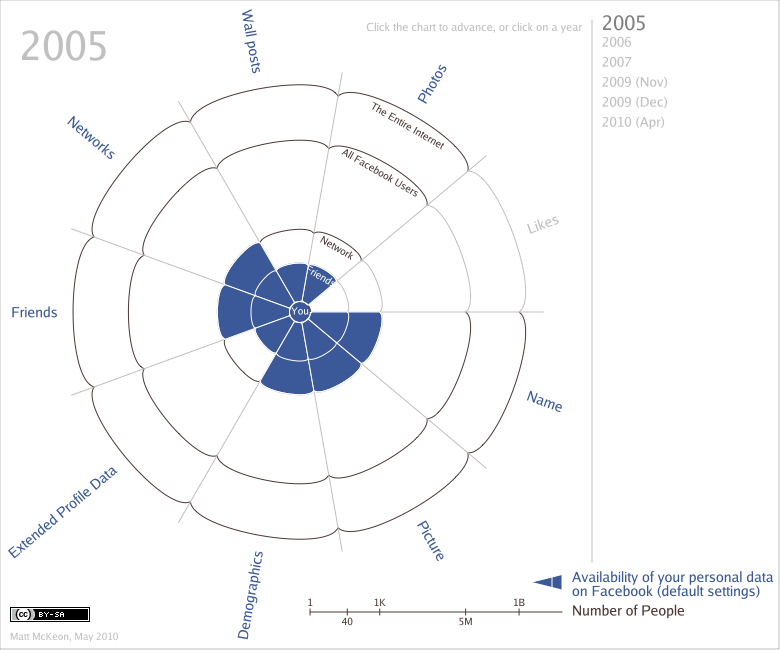
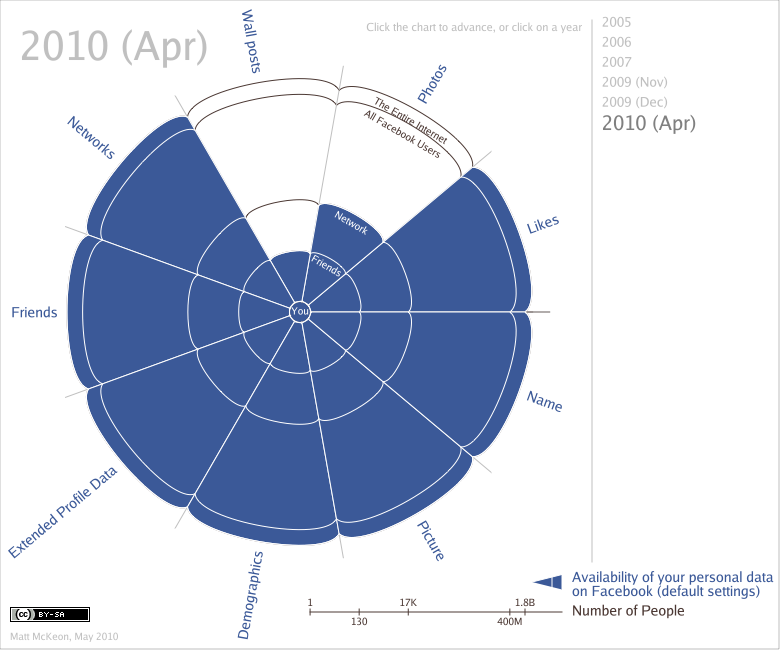
Matt McKeon has a very persuasive set of images, showing the extent of changes to your private information on Facebook between 2005 and last month:

2005

Compare that to the latest set of changes to the default Facebook privacy settings:

April 2010

Facebook is a great service. I have a profile, and so does nearly everyone I know under the age of 60.

However, Facebook hasn’t always managed its users’ data well. In the beginning, it restricted the visibility of a user’s personal information to just their friends and their “network” (college or school). Over the past couple of years, the default privacy settings for a Facebook user’s personal information have become more and more permissive. They’ve also changed how your personal information is classified several times, sometimes in a manner that has been confusing for their users. This has largely been part of Facebook’s effort to correlate, publish, and monetize their social graph: a massive database of entities and links that covers everything from where you live to the movies you like and the people you trust.

Six years of blogging

Filed under: Administrivia, Media — Tags: — Nicholas @ 08:57

Six years ago today, Jon installed a copy of MovableType on his server and invited me to start my own blog. He got tired of his own blog fairly quickly, but in an odd sort of way it still lives on — I named my blog Quotulatiousness as a joking reference to his Blogulatiousness.

The very first post was pretty indicative of what I’d be doing on the blog for the next six years: a brief introduction, a long-ish quote from the linked item of interest, and a brief closing comment (in that case, no actual commentary).

2004 was a pretty busy year, so if you’re terminally bored, you can sample a bit of blog history here (most of these entries don’t follow the pattern of the first blog post):

In short, I’m still one of the laziest bloggers on the planet, but I’m still blogging after half a century in blog-years (most blogs start up with a few quick posts, then fade out never to be updated again).

Thanks again to Jon, both for getting me started in blogging, and for continuing to host my archives from the first five years.

May 9, 2010

“Canada sucks” says Heather Mallick

Filed under: Britain, Cancon, Politics — Tags: , , — Nicholas @ 11:18

Seeking to aid the poor folks in Britain currently struggling under the unaccustomed weight of a “hung parliament”, Heather Mallick advises them to avoid having anything to do with Canadian precedent:

Right now, Canada sucks, and all because we have a hung Parliament and no one’s done anything about it for years. We are ruled by Stephen Harper, a hard-right hick with a grudge who after serial elections cannot get a clear mandate from the voters.

When you have a hung Parliament, you try to form coalitions. We have formed none. We remain hanging, like a dry-aged haunch of venison out back of the garage. Our MPs hurl figurative faeces at each other in the House of Commons and then go to monkey sleep under their minute Parliamentary desks, dreaming of democracy.

Apparently, I was having delusions when the Liberals and NDP tried to team up with the support of the Bloc . . . didn’t happen. Sorry for any confusion I may have caused. I stand corrected.

Excellent campaigning. If only our hateful pseudo-human prime minister would meet a nice granny in Kamloops and hurt her feelings. Actually, Harper would knee her in the groin and block her hip replacement, he’s that personal in his hates.

Canada has a Conservative minority government right now that does have a core belief. It’s that Canadians deserve a good stomping, all of them. Conservatives can’t stand people, particularly if they’re female, or second-generation Canadian, or educated, or principled, or not from Alberta, which is the home of the hard-right belly-bulging middle-aged Tory male. Watch them at the G8, ostensibly fighting for women’s health internationally while blocking abortions for raped Congolese.

Harper cannot get a real majority. If the centre-right Liberals and the centre-left New Democrats would form a coalition, Harper would be toast and we’d get started on what we need: national day care, TGV trains, an economic strategy, a green strategy, oh a strategy for anything, a plan is all we seek.

Some lovely drive-by characterizations there. Of course, most Brits know little about Canada (and many of them know things that aren’t true), so this little diatribe isn’t likely to cause anyone to change their mind on any issue of substance. And just as well . . .

May 8, 2010

Facebook’s business model

Filed under: Media, Technology — Tags: , , , — Nicholas @ 09:47

Ryan Singel looks at where Facebook started and why it’s changed its privacy protections:

Facebook used to be a place to share photos and thoughts with friends and family and maybe play a few stupid games that let you pretend you were a mafia don or a homesteader. It became a very useful way to connect with your friends, long-lost friends and family members. Even if you didn’t really want to keep up with them.

Soon everybody — including your uncle Louie and that guy you hated from your last job — had a profile.

And Facebook realized it owned the network.

Then Facebook decided to turn “your” profile page into your identity online — figuring, rightly, that there’s money and power in being the place where people define themselves. But to do that, the folks at Facebook had to make sure that the information you give it was public.

So in December, with the help of newly hired Beltway privacy experts, it reneged on its privacy promises and made much of your profile information public by default. That includes the city that you live in, your name, your photo, the names of your friends and the causes you’ve signed onto.

This spring Facebook took that even further. All the items you list as things you like must become public and linked to public profile pages. If you don’t want them linked and made public, then you don’t get them — though Facebook nicely hangs onto them in its database in order to let advertisers target you.

Every time Facebook changes their privacy policies, well-meaning folks try to explain how to retain as much of your previous settings as possible . . . and every time, Facebook’s defaults have changed further towards exposing everything. There’s money in that information, money that Facebook is determined to obtain. Privacy? The inevitability of zero-privacy is Facebook’s unspoken motto.

May 7, 2010

QotD: The HST only looks good on paper

Filed under: Cancon, Economics, Government, Quotations — Tags: , — Nicholas @ 09:47

I know all the reasons why sales taxes — i.e. consumption taxes — are to be preferred to income taxes. Every economist I respect believes consumption taxes are better because they let the taxpayer control the amount of tax he pays. Don’t want to pay as much? Don’t buy as much.

But to an ordinary person, this is a silly argument. Everyone has to buy stuff — school clothes for the kids, a new car, a laptop. If your washing machine breaks down, you have to buy a new one or pay for repairs. There is no alternative but to pay the sales tax.

To consumers, a sales tax looks like the least avoidable kind of tax. For most people, the only true way around a consumption tax is to hid their spending by switching to cash, barter or the black market.

On paper, I agree with my economist buds. And if we lived on paper, I might try to convince you to learn to love the HST.

Lorne Gunter, “The HST is fine on paper. It’s only painful in real life”, National Post, 2010-05-07

May 6, 2010

As if we didn’t have enough to worry about already

Filed under: Humour — Tags: , — Nicholas @ 17:03

New Age terrorists have reportedly developed a new, terrifying weapon — the homeopathic bomb:

Homeopathic bombs are comprised of 99.9% water but contain the merest trace element of explosive. The solution is then repeatedly diluted so as to leave only the memory of the explosive in the water molecules. According to the laws of homeopathy, the more that the water is diluted, the more powerful the bomb becomes.

‘It was only a matter of time before these people got hold of the material that they needed to make these bombs,’ said former UN weapons inspector, Hans Blix, ‘The world is a much more dangerous place with the advent of these Weapons of Mass Dilution.’

‘A homeopathic attack could bring entire cities to a standstill,’ said BBC Security Correspondent, Frank Gardner, ‘Large numbers of people could easily become convinced that they have been killed and hospitals would be unable to cope with the massive influx of the ‘walking suggestible’.’

The severity of the situation has already resulted in the New Age terror threat level being raised from ‘lilac’ to the more worrisome ‘purple’ aura. Meanwhile, new security measures at airports require that all water bottles be scanned to ensure that they are not being used to smuggle the memory of an explosion on board a plane.

H/T to Megan McArdle.

Possible oil discovery in the Falkland Islands

Filed under: Americas, Britain — Tags: , — Nicholas @ 12:11

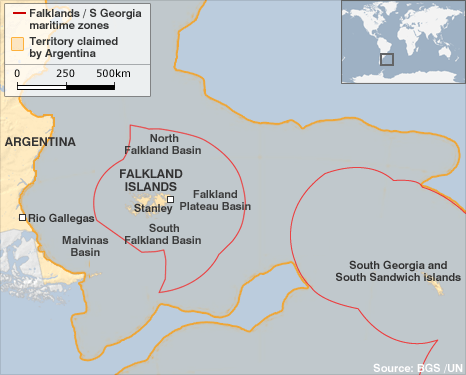
Expect an increase in sabre-rattling from Argentina, now that one of the exploration companies drilling in the North Falkland Basin claims to have struck oil:

Rockhopper Exploration said that initial data collected from one well “indicated an oil discovery”.

The find would be the first in North Falkland Basin, the area north of the islands currently being explored.

Earlier this year, another exploration company, Desire Petroleum, said its drilling programme had disappointed.

It is currently drilling further wells after it decided to abandon its first oil well.

UK-based Rockhopper said further tests now needed to be carried out on the well.

“We are extremely excited by the results of this well,” said Samuel Moody, managing director of Rockhopper.

Argentina disputes ownership of the islands with the British government, although not many seriously fear a second Falklands War (but not many expected the first one either).

That “no fly list” keeps getting worse

Filed under: Bureaucracy, Liberty, USA — Tags: , , , , , — Nicholas @ 07:42

It’s not bad enough that the list is filled with names of people who should never have been added, and that it’s incredibly difficult to get off the list, but now it’s proposed to restrict the rights of those people even more:

Seems Bloomberg (and Keith Olbermann, more about that in a moment) are on board with the idea the government should be able to take away people’s rights simply by putting them on a list. I don’t think they’d like that idea if say, George W. Bush were president and it was a right they liked. Hey maybe people on the list shouldn’t be able to exercise their First Amendment rights and post to Youtube. Why no Youtube? It’s a jihadi recruitment tool. Surely that’s a danger too.

Now, I’m not a legal expert but I’m pretty sure the 14th Amendment mentions something about “due process” before taking away a person’s rights. Again, not a legal expert but I’m thinking the mere act of the government putting your name on a list is not in fact “due process”.

Notice that Bloomberg calls people on the list “suspects”. Again, I wasn’t aware that rights could be taken away from people simply because the government “suspects” you’ve done something wrong without any notice or opportunity for redress.

May 5, 2010

Three reasons not to remove the Downfall parodies

Filed under: History, Law, Media, WW2 — Tags: , , , , — Nicholas @ 12:50

3 Reasons YouTube Shouldn’t Censor Downfall Parodies

[. . .]

It’s understandable why Downfall’s production company, Constantin Film, might be upset that such a serious movie is being burlesqued, but pushing YouTube to ban the parodies is a terrible idea for at least three reasons:

1. It’s fair use! The parodies, which transform a few minutes of a three-hour movie, are clearly legit under existing copyright laws. Because they clearly transform the original and have no possibility of confusing viewers, the parodies are clearly protected speech.

2. This is free promotion! As George Lucas could tell the filmmakers, fan-generated videos help keep the original source material vital and relevant. Lucas used to try to police all Star Wars knock-offs, until he realized that his audience was promoting his films more effectively than he ever could. More people have surely seen Downfall due to the popularity of the parodies.

3. Let’s keep the Internet creative! The greatest cultural development over the past 20 or so years has been technologies that allow producers and consumers to create and enjoy an ever-increasing array of creative expression in an ever-increasing array of circumstances. This development is nowhere more powerful than on the Internet, which has unleashed a whole new universe of writing, music, video, and more. Indeed, YouTube is itself one of the great conduits of cyberspace. Pulling down the Downfall parodies may be within YouTube’s rights, but it nonetheless strikes a blow to the heart of what is totally awesome about the Internet.

Facebook obliterates the entire notion of “privacy settings”

Filed under: Technology — Tags: , , , , — Nicholas @ 09:03

As someone noted the other day, when it comes to Facebook and their constant twiddling with privacy settings, you can just copy-and-paste the last outraged story you did and change the date. That being said, the latest Facebook changes are pretty bad:

“Connections.” It’s an innocent-sounding word. But it’s at the heart of some of the worst of Facebook’s recent changes.

Facebook first announced Connections a few weeks ago, and EFF quickly wrote at length about the problems they created. Basically, Facebook has transformed substantial personal information — including your hometown, education, work history, interests, and activities — into “Connections.” This allows far more people than ever before to see this information, regardless of whether you want them to.

Since then, our email inbox has been flooded with confused questions and reports about these changes. We’ve learned lots more about everyone’s concerns and experiences. Drawing from this, here are six things you need to know about Connections:

  1. Facebook will not let you share any of this information without using Connections. [. . .]
  2. Facebook will not respect your old privacy settings in this transition. [. . .]
  3. Facebook has removed your ability to restrict its use of this information. [. . .]
  4. Facebook will continue to store and use your Connections even after you delete them. [. . .]
  5. Facebook sometimes creates a Connection when you “Like” something. [. . .]
  6. Facebook sometimes creates a Connection when you post to your wall. [. . .]

Overall, you’d have to assume that nobody in the Facebook architecture group has ever needed or even wanted to keep certain information private. Every change they make seems to make it harder and harder to restrict where your personal information will be accessible, and it’s not as though there haven’t been complaints: Facebook just carries on as if nobody cared.

I’ve still got a Facebook account, although I find I’m using it less and less (ironically, many of you reading this will have come here because of a link from Facebook . . .). Lack of ability to fine-tune the privacy settings is certainly one of the reasons I don’t use Facebook as much as I once did.

May 4, 2010

Let’s return to the proper name: the Royal Canadian Navy

Filed under: Cancon, Government, Military — Tags: , — Nicholas @ 12:05

I can’t help but endorse this Globe & Mail editorial calling for the government to give the Navy back its proper name:

Today marks the 100th anniversary of Canada’s navy, which fought with distinction in two World Wars and the Korean War, and is now, alas, known as the Canadian Forces Maritime Command, a bulky and obscure label that communicates little of what it is and what it has done.

What better way to mark the centennial than to restore its rightful name, the Royal Canadian Navy, which it carried from 1911 to 1968, when defence minister Paul Hellyer unified the navy, army and air force under one command. (At one time, each service reported to its own cabinet minister.) The unification does not need to be undone. The navy does not need to go back to having its own command structure. Just the name will do.

[. . .]

Defence Minister Peter MacKay has honoured the service and sacrifice of the navy by announcing on the weekend that the executive curl, a distinctive loop on the upper stripe of naval officers’ uniforms that disappeared after unification, will make a comeback. He should take the next step and bring the name back.

And while we’re at it, I’m sure the Royal Canadian Air Force would like to go back to its correct name, too.

The lesson, kids, is don’t ask for colour advice

Filed under: Humour, Randomness, Technology — Tags: , , — Nicholas @ 08:04

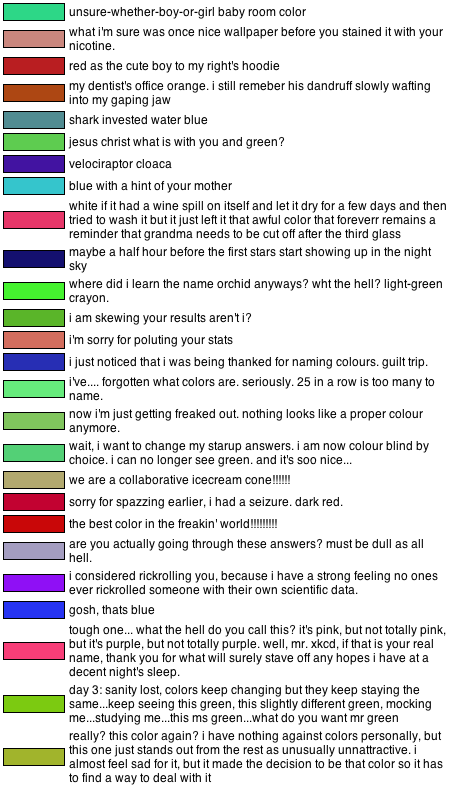
A colour survey gone very wrong:

Thank you so much for all the help on the color survey. Over five million colors were named across 222,500 user sessions. If you never got around to taking it, it’s too late to contribute any data, but if you want you can see how it worked and take it for fun here.

First, a few basic discoveries:

* If you ask people to name colors long enough, they go totally crazy.
* “Puke” and “vomit” are totally real colors.
* Colorblind people are more likely than non-colorblind people to type “fuck this” (or some variant) and quit in frustration.
* Indigo was totally just added to the rainbow so it would have 7 colors and make that “ROY G. BIV” acronym work, just like you always suspected. It should really be ROY GBP, with maybe a C or T thrown in there between G and B depending on how the spectrum was converted to RGB.
* A couple dozen people embedded SQL ‘drop table’ statements in the color names. Nice try, kids.
* Nobody can spell “fuchsia”.

Overall, the results were really cool and a lot of fun to analyze. There are some basic limitations of this survey, which are discussed toward the bottom of this post. But the sheer amount of data here is cool.

And a selection of miscellaneous answers:

Spear phishing (test) attack on US Air Force

Filed under: Military, Technology — Tags: , , , , , — Nicholas @ 07:43

I’d heard the term “phishing” before, and I’ve reported at least a dozen various attempts to the appropriate parties (companies and organizations who are used in phishing attempts often have a reporting address set up so you can just forward the message to them). “Spear phishing” was new to me, and apparently it was also new to a large number of US Air Force personnel:

Offers to hire American airmen, stationed at an airbase on the Central Pacific island of Guam, as extras in the Transformers 3 movie, turned out to be an unexpectedly scary training exercise. First, keep in mind that there is no Transformers 3 filming scheduled for Guam. The email was a fake, used to test how well airmen could detect a hacker attempts to deceive military Internet users to give up valuable information.

The Transformers 3 email was a test to see how many airmen would fall for a “spear phishing” offensive. “Phishing” (pronounced “fishing”) is when a hacker sends out thousands, or millions, of emails that look like warnings from banks, eBay or PayPal, asking for you to log in (thus revealing your password to the hackers, who have set up a false website for this purpose) to take care of some administrative matter. The hacker then uses your password to loot your account. “Spear phishing” is when the emails are prepared with specific individuals in mind. The purpose here is to get specific information from, say, a bank manager, or someone known to be working on a secret project. In the Guam case, the targets of the spear phishing test were asked to go to a web site and fill out an application form to be eligible to be an extra. That form asked for information that would have enabled hostile hackers to gain more access to air force networks. A lot of the airmen who received the Transformers 3 email, responded. The air force won’t say how many, but it was more than expected. A lot more.

I doubt that many readers need to be told this, but no legitimate bank or financial institution should ever be sending you an email requesting you to follow an embedded link and log in to your account. If you get such an email, forward it to the bank’s security folks. If it’s legitimate, they can confirm it for you, but in 2010, no sensible bank should be communicating with you in this way.

Introducing the Greaves Underdog Strategy

Filed under: Britain, Media, Politics — Tags: , , , , , — Nicholas @ 07:04

Occasional commenter Chris Greaves sent me this link, saying

Read down towards the bottom:

“Duffy told the Mail she wasn’t impressed. “Sorry is a very easy word, isn’t it,” she was quoted as saying, adding that she would not be casting her vote for Brown — or anyone else — in the election.”

Herein lie the seeds for the Greaves Underdog Strategy:

* If you are the underdog, insult as many bigoted voters as you can reach; it inoculates them against voting, thereby reducing the overdog’s lead.

Gordon Brown is right on track . . .

« Newer PostsOlder Posts »

Powered by WordPress