
The urge to uncover past wrongs in the Canadian government’s dealings with First Nations groups isn’t a bad thing … but the government’s unwillingness to require factual evidence in support of claims of past wrongs will do exactly the opposite of working toward cultural reconciliation:

Photo from Woke Watch Canada
Why is the federal government trying to prevent Canadians from learning the truth about Indian residential schools?
On 24 September 2026, six days before Canada’s National Day for Truth and Reconciliation, Minister of Crown-Indigenous Relations Rebecca Alty issued a statement about so-called ‘Residential Schools denialism’.
Alty claims so-called ‘Residential Schools denialism’ “spreads false information by denying or casting doubt on the history of Residential Schools and the lasting harm they caused”. She offers no examples, which strongly suggests she could not provide examples if pressed to do so. The federal government is thus using Canadian taxpayer funds to attack a straw man of its own creation.
In fact, the federal government has gone far beyond using Canadian taxpayer funds to attack the straw man it calls ‘Residential Schools denialism’. It has even entertained bills which would criminalize it.
The federal government refuses to release residential school attendance records to the public which would disprove claims of missing children
In addition to using Canadian taxpayer money to attack so-called ‘Residential Schools denialism’ — a straw man of its own creation — and entertaining bills which would criminalize it, the federal government has actively prevented the truth about Canada’s Indian residential schools from coming out.
For years there have been tales of thousands of missing Indian residential school students. The federal government has allowed these baseless rumours to proliferate, despite the fact that not a single name of a missing Indian residential school student has ever been produced by anyone, including the federal government.
Moreover the federal government has allowed these baseless tales of missing Indian residential school students to proliferate while actively concealing from the Canadian public the attendance records in its possession which disprove them.
An example is the attendance records for the Kamloops Indian Residential School. A close examination of the quarterly returns for the Kamloops Indian Residential School from 1943-1952, which are available online, establishes that every student is accounted for during that decade.
The government also has quarterly returns and other attendance records for the remaining years of the existence of the Kamloops Indian Residential School, 1952-1977, which it has not released to the public. Their existence is attested to by the federal government itself in the school narrative it prepared for use in the Independent Assessment Process.
Quarterly returns were the basis on which the Department of Indian Affairs calculated the per capita grant which covered the operating costs of the school. School officials ensured they were meticulously accurate in order to obtain as large a grant as possible based on current student enrolment, and the Department of Indian Affairs likewise demanded that they be meticulously accurate to avoid the federal government overpaying the school.
It is thus of the greatest significance that on pp. 7-8 of the attached school narrative, the federal government provides a table of total attendance figures for the years of the Kamloops Indian Residential School’s existence. The figures given by the federal government for the years from 1952-1977 are not estimates. They are very precise numbers — 402, 424, 381, 390, for example — indicating that they are derived from attendance records in the federal government’s possession, and in fact the federal government’s heading on the table reads “most are September figures for each year and based on Quarterly Returns where possible“.
It is thus clear that if released by the federal government, the quarterly returns underlying the figures in this table would establish conclusively that not a single student from the Kamloops Indian Residential School went missing between the years 1952-1977, yet the federal government refuses to release these attendance records so that the Canadian public can learn the truth. Instead, the federal government allows the damaging and completely unfounded myth of thousands of missing Indian residential school students to proliferate, and even to be promulgated beyond Canada’s borders (as, for example, in the recent hearings of the Rome-based Permanent Peoples’ Tribunal).
The federal government needs to release these attendance records, not just for the Kamloops Indian Residential School, but for all Indian residential schools in Canada, so that the Canadian public can learn the truth, i.e., that federal government records establish that not a single student is missing from an Indian residential school.
On X, Mr Bench points out that First Nations’ political representatives see literally no end to the need for reconciliation for generations yet to come:
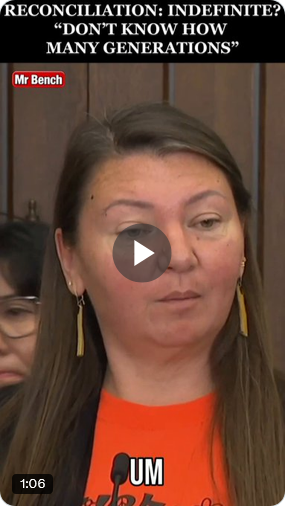
Will reconciliation ever end?
According to Candice … NO.
Plan for this to continue for generations.
She says some people haven’t even started healing yet.
Her son will need healing.
Her future grandchildren will need healing.
And she admits:
“Don’t know how many generations it’s gonna take for us to heal, and healing is forever.”
So when does reconciliation end?
It doesn’t. So keep the funds flowing
If “healing is forever”, apparently there is no finish line.
L. Wayne Mathison speaks for an increasing number of Canadians here:
I’m sick and tired of being told that people generations from now will still need to “heal” from events they never personally experienced. My ancestors went through terrible things too. History is full of conquest, poverty, discrimination, war and displacement.
Remember the past. Teach it accurately. Deal with specific injustices that still exist. But at some point adults also have to build a life in the present.
I do not believe anyone should inherit permanent victimhood, and I do not believe anyone alive today should inherit permanent guilt.
Reconciliation without measurable goals, accountability or any conceivable end point stops looking like reconciliation to me, period.
Keep this up, and I am totally done with this.


