
Quotulatiousness

January 23, 2020

Pascal’s Wager, environmentalists’ version

Filed under: Economics — Tags: , , , , , — Nicholas @ 05:00

Hector Drummond indulges in a proper “Fisking” of a recent column in the Telegraph:
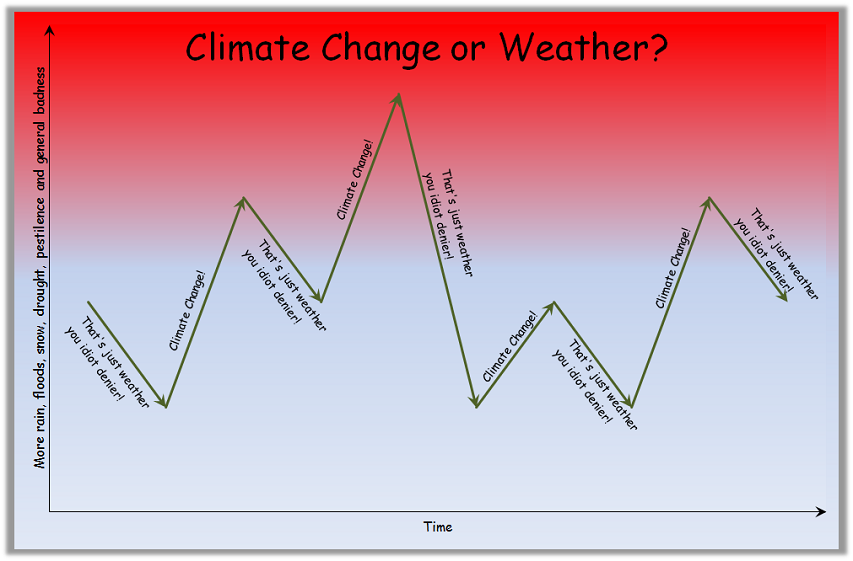
    We don’t have to buy into the apocalyptic angst of Greta Thunberg, on show again in Davos yesterday, to recognise that something has to be done.

He actually said “Something Has To Be Done”. How about we do a snow dance, Philip? That’s “something”.

    Whether or not you are a sceptic about the impact of CO2 on the climate or question man’s involvement in producing the greenhouse gas, our energy future is a non-carbon one, like it or not.

Our energy future involves a lot of talk about non-carbon energy sources, while relying on “carbon” for a long time to come.

    Virtually every government has committed to this as an overt aspect of public policy and those that haven’t, like China or the US, have a rapidly growing green energy sector poised to exploit the move to a carbon‑free future.

You mean the China that’s building coal-fired power plants at a rate of knots? That China?

Later on, the column invokes Pascal’s Wager, which Hector finds both amusing and irritating:

Seriously? Pascal’s Wager, which has been long ridiculed by most scientists and philosophers and thinkers, is now the basis for the largest and riskiest economic and political transformation in human history?

Pascal’s Wager justifies any proposed change in response to any possible threat. It’s possible that all the ducks in the world are really super-intelligent and they’re about to launch a takeover, so we need to kill them all. It’s possible that nylon stockings are eventually going to cause a nuclear explosion. Make your own ones up. The consequences of doing nothing, should these claims turns out to be true, are calamitous. In fact, they’re far more calamitous than most of the possible climate change scenarios.

Proper risk analysis, on the other hand, tells us to look at probabilities of the possible bad outcomes, not just how bad some possible bad outcome would be, were it true. The catastrophic climate change scenarios all have tiny probabilities. Even the IPCC admits that.

[…]

Then we have to look at the costs of the proposed action. The real costs, that is, not just vague claims like “Oh, moving everything to solar energy would be, like, you know, cool, my friend went to this talk once and she said that apparently solar works just as well as coal”. The costs – the real costs – are what needs be weighed against alternative courses of action.

The costs of abandoning fossil fuels are not zero. Not even remotely. Changing to renewables will be massively expensive, destroy jobs, and hinder prosperity, because they cannot provide anywhere near the energy we need. “Generate growth and prosperity” is nonsense, and Johnston should be ashamed of himself for falling for this.

May 27, 2019

QotD: The Green death cult

In keeping with all millenarian movements, the extinction-obsessed green cult reserves its priestly fury for ordinary people. Even when it is putting pressure on the government, it is really asking it to punish us. It wants tighter controls on car-driving, restrictions on flying, green taxes on meat. That these things would severely hit the pockets of ordinary people – but not the deep pockets of Emma Thompson and the double-barrelled eco-snobs who run Extinction Rebellion – is immaterial to the angry bourgeoisie. So convinced are they of their own goodness, and of our wickedness, that they think it is utterly acceptable for officialdom to make our lives harder in order to strongarm us into being more “green”. People complaining about Extinction Rebellion disrupting people’s lives in London over the past few days are missing the point – the entire point of the green movement is to disrupt ordinary people’s lives, and even to immiserate them. All in the jumped-up name of “saving the planet”.

And now the green cult has pushed Ms [Greta] Thunberg into the position of its global leader, its child-like saviour, the messiah of their miserabilist political creed. What they have done to Ms Thunberg is unforgivable. They have pumped her – and millions of other children – with the politics of fear. They have convinced the next generation that the planet is on the cusp of doom. They have injected dread into the youth. “I want you to panic”, said Ms Thunberg at Davos, and the billionaires and celebs and marauding NGOs that were in attendance all lapped it up. Because adult society loves nothing more than having its own fear and confusions obediently parroted back to it by teenagers. They celebrate Thunberg because she tells them how horrible they are: it is an entirely S&M relationship, speaking to the deep self-loathing of the 21st-century elites.

Brendan O’Neill, “The cult of Greta Thunberg: This young woman sounds increasingly like a millenarian weirdo”, Spiked, 2019-04-22.

April 29, 2019

Banning single-use plastics won’t make much (if any) difference

Filed under: China, Environment, India, Pacific — Tags: , , , — Nicholas @ 03:00

My local high school is suddenly all about the proposed ban on single-use plastics — where student-made posters used to proclaim their dedication to gender equality, they’re now all about the evils of plastics. It’s almost like it’s a co-ordinated campaign that originated somewhere else…

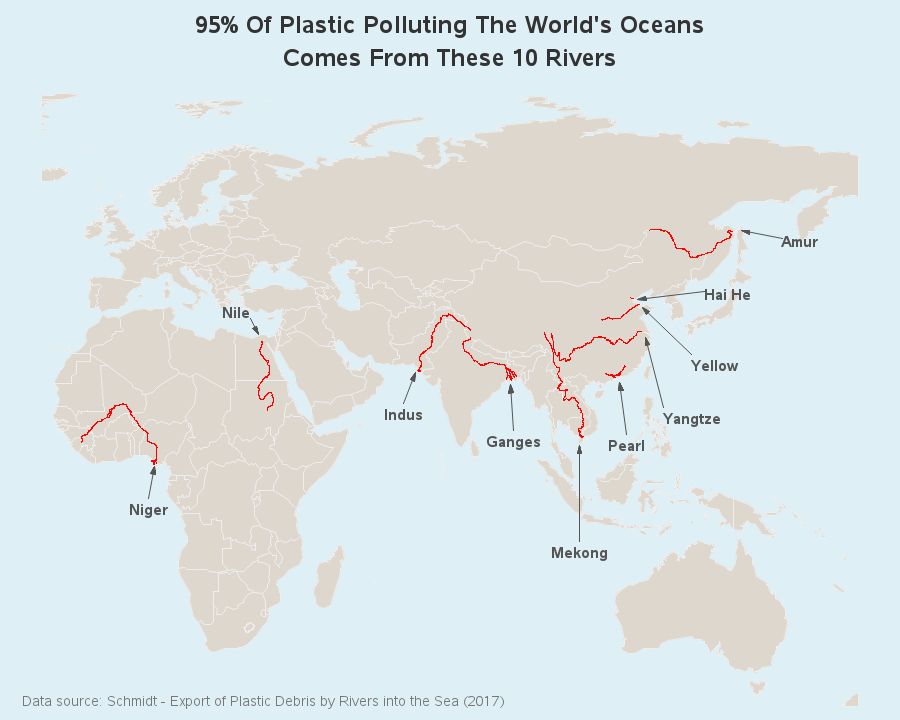
But despite the students’ new-found environmental awareness, the ban they favour would make little or no difference to plastic items ending up in the oceans, because the vast majority of the plastic there comes from only ten rivers, none of them in North America (this is from a World Economic Forum report). Jason Unrau reports on his trip up the Yangtze River in China twenty years ago that illustrates the breadth of the problem:

Beginning in Shanghai in the summer of 1999, I boarded a large flat-bottom boat with around 300 other passengers. It would be the first of about a dozen different vessels, that over two weeks ferried me 2500 kilometres to Chongqing.

After taking my first meal in the ferry’s mess hall, served in a Styrofoam box, I searched everywhere for a garbage can. There were none – passengers simply tossed their garbage overboard and without an alternative, I joined in the littering.

The banks of the Yangtze are home to more than 200 million Chinese who treat the waterway as commuter corridor and as I soon discovered, a dump. I took the trip to get a glimpse the fabled Three Gorges, before a hydro-electric project and dam would change the watershed forever. As my trip progressed, however, so did my treatment of this historic river as trash receptacle.

The closer I got to Chongqing, the narrower the river became and the smaller the ferries got. About 10 days into the trip, I exited the dining hall of a different vessel to engage in the daily ritual of reckless Styrofoam abandonment, but to my surprise there was a garbage bin.

Delighted at the prospect that my littering ways on the Yangtze were through, enthusiastically I added my box to a near overflowing bin. As if on cue a kitchenhand exited the dining hall, gathered up the bag and heaved the entire thing overboard.

Like I experienced and begrudgingly participated in creating, the World Economic Forum’s report describes “rivers of plastic” – its analyses of respective outputs and comparisons to garbage island and other samples, could be traced back to their source.

According to the economic forum eight of these rivers are in Asia: the Yangtze; Indus; Yellow; Hai He; Ganges; Pearl; Amur; Mekong; and two in Africa – the Nile and the Niger.

July 25, 2017

Great Man Theory? No. Impersonal Forces of History? No. How about the Bond Villain Theory?

Filed under: History, Humour — Tags: , , , , — Nicholas @ 03:00

Charles Stross may have cracked the mystery of what the heck is happening in our particularly odd time period:

History: is it about kings, dates, and battles, or the movement of masses and the invisible hand of macroeconomics?

There’s something to be said for both theories, but I have a new, countervailing theory about the 21st century (so far); instead of the traditional man on a white horse who leads the revolutionary masses to victory, we’ve wandered into a continuum dominated by Bond villains.

Consider three four five, taken at random:

Mr X: leader of a chaotic former superpower with far too many nuclear weapons, Mr X got his start in life as an agent of SMERSH the KGB. Part of its economic espionage directorate, tasked with modernizing a creaking command economy in the 1980s, Mr X weathered the collapse of the previous regime and after a turbulent decade of asset stripping rose to lead a faction of billionaire oligarchs, robber barons, and former secret policemen. Mr X trades on his ruthless reputation — he is said to have ordered a defector murdered by means of a radioisotope so rare that the assassination consumed several months’ global production — and despite having an official salary on the order of £250,000 he has a private jet with solid gold toilet seats and more palaces than you can shake a stick at. Also nuclear missiles. (Don’t forget the nuclear missiles.) Said to be dating the ex-wife of Mr Y. Exit strategy: change the constitution to make himself President-for-Life. Attends military parades on Red Square, natch. Bond Villain Credibility: 10/10

Mr Y: Australian multi-billionaire news magnate. (Currently married to a former supermodel and ex-wife of Mick Jagger.) Owns 80% of the news media in Australia and numerous holdings in the UK and USA, including satellite TV channels, radio stations, and newspapers. Reputedly had Arthur C. Clarke on speed-dial for advice about the future of communications technology. Was the actual no-shit model upon whom Elliot Carver, the villain in “Tomorrow Never Dies”, the 18th Bond movie, was based. Exit strategy: he’s 86, leave it all to the kids. Bond Villain Credibility: 10/10

[…]

I think there’s a pattern here: don’t you? And, more to the point, I draw one very useful inference from it: if I need to write any more near-future fiction, instead of striving for realism in my fictional political leaders I should just borrow the cheesiest Bond villain not already a member of the G20 or Davos.

January 25, 2016

The Davos Men

Filed under: Cancon, Media, Politics — Tags: , , , — Nicholas @ 03:00

In the Globe and Mail, Margaret Wente explains why the great and the good at Davos are worried about the lumpenproles back home:

Forget APEC and the G20. Forget the climate-change summit. If you belong to the global elite, the only place that really counts is Davos – the yearly schmoozefest where central bankers and celebrities meet to network and exchange Big Thoughts. Where else can you party with both George Soros and Leonardo DiCaprio? When they invite you to Davos, you know you’ve arrived.

Prime Minister Justin Trudeau has arrived. This year he shared top billing with Mr. DiCaprio, the activist actor who has been nominated for an Oscar for being mauled by a bear. Everybody wants to get a load of the hottest star in politics. Besides, they need a break from the relentless doom and gloom.

[…]

But Davos Men aren’t like the rest of us. As Chrystia Freeland so memorably wrote in a famous 2011 piece in The Atlantic, they live increasingly in a world apart, “a transglobal community of peers who have more in common with” each other than with the folks back home. They live in gated communities and send their kids to private school. “The real community life of the 21st-century plutocracy occurs on the international conference circuit,” she wrote.

[…]

The gathering at the Swiss ski resort is as close as you can get to a pure meritocracy. All the people at Davos are the smartest people in the room. Like Mr. Trudeau, they are forward-looking and postnational. They believe that nationalist sentiment is a defect of the bitter clingers, who don’t understand that diversity (despite Cologne) is good for them. Unlike the bitter clingers, they are personally untouched by the seismic shifts underfoot. They’re on the winning side of change. Every year their lives get better and better.

But now, the bitter clingers are rising up, pitchforks at the ready. They are rallying behind Donald Trump – Trump! – in a massive rejection of every value a Davos Man holds dear. They’re convinced the elites have failed them. They blame the elites for the disruptions of globalization and technology that have stolen their jobs and their children’s futures.

They will never work at Google. And they’re mad as hell. They’ve lost all trust in the business and political and intellectual and celebrity class, jetting to their conferences 60,000 feet in the air. That includes the folks in Davos – the smartest people in the world, with no idea what to do.

February 9, 2015

QotD: The hyper-rich are not like you and I

Convening to ring the alarm about global warming, our putative betters and would-be rulers gathered in Davos, Switzerland, filling the local general-aviation hangars with some 1,700 private jets. Taking an international commercial flight is one of the most carbon-intensive things the typical person does in his life, but if you’re comparing carbon footprints between your average traveler squeezed into coach on American and Davos Man quaffing Pol Roger in his cashmere-carpeted intercontinental air limousine, you’re talking Smurfette vs. Sasquatch. The Bombardier’s Global 6000 may be a technical marvel, but it still runs on antique plankton juice. The emissions from heating all those sprawling hotel suites in the Alps in winter surely makes baby polar bears weep bitter and copious baby-polar-bear tears.

The stories add up: Jeff Greene brings multiple nannies on his private jet to Davos, and the rest of the guys gathered to talk past each other about the plight of the working man scarf down couture hot-dogs that cost forty bucks. Bill Clinton makes the case for wealth-redistribution while sporting a $60,000 platinum Rolex.

The hypocrisy of our literally (literally, Mr. Vice President!) high-flying crusaders against fossil fuels — who overlap considerably with our high-living crusaders against economic inequality — is endlessly annoying if frequently entertaining. And there is something unseemly about enduring puritanical little homilies on how we need to learn to live with less from guys wearing shoes that cost more than the typical American family earns in a quarter. When that obnoxious Alec Baldwin character from Glengarry Glen Ross informs that sad-sack real-estate salesman that his watch costs more than that guy’s car, he was trying to provoke him into getting richer, to the tune of a Cadillac Eldorado or, if not that, at least the second-prize set of steak knives. But our modern progressive versions of that guy are even more obnoxious: They demand that we lower our expectations while they live lives of opulence that would have embarrassed the Count of Monte Cristo.

Out-obnoxious-ing a guy with Alec Baldwin’s smirking mug takes a lot of brass.

Kevin Williamson, “Davos’s Destructive Elites: ‘None of us is as dumb as all of us'”, National Review, 2015-01-25.

January 28, 2015

The great and the good gather at Davos

And Monty calls ’em exactly what they are:

Luckily, all is not lost. Our moral and ethical betters have gathered in Davos to light their cigars with hundred-dollar bills while mocking the tubercular bootblack who’s been pressed into service to keep their shoes looking spiffy while they chat and laugh and eat lobster canapes. Oh, wait, I read that wrong, sorry. They’re in Davos to discuss the pressing problem of Global Warming(tm). Because they’re so concerned about Global Warming(tm) that they felt compelled to fly their private jets to an upscale enclave in the Swiss Alps to talk about it. While making fun of the tubercular bootblack who’s spit-shining their wingtips.

Don’t get me wrong – I’m a big believer in ostentatious displays of wealth. If I had the money, I’d build a hundred-foot-high statue of myself made out of pure platinum and then hire homeless people to worship at it for no fewer than eight hours per day. (I’d pay them a fair wage, though. What’s the going rate for abject obeisance to a living God? I’ll have to look it up.) But this Davos thing is just…rank. It’s a collection of rich fart-sniffers who want to congratulate each other on how socially conscious they are, and how much they care about the Little People. (Except the tubercular bootblack, whom they often kick with their rich-guy shoes.)

November 2, 2014

It’s safe to just ignore the World Economic Forum’s report on pay gaps

Filed under: Economics, Media — Tags: , , , , , — Nicholas @ 08:37

In Forbes, Tim Worstall looks at how the World Economic Forum came up with their scary conclusions that the pay gap between men and women won’t disappear until 2095:

And that’s it: no, really, that is what they’re basing, in its entirety, their estimations of the gender pay gap upon. They asked a few people whether they thought that men and women got roughly the same pay for roughly the same sort of job or not and that’s it. This isn’t cutting edge data science to put it very kindly indeed.

For when we go off and look at the messy details of the gender pay gap we find that we’ve not really got one, not in the industrialised countries. Once we correct for the obvious things like hours at work, years in the workforce, educational background and so on we find that the mythical gender pay gap (that “women earn 77 cents to every $ men do”) simply disappears. There might be a small residual, a few percent, left in there but not enough that we can really notice. And quite apart from anything else it’s actually illegal to pay men and women different amounts for doing the same job (if on the basis that the different pay is purely as a result of their being men or women that is).

So, no, we shouldn’t be taking this report or finding seriously. And there’s more than just the fact that they’re using a survey to measure that gap. For of course the printing of this report will lead to, as the other incorrect claims about the gender pay gap do, a certain circularity of reasoning.

Ask someone: “Are men and women paid equally?” And they’ll start thinking about whoever it was that said that 77 cents line, recall that last year the WEF said that gender pay inequality was very bad indeed. So, now we come to asking them the same question for the next WEF survey and their answer will be influenced by the cacophony of voices that have been telling them how bad the gender pay disparity is. Including, obviously, last year’s WEF report that said so. It’s entirely circular and self-reinforcing.

Really, we shouldn’t be taking this stuff seriously.

April 14, 2010

QotD: The environmental conspiracy theorists

In the conventional wisdom, conspiracy theorists are stubble-faced old coots missing every third tooth, who live in backwoods shacks and claim the Pope (who is really Hitler’s love child) is in league with the Freemasons and the World Economic Forum to enslave us all through the cashless society.

Environmentalists, on the other hand, live in low-energy townhouses in upscale neighbourhoods, drink fair-trade coffee from 100% post-consumer recyclable cups, drive hybrid cars and eat only organic food grown within 100 kilometres of their homes. They are trendy, tony, highly educated and socially conscious with small carbon footprints. So, surely, they can’t be conspiracy theorists.

But they are.

In his new book, for instance, Mr. McKibben spins a tale about a vast web of shadowy payoffs to for-hire scientists, and intense pressure placed on politicians and editors by powerful lobbyists. He, like many environmentalists, sees himself and his colleagues as the little guys battling an enormous, unseen disinformation machine funded by Big Oil and Big Coal that is keeping the people from hearing the truth about the coming climate catastrophe.

They fancy themselves the underdogs when in fact they are the overdogs.

Lorne Gunter, “Green paranoia on parade”, National Post, 2010-04-14

« Newer Posts

Powered by WordPress

