Quotulatiousness

August 14, 2020

Warsaw, 1920 – “Smash a Bolshevik!”

Filed under: Europe, History, Military, Russia — Tags: , , , , , , — Nicholas @ 05:00

Arthur Chrenkoff on the important but little-known Russo-Polish conflict a century ago:
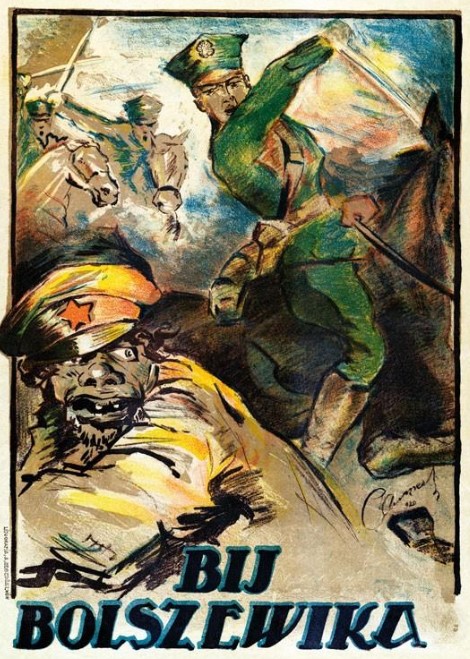
Polish propaganda poster “Smash a Bolshevik”
Image via Daily Chrenk.

The Polish-Russian war of 1919-20 was the last major conflict where massed cavalry played an important role. Unlike the static Western Front a few years earlier (but similarly to the much more mobile Eastern Front) it was a war of maneuver and speed, conducted over vast swathes of territory. While still fought in a pre-armour era, its conduct directly and indirectly inspired the major proponents of the future tank warfare and the doctrine of blitzkrieg, from the young De Gaulle (who was one of the official French Army observers in Poland at the time) through Tukhachevsky in the Soviet Union to Guderian in Germany. Two million troops from both sides took part in the conflict, making it the most significant foreign intervention against the newly installed Bolshevik regime over the course of the Russian Civil War. It might have even succeeded in strangling communism in its cradle; what prevented the cooperation with the counter-revolutionary White forces was their old imperial hostility to independent Poland (coincidentally, the anti-Hitler German opposition of 1944 was likewise unfriendly to the idea).

The basic story of the war is easily enough told. After 123 years of partition between Russia, Prussia and Austria-Hungary, Poland was recreated (or, really, recreated herself) among the chaos of the late 1918, with the collapse of all three of her occupying empires. The new “Versailles” Poland was smaller than in the past, which led the new government to try to restore by force what has been denied to her at the negotiating table (where Poles had no seat in any case). The Russian Revolution (or rather the Bolshevik coup d’etat) and the following civil war provided a perfect opportunity. Throughout 1919, the reconstituted Polish Army under the command of Marshall Jozef Pilsudski fought against and took over the briefly independent Western Ukraine republic and then marched on Kiev, this time in alliance with the forces of also briefly independent Eastern Ukraine republic (it was Pilsudski’s intention to recreate some form of an independent Ukrainian state – minus the predominantly Polish areas – as part of his larger project to create the Miedzymorze (Intermarum) Confederation of both anti-Russian and anti-German states stretching from the Baltic to the Black Sea).

But the Polish Army became overstretched and the Soviet government, now having defeated its major White opponents, found itself willing and able to stand up to and roll back what they saw as the Polish aggression against historically Russian territories. The Red Army, which sporadically skirmished with the Poles over the previous year, now counter-attacked across the whole wide front across what is now Belarus and Ukraine, driving the Polish Army back at an unprecedented pace of 30 kilometres a day. Soviet Marshall Tukhachevsky ordered his troops “To the West! Over the corpse of White Poland lies the road to worldwide conflagration. March on Vilno, Minsk, Warsaw!” and “onward to Berlin over the corpse of Poland!” Pravda newspaper echoed “Through the corpse of the White Poland lies the way to World Inferno. On bayonets we will carry happiness and peace to working humanity”. British Labour Party and French Socialists vowed not to support “reactionary” Poland; German and Czech unions sabotaged the delivery of crucial military supplies to the beleaguered Poland.

On 10 August, Cossack units of Tukhachevsky’s northern Army crossed the Vistula River north of Warsaw in at attempt to envelop the capital. This was a mistake, as the southern Army, under Budyonny, was still stuck around Lwow, three hundred kilometres to the south-east. For weeks preparing in secret, the last Polish reserves punched through the centre, first cutting off the two Soviet fronts from each other and then in a series of counter-enveloping maneuvers routing three Soviet armies. Now it was the Poles’ turn to advance 30 kilometres per day, as the Red Army collapsed and retreated in chaotic circumstances. The Polish counter-strike subsequently became known as “Cud nad Wisla” (Miracle of the Vistula), but it was less of a supernatural intervention and more a combination of several favourable factors: Soviet missteps, good Polish organisation, the growing hostility between Stalin and Trotsky as well as various military commanders, which hampered the cooperation between the Soviet fronts. Last but not least, and this was only revealed in 2004, Polish cryptographers had managed to break the Red Army codes – just as they would later be instrumental in breaking the German Enigma.
August 13, 2020

Warsaw, August 1920

Filed under: Europe, History, Military, Russia — Tags: , , , , — Nicholas @ 03:00

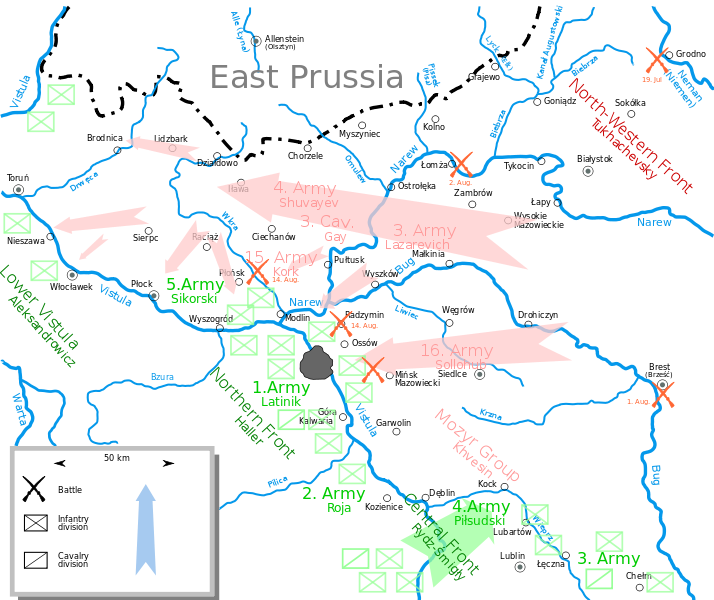
Lawrence W. Reed discusses one of the most historically significant battles of the 20th century:

Initial Soviet advances during the Battle of Warsaw, 12 August, 1920.
Map by Halibutt via Wikimedia Commons.

This month marks the 100th anniversary of one of the most important military engagements of the 20th Century. It will be celebrated in Poland, the country which won it decisively. The country which lost it, Vladimir Lenin’s nightmarish gulag known as the Soviet Union, is thankfully extinct. Free people everywhere should be grateful to the Poles for the victory.

From 1795 until 1918, Poland disappeared as Austria, Prussia, and Russia partitioned it into pieces for themselves. Upon its re-emergence as an independent nation (an outcome of World War I), a reconstituted Poland immediately faced an existential challenge from Moscow. Lenin’s Bolsheviks were still consolidating power at home but their territorial appetites were well known to Poles and their new Chief of State, Józef Piłsudski. The fateful Polish-Soviet War broke out in February 1919.

Making war on Poland was more than a local affair to the Soviets. They made it plain that the Poles were simply in the way of their larger goal: exporting communism to the rest of Western Europe. Germany, gripped by post-war economic and political chaos, seemed ripe for a Marxist revolution if only Soviet troops could move in and assist, but Poland would have to be disposed of first.

Nicknamed “the Red Napoleon,” Soviet commander Mikhail Tukhachevsky ordered, “To the West! Over the corpse of Poland lies the road to worldwide conflagration. March upon Vilnius, Minsk, Warsaw and onward to Berlin over the corpse of Poland!” Bolshevik theoretician and Lenin confidant Nikolai Bukharin publicly declared that the campaign would take communist forces “straight to London and Paris.” In a letter to Joseph Stalin, Lenin himself suggested the Red Army should attack Romania, Czechoslovakia, and Hungary for the purpose of provoking a communist revolution in Italy, to which Stalin replied in the affirmative.

Both Tukhachevsky and Bukharin, by the way, were executed during Stalin’s purges in 1938 but they were at Lenin’s side and at the pinnacle of Soviet power in 1920. Lenin died in 1924 and was eventually succeeded by Stalin.

Soviet victories in the summer of 1920 looked unstoppable, as Moscow’s Red Army pushed to within striking distance of the Polish capital. From August 12-25, the Battle of Warsaw raged. Foreign observers expected the imminent collapse of Poland. Then, the tactical brilliance of Pilsudski and his chief of staff Tadeusz Jordan-Rozwadowski plus the legendary courage of Polish fighters combined to produce what Poles call “the Miracle on the Vistula.” Author Michael Peck writes in The National Interest:

    Just as all seemed lost, Marshal Pilsudski unleashed his masterstroke, a move worthy of Robert E. Lee or Rommel. While the central Russian armies were fixated on Warsaw, a Polish strike force side-slipped to the south of the city, and then turned north in a left hook into the exposed Russian flank. Surprised, demoralized, and outmaneuvered, the Russian armies disintegrated, with some retreating back to Russia and others fleeing to German territory to be interned. Pilsudski’s counteroffensive was assisted by the breaking of Russian codes, a Polish specialty that they later used to crack the Nazi Enigma machine.

Piłsudski’s attack from the Wieprz river area on August 15, 1920.
Map by Halibutt via Wikimedia Commons.

July 17, 2020

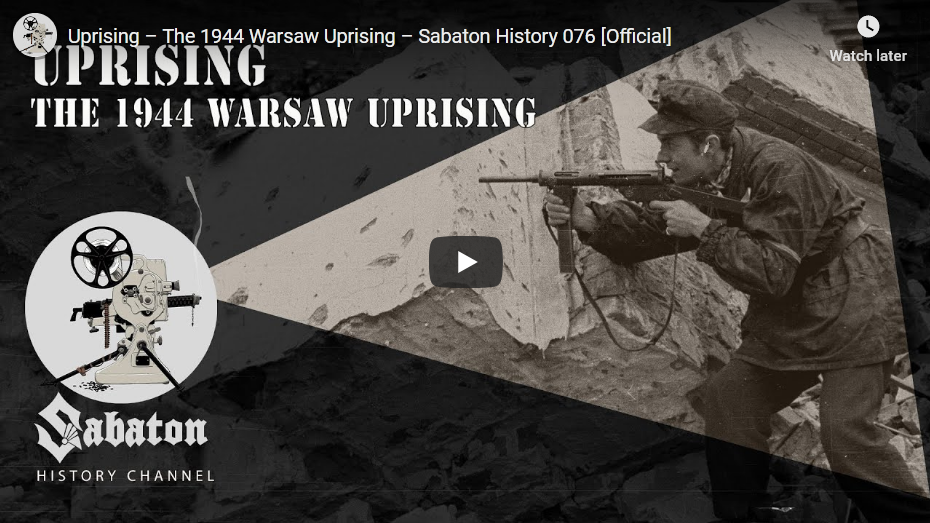
“Uprising” – The 1944 Warsaw Uprising – Sabaton History 076 [Official]

Filed under: Europe, Germany, History, Media, Military, WW2 — Tags: , , , , , — Nicholas @ 06:00

Sabaton History
Published 16 Jul 2020

August 1944. After nearly 5 years of suffering and oppression at the hands of the Nazis, the Polish resistance in Warsaw was ready to rise up against the German occupation. With the Red Army approaching towards the Vistula from the east, the insurgents planned to take over much of the Polish capital and hold it until help from their Allies arrived. In the early morning hours of August 1, groups of armed young men broke the curfew and stormed official buildings and German warehouses. But as insurgents fought for their lives and future, the outside world however, remained eerily quiet to their pleas for help.

Support Sabaton History on Patreon: https://www.patreon.com/sabatonhistory

Listen to “Uprising” on the album Coat Of Arms:
“CD: http://bit.ly/CoatOfArmsStore
Spotify: http://bit.ly/CoatOfArmsSpotify
Apple Music: http://bit.ly/CoatOfArmsAppleMusic
iTunes: http://bit.ly/CoatOfArmsiTunes
Amazon: http://bit.ly/CoatOfArmsAmzn
Google Play: http://bit.ly/CoatOfArmsGooglePlay

Watch the Official Music Video of “Uprising” here:
https://www.youtube.com/watch?v=01IaK…

Listen to Sabaton on Spotify: http://smarturl.it/SabatonSpotify
Official Sabaton Merchandise Shop: http://bit.ly/SabatonOfficialShop

Hosted by: Indy Neidell
Written by: Markus Linke and Indy Neidell
Directed by: Astrid Deinhard and Wieke Kapteijns
Produced by: Pär Sundström, Astrid Deinhard and Spartacus Olsson
Creative Producer: Joram Appel
Community Manager: Maria Kyhle
Executive Producers: Pär Sundström, Joakim Broden, Tomas Sunmo, Indy Neidell, Astrid Deinhard, and Spartacus Olsson
Post-Production Director: Wieke Kapteijns
Edited by: Iryna Dulka
Sound Editing by: Marek Kaminski

Eastory YouTube Channel: https://www.youtube.com/channel/UCEly…
Archive by: Reuters/Screenocean https://www.screenocean.com
Music by Sabaton

Colorizations by Mikołaj Kaczmarek – Kolor Historii – https://www.facebook.com/KolorHistorii/

Sources:
– Imperial War Museum: H 4963.
– Mil.ru
– Bundesarchiv, CC-BY-SA 3.0: Bild_183-S73507, Bild_146-2005-0038, Bild_101I-695-0411-02A, Bild_183-97906, Bild 101I-695-0425-13, Bild_146-1973-113-23, Bild_146-1996-057, Bild_146-1994-054-30
– Liftarn from Wikimedia

An OnLion Entertainment GmbH and Raging Beaver Publishing AB co-Production.

© Raging Beaver Publishing AB, 2019 – all rights reserved.

September 25, 2019

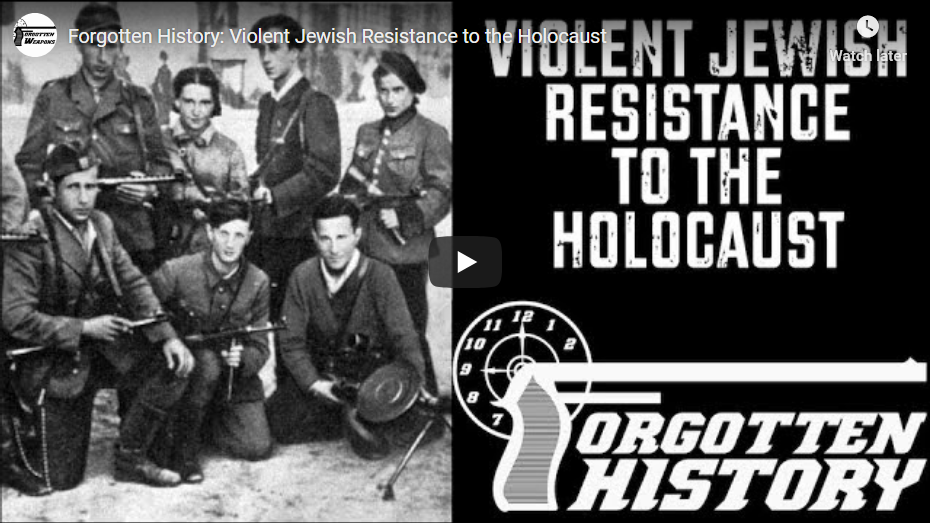
Forgotten History: Violent Jewish Resistance to the Holocaust

Filed under: Europe, Germany, History, Military, Religion, WW2 — Tags: , , , , , — Nicholas @ 04:00

Forgotten Weapons
Published 24 Sep 2019

http://www.patreon.com/ForgottenWeapons

Cool Forgotten Weapons merch! http://shop.bbtv.com/collections/forg…

I wrote this paper back in 2003 or 2004 for a college class I was taking (HIST 595 – The Holocaust And Genocide). Today, it sounds a bit amateurish — but I suppose that is to be expected of something written by someone barely out of their teens. I think it could be much better written today, and its subject matter deserves much greater depth, but I believe its conclusions are sound. In particular, I would not be so casual in identifying the perpetrators simply as “the Germans”, as this is an unfair simplification of the guilt for the crimes of the Holocaust.

Some people will interpret this paper though narrow political viewpoints today, which is unfortunate. I shouldn’t have to say it, but obviously such interpretations are certainly not reflective of my own beliefs.

Bibliography:

Ainsztein, Reuben. Jewish Resistance in Nazi-Occupied Europe. Paul Elek Ldt, London: 1974.

Arad, Yitzhak. Ghetto in Flames. Holocaust Library, New York: 1982.

Berenbaum, Michael. The World Must Know. New York: Little, Brown, and Co, 1993.

Donat, Alexander. The Death Camp Treblinka. New York: Holocaust Library, 1979.

Gutman, Yisrael. The Jews of Warsaw, 1939-1943. Indiana University Press, Bloomington:1982.

Mark, Ber. Uprising in the Warsaw Ghetto. Schocken Books, New York: 1975.

Novitch, Miriam. Sobibor: Martydom and Revolt. Holocaust Library, New York: 1980.

Rotem, Simha. Memoirs of a Warsaw Ghetto Fighter. New Haven: Yale University Press, 1994.

Zuckerman, Yitzhak. A Surplus of Memory. University of California Press, Berkeley: 1993.

Contact:
Forgotten Weapons
6281 N. Oracle #36270
Tucson, AZ 85704

August 3, 2019

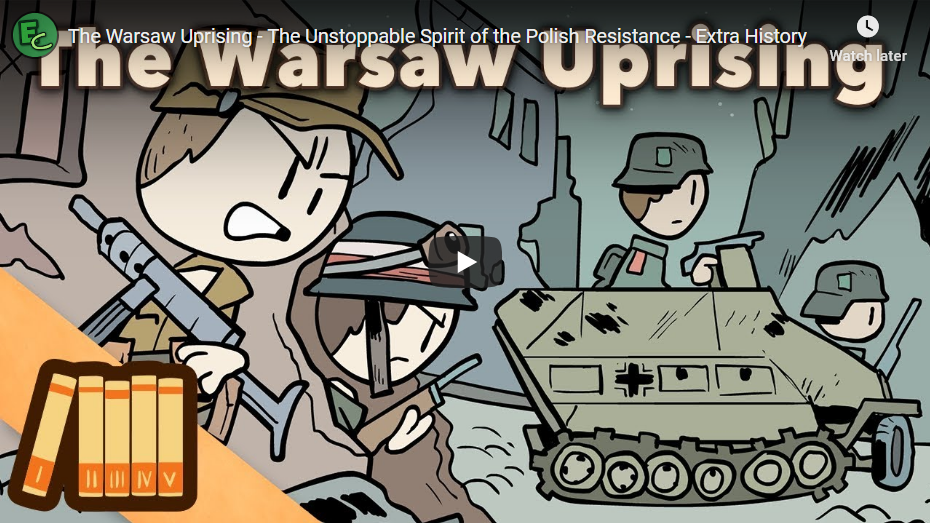
The Warsaw Uprising – The Unstoppable Spirit of the Polish Resistance – Extra History

Filed under: Europe, Germany, History, Military, Russia, WW2 — Tags: , , , , — Nicholas @ 06:00

Extra Credits
Published on 1 Aug 2019

Thanks to the Polish National Foundation for sponsoring this video. https://www.pfn.org.pl/

The Polish are determined to make Poland matter on the world stage, and they will not wait for whatever mercies may come from the Russians. So the Home Army stages their own uprising to liberate Warsaw, and for some 60-odd days, their strongest members, the Grey Ranks, tragically held steadfast.

Join us on Patreon! http://bit.ly/EHPatreon

« Newer Posts

Powered by WordPress