The article discusses a day planner that was distributed to students at a Toronto primary school. The planner included a printed version of an online “Days of Significance” calendar that had references to sex workers, female genital mutilation and Palestinian solidarity. The board agreed with the complaint that this material was not appropriate for a kindergarten-through-grade 5 audience (although they did not say whether the planners were being withdrawn). The National Post headline, however conveys a slightly different message:
Like everyone else, I hate paying tolls, but my time is worth more than the toll to use the faster route. The C.D. Howe Institute is proposing converting the existing (and additional planned) high occupancy lanes on highways to toll lanes:
Car-pool lanes on Canadian highways should be converted to high-occupancy toll lanes to reduce congestion and generate revenue for municipalities, says a C.D. Howe Institute report released Wednesday.
High-occupancy toll lanes differ from high-occupancy vehicle lanes by allowing solo drivers to use them, but at a cost. The lanes require that individual drivers pay to use them, but vehicles carrying more than one passenger can drive on them for free.
“When you have bad congestion, the only way to maximize capacity of the highway is to restrict and manage access,” said Ben Dachis, author of the report. “You do that by charging people for that access.”
My commute into Toronto is pretty much at road speed until I get off the 407 ETR (a toll road) and get on the southbound 404 (a non-toll road with an HOV lane in each direction). That’s about the halfway point of my journey, but I’ll spend 75% of my travel time on the second half of my commute. The HOV lane is rarely full to capacity, and there are always “cheaters” who use the lane even though they’re alone in their vehicles (you can tell because they dart back into the regular lanes at the first hint of a police cruiser ahead).
In my own case, converting the HOV lanes on the 404 to toll would only save me 10-15 minutes, as the Don Valley Parkway does not have HOV lanes, but saving 20-25 minutes per commute would be quite worthwhile for me.
Michael Pinkus responds to an unfair accusation against Diamond Estates over their ability to open a retail store in Scarborough (most wineries are not legally able to do this):
Upon reading the Fashionable Press’ article I shot back the following (on everybody’s favourite medium these days) the Facebook comment section: “Have you really not been paying attention??? Diamond has a store because they bought a winery that had 1) a pre-1993 license and 2) had a pre-existing store. No mystery here, no cronyism, just smart business sense. In Ontario’s archaic system there are two things that reign supreme: a pre-1993 license (which allows you to blend foreign and domestic wines) and a winery with an outside store attached. Diamond got them both when they acquired DeSousa.”
The reply from Fashionable was quick: “Yes we understand that point the issue remains why no other winery can do the same thing?”
To which I answered, “This comes back to the archaic laws … not cronyism or the fact that Murray Marshall is chairman and CEO of VQA Canada. As many know I am not a huge supporter of the big wineries that can blend (and do) but Murray is working well within the crappy, backward, stink-ass system we call the alcohol laws in Ontario. If another winery wanted to do it they can pony up the 3+ million Cilento will sell their license for (of course I may be off by a few million on the price because that pre-93 piece of paper is a license to print money).”
To understand all this, and all it’s intricacies and complexities is to understand why Ontario’s small wineries are so pissed off (and yes that is the right wording here) when the subject of VQA stores is brought up. But back to Diamond … The moment DeSousa went up for sale Murray saw it as an opportunity to get a store that wasn’t tied to Niagara and a way to get his products into the hands of consumers in the much more lucrative market of Toronto (in this case Scarborough).
Now the astute amongst you (or the Ontario wine history buff) will note that Lakeview also has a pre-1993 license (est. 1991) – but that’s where it gets even wonkier. While Lakeview would be allowed to blend foreign with domestic wines, the original owners never branched out to buy another retail store, so their operation was stuck in Niagara post-1993 when the moratorium on wine store licenses was imposed. DeSousa (est. 1990) on the other hand, did acquire one additional retail licence prior to the cut-off.
The hard part about owning these stores is they are rarely permanent, and here’s why. The rationale behind placing one of these additional retail outlets somewhere is that it is an “under-serviced neighbourhood” … Fashionable asks the following: “Why didn’t the LCBO find this under-serviced gem and plunk one of its outlets there? … Why did they choose in a gentlemanly way to cede over to Diamond?”
To that I say ‘Have No Fear’, if that Diamond store does well then you can bet the farm that the liquor monopoly will parade in like a white knight and announce a store nearby … which will force Diamond to relocate the store to another “under-serviced area” … and how, you may ask, will the LC know that Diamond is doing so well? That my friends is what smells bad in this entire deal: Who do you think gets to look at the sales numbers from these off site stores? Hmm? They’re not called the KGBO by some for nothing.
So the brief and fleeting moment that Diamond has taken advantage of will disappear as soon as the LCBO decides that they need to move into that disadvantaged area and open an LCBO store, which will force the private seller to close their store in the area. Nice.
Comments Off on Yet another twist in the twisty-turny mess that is Ontario liquor law
Post-graduate students at the U of T may have gotten a bit too honest and outspoken in class:
Picture the following: A discussion in a post-graduate university class on the topic of Jews turns ugly. The professor is uncritical when one student says he doesn’t want to be around Jews. Another student complains about “rich Jews,” implying their excessive power. In a subsequent class, the same professor, as if to validate those points, says half her department faculty are Jews and with her approbation, students conduct a ‘Jew count’.
While this sounds like an episode in Germany leading up to the anti-Jewish Nuremberg Laws, it occurred more recently and much closer to home, at the University of Toronto’s Faculty of Social Work. Now, more details are emerging under the exceptional circumstance of two U of T professors publicly criticizing a colleague for facilitating classroom anti-Semitism and the university administration’s inadequate response.
The controversy began when some visible minority students in a Social Work Master’s program at the University of Toronto expressed discomfort about being around “rich Jews,” in Professor Rupaleem Bhuyan’s class, regarding a proposed outing in 2009 to the Baycrest Centre, an internationally renowned Jewish geriatric and research facility. They were undoubtedly confident of a sympathetic ear from her. The previous year, Bhuyan denounced Israel as a satellite of the United States, unworthy of distinction as a separate country.
The few Jewish students in Bhuyan’s Master’s Program class were intimidated into silence for much of the discussion by a classroom culture slanted against them. Finally, one young woman spoke up, protesting her grandparents had come to Canada with virtually nothing and she was proud her family could now afford the fees for them to reside at Baycrest.
That must have rung an alarm bell for Professor Bhuyan, because startlingly, she then admonished her students not to divulge what transpired in class to outsiders.
John Manley strikes me as a shining example of one of the great tragedies of the Liberal Party of Canada: a fine public servant blessed with good sense, but subsumed by the weird rituals of that odd cult. Over the years I’ve been shocked at how many really smart, well-meaning ex-Liberals I’ve met who left the party, and public service, because their skills and talent go thrown under the bus at some point by those hidden party puppet-masters we hear so much about, but so rarely show themselves (I assume they’re in some underground fortress in Rosedale) because it was what the party required.
Not being a Central Canadian lawyer, I don’t think I can ever understand the sort of strange grip the Liberal party in its prime once seemed to have on people, but it certainly appeared like it was, for a very long time, some kind of skull-and-bones society, promising Canada’s ambitious, young, bright men and women a route to power, but requiring their allegiance till death. I consider sharp, well-meaning guys like Manley, or former Indian Affairs minister Bob Nault, victims of a game they were obliged to play in order to achieve what they wanted. Until the Liberal party’s recent conversion into a yawning, smoldering crater, if you wanted to make an impact in Canada, especially through government, you’d be best to sell your soul to the Trudeausmen — which, ironically, often meant submitting principle, and logic, to the greater good of the party. I can see why Manley had to go along with the ritual, and retain his silence about the peculiar and problematic universe of mini-lobby groups that had grown like weeds within the party itself. Perhaps, like a befuddled Moonie, he couldn’t even see the problems until he broke free of the party’s hold. But then again, it’s also hard to sound credible complaining about structural problems in your party when it keeps winning election after election after election.
Chris Greaves (who doesn’t even own a car) looks at the possibility of using weekly boycott targets in an attempt to force oil companies to lower the retail price of gasoline in Toronto:
Consider therefore a web site for the GTA which announced as the next boycott period approached that the new target was “Shell”.
Those drivers who subscribe to the mass-boycott idea would avoid buying gas at Shell and, being evangelical, would tell their friends and colleagues that “Shell” was the target this period.
The question is “Who picks the target?” and the answer is simple: torontogasprices already announces the highest and lowest price for gas in the GTA. Score +1 against that company with the highest gas price at a random time each day. Then pick the company with the highest score. Over a short period, the company with the highest prices would float to the top of the list and be ready for a boycott.
In order to avoid any hint of collusion and legal attack, the web site would be hosted as a private web site, a blog perhaps, with the views expressed being solely those of the individual. There can be no legal complaint against an individual blogging and/or tweeting a disarmingly simple statement “This week I am boycotting Shell”.
Ilkka is usually a pedestrian/public transit rider, so it’s quite a surprise when he looks at the world from the driver’s perspective:
It’s always good to see things from the other guy’s perspective, and today we went on errand to the city on a car, very different from my usual public transit and pedestrian viewpoint. I understand not just the complaints of drivers much better now, but also the notion of “high cost of free parking”. I thought it was absurd how the city of Toronto, by allowing curbside parking, effectively turns its perfectly good four-lane streets into narrow two-lane bottlenecks that massively throttle the traffic. And then all those freaking pedestrians crossing the streets wherever they feel like, something I basically never do. It actually wouldn’t be a bad idea to impose a law that not only is it never a crime to hit a pedestrian who is on the street anywhere else than the sidewalk or a crosswalk, but the city would actually pay a small reward for this service to society, bit like the “kill money” bounty that hunters traditionally get for putting down pests. The problem of pedestrians running around in the traffic would vanish within a week.
Phillip Ilijevski is shocked that the Canadian government hasn’t been providing him with personalized information on what’s happening near him:
A Toronto man living in Japan says the federal government is “providing no help” to Canadians wanting to know if they should leave the earthquake and tsunami-ravaged country, especially given the nuclear threat.
Phillip Ilijevski teaches English in Takasaki, about 100 kilometres north of Tokyo. He called Canada’s Department of Foreign Affairs and International Trade to find out if it’s safe to stay in Japan, but says the only advice they gave him was to watch the news.
I have no idea why the Canadian government is expected to have better information on what’s happening in Japan in the aftermath of the earthquake and tsunami than the Japanese government, but it must be Stephen Harper’s fault, right?
If Mr. Ilijevski was in a third world nation with poor communications and little infrastructure, it might be reasonable to assume that Canadian officials would be in a better position to provide advice than local government, but in this case there’s no reason — Japan is better equipped to handle this kind of disaster (and public information flow) than just about any other nation on earth.
As jonkay said in a Twitter update: “As usual,when disaster strikes abroad, TStar’s #1 focus is finding a Canuck to bitch about how Ottawa isn’t helping him”
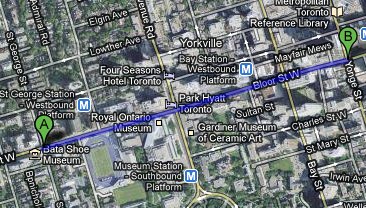
I guess the weekend staff were celebrating St. Patrick’s day a little early, as not only the photo caption (left) but also the pa(p)rade directions leave you a little misdirected:
The parade begins at Bloor and St. George Sts. and heads west to Yonge, where it turns south and goes to Queen and then heads west again to University, ending just south of Dundas on University.
The streets are expected to be closed from 8 a.m. to 3 p.m., making driving to the parade difficult.
Highlighting mine. Going west from Bloor and St. George won’t get you to Yonge Street for a fair amount of time:
H/T to Chris Greaves for bringing this to my attention.
Actually, compared to a lot of newspaper articles on the SCA, this one isn’t too bad:
The Society is a global organization with some 30,000 registered members reliving the world before the 17th century. Most stick to European history, but there are plenty of katana-wielding Japan enthusiasts among the ranks. Members get together and do any and everything medieval and renaissance, from armored combat and blacksmithing to the craftier trades such as glass-etching and embroidery.
The Toronto group is know as the Canton of Eoforwicof, one chapter of the Kingdom of Ealdormere, which encompasses most of Ontario and is one of 19 worldwide kingdoms. Each kingdom has its own King, Queen and handful of other royals and nobility.
Unlike a Renaissance Faire, these gatherings are not for anyone’s entertainment but their own.
“We’re not playing to an audience, we’re just doing things for fun,” Ms. Carroll-Clark says.
No mention of rapier combat (my bit of the SCA), but that’s not surprising — even in the SCA it’s a minority interest.
Comments Off on Local SCA group gets a bit of newspaper coverage
It’s been eight months since the G20 and the iconic images are still with us — burning police cars, rampaging mobs, the massive security presence that according to the official story is all that stood between Canada’s largest city and chaos. But that’s not the whole story of Toronto’s G20. Astonishing new images caught on camera are now emerging and they expose a troubling new picture of what happened to hundreds of ordinary citizens caught in the huge police dragnet during those three highly-charged days last June.
Gillian Findlay presents a revealing new street-level perspective of what happened when thousands of police were deployed in downtown Toronto and instructed to do what was necessary to ensure the wall around the G20 Conference Centre was never breached. Exclusive eyewitness video obtained by the fifth estate brings to light startling images captured on cellphones and minicams by the innocent bystanders who found themselves on the wrong side of all that G20 “order.” In a rare television interview, Toronto Police Chief Bill Blair explains why police took the actions they did.
I was critical of the G20 even before things went off the rails. It was a stupid idea to hold it in the middle of Canada’s biggest city, and the police reaction to provocation was worthy of any rag-tag third world dictatorship.
It’s a crafty move, but it’s not clear whether it’s the buyer or the seller being the craftier:
London Stock Exchange Group Plc, the 210-year-old bourse operator, agreed to buy Toronto Stock Exchange owner TMX Group Inc. for about C$3.2 billion ($3.2 billion) in stock as the companies cut costs to counter lost market share. LSE surged to a two-year high.
LSE shareholders will own 55 percent of the company, while TMX investors will hold the rest, the exchanges said today in a statement. TMX shareholders will receive 2.9963 LSE shares for each they own, valuing the Toronto-based company at about C$42.68 a share, 6 percent more than yesterday’s closing price.
Xavier Rolet, LSE’s chief executive officer, will reduce 35 million pounds ($56 million) a year in costs and expand into new businesses such as derivatives as competition from alternative trading platforms increases as do mergers among rivals. His predecessor Clara Furse fought off five takeover offers in two years and bought the operator of the Milan stock exchange. The LSE’s share of U.K. equity trading was 63.8 percent last quarter, compared with 75 percent in 2009, data from the London- based company show.
It could be a way for London to diminish the impact of European rules on their business (by having a non-EU place to land if necessary) or it could be a way for the EU to extend their rule-making to the Canadian market. Or, and this is the least believable scenario, it might just be an ordinary acquisition by a company that happens to run stock markets.
Update: What is presented as a take over in other markets is being positioned (spun?) as a “merger” for domestic consumption:
TMX Group, which operates the Toronto Stock Exchange, and the London Stock Exchange announced Wednesday they are merging to create one of the world’s largest stock exchanges.
The merger, which is subject to regulatory approvals, is unanimously being recommended by the boards of both exchanges.
The merger, if approved, would give the new firm a value of just over $6 billion (Cdn.) and give LSE shareholders just over 50 per cent of the combined company.
TMX Group is valued at $2.99 billion, while the London Stock Exchange Group’s value is slightly higher, around $3.25 billion.
The new company will have the world’s largest number of listing, more than 6,700 companies with an aggregate value of $5.8 trillion, the partners said in a statement early Wednesday.
[. . .]
The company will be co-headquartered in Toronto and London with Xavier Rolet, the CEO of the London Exchange, retaining that position with the new company. The president will be Thomas Kloet, the CEO of TMX. The FO will be Michael Ptasznik, who currently holds the same post with TMX, and the company director will be Raffaele Jerusalmi, the Milan-based CEO of Borsa Italiana.
Expect this deal, even if it eventually gets regulatory approval, to drag on for most of this year.
The January 18, 1969 Montreal Gazette ran this most peculiar comic, chock full of hilarious expositional dialogue and dystopian delights.
We follow the futuristic misadventures of George Daedalus, also known as Daeda 928 502 467, in the year 2000 AD. George lives in Oshtoham, Canada’s second largest city — which I’m guessing is a combination of the cities Oshawa, Toronto and Markham — and works as a travel agent. George lives his life surrounded by technological wonders like robot servants, videophones, moving sidewalks and 3D hologram walls, but we come to find out that he’s really just not that happy. The last panel shows George taking drugs and using a computer to escape his reality. Boy am I glad I don’t live in that future!
I had a great commute into downtown Toronto today: unlike my usual pattern of spending 20-30 minutes inching down the Don Valley Parkway from Finch to York Mills (and then sometimes another 20-30 minutes from there to Bloor/Bayview), today’s drive was actually pleasant. There was a bit of congestion in the right-hand lanes coming south on the 404 past the Sheppard/401 exit, but other than that, I didn’t even need to downshift until just north of Eglinton.
I’m sure some of this is due to the efforts of energetic, enthusiastic news and weather folks at 680 News and other media outlets. They’ve been in full pantswetting mode for the last 24 hours, warning us about the alarming possibility of snowfall. That drumbeat of doom must have persuaded lots of drivers to avoid coming in to the looming epicentre of severe winter weather at Yonge and Bloor.
For those of you unfamiliar with Toronto weather, you probably think we experience regular snowfall, with cold temperatures and high winds (like Montreal and Winnipeg often do). If Toronto did experience things like that, we wouldn’t be able to deploy any troops to Afghanistan, because they’d all be in Toronto trying to save the city from utter panic and absolute civic collapse. Toronto doesn’t handle winter very well at all.
I thought it was just the highways, but Darkwatermuse found the same phenomenon on city streets today:
Did anybody else notice the light traffic today? I had to head uptown on the bus for a mid-day appointment and the bus cruised slowly past each empty bus stop. Stops which normally have two or three people debarking or embarking the bus.
On the way home I found myself alone on the bus, not considering the driver. If the driver’s seat had been empty I would have snapped a photo of it with my smart phone and emailed the photo to the media. Assuming I survived the crash and after the bus came to a complete stop and having shown somebody at the TTC my valid transfer.
Alone. On the Sherbourne bus. That’s like being alone in the serving line at the shelter on Christmas Eve. Strangely, a lot of those same missing people normally take the Sherbourne bus so I wasn’t too fussed being alone for once.
For once the bus didn’t smell like 3AM vomit and an ashtray overflowing with Player’s Navy Cut cigarette butts. An unlikely outcome just like snowballs in hades or, apparently, snow in Toronto.
Of course, I may have to retract all of this if the weather really does (for once) come close to the media’s hyperventilated predictions: I’m meeting another member of the VRWC (libertarian sub-committee) after work tonight, so I’ll get to experience a bit more of the joy of Toronto in snow.
Update, 2 February: As we few, bedraggled survivors claw our way out of the Massive, Unprecedented, Crippling Snowfall, the CBC offers us their support and sympathy:

 I guess the weekend staff were