
Quotulatiousness

July 10, 2025

The Prussian defeats at Jena and Auerstadt in 1806

Filed under: Europe, France, Germany, History, Military — Tags: , , , , , — Nicholas @ 03:00

At Dead Carl and You, Kiran Pfitzner describes the disastrous 1806 campaign that knocked Prussia out of the war against Napoleon and shattered the military reputation of the army built by Frederick the Great:
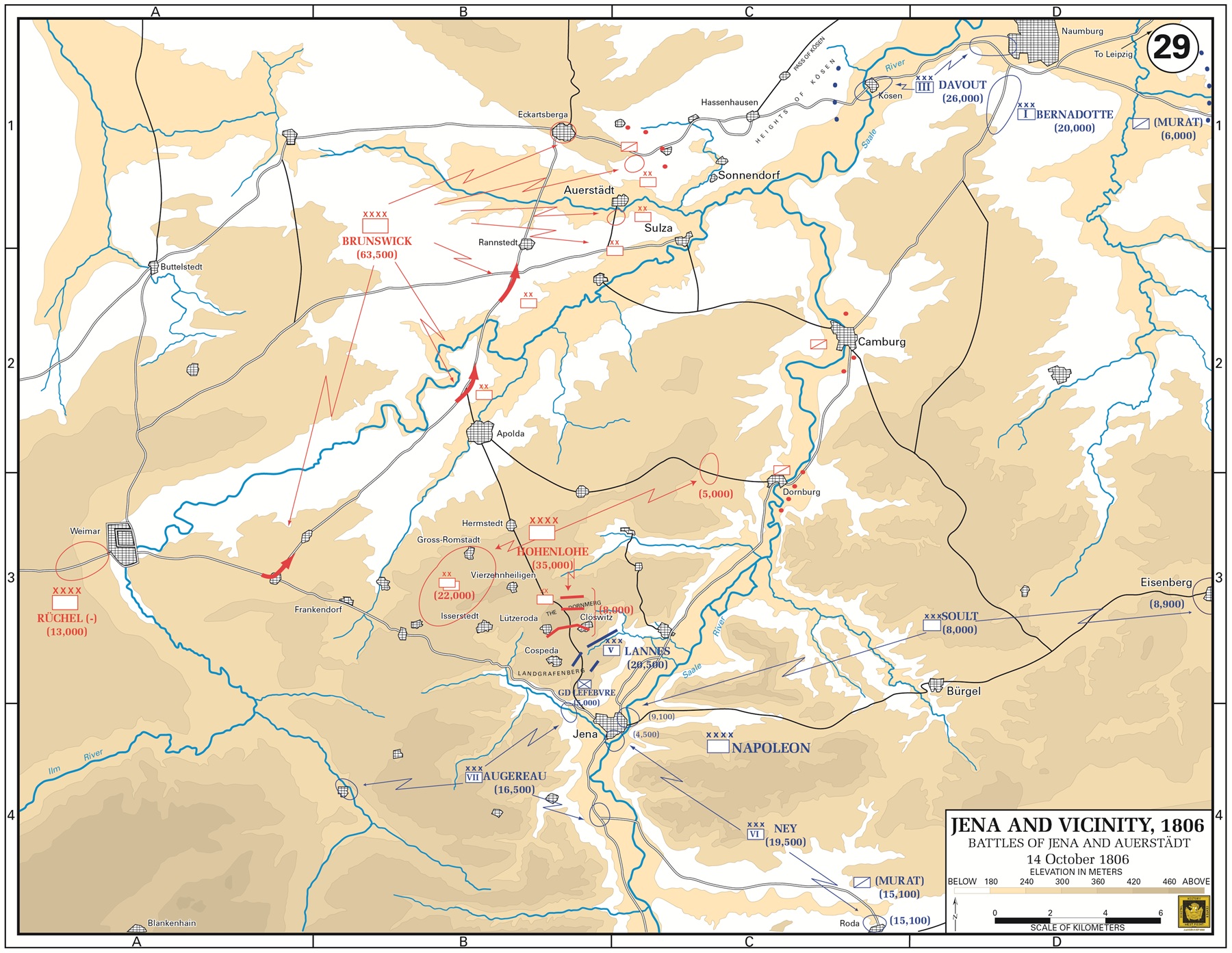
In brief, the course of the 1806 campaign was that the Prussians met the French at Saalfeld and were initially defeated. The Prussians therefore decided to retreat before meeting Napoleon himself in battle. However, poor command organization and irresolution ended up dividing and delaying the Prussian forces. Thus, the rearguard ended up meeting the French main body under Napoleon which was able to overwhelm it at Jena.

The battle itself was not especially punishing, but the relentless pursuit of the French cavalry yielded many prisoners and prevented the reconstitution of the army. On the same day, the Prussian main body had encountered a French corps under Marshal Davout at Auerstedt, but failed to overcome it in a series of piecemeal attacks that cost it the lives of its commanders. The Prussians were demoralized enough that an attack from the outnumbered French was enough to force the main body into disorder. The arrival of fleeing forces from Jena spread a general panic and prevented any chance of recovery. From there, the campaign was a matter of pursuit and capitulation — within weeks the French were parading through the streets of Berlin. This humiliating defeat gave Clausewitz impetus to seek an understanding of the nature of war. How could the vaunted Prussian army, envy of the world in the days of Frederick the Great (still within living memory), be so summarily dispatched?

It was clear to virtually all military thinkers of the time that war had changed. To many, Napoleon was utilizing a higher, more perfect form of war than had been previously known. Clausewitz instead recognized that Napoleon was not refining war, but recognizing that changes in social conditions had enabled fighting with more energy and violence than had been possible in the cabinet wars of the 18th century. This had proven significant because the limitations of the 18th century made maneuver and logistics central to skilled generalship. Battles were important, but much that was won or lost in a battle could be subsequently lost or won outside it.

The removal of these restrictions drastically increased the importance of battle as it was able to produce results that could not be compensated for actions outside of it. Skilled generalship was therefore no longer a matter of outmaneuvering the enemy or protecting your supply lines while threatening his, but of bringing maximum force to the point of battle. Initiative, coordination, and aggression become the key traits of an officer. Thus, more expansively, the task of the officer is to recognize changes to the character of war and so understand what is required in practice. Neither history nor experience can anticipate these developments — it falls to the judgment of the individual to recognize them.

This framing shows clearly the mistakes of the Prussians. Operating in the old paradigm, they sought to make good with maneuver what they had lost in the opening battle of the campaign. They had divided their forces under the assumption the French would be unable or unwilling to aggressively pursue their retreat. At the same time, when they engaged the French, they showed caution entirely congruent with a cabinet army but fatally out of place when facing a Napoleonic force. On numerous occasions, the French made serious blunders that went unpunished because the Prussians failed to take the initiative and capitalize on them.

Nowhere is this more clear than in the failure of the Prussian main body to overcome the single corps it faced at Auerstedt. While outnumbering the French, the Prussian attacked piecemeal, becoming demoralized under French fire. The morale of the Prussians was substantially more brittle on account of their relative lack of nationalism — the state and therefore the army were not objects of any great affection by those subject to them. While this would require social reforms to remedy, Auerstedt had nevertheless been an opportunity for the Prussians. They had a French corps outnumbered more than two-to-one and merely needed to bring that force to bear to inflict a serious defeat. A Prussian victory would have positioned the main body to receive the retreating forces from Jena, allowing another confrontation with Napoleon on at least equal terms. Timidity and irresolution therefore played as big a part in the disaster as did the deeper defects.

In part, this must be ascribed to the advanced age of Prussian leadership. The senior commanders at both Jena and Auerstedt were over seventy. Not only did this ensure continuity with older forms of war, but men of such an age were unlikely to have the energy to campaign aggressively — by contrast, Napoleon and his marshals were three or four decades younger. The Prussian leaders did not lack physical courage, as their valiant deaths attest, but exposing oneself to danger is not the same quality that is needed for decisive and energetic action over an extended period of time.

The Prussian strategy deserves further criticism because by that point Bonaparte’s character was well known. There was no justification to have any illusions as to what the consequences of defeat would be. Prussia’s status amongst the great powers — if not its very existence as an independent state — would be determined by the confrontation. Leaving troops in Silesian fortresses or Polish garrisons (through which Prussia’s available forces were reduced by half) meant narrowing the odds of victory in pursuit of things that could be no substitute for victory and no comfort in defeat.

April 27, 2025

QotD: Fighting against Japan in the Pacific

Filed under: History, Japan, Military, Pacific, Quotations, USA, WW2 — Tags: , , , , , , — Nicholas @ 01:00

Japan’s biggest advantage in the Pacific was knowing the terrain. Volcanic atolls being what they are, there are only a few places in the whole South Pacific that can be turned into airfields. Not only that, but there are only a very few approaches to those places, and the Japanese knew them all. If you’re outmanned and outgunned, a strategy of digging in deep and selling your lives as dearly as possible is the only way to go. Bleed the enemy white.

And lord knows the Americans took the bait, more than once. If “bait” is really the right word, because if you’ve got no choice … the early campaigns in the Solomons were so legendarily nasty for that reason: You have no choice but to go right up the pipe to seize an objective, and if you do, the enemy has no choice but to go right up the pipe to get it back.

The genius of the later American strategy — and credit where it’s due, few people have a lower opinion of MacArthur than I, but this was brilliant — was to simply go around. Heavy bomber strips are a must, and in the even fewer places in the Pacific that can take heavy bombers, the Americans had no choice but to go right up the chute … but carrier airpower can do a hell of a lot, particularly when it can move about completely unmolested by the enemy. Thus the Americans turned all those guaranteed meat grinders the Japanese had set up for them into big open-air POW camps, without bothering to go in there and force them to surrender (which, of course, they wouldn’t). Have fun starving in your bunkers, boys; we’ll just leave a covering naval detachment, to make sure you can’t evacuate; see you when the war’s over.

Severian, “Strategy”, Founding Questions, 2021-11-21.

March 15, 2025

QotD: Strategy

Filed under: History, Military, Quotations — Tags: , , — Nicholas @ 01:00

It has become popular of late to associate strategy with a “theory of victory”. Many policy pieces and journal articles define this as a narrative explanation of why a particular strategy will work — something every strategy must contain, if only implicitly. Others go so far as to insist that a strategy is nothing more than a theory of victory. […]

Strategy itself is a slippery term, used in slightly different ways in different contexts. In everyday usage, it is simply a plan to accomplish some task, whereas formal military definitions tend to specify the particular end. The US joint doctrinal definition, for instance, is: “A prudent idea or set of ideas for employing the instruments of national power in a synchronized and integrated fashion to achieve theater, national, and/or multinational objectives”. If strategy is not quite a theory for victory, the connection between them is apparent.

There is a subtle problem with this definition, however. Victories are rarely won in precisely the way the victors anticipate. Few commanders can call their own shots, as Napoleon did in Italy or William Slim in Burma. Wars are complex and messy things, and good strategy requires constant adaptation to circumstance — a system of expedients, as Moltke put it. Even with the benefit of hindsight, the cause of a war’s outcome is not always perfectly clear, as the ongoing debate over strategic bombing bears witness.

Indeed, the very idea that strategy represents a plan is very recent. From the first adoption of the word into modern languages,1 strategy was defined more as an art: of “commanding and of skilfully employing the means [the commander] has available”, of “campaigning”, of “effectively directing masses in the theater of war”. The emphasis was decidedly on execution, not planning. As recently as 2001, the US Army’s FM 3-0 Operations defined strategy as: “the art and science of developing and employing armed forces and other instruments of national power in a synchronized fashion to secure national or multinational objectives”. Something one does, not something one thinks.

This is best understood by analogy to tactics, a realm less given to formalism and abstraction. What makes a good tactician? Devising a good plan is certainly part of it, but most tactical concepts are not especially unique — there are only so many tools in the tactical toolkit. The real challenge lies in execution: providing for comms and logistics, ensuring subordinates understand the plan, going through rehearsals, making sure that everyone is doing their job correctly, then putting oneself at the point where things are likely to go wrong and dealing with the unexpected.

Ben Duval, “Is Strategy Just a Theory of Victory? Notes on an Annoying Buzzword”, The Bazaar of War, 2024-12-01.


January 13, 2025

The “Thucydides Trap”

Filed under: Books, China, History, Military, USA — Tags: , , , , , , — Nicholas @ 03:00

At History Does You, Secretary of Defense Rock provides a handy explanation of the term “the Thucydides Trap”:

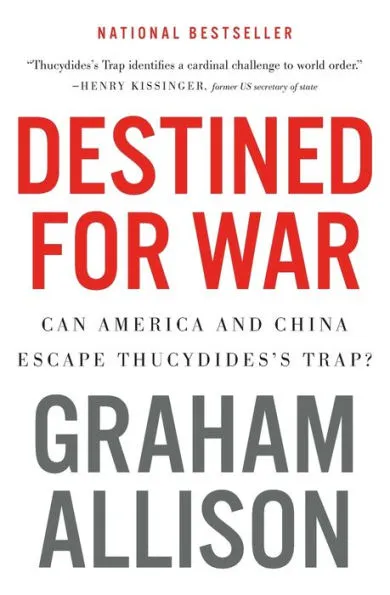
In the world of international relations, few concepts have captured as much attention — and sparked as much debate — as the “Thucydides Trap”. Brought to prominence by Harvard political scientist Graham Allison, the term suggests that conflict is almost inevitable when a rising power threatens to displace an established one, a dynamic often invoked to frame the strategic rivalry between the United States and China. Lauded as a National Bestseller and praised by figures like Henry Kissinger and Joe Biden, Allison’s Destined for War: Can America and China Escape Thucydides’s Trap? has become a staple of policy discussions and academic syllabi. Yet beneath the widespread acclaim lies a deeply flawed analysis, one that risks oversimplifying history and perpetuating a fatalistic narrative that could shape policy in dangerous ways. Far from an inescapable destiny, the lessons of history and the nuances of modern geopolitics suggest that the so-called “trap” may be more myth than inevitability.

The term “Thucydides Trap” is derived from a passage in the ancient Greek historian Thucydides’ work History of the Peloponnesian War, where he explained the causes of the conflict between Athens (the rising power) and Sparta (the ruling power) in the 4th century BC. Thucydides famously wrote

    It was the rise of Athens and the fear that this instilled in Sparta that made war inevitable.

Allison defines the “Thucydides Trap” as “the severe structural stress caused when a rising power threatens to upend a ruling one”.1 More articles by Allison using this term previously appeared in Foreign Policy and The Atlantic. The book, published in 2017, was a huge hit, being named a notable book of the year by the New York Times and Financial Times while also receiving widespread bipartisan acclaim from current and past policymakers. Historian Niall Ferguson described it as a “must-read in Washington and Beijing”.2 Senator Sam Nunn wrote, “If any book can stop a World War, it is this one”.3 A brief search on Google Scholar reveals the term “Thucydides Trap” has been cited or used nearly 19,000 times. In 2015, Australian Prime Minister Malcolm Turnbull even publicly urged President Xi and Chinese Premier Li Keqiang to avoid “falling into the Thucydides Trap”.4 One analyst observed that the term had become the “new cachet as a sage of U.S.-China relations”.5 The term has become so prominent that it is almost guaranteed to appear in any introductory international politics course when discussing U.S.-China relations.

Allison wrote in his essay “The Thucydides Trap: Are the U.S. and China Headed for War?” in The Atlantic published in 2015, “On the current trajectory, war between the United States and China in the decades ahead is not just possible, but much more likely than recognized at the moment” forewarning, “judging by the historical record, war is more likely than not”.6 A straightforward analysis of the 16 cases in the book and previous essays might indicate that, based on historical precedent, there is approximately a 75 percent likelihood of the United States and China engaging in war within the next several decades. Adding the additional cases from the Thucydides Trap Website would still leave a 66 percent chance, more likely than not, that two nuclear-armed superpowers will go to war with one another, a horrifying and unprecedented proposition.7

With such alarm, it’s no surprise that the concept gained such widespread attention. The term is simple to understand and in under 300 pages, Allison delivers a sweeping historical narrative, drawing striking parallels between events from ancient Greece to the present day.8 International Relations as a field often struggles to break through in the public discourse, but Destined for War broke through, making a broad impact on academic and popular discourse.


    1. Graham Allison, Destined For War: Can America and China Escape Thucydides’s Trap? (Boston: Houghton Mifflin Harcourt, 2017), 29.

    2. Ibid., iii.

    3. Ibid., vi.

    4. Quoted by Alan Greeley Misenheimer, Thucydides’ Other “Traps”: The United States, China, and the Prospect of “Inevitable” War (Washington: National Defense University, 2019), 8.

    5. Misenheiemer, 1.

    6. “Thucydides’s Trap Case File” Belfer Center for Science and International Affairs, Harvard Kennedy School, accessed December 31, 2024

    7. Graham Allison, “The Thucydides Trap: Are the U.S. and China Headed for War?” The Atlantic, September 24, 2015.

    8. Misenheimer details what Thucydides actually said about the origins of the Peloponnesian War, 10-17.

« Newer Posts

Powered by WordPress


