
Quotulatiousness

March 1, 2011

The shifting tide of extreme wealth

Filed under: Economics, Europe, France, Politics — Tags: , , , — Nicholas @ 07:07

Ever wonder how the children of wealthy foreign potentates fit in with “ordinary” wealthy westerners? Anne Applebaum says the relationship has shifted from bare toleration all the way out to sycophancy, but its most noticeable change is the way they can buy influence and apologists:

Money, even foreign money (and particularly that Saudi money), has always been able to buy access to Western statesmen. But in the last decade or so, the proportions have subtly shifted. The democratic West has become relatively poorer, while a clutch of undemocratic “emerging” markets have become richer. To put it more bluntly, Western politicians, ex-politicians, and even aristocrats have become much, much poorer than the very, very rich businessmen emerging from the oil-and-gas states of Central Asia, Eastern Europe, and the Middle East. Twenty years ago, no retired British or German statesman would have looked outside his country for employment. Nowadays, Blair advises the governments of Kuwait and the United Arab Emirates, among others; Gerhard Schröder, the former German chancellor, collects a paycheck from Gazprom, the Russian energy behemoth.

True, there is a legitimate argument for maintaining contacts with dictators: Blair helped persuade Col. Qaddafi to give up his nuclear weapons program in 2003, and in the last 10 days he has twice called the dictator and asked him to stop shooting his people. It hasn’t helped, of course, but it can’t hurt to try.

But there is no justification for taking dictators’ money or befriending their offspring, especially not while simultaneously playing politics with their parents. This is not just a British problem, either. Frank Wisner, the U.S. envoy sent by President Barack Obama to negotiate with Hosni Mubarak in the early days of the Egyptian revolution, also works for Patton Boggs, a law firm that has worked for the Egyptian government. The administration was reportedly angry when he unexpectedly opined that Mubarak “must stay” just a few days before Mubarak fled Cairo. But should anyone have been surprised? Meanwhile, Michelle Alliot-Marie, the French foreign minister, has just lost her job because she went on holiday in Tunisia during the revolution, hitched a few rides on a private plane belonging to a friend of the Tunisian president, and helped her father do a business deal there. When she got back, she tactfully suggested that the French help their friends in the Tunisian police put down the riots.

February 19, 2011

When “hacker army” is not an exaggeration

Filed under: Britain, China, Government, Military, Russia, Technology — Tags: , , , , , — Nicholas @ 10:07

Strategy Page counts noses of the various semi-organized hacker armies out in the wild:

Despite spending over a billion dollars a year defending their government networks, Britain recently complained openly of hackers getting into the communications network of the Foreign Office. The government also warned of increasing attacks on British companies. The recent attacks government and corporations were all targeting specific people and data. While China was not mentioned in these official announcements, British officials have often discussed how investigations of recent hacking efforts tended to lead back to China. There is also a strong suspicion, backed up by hacker chatter, that governments are offering large bounties for information from foreign governments. Not information from China, but from everyone else.

China one of many nations taking advantage of the Internet to encourage, or even organize, patriotic Internet users to obtain hacking services. This enables the government to use (often informally) these thousands of hackers to attack targets (foreign or domestic.) These government organizations arrange training and mentoring to improve the skills of group members. Turkey has over 45,000 of hackers organized this way, Saudi Arabia has over 100,000, Iraq has over 40,000, Russia over 100,000 and China, over 400,000. While many of these Cyber Warriors are rank amateurs, even the least skilled can be given simple tasks. And out of their ranks will emerge more skilled hackers, who can do some real damage. These hacker militias have also led to the use of mercenary hacker groups, who will go looking for specific secrets, for a price. Chinese companies are apparently major users of such services, judging from the pattern of recent hacking activity, and the fact that Chinese firms don’t have to fear prosecution for using such methods.

It was China that really pioneered the militia activity. It all began in the late 1990s, when the Chinese Defense Ministry established the “NET Force.” This was initially a research organization, which was to measure China’s vulnerability to attacks via the Internet. Soon this led to examining the vulnerability of other countries, especially the United States, Japan and South Korea (all nations that were heavy Internet users). NET Force has continued to grow. NET Force was soon joined by an irregular civilian militia; the “Red Hackers Union” (RHU). These are nearly half a million patriotic Chinese programmers, Internet engineers and users who wished to assist the motherland, and put the hurt, via the Internet, on those who threaten or insult China. The RHU began spontaneously in 1999 (after the U.S. accidentally bombed the Chinese embassy in Serbia), but the government has assumed some control, without turning the voluntary organization into another bureaucracy. The literal name of the group is “Red Honkers Union,” with Honker meaning “guest” in Chinese. But these were all Internet nerds out to avenge insults to the motherland.

You have to wonder how many script kiddies ever thought they’d end up being government operatives.

February 1, 2010

Modern etiquette

Filed under: Japan, Middle East, USA — Tags: , , — Nicholas @ 13:06

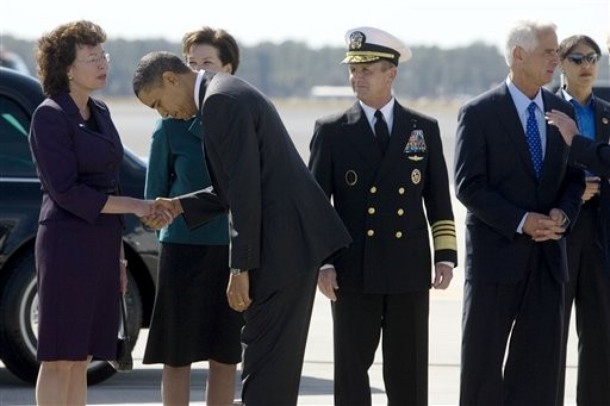
I guess I missed the class on American etiquette, because I had this odd notion that Americans weren’t supposed to bow to royalty. There must have been more to than that, however, as apparently you’re supposed to bow to Mayors, too:

So let me get this straight . . . Americans should not bow to Queen Elizabeth (who is head of state of the United Kingdom, Canada, Australia, New Zealand, etc.), but should bow to the Emperor of Japan, the King of Saudi Arabia, and the Mayor of Tampa? Is that the full list? How about deputy mayors?

October 29, 2009

Sometimes better technology can lead to trouble

Filed under: Middle East, Military, Politics — Tags: , — Nicholas @ 07:20

In this case, along the not-fully-marked borders of Saudi Arabia:

In the last few weeks, tensions have been rising between Saudi Arabian border guards and Yemeni tribesmen who live along the border. The source of the tension is a fence that the Saudis are building. The problem is that neither country has agreed on exactly where the border is. Moreover, the tribesmen do not want a fence blocking their way, as the border has never been recognized by the tribes that live astride it. The big problem is that Saudi Arabia’s land borders are mostly sand. The dunes keep moving as the winds blow this way and that. Historically, the local warlords used the few obvious landmarks to establish a vague border. But now there is GPS, and most countries in Arabia are ready to establish precise borders. The problem is that each country has a different idea of where the real border, as precisely marked by GPS, is.

The negotiations proceed, but the tribesmen living astride the border are often not willing to negotiate. In that case, force must be used. But first, both nations involved have to agree to apply force. That is not a problem on the Yemen border, because those Yemeni tribesmen that have been shooting at the Saudi fence builders, are already at war with the Yemeni army. But throughout Arabia, there will be more disputes like this, probably for decades, until all the borders are agreed on.

« Newer Posts

Powered by WordPress

