
Yes, the reader might respond, but surely we are on firmer ground with regard to [Rommel’s] military skill! After all, no less a figure than British Prime Minister Winston Churchill called him “a great general” on the floor of the House of Commons. Even here, it is possible to make a counterargument. Rommel’s daring exploits at the head of the Afrika Korps (later enlarged and renamed Panzerarmee Afrika) were exciting, to be sure, but many officers in his own army reckoned them as an ultimately valueless sideshow. His disinterest in the dreary science of logistics, his “bias for action,” his tendency to fly off wherever the fighting was hottest are qualities that may make for an exciting movie, but they are problematic in an army commander under modern conditions, and they all contributed materially to the disaster that ultimately befell him and his army in the desert.
[…]
When Rommel arrived in Africa, he brought with him a fully realized art of war. He’d won a Pour le Mérite (the famed “Blue Max“) for a series of nail-biting mountain exploits in the 1917 Caporetto campaign; he had been a very popular tactical instructor at the Dresden Infantry School between the wars; he had commanded one of the army’s precious Panzer divisions (the 7th) during the 1940 campaign in the West. In France, Rommel had behaved more like an 18th century hussar cut loose on a raiding mission than a divisional commander. He led from the front, braved enemy fire on numerous occasions, and turned off his radio from time to time rather than risk receiving orders to rein himself in. He drove forward so rapidly that the 7th Panzer became known as the “ghost division” for its tendency to drop off the situation maps and reappear where least expected. There were many in the German high command, including the chief of the General Staff Franz Halder, who didn’t much appreciate Rommel running amok, but as one analyst put it, “it was impossible to court martial such a successful general, so Rommel instead got the Ritterkreuz” [the Knight’s Cross of the Iron Cross].
Robert Citino, “Drive to Nowhere: The Myth of the Afrika Korps, 1941-43″, The National WWII Museum, 2012. (Originally published in MHQ, Summer 2012).
March 13, 2020
QotD: Rommel’s generalship
March 2, 2020
QotD: The legend of Rommel and the Afrika Korps
It’s an attractive image all around, and it is unfortunate that practically all of it is false. The desert was hardly a haven of beauty or romance. It was a pain, and fighting in it was a nightmare for both sides. Far from letting the respective tank fleets roam free, the desert chained them irresistibly to their supply lines, and a single failed supply convoy or a lost column of trucks could stop an entire offensive dead in its tracks. Contrary to the alleged mobility of desert warfare, both sides would spend far more time in static defensive positions, often quite elaborate, then they would launching tank charges.
That leaves us with Rommel. Here, too, we should challenge the mythology. He was hardly apolitical. His entire career had been based on Hitler’s favor, and we might reasonably describe his attitude toward the Führer as worshipful. He was Hitler’s fair-haired boy, a young officer repeatedly promoted over more senior candidates. He was a media creation. Nazi propaganda painted him not only as a garden-variety hero, but as a model National Socialist and Aryan, a man who could overcome stronger enemies through the sheer force of his will. He was not merely a passive bystander to the hype; he was an active accomplice. He loved nothing better than having a camera crew along with him on campaign, and he would regularly order scenes to be reshot if his posture was insufficiently heroic or the lighting had not shown him to best advantage. As is often the case, his relationship to the media was both self-serving and self-destructive. During the years of victory, the German propaganda machine used him as an example to the nation. When things went sour, he became a diversion from the increasingly bad news on other fronts. Finally, when he was no longer useful for any purpose at all, the regime dropped him altogether and eventually killed him.
Robert Citino, “Drive to Nowhere: The Myth of the Afrika Korps, 1941-43″, The National WWII Museum, 2012. (Originally published in MHQ, Summer 2012).
February 16, 2020
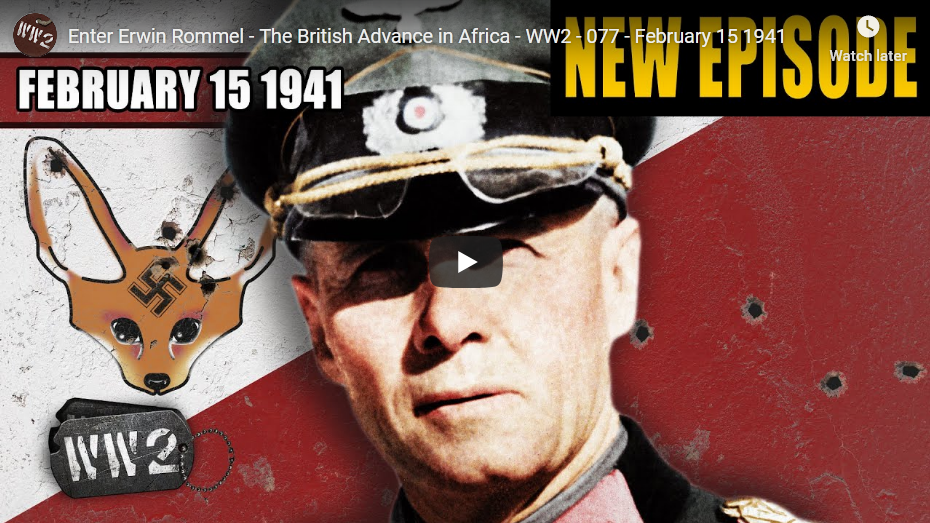
Enter Erwin Rommel – The British Advance in Africa – WW2 – 077 – February 15 1941
World War Two
Published 15 Feb 2020While the Germans send one of their best generals to North Africa to bail out the Italians, Great Britain switches focus from Libya to Greece, but make symbolically important gains in East Africa.
Join us on Patreon: https://www.patreon.com/TimeGhostHistory
Or join The TimeGhost Army directly at: https://timeghost.tvFollow WW2 day by day on Instagram @World_war_two_realtime https://www.instagram.com/world_war_t…
Join our Discord Server: https://discord.gg/D6D2aYN
Between 2 Wars: https://www.youtube.com/playlist?list…
Source list: http://bit.ly/WW2sourcesWritten and Hosted by: Indy Neidell
Produced and Directed by: Spartacus Olsson and Astrid Deinhard
Executive Producers: Bodo Rittenauer, Astrid Deinhard, Indy Neidell, Spartacus Olsson
Creative Producer: Joram Appel
Post-Production Director: Wieke Kapteijns
Research by: Indy Neidell
Edited by: Iryna Dulka
Map animations: Eastory (https://www.youtube.com/c/eastory)Colorizations by:
– Julius Jääskeläinen – https://www.facebook.com/JJcolorization/
– Norman Stewart – https://oldtimesincolor.blogspot.com/Sources:
– Bundesarchiv
– A German soldier poses atop a tank, photo credit: United States Holocaust Memorial Museum, courtesy of Perquimans County Library
– US National Archive
– IWM: A 4035, HU 39482Archive by Screenocean/Reuters https://www.screenocean.com.
A TimeGhost chronological documentary produced by OnLion Entertainment GmbH.
From the comments:
World War Two
2 days ago
When you know the story going forward it’s fascinating to see how the decisions unfold this week — the reshuffling of command both on the Axis and Allied side might seem like innocuous administrative decisions when you don’t know the future. But if you have a crystal ball, you’ll know that not just Rommel arriving in North Africa, but also the decisions on the British side this week will have momentous impact on the war in total. That’s one of the things we discovered early-on with a chronological narrative, it suddenly puts things in a new perspective. The relationship between events changes, and things that might seem too boring, or undramatic to include in a “great story” take on a whole new meaning, increasing our understanding of cause and effect of the “greater” events that will come. On a different note, we just finished shooting a new batch of videos today and we’ll be announcing some fascinating developments on our program in the coming weeks. Stay tuned, and stay awesome, you all are by far the best community on YouTube!
February 9, 2020
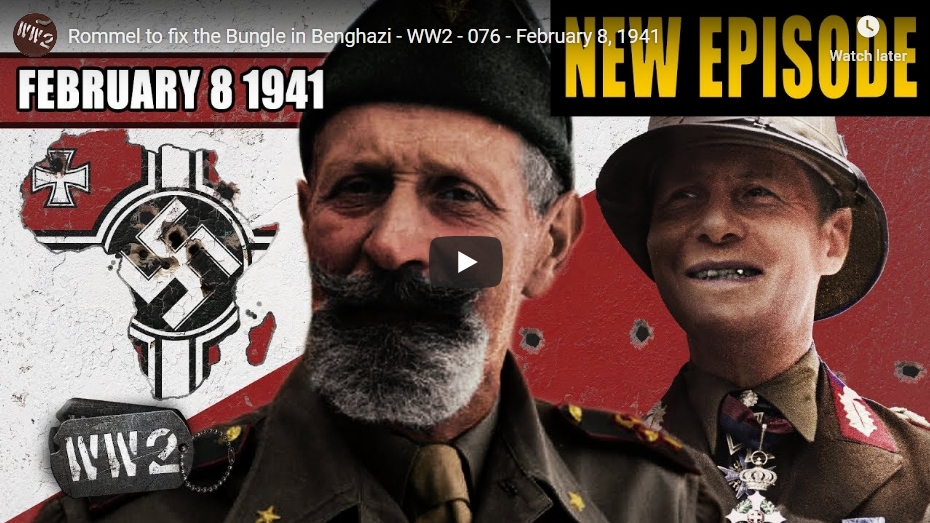
Rommel to fix the Bungle in Benghazi – WW2 – 076 – February 8, 1941
World War Two
Published 8 Feb 2020As the Italian campaigns in Africa collapse, Hitler considers his options and then chooses Erwin Rommel to rescue their Italian allies.
Join us on Patreon: https://www.patreon.com/TimeGhostHistory
Or join The TimeGhost Army directly at: https://timeghost.tvFollow WW2 day by day on Instagram @World_war_two_realtime https://www.instagram.com/world_war_t…
Join our Discord Server: https://discord.gg/D6D2aYN.
Between 2 Wars: https://www.youtube.com/playlist?list…
Source list: http://bit.ly/WW2sourcesWritten and Hosted by: Indy Neidell
Produced and Directed by: Spartacus Olsson and Astrid Deinhard
Executive Producers: Bodo Rittenauer, Astrid Deinhard, Indy Neidell, Spartacus Olsson
Creative Producer: Joram Appel
Post-Production Director: Wieke Kapteijns
Research by: Indy Neidell
Edited by: Mikołaj Cackowski
Map animations: Eastory (https://www.youtube.com/c/eastory)
Additional animations: Ryan WeatherbyColorizations by:
Adrien Fillon – https://www.instagram.com/adrien.colo…
Julius Jääskeläinen – https://www.facebook.com/JJcolorization/
Dememorabilia – https://www.instagram.com/dememorabilia/Sources:
Narodowe Archiwum Cyfrowe
Artillery by Creative Mania from the Noun ProjectSoundtracks from the Epidemic Sound:
Johannes Bornlof – “Last Man Standing 3”
Hakan Eriksson – “Epic Adventure Theme 3”
Phoenix Tail – “At the Front”
Gunnar Johnsen – “Not Safe Yet”
Johan Hynynen – “Dark Beginning”
Yi Nantiro – “Watchmen”
Rannar Sillard – “March Of The Brave 10”Archive by Screenocean/Reuters https://www.screenocean.com.
A TimeGhost chronological documentary produced by OnLion Entertainment GmbH.
January 14, 2020
The Desert Fox | Rommel’s FIRST Battle in the North African Campaign | BATTLESTORM
TIK
Published 17 May 2016Erwin Rommel faces the might of the British Empire. In 3D animation, we’ll see the units, the battlefield and the tactics The Desert Fox uses to overcome the British and Australian forces at Mersa Brega and throw them out of Italian Libya. Except for Tobruk of course! The video covers Erwin Rommel’s arrival in Italian Libya up to the beginning part of the Battle of Tobruk 1941.
This video is Part 2 of the Western Desert Campaign – Part 1 (Operation Compass) is in the link below
https://www.youtube.com/watch?v=b71kd…Bibliography
Battistelli, Pier Paolo. Erwin Rommel (Command). Osprey Publishing, 2010.
Beckett, Ian F. Rommel: A Reappraisal. Great Britain, 2013.
Beevor, Antony. The Second World War. Phoenix, 2014.
Bickers, Richard Townshend. The Desert Air War: 1939-1945. Endeavour Press Ltd, 2015.
Butler, Daniel Allen. Field Mashal: the Life and Death of Erwin Rommel. Casemate Publishers, 2015.
Dimbleby, Jonathan. Destiny in the Desert: The Road to El Alamein – the Battle that Turned the Tide. Great Britain, 2012.
Liddell Hart, B.H. A History of the Second World War. Pan Books, 2015.
Hastings, Max. All Hell Let Loose: The World at War 1939-1945. HarperPress, 2011.
Jorgensen, Christer. Afrika Korps: Rommel’s 1941 Offensive (Rapid Reads). Brown Bear Books, 2014.
LaFace, Major Jeffrey L. Tactical Victory Leading to Operational Failure: Rommel in North Africa. Pickle Partners Publishing, 2014.
Lyman R. The Longest Siege: Tobruk – The Battle That Saved North Africa. Pan Books, 2011.
Moorehead, Alan. The Desert War: the Classic Trilogy on the North Africa Campaign 1940-43. CPI Group, 2012.
Nash, N. Strafer Desert General: The Life and Killing of Lieutenant General WHE Gott. Pen and Sword Books Ltd, 2013.
Neillands, Robert. The Desert Rats: 7th Armoured Division 1940-45. UK, 2005.
Neillands, Robert. Eighth Army: From the Western Desert to the Alps, 1939-1945. John Murray Publishers, 2004.
Pitt, Barrie. The Crucible of War: Volume 1: Wavell’s Command. Cassell & Co, 2001.
Playfair, Major-General I.S.O. The Mediterranean and Middle East, Volume II, “The Germans come to the help of their Ally” (1941). The Naval & Military Press Ltd, 2004.
Raugh, H. Wavell in the Middle East 1939-1941: A Study in Generalship. USA, 2013.
Reuth, Ralf Georg. Rommel: The End of a Legend. Haus Publishing, 2005.
Thompson, Dennis H. Discarded Victory – North Africa, 1940-1941. Pickle Partners, 2014.
Williamson, Gordon. Afrikakorps 1941-43 (Elite). Osprey Publishing, 2009.

July 30, 2019
QotD: Business versus economics
Erwin Rommel, edited by B.H. Liddell Hart in The Rommel Papers, 1953.
April 16, 2019
World War 2 British Armour Doctrine & Tactics with David Willey of the Tank Museum at Bovington
Military History Visualized
Published on 8 Dec 2017David Willey the Curator of the Tank Museum at Bovington explains British Interwar and World War 2 Armour Doctrine and Tactics. Especially, about the Infantry and Cruiser tank “concept”. Additionally, we talk a bit about the 2nd Battle of El Alamein, Montgomery and Rommel.
March 2, 2019
Rommel, German Press and Polish Resistance – WW2 – OOTF 001
World War Two
Published on 28 Feb 2019This is the very first episode of Out of the Foxholes, in which we answer questions from the community. In this first edition, we’ll talk about the early-war career of Erwin Rommel, German press on the invasion of Poland and the birth of Polish resistance movements after the German occupation in 1939.
Join us on Patreon: https://www.patreon.com/TimeGhostHistory
Or join The TimeGhost Army directly at: https://timeghost.tv
Between 2 Wars: https://www.youtube.com/playlist?list…
Written and Hosted by: Indy Neidell
Produced and Directed by: Spartacus Olsson and Astrid Deinhard
Creative Producer: Joram Appel
Executive Producers: Bodo Rittenauer, Astrid Deinhard, Indy Neidell, Spartacus Olsson
Research by: Joram Appel and Spartacus Olsson
Edited by: Joram Appel and Spartacus OlssonA TimeGhost chronological documentary produced by OnLion Entertainment GmbH
From the comments:
World War Two
20 hours ago
Hey all! We are here with the very first episode of Out of the Foxholes in which we answer YOUR questions. Because we would like to be a little more reactive, Spartacus and Joram will also occasionally answering the questions, but rest assured, we’ll never replace Indy. Do you have a question on your own? Don’t just write it in the comments, but submit it on our community Forum by adding it as a topic (read the instructions first please) -> https://community.timeghost.tv/c/Out-of-the-Foxholes-QsCheers,
Joram
June 15, 2017
Why is Rommel so complicated? – Erwin Rommel vs. Desert Fox
Published on 17 May 2017
This video takes a look at why Erwin Rommel often called the “Desert Fox” is so complicated due to the various interest groups and his complex situation in World War 2.
March 2, 2016
Erwin Rommel – Infantry Attacks During World War 1 I WHO DID WHAT IN WW1?
Published on 29 Feb 2016
Erwin Rommel’s book Infantry Attacks in our Amazon Store: http://bit.ly/RommelAttacks (Affiliate Link)
Erwin Rommel had his baptism of fire during the initial offensives of World War 1 on the Western Front. His fearlessness and daring actions made him rise through the ranks quickly. When the German infantry tactics changed and the new Stormtrooper regiments were built, Rommel was the kind of officer needed. During the war in Romania and the battles of Italy he distinguished himself and already started building his legendary reputation that followed him into World War 2 as the Desert Fox.


